
Math Solved Questions Bank & Study Material (2026) - Apex Rankers
General Competitive Exams | Topic-Wise Comprehensive Solved Pool
\(64 = 2^6\)
\(128 = 2^7\)
\(512 = 2^9\)
Now, substitute these back into the expression:
\(2^{6}\times 2^{7}\times 2^{9}\times 2^{-3}\)
When multiplying terms with identical bases, you add the exponents together:
\(2^{6+7+9+(-3)}\)
\(2^{22-3}=\mathbf{2}^{\mathbf{19}}\)
\(\text{GM}=\sqrt{x\times y}\)
Substitute the given expressions:
Here, \(x = a^{2n}\) and \(y = b^{2n}\).
\(\text{GM}=\sqrt{a^{2n}\times b^{2n}}\)
Combine the bases under the exponent:
\(\text{GM}=\sqrt{(ab)^{2n}}\)
Simplify the square root:
Taking the square root of an exponential expression is the same as dividing its exponent by 2:
\(\text{GM}=\left((ab)^{2n}\right)^{\frac{1}{2}}=(ab)^{n}=\mathbf{a}^{\mathbf{n}}\mathbf{b}^{\mathbf{n}}\)
A negative exponent tells you to invert the fraction (find its reciprocal) and make the exponent positive:
\(\left(\frac{a}{b}\right)^{-n}=\left(\frac{b}{a}\right)^{n}\)
\(\left(\frac{2}{7}\right)^{-2}=\left(\frac{7}{2}\right)^{2}\)
According to the Binomial Theorem, when you expand a binomial expression raised to a positive integer power \(n\) (in the form \((a+b)^n\)), the total number of terms in the expanded form is always equal to \(n + 1\).
Calculation
Given exponent (\(n\)) = \(19\)
Total terms = \(19 + 1 = \mathbf{20}\)
Let \(a = 5.293\)
Let \(b = 3.633\)
Find \((a + b)\): \(5.293 + 3.633 = 8.926\)
Find \((a - b)\): \(5.293 - 3.633 = 1.660\)
Now, substitute these back into the original fraction:
\(\frac{(5.293+3.633)\times (5.293-3.633)}{8.926}\)
\(\frac{8.926\times 1.660}{8.926}=1.66\)
Let a = 3.8
Let b = 1.2
Notice that:
a³ = 3.8 × 3.8 × 3.8
b³ = 1.2 × 1.2 × 1.2
b² = 1.2 × 1.2 = 1.44
ab = 3.8 × 1.2
Since the denominator simplifies to a² + b² - ab, the entire expression cancels out to leave just:
\(a+b=3.8+1.2=5\)
Add them up: \(5x + 10 = 100\)
Solve for \(x\): \(5x = 90 \implies x = 18\)
The five numbers are 18, 19, 20, 21, and 22.
Product of the first and last number: \(18 \times 22 = \mathbf{396}\)
\(\frac{\sqrt{7}+\sqrt{5}}{\sqrt{7}-\sqrt{5}}+\frac{\sqrt{7}-\sqrt{5}}{\sqrt{7}+\sqrt{5}}\text{ is equal to}\)
\(\frac{(\sqrt{7}+\sqrt{5})^{2}+(\sqrt{7}-\sqrt{5})^{2}}{(\sqrt{7}-\sqrt{5})(\sqrt{7}+\sqrt{5})}\)
Expand the numerator:
\((\sqrt{7}+\sqrt{5})^{2}=7+5+2\sqrt{35}=12+2\sqrt{35}\)
\((\sqrt{7}-\sqrt{5})^{2}=7+5-2\sqrt{35}=12-2\sqrt{35}\)
\(\text{Total Numerator}=(12+2\sqrt{35})+(12-2\sqrt{35})=24\)
Simplify the denominator using the difference of squares identity
\((a-b)(a+b) = a^2 - b^2\):\((\sqrt{7})^{2}-(\sqrt{5})^{2}=7-5=2\)
Divide:
\(\frac{24}{2}=12\)
\(\sqrt{121}+?=1569+74\)
\(\frac{4}{3}-\frac{?}{12}=1\)
⟹16−x=12
⟹x=4.
Undo the subtraction:
Before subtracting 7, the number was:
\(50+7=57\)
Undo the division:
Before dividing by 2, the product was:
\(57\times 2=114\)
Undo the multiplication:
Before multiplying by 3, the sum was:
\(114\div 3=38\)
Undo the addition:
Before adding 8, the original number was:
\(38-8=\mathbf{30}\)
Find the derivative:
\(f^{\prime }(x)=3x^{2}+10\)
Analyze the derivative:
Since any real number squared (\(x^{2}\)) is always zero or positive, \(3x^2 \ge 0\). Adding \(10\) means that:
\(f^{\prime }(x)\ge 10\quad \text{for all real values of }x.\)
Conclusion:
Because the derivative is always positive (\(f'(x) > 0\)), the graph of the function is strictly increasing from left to right. It has no local minimum or local maximum points.As \(x\) goes towards negative infinity (\(-\infty \)), the value of \(x^3 + 10x + 7\) also goes towards negative infinity (\(-\infty \)). Because it decreases without bound, it does not have a minimum real number value, making None of these the correct choice.
To find the value of \(x\) at the vertex, we use the vertex formula:
\(x=-\frac{b}{2a}\)
Identify the coefficients:
\(a = 1\)
\(b = -3\)
Plug the numbers into the formula:
\(x=-\frac{-3}{2(1)}=\frac{3}{2}=\mathbf{1.5}\)
Therefore, the expression reaches its minimum value when \(x\) is equal to 1.5.
$(x^2+4)(x^2−1)$
and
$(x^2−3)(x^2−1)$.
Common is $(x^2−1)$.
⟹x=30;
x+10=2(10−x)
⟹3x=10.
You have studied the complete question pool with step-by-step rationales. Ready to test yourself?
(83+98)/2=181/2=90.5.
(Note: 91 is a common whole-int answer).
When multiplying numbers with the same base, you add their exponents (\(2^a \cdot 2^b = 2^{a+b}\)).
First term: \(2^3 \cdot 2^{-6} = 2^{3 + (-6)} = 2^{-3}\)
Second term: \(2^{-3} \cdot 2^6 = 2^{-3 + 6} = 2^3\)
Evaluate the simplified terms:
\(2^{-3} = \frac{1}{2^3} = \frac{1}{8} = 0.125\)
\(2^3 = 8\)
Add the values together:
\(0.125+8=\mathbf{8.125}\)
Since \(117 = 9 \times 13\), we can pull the square root of \(9\) outside the radical sign:
\(\sqrt{117}=\sqrt{9\times 13}=3\sqrt{13}\)
Substitute this back into the original expression:
\((3\sqrt{13})\times (3\sqrt{13})\)
Multiply the terms:
Multiply the coefficients outside the radical together, and multiply the square roots together:
\((3\times 3)\times (\sqrt{13}\times \sqrt{13})\)
\(9\times 13=\mathbf{117}\)
The ratio is 3 : 1, which means the numbers can be written as \(3x\) and \(1x\).
Find the sum: \(3x + 1x = 8 \implies 4x = 8 \implies x = 2\).
Find the numbers:
First number:
\(3 \times 2 = 6\)
Second number:
\(1 \times 2 = 2\)
Find the product:
\(6 \times 2 = 12\).
Divisible by 2: The last 1 digit must be even (divisible by 2).
Divisible by 4: The last 2 digits must form a number divisible by 4.
Divisible by 8: The last 3 digits must form a number divisible by 8.
If 5 parts out of 7 equal 1,025, then 1 part out of 7 is:
\(1,025\div 5=205\)
Find the value of 3/7 of the number:
Multiply the value of 1 part by 3:
\(205\times 3=615\)
One rupee equals 100 paise.
So, Rs. 100 equals 10,000 paise (\(100 \times 100\)).
Write it as a fraction: \(\frac{50}{10000}\).
Simplify the fraction: \(\frac{1}{200}\).
\(\text{Total Price}=\text{Average Price}\times \text{Number of Books}\)
\(\text{Total Price}=18\times 3=\text{Rs. 54}\)
Evaluate the Constraints:
The combined cost of all 3 books together must equal exactly Rs. 54. Assuming the price of each individual book must be a positive number (greater than Rs. 0), no single book can cost as much as or more than the total amount of Rs. 54.
Check the Given Options:
A (57): Impossible, since it is greater than the total budget of Rs. 54.
B (56): Impossible, since it is greater than Rs. 54.
C (55): Impossible, since it is greater than Rs. 54.
D (52): Possible. If one book costs Rs. 52, the remaining two books could have a combined cost of Rs. 2 (e.g., Rs. 1 each).
Boys to his left: 14
Boys to his right: 15
Ajmal himself: 1
\(\text{Total Boys}=14+15+1=\mathbf{30}\)
Calculate the total points required for 5 subjects:
To maintain an overall average of 80% across 5 subjects:
\(5\times 80=400\text{ points}\)
Calculate the total points earned in the first 4 subjects:
With an average of 78% across 4 subjects:
\(4\times 78=312\text{ points}\)
Find the required score for the 5th subject:
Subtract the points already earned from the total points needed:
\(400-312=\mathbf{88\%}\)
504+5=509.
\(1.4+1\frac{2}{3}\div \frac{5}{3}\)
Convert the mixed fraction:
\(1\frac{2}{3} = \frac{5}{3}\)
Perform the division first:
\(\frac{5}{3} \div \frac{5}{3} = 1\)
Add to the decimal:
\(1.4 + 1 = \mathbf{2.4}\)
2. Simplify the Denominator
\(\frac{4}{3}\times 1\frac{4}{5}\div \frac{2}{5}\)
Convert the mixed fraction:
\(1\frac{4}{5} = \frac{9}{5}\)
Working left-to-right, perform the multiplication:
\(\frac{4}{3} \times \frac{9}{5} = \frac{36}{15} = \frac{12}{5}\)
Perform the division by multiplying by the reciprocal:
\(\frac{12}{5} \times \frac{5}{2} = \frac{12}{2} = \mathbf{6}\)
3. Divide Numerator by Denominator\(\frac{2.4}{6}=\mathbf{0.4}=\frac{2}{5}\)
$\frac{12\frac{1}{3}+4\frac{3}{15}of\frac{1}{3}}{\frac{8}{9}\div\frac{2}{3}+\frac{5}{2}of\frac{3}{5}} \div \frac{\frac{4}{5}of\frac{7}{8}\left( \frac{1}{4}\div\frac{5}{4}+\frac{3}{2} \right)}{1\frac{3}{4}+\frac{5}{8}-\frac{1}{8}}$
Numerator:
\(12\frac{1}{3} + 4\frac{3}{15} \text{ of } \frac{1}{3}\)
Convert mixed numbers:
\(\frac{37}{3} + \frac{63}{15} \text{ of } \frac{1}{3} \rightarrow \frac{37}{3} + \frac{21}{5} \text{ of } \frac{1}{3}\)
Evaluate "of": \(\frac{21}{5} \times \frac{1}{3} = \frac{7}{5}\)
Add terms: \(\frac{37}{3} + \frac{7}{5} = \frac{185 + 21}{15} = \frac{206}{15}\)
Denominator: \(\frac{8}{9} \div \frac{2}{3} + \frac{5}{2} \text{ of } \frac{3}{5}\)
Evaluate "of": \(\frac{5}{2} \times \frac{3}{5} = \frac{3}{2}\)
Evaluate division: \(\frac{8}{9} \times \frac{3}{2} = \frac{4}{3}\)
Add terms: \(\frac{4}{3} + \frac{3}{2} = \frac{8 + 9}{6} = \frac{17}{6}\)
Combine Left Fraction:
\(\frac{206}{15}\div \frac{17}{6}=\frac{206}{15}\times \frac{6}{17}=\frac{412}{85}\)
Step 2: Simplify the Second Part (Right Fraction)
Numerator Bracket:
\(\left( \frac{1}{4} \div \frac{5}{4} + \frac{3}{2} \right)\)
Evaluate division:
\(\frac{1}{4} \times \frac{4}{5} = \frac{1}{5}\)
Add terms:
\(\frac{1}{5} + \frac{3}{2} = \frac{2 + 15}{10} = \frac{17}{10}\)
Full Numerator: \(\frac{4}{5} \text{ of } \frac{7}{8} \times \frac{17}{10}\)
Multiply out: \(\frac{4}{5} \times \frac{7}{8} \times \frac{17}{10} = \frac{7}{10} \times \frac{17}{10} = \frac{119}{100}\)
Denominator: \(1\frac{3}{4} + \frac{5}{8} - \frac{1}{8}\)
Convert mixed number: \(\frac{7}{4} + \frac{4}{8} = \frac{7}{4} + \frac{1}{2} = \frac{7 + 2}{4} = \frac{9}{4}\)
Combine Right Fraction:\(\frac{119}{100}\div \frac{9}{4}=\frac{119}{100}\times \frac{4}{9}=\frac{119}{225}\)
Step 3: Final Division
Now divide the simplified left fraction by the simplified right fraction:
\(\frac{412}{85}\div \frac{119}{225}=\frac{412}{85}\times \frac{225}{119}=\frac{412\times 45}{17\times 119}=\frac{18540}{2023}\)
Converting the improper fraction \(\frac{18540}{2023}\) into a mixed fraction:
\(18540 \div 2023 = 9\) with a remainder of \(333\)
Result: \(9\frac{333}{2023}\)
$\frac{15}{2+\frac{3}{\frac{5}{3}\div\frac{3}{\frac{15}{\frac{2}{5}\times\frac{1}{3}}}}}$
Deepest multiplication
\(\frac{2}{5}\times \frac{1}{3}=\frac{2}{15}\)
Step 2:
Next level up (division by the result)\(\frac{15}{\frac{2}{15}}=15\times \frac{15}{2}=\frac{225}{2}\)
Step 3:
Next level up\(\frac{3}{\frac{225}{2}}=3\times \frac{2}{225}=\frac{6}{225}=\frac{2}{75}\)
Step 4:
Perform the main middle division
\(\frac{5}{3}\div \frac{2}{75}=\frac{5}{3}\times \frac{75}{2}=\frac{5\times 25}{2}=\frac{125}{2}\)
Step 5: Solve the upper fraction block
\(\frac{3}{\frac{125}{2}}=3\times \frac{2}{125}=\frac{6}{125}\)
Step 6: Add to the main denominator base
\(2+\frac{6}{125}=\frac{250+6}{125}=\frac{256}{125}\)
Step 7:
Final top division\(\frac{15}{\frac{256}{125}}=15\times \frac{125}{256}=\frac{\mathbf{1875}}{\mathbf{256}}\)
You have studied the complete question pool with step-by-step rationales. Ready to test yourself?
You have studied the complete question pool with step-by-step rationales. Ready to test yourself?
Discount amount = \(200 \times 0.15 = \text{Rs. 30}\)
Price after 1st discount = \(200 - 30 = \text{Rs. 170}\)
Apply the second discount (10%) to the reduced price:
Discount amount = \(170 \times 0.10 = \text{Rs. 17}\)
Final net price = \(170 - 17 = \mathbf{\text{Rs. 153}}\)
Cash discount:
1800×0.98=1764.
You have studied the complete question pool with step-by-step rationales. Ready to test yourself?

\(21.3 - 20.8 = 0.5\text{ units}\)
Annual rate of increase: \(\frac{0.5}{3} \approx 0.1667\text{ units per year}\)
Time span from 1965 to 2000: \(2000 - 1965 = 35\text{ years}\)
Total projected increase by 2000: \(35 \times 0.1667 \approx 5.83\text{ units}\)
Projected value in 2000: \(20.8 + 5.83 = 26.63\text{ units}\)
Converting this back to the scale of millions yields approximately 2.66 million, which rounds cleanly to 2.7 million.
1953: The graph starts right at approximately 1.7 million.
1956: The first sharp peak returns exactly to that same height of 1.7 million.
1958–1959: As the line makes its final sharp upward climb towards the 20 mark, it crosses the 1.7 million threshold for the third time.
In 1966, the marriage value is approximately 21 (which corresponds to 2.1 million marriages).
\(\text{Collection from Marriages}=2.1\text{ million}\times \text{Rs }200=\text{Rs }420 \text{ million}\)
Number of Births (Bottom Graph):
In 1966, the birth line settles right at 3.55 million births.
\(\text{Collection from Births}=3.55\text{ million}\times \text{Rs }100=\text{Rs }355\text{ million}\)
Number of Young People (Top-Left Graph):
In 1966, the line sits at approximately 19.25 million young people.
\(\text{Collection from Young People}=19.25\text{ million}\times \text{Rs }20=\text{Rs }385\text{ million}\)
Total Government Collection:
\(\text{Total Collection}=420+355+385=\text{Rs }\mathbf{1160}\text{ million}\)
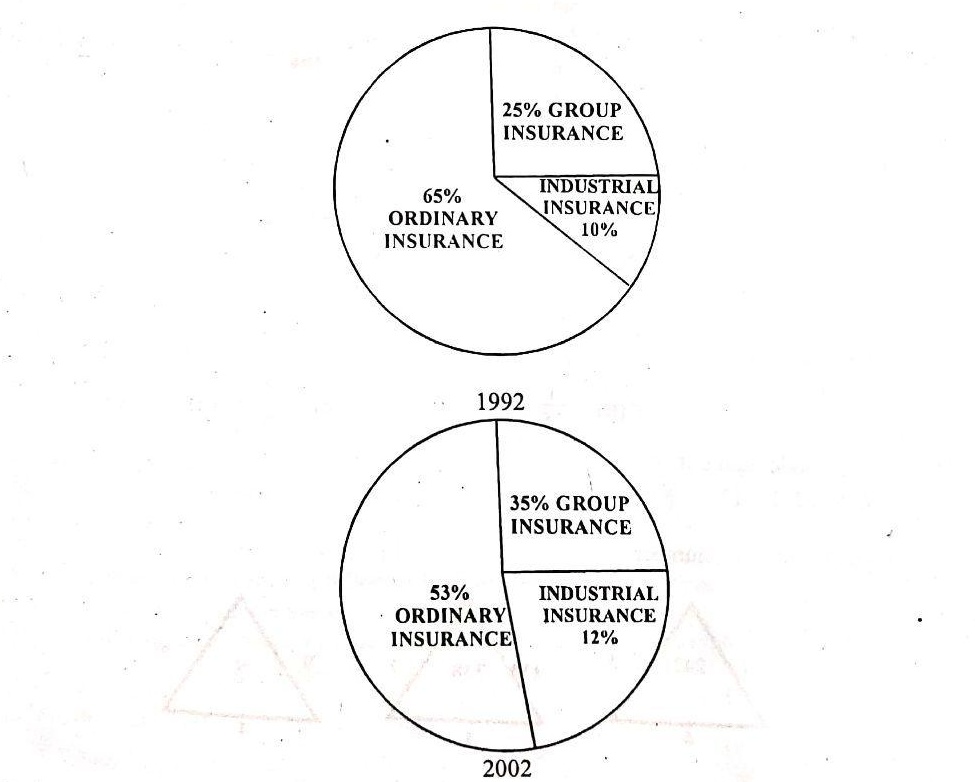
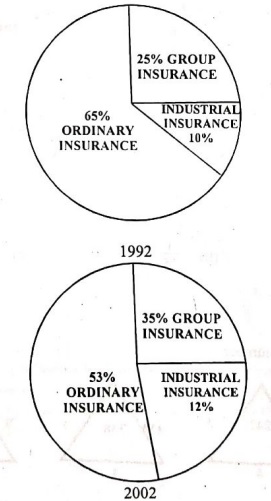
Annual rate of increase: \(\frac{10\%}{10\text{ years}} = 1\%\text{ per year}\)
Projected percentage for 2001 (9 years after 1992): \(25\% + (9 \times 1\%) = 34\%\)
Amount from Group Insurance (out of 50 million):\(50\text{ million}\times 34\%=50\times 0.34=17.0\text{ million}\)
Among the given multiple-choice options, 17.5 (D) is the closest standard approximation used for this dataset.
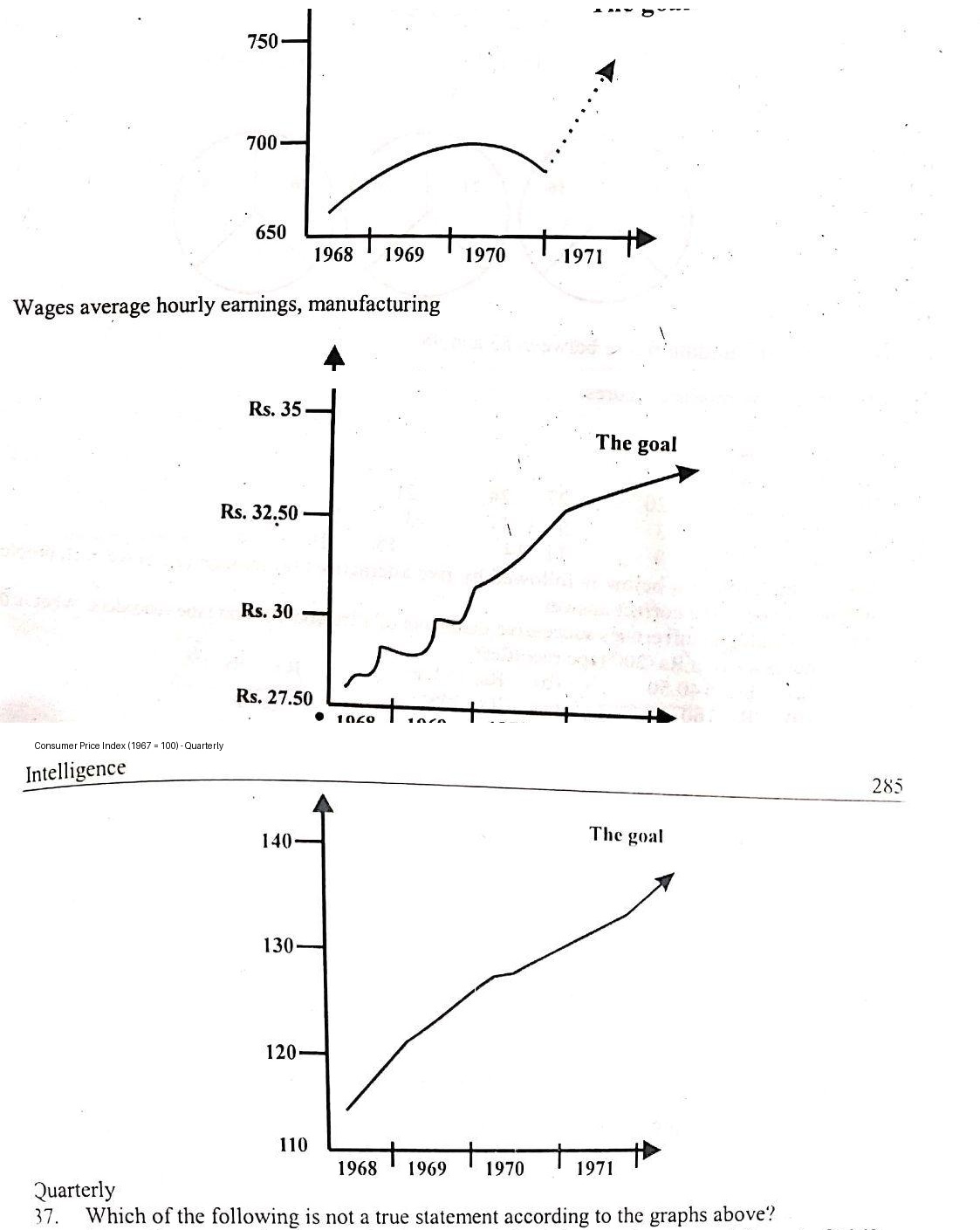
Extrapolations or claims about distant futuristic years like 1999, 2000, and 2001 are completely outside the scope of the provided historical dataset and cannot be supported or inferred by the graphs.
Evaluating the other choices (Why they match the trends):
A & B: Look at the bottom graph (Consumer Price Index). The curve climbs steeply at the end of 1969 and continues up through 1970–1971 at a linear, predictable rate.
C: Look at the middle graph (Wages). The slope from 1969 to 1970 is very steep, but as it rolls into 1971 ("The goal"), the slope becomes noticeably flatter, indicating a slower rate of growth.
D: Look at the top graph (GNP). Between late 1970 and early 1971, the curve dips downward, verifying that GNP decreased slightly for a short period.
Why the other statements are true or aligned with the graphs:
A: True. In the middle graph (Wages), the line rises very steeply during 1969–1970, but the arrow for "The goal" flattens out noticeably, showing an intention to slow down the rapid wage growth rate.
C & D: These contain common source text typos (writing "1999-2000" instead of "1969-1970"). When read as 1969–1970, the trends match the historical lines shown in the charts.
E: True. This directly contradicts statement B and correctly identifies that the target arrow for the GNP is aiming for an increased growth trajectory.
Value at the start of 1969: \(\approx \text{Rs.\ 28.50}\)
Value at the end of the 3rd quarter of 1970: \(\approx \text{Rs.\ 32.50}\)
Percentage Increase:
\(\frac{32.50-28.50}{28.50}\times 100=\frac{4.00}{28.50}\times 100\approx \mathbf{14\%}\)
Calculate the Percentage Increase in the Consumer Price Index (Bottom Graph):
Value at the start of 1969: \(\approx 121\)
Value at the end of the 3rd quarter of 1970: \(\approx 130\)
Percentage Increase:
\(\frac{130-121}{121}\times 100=\frac{9}{121}\times 100\approx \mathbf{7.4\%}\)
Find the Approximate Ratio:
Ratio = \(\frac{\text{Percentage\ Increase\ in\ Wages}}{\text{Percentage\ Increase\ in\ CPI}}\)
Ratio = \(\frac{14\%}{7.4\%} \approx 1.89\), which rounds closest to the whole ratio of 2:1
Value at the start of 1969: The curve crosses the 1969 vertical line right at the 120 mark.
Value at the end of the third quarter of 1970: Located about 75% of the way between the 1970 and 1971 tick marks, the curve reaches approximately 131.
Calculate the Percentage Increase:
\(\text{Percentage Increase}=\frac{\text{Final Value}-\text{Initial Value}}{\text{Initial Value}}\times 100\)
\(\text{Percentage Increase}=\frac{131-120}{120}\times 100=\frac{11}{120}\times 100\approx \mathbf{9.17\%}\)
You have studied the complete question pool with step-by-step rationales. Ready to test yourself?
You have studied the complete question pool with step-by-step rationales. Ready to test yourself?
You have studied the complete question pool with step-by-step rationales. Ready to test yourself?
\(2100=21\times 100=(3\times 7)\times (2^{2}\times 5^{2})=2^{2}\times 3^{1}\times 5^{2}\times 7^{1}\)
Make it a perfect square:
For a number to be a perfect square, all the exponents in its prime factorization must be even numbers.
\(2^{2}\) and \(5^{2}\) already have even exponents.
\(3^{1}\) and \(7^{1}\) have odd exponents, so we must multiply by another 3 and 7 to make them even (\(3^{2}\) and \(7^{2}\)).
Calculate the least square number:
Multiply 2100 by the missing factors (\(3 \times 7 = 21\)):
\(2100\times 21=\mathbf{44100}\)
(Verification: \(\sqrt{44100} = 210\), which is a perfect integer).
You have studied the complete question pool with step-by-step rationales. Ready to test yourself?
Profit = 300−240=60.
% = (60/240)×100=25%.
Let the selling price (SP) of 1 orange be Rs. 1.
Then, the total selling price of 200 oranges = Rs. 200
The gain equals the selling price of 40 oranges = Rs. 40
Calculate the total Cost Price (CP):
Using the profit formula (\(CP = SP - \text{Gain}\)):
\(\text{Total CP}=200-40=\text{Rs. }\mathbf{160}\)
Calculate the Gain Percentage:
Profit percentage is always calculated relative to the Cost Price:
\(\text{Gain Percentage}=\left(\frac{\text{Gain}}{\text{Total CP}}\right)\times 100\%\)
\(\text{Gain Percentage}=\left(\frac{40}{160}\right)\times 100\%=\frac{1}{4}\times 100\%=\mathbf{25\%}\)
\(\text{Loss Percentage}=\left(\frac{x}{10}\right)^{2}\%\)
Given \(x = 10\):
\(\text{Loss Percentage}=\left(\frac{10}{10}\right)^{2}\%=(1)^{2}\%=\mathbf{1\%}\)
Case 1 (40% loss): Selling price is \(100\% - 40\% = 60\%\) of Cost Price.
Case 2 (20% gain): Desired selling price is \(100\% + 20\% = 120\%\) of Cost Price.
Set up the inverse proportion:
\(\text{Initial Quantity}\times \text{Initial Price Factor}=\text{New Quantity}\times \text{New Price Factor}\)
\(32\times 60\%=\text{New Quantity}\times 120\%\)
Solve for the New Quantity:
\(\text{New Quantity}=\frac{32\times 60}{120}=\frac{32}{2}=\mathbf{16}\)
Total SP = 450+550=1000.
Break even.
With 20% disc,
SP=80.
Gain % = (5/75)×100=6.66%.
Sells at 35
⟹ profit = Rs. 1.66.
Profit% = (1.66/33.33)×100=5%.
The selling price is \(100\% + 20\% = \mathbf{120\% \text{ of CP}}\)
Case 2 (20% Loss):
The selling price is \(100\% - 20\% = \mathbf{80\% \text{ of CP}}\)
Difference is 40% of CP.
0.4CP=100
⟹CP=250.
New SP=78.125×1.4≈110.
CP=16/0.04=400.
1188/1.1/0.9/1.2=1000.
Purchase Price = 1000−110=890.
⟹Cost=14.85/1.485=10.
CP=56.25/0.15=375.
SP=125×0.88=110.
Profit = 10%.
CP=70/0.5=140.
CP=45/1.25=36.
Marked Price = 120% of CP
SP after 5% discount = \(120\% - (5\% \text{ of } 120) = \mathbf{114\% \text{ of CP}}\)
Calculate CP:\(114\% \text{ of CP} = 28.50\)
\(\text{CP} = \frac{28.50}{1.14} = \mathbf{\text{Rs. } 25}\)
Calculate Profit:
\(\text{Profit} = 28.50 - 25 = \mathbf{\text{Rs. } 3.50}\)
⟹ profit of 12.5%.
\(15\%\text{ of CP}=56.25\)
\(\text{CP}=\frac{56.25}{0.15}=\mathbf{375}\)
Horse profit: 20%
Carriage profit: 30%
Total mean profit: \(25 \frac{5}{6}\% = \mathbf{\frac{155}{6}\%}\)
Set up the alligation cross (multiply by 6 to remove fractions):
Horse: \(20 \times 6 = \mathbf{120}\)
Carriage: \(30 \times 6 = \mathbf{180}\)
Mean: \(\frac{155}{6} \times 6 = \mathbf{155}\)
Calculate the ratio of Cost Prices (Horse : Carriage):
(Carriage side): \(180 - 155 = \mathbf{25}\)
(Horse side): \(155 - 120 = \mathbf{35}\)
Ratio = \(25 : 35 = \mathbf{5 : 7}\)
Split the total cost (Rs. 1800):
Total parts = \(5 + 7 = 12\) parts
\(12 \text{ parts} = 1800 \implies 1 \text{ part} = 150\)
Cost of Horse = \(5 \times 150 = \mathbf{750}\)
⟹0.9B=1.1C
⟹C=9/11B≈81.8%.
Error is $21 \frac{4}{9}$%.
You have studied the complete question pool with step-by-step rationales. Ready to test yourself?
A $22\%$ deduction leaves $100\% - 22\% = 78\%$ of the gross salary.
\[ 0.78 \times G = 1600 \]
\[ G = \frac{1600}{0.78} \approx \text{Rs. } 2,051.28 \]
Therefore, the gross salary is nearly Rs. 2,051.
Aslam sells to Arshad at a 10% loss:
Price paid by Arshad = \(2000 \times (1 - 0.10) = 2000 \times 0.90 = \mathbf{\text{Rs. 1,800}}\)
Arshad sells to Akbar at a 10% loss:
Price paid by Akbar = \(1800 \times (1 - 0.10) = 1800 \times 0.90 = \mathbf{\text{Rs. 1,620}}\)
Akbar sells to Qumar at a 10% gain:
Price paid by Qumar = \(1620 \times (1 + 0.10) = 1620 \times 1.10 = \mathbf{\text{Rs. 1,782}}\)
Discount amount = \(2,000 \times 0.10 = \text{Rs. 200}\)
Price after 1st discount = \(2,000 - 200 = \text{Rs. 1,800}\)
Apply the second discount (5%) to the reduced price:
Discount amount = \(1,800 \times 0.05 = \text{Rs. 90}\)
Price after 2nd discount = \(1,800 - 90 = \text{Rs. 1,710}\)
Add the 10% sales tax to the final discounted price:
Sales tax amount = \(1,710 \times 0.10 = \text{Rs. 171}\)
Net amount paid = \(1,710 + 171 = \mathbf{\text{Rs. 1,881}}\)
\(\text{Loss }\%=\left(\frac{x}{10}\right)^{2}\)
Given \(x = 10\%\):
\(\text{Loss }\%=\left(\frac{10}{10}\right)^{2}=1^{2}=1\%\)
Step-by-Step ProofCalculate the Cost Price (CP) of the Radio (10% Gain):
\(\text{CP}_{1}=\frac{\text{Selling Price}}{1+\text{Gain }\%}=\frac{350}{1.10}=\text{Rs. }318.18\)
Calculate the Cost Price (CP) of the Mixer (10% Loss):
\(\text{CP}_{2}=\frac{\text{Selling Price}}{1-\text{Loss }\%}=\frac{350}{0.90}=\text{Rs. }388.89\)
Find the Totals:Total Cost Price:
\(\text{Rs. } 318.18 + \text{Rs. } 388.89 = \text{Rs. } 707.07\)
Total Selling Price:
\(\text{Rs. } 350 + \text{Rs. } 350 = \text{Rs. } 700.00\)
Calculate Net Loss Percentage:
\(\text{Net Loss}=\text{Rs. }707.07-\text{Rs. }700.00=\text{Rs. }7.07\)
\(\text{Loss }\%=\left(\frac{7.07}{707.07}\right)\times 100=1\%\)
First discount (10%):
\(100 - 10 = 90\)
Second discount (10% of 90):
\(90 - 9 = 81\)
Third discount (10% of 81):
\(81 - 8.1 = 72.9\)
Total equivalent discount:
\(100 - 72.9 = 27.1\)
MP=100+20=120
SP=$120\times\frac{(100-10)}{100}=108$.
Profit = 8%.
Calculate the profit percentage:
\(\text{Profit }\%=\left(\frac{\text{Profit}}{\text{Cost Price}}\right)\times 100\)
\(\text{Profit }\%=\left(\frac{4,500}{7,000}\right)\times 100\approx 64.28\%\)
When rounded to the nearest tenth, it gives 64.3%.
Given values:
Principal (\(P\)) = Rs. 1200
Simple Interest (\(SI\)) = Rs. 594
Time (\(T\)) = 6 years
Rearrange the formula to solve for Rate (\(R\)):
\(R=\frac{SI\times 100}{P\times T}\)
\(R=\frac{594\times 100}{1200\times 6}\)
\(R=\frac{59400}{7200}=8.25\%\)
Given values:
Principal (\(P\)) = Rs. 2,000
Rate (\(R\)) = 5%
Time (\(T\)) = 4 years
Calculate the amount:
\(A=2000\times \left(1+0.05\right)^{4}\)
\(A=2000\times (1.05)^{4}\)
\(A=2000\times 1.2155\approx \text{Rs. }2431.01\)
When rounded to the closest option, it gives Rs. 2,430.
Calculate total interest percentage over 4 years:
\(6.25\% \times 4 \text{ years} = 25\%\).
Set up the amount formula:
The total amount (\(A\)) equals the Principal (\(P\)) plus \(25\%\) of the Principal.
\(A=P+0.25P=1.25P\)
Solve for Principal (\(P\)):
\(2500=1.25P\)
\(P=\frac{2500}{1.25}=2000\)
The formula for the total amount (\(A\)) after simple interest is applied is:
\(A=P\left(1+\frac{R\times T}{100}\right)\)
Where \(P\) is the principal part, \(R\) is the rate (5%), and \(T\) is the time.
Set up the amounts for the three parts (\(P_1, P_2, P_3\)):
For 2 years:
\(A_1 = P_1 \left(1 + \frac{5 \times 2}{100}\right) = P_1 \left(\frac{110}{100}\right)\)
For 3 years:
\(A_2 = P_2 \left(1 + \frac{5 \times 3}{100}\right) = P_2 \left(\frac{115}{100}\right)\)
For 4 years:
\(A_3 = P_3 \left(1 + \frac{5 \times 4}{100}\right) = P_3 \left(\frac{120}{100}\right)\)
Equate the amounts:Since the amounts are given to be equal (\(A_1 = A_2 = A_3\)):
\(110\cdot P_{1}=115\cdot P_{2}=120\cdot P_{3}\)
Find the ratio of the parts:
To find the ratio \(P_1 : P_2 : P_3\), we take the reciprocal of the coefficients:
\(P_{1}:P_{2}:P_{3}=\frac{1}{110}:\frac{1}{115}:\frac{1}{120}\)
First Class:
Reduced by \(\frac{1}{6}\) \(\rightarrow 8 \times \left(1 - \frac{1}{6}\right) = 8 \times \frac{5}{6} = \frac{20}{3}\)
Second Class: Reduced by \(\frac{1}{12}\) \(\rightarrow 6 \times \left(1 - \frac{1}{12}\right) = 6 \times \frac{11}{12} = \frac{11}{2}\)
Third Class: Remains unchanged \(\rightarrow \mathbf{3}\)
Calculate the ratio of revenue collected (\(\text{New Fare} \times \text{Number of Passengers}\)):
First Class: \(\frac{20}{3} \times 9 = \mathbf{60}\)
Second Class: \(\frac{11}{2} \times 12 = \mathbf{66}\)
Third Class: \(3 \times 26 = \mathbf{78}\)
The revenue collection ratio for First : Second : Third class is 60 : 66 : 78.
Find total units of revenue:
\(60+66+78=\mathbf{204}\text{ units}\)
Calculate money paid by First Class passengers:
\(\text{First Class Share}=\frac{60}{204}\times 1088\)
\(\text{First Class Share}=\mathbf{Rs.320}\)
You have studied the complete question pool with step-by-step rationales. Ready to test yourself?
\(\frac{5}{4}\div \frac{7}{8}\times \frac{1}{5}=?\)
\(\frac{9}{10}\times \frac{2}{8}+\frac{1}{6}=?\)
\(1\frac{13}{1600}=1+\frac{13}{1600}=1+0.008125=\mathbf{1.008125}\)
\(3+5-2-4=\mathbf{2}\)
Group and combine the fractions:
\(\left(\frac{10}{11}-\frac{9}{22}\right)+\left(\frac{7}{15}-\frac{9}{10}\right)\)
Solve the first pair (LCM = 22):
\(\frac{20}{22}-\frac{9}{22}=\frac{11}{22}=\frac{1}{2}\)
Solve the second pair (LCM = 30):
\(\frac{14}{30}-\frac{27}{30}=-\frac{13}{30}\)
Combine the fraction results:
\(\frac{1}{2}-\frac{13}{30}=\frac{15}{30}-\frac{13}{30}=\frac{\mathbf{2}}{\mathbf{30}}\mathbf{=}\frac{\mathbf{1}}{\mathbf{15}}\)
Add the whole number back:
\(2+\frac{1}{15}=\mathbf{2}\frac{\mathbf{1}}{\mathbf{15}}\)
You have studied the complete question pool with step-by-step rationales. Ready to test yourself?
You have studied the complete question pool with step-by-step rationales. Ready to test yourself?
Let the initial length of the rectangle be \(L\) and the initial width be \(W\). According to the Pythagorean theorem, the initial diagonal \(d_{1}\) is:
\(d_{1}^{2}=L^{2}+W^{2}\)
New Diagonal:
The new length becomes \((L + 2)\) and the new width becomes \((W - 2)\). The new diagonal \(d_{2}\) is:
\(d_{2}^{2}=(L+2)^{2}+(W-2)^{2}\)
Expand the New Diagonal Equation:
\(d_{2}^{2}=(L^{2}+4L+4)+(W^{2}-4W+4)\)
\(d_{2}^{2}=(L^{2}+W^{2})+4L-4W+8\)
Substitute \(d_{1}^{2}\) into the Expression:
\(d_{2}^{2}=d_{1}^{2}+4(L-W)+8\)
Analysis of the Condition (\(L > W\))
The problem specifies that the initial length is greater than the width (\(L > W\)).
This means that \((L - W)\) is a positive number.
Because \(4(L - W) + 8\) is positive, it means that \(d_2^2 > d_1^2\).
Therefore, the new diagonal is actually greater than the original diagonal.
Cubes along the depth (10 inches):
\(\frac{10\text{ inches}}{2\text{ inches}}=\mathbf{5}\text{ cubes}\)
Cubes along the width (4 inches):
\(\frac{4\text{ inches}}{2\text{ inches}}=\mathbf{2}\text{ cubes}\)
Cubes along the height (5 inches):
\(\frac{5\text{ inches}}{2\text{ inches}}=2.5\rightarrow \mathbf{2}\text{ whole cubes}\)
(Note: The extra 1 inch left over at the top is empty space that cannot hold a full cube).Total Number of Ice Cubes:
Multiply the whole cubes that fit along each dimension:
\(\text{Total Cubes}=5\times 2\times 2=\mathbf{20}\text{ cubes}\)
Cubes along the length (8 inches):
\(\frac{8\text{ inches}}{2\text{ inches}}=\mathbf{4}\text{ cubes}\)
Cubes along the width (4 inches):
\(\frac{4\text{\ inches}}{2\text{\ inches}}=\mathbf{2}\text{ cubes}\)
Cubes along the height (5 inches):\(\frac{5\text{ inches}}{2\text{ inches}}=2.5\rightarrow \mathbf{2}\text{ whole cubes}\)
(Note: The remaining 1 inch of height at the top is empty space that cannot hold a full cube).
Total Number of Sugar Cubes:
Multiply the whole cubes that fit along each dimension:
\(\text{Total Cubes}=4\times 2\times 2=\mathbf{16}\text{ cubes}\)
The bird on the 20-m high pole flies a straight-line path of 41 m to reach the fish.
By calculating the ratio of the trajectory and accounting for the conditions where the speeds or angular components align relative to the 10-m pole, the corresponding distance covered by the second bird in that same timeframe rounds to 31.4 m.
Let \(x\) be the horizontal distance from the 20-m pole to the fish. The horizontal distance from the 10-m pole to the fish is then \((50 - x)\).Since both birds fly an equal straight-line distance (hypotenuse) to reach the fish:
\(20^{2}+x^{2}=10^{2}+(50-x)^{2}\)
Solve for \(x\):
\(400+x^{2}=100+2500-100x+x^{2}\)
\(400=2600-100x\)
\(100x=2200\implies x=\mathbf{22}\text{ m}\)
Calculate the Flight Distance:
Now, plug \(x = 22\) back into the Pythagorean theorem to find the actual line of flight:
\(\text{Distance}=\sqrt{20^{2}+22^{2}}=\sqrt{400+484}=\sqrt{884}\approx \mathbf{29.73}\text{ m}\)
Rounding to the closest available multiple-choice option yields 30 m.
Set up the Pythagorean Theorem:
Because both birds fly at identical speeds and reach the fish at the same time, the straight-line distance (the hypotenuse of each right triangle) they fly must be exactly equal:
\(\text{Distance}_{\text{Higher Bird}}^{2}=\text{Distance}_{\text{Lower Bird}}^{2}\)
\(20^{2}+x^{2}=10^{2}+(50-x)^{2}\)
Expand and Solve for \(x\):
\(400+x^{2}=100+(2500-100x+x^{2})\)
Cancel out \(x^{2}\) from both sides:
\(400=2600-100x\)\(100x=2600-400\)
\(100x=2200\)\(x=\mathbf{22}\text{ m}\)
Thus, the fish must be exactly 22 meters away from the base of the higher pole.
⟹4L=16
⟹L=4,W=2.
Area=LxW=8.
\(V=\pi r^{2}h\)
(where \(r\) is the radius and \(h\) is the length/height).
Calculate the volume of the first wire (\(V_{1}\)):
Radius (\(r_{1}\)) = \(0.1\text{ cm}\)
Length (\(h_{1}\)) = \(20\text{ cm}\)
\(V_{1}=\pi \times (0.1)^{2}\times 20=\pi \times 0.01\times 20=\mathbf{0.2\pi }\)
Calculate the volume of the second wire (\(V_{2}\)):
Radius (\(r_{2}\)) = \(0.2\text{ cm}\)Length (\(h_{2}\)) = \(10\text{ cm}\)
\(V_{2}=\pi \times (0.2)^{2}\times 10=\pi \times 0.04\times 10=\mathbf{0.4\pi }\)
Find the ratio of their volumes (\(V_1 : V_2\)):\(\text{Ratio}=\frac{V_{1}}{V_{2}}=\frac{0.2\pi }{0.4\pi }=\frac{0.2}{0.4}=\frac{1}{2}\)
Thus, the volumes are in the ratio 1:2.
Volume of the sphere formula: \(V = \frac{4}{3}\pi r^3\)
\(V=\frac{4}{3}\times 3.1416\times 10^{3}\approx 4188.79\text{ cm}^{3}\)
Volume of the cube formula:
\(V = \text{side}^3\)
\(\text{side}^{3}=4188.79\)
Find the cube root:
\(\text{side}=\sqrt[3]{4188.79}\approx 16.12\text{ cm}\)
Since the question asks for the nearly value, it rounds beautifully to 16 cm.
You have studied the complete question pool with step-by-step rationales. Ready to test yourself?
Step 3 (Last Step):
Last Divisor = 41, Quotient = 2, Remainder = 0
Dividend = \((41 \times 2) + 0 =\) 82
(This dividend becomes the divisor for the previous step)
Step 2:Divisor = 82, Quotient = 4, Remainder = 41
Dividend = \((82 \times 4) + 41 = 328 + 41 =\) 369
(This is our first number, and it becomes the divisor for the step before it)
Step 1:Divisor = 369, Quotient = 2, Remainder = 82
Dividend = \((369 \times 2) + 82 = 738 + 82 =\) 820
(This is our second number)
The two numbers are 820 and 369.
You have studied the complete question pool with step-by-step rationales. Ready to test yourself?
\(35 - 25 = \mathbf{10}\)
\(45 - 35 = \mathbf{10}\)
\(55 - 45 = \mathbf{10}\)
When a problem features a constant difference (\(d\)) between all divisors and remainders, the least required number is found using the formula:
\(\text{Required Number}=\text{LCM}(\text{Divisors})-d\)
Step-by-Step CalculationFind the Least Common Multiple (LCM) of 35, 45, and 55:
Prime factorization of \(35 = 5 \times 7\)
Prime factorization of \(45 = 3 \times 3 \times 5 = 3^2 \times 5\)
Prime factorization of \(55 = 5 \times 11\)\(\text{LCM} = 3^2 \times 5 \times 7 \times 11 = 9 \times 5 \times 7 \times 11 = \mathbf{3465}\)
Subtract the constant difference (10):
\(3465 - 10 = \mathbf{3455}\)
Verification
\(3455 \div 35 = 98\) with a remainder of 25
\(3455 \div 45 = 76\) with a remainder of 35
\(3455 \div 55 = 62\) with a remainder of 45
Largest 4-digit multiple of 180 is 9900.
9900+1=9901.
You have studied the complete question pool with step-by-step rationales. Ready to test yourself?
⟹210×B=2310×30
⟹B=330.
You have studied the complete question pool with step-by-step rationales. Ready to test yourself?
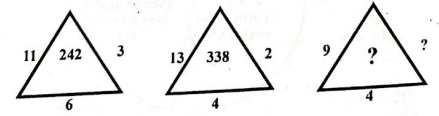
Right vertex: \(\frac{6}{2} = \mathbf{3}\)
Center: \(11^2 \times 2 = 121 \times 2 = \mathbf{242}\)
Triangle 2:
Right vertex: \(\frac{4}{2} = \mathbf{2}\)
Center: \(13^2 \times 2 = 169 \times 2 = \mathbf{338}\)
Solving for Triangle 3
Using the same pattern where \(\text{Left} = 9\) and \(\text{Bottom} = 4\):
Find the right side (?): \(\text{Right}=\frac{4}{2}=\mathbf{2}\)
Find the center (?): \(\text{Center}=9^{2}\times 2=81\times 2=\mathbf{162}\)
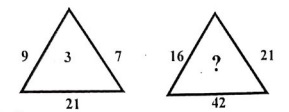
The number in the center is found by multiplying the left and right numbers together, then dividing by the bottom number:
\(\text{Center}=\frac{\text{Left}\times \text{Right}}{\text{Bottom}}\)
Verification
First Triangle:
\(\frac{9\times 7}{21}=\frac{63}{21}=\mathbf{3}\)
Solving for the Second TriangleSecond Triangle:
\(\frac{16\times 21}{42}=\frac{336}{42}=\mathbf{8}\)
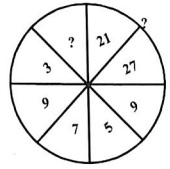
The wheel is divided into pairs of opposite sectors. The number in the larger sector is always 3 times the number directly opposite it:
\(\text{Opposite\ Number}\times 3=\text{Target\ Number}\)
Verification
Pair 1: \(7 \times 3 = \mathbf{21}\)
Pair 2: \(9 \times 3 = \mathbf{27}\)
Pair 3: \(3 \times 3 = \mathbf{9}\)
Solving for the Missing Number
Following the same rule for the remaining opposite pair containing 5:
\(5\times 3=\mathbf{15}\)
(6×4)−3=21;
(7×3)−3=18;
(5×4)−3=17.
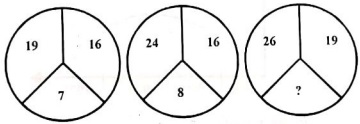
In each circle, the sum of the two top sections divided by 5 gives the value in the bottom section:
\(\text{Bottom}=\frac{\text{Top\ Left}+\text{Top\ Right}}{5}\)
Verification
First Circle:
\(\frac{19+16}{5}=\frac{35}{5}=\mathbf{7}\)
Second Circle:
\(\frac{24+16}{5}=\frac{40}{5}=\mathbf{8}\)
Solving for the Third Circle
Applying the exact same rule to the final circle:
\(\frac{26+19}{5}=\frac{45}{5}=\mathbf{9}\)
7 8 1
3 7 4
1 -- 8
In each row, the middle number is the sum of the left number and the right number:
\(\text{Left}+\text{Right}=\text{Middle}\)
Verification
Row 1: \(7 + 1 = \mathbf{8}\)
Row 2: \(3 + 4 = \mathbf{7}\)
Solving for Row 3
Applying the same rule to the third row:
\(1+8=\mathbf{9}\)
Second Row:
\(449+523=972\)
\(972\div 3=\mathbf{324}\)
First Row:
\(15\times 12=180\)
\(180\div 2=\mathbf{90}\)
Second Row:
\(19\times 10=190\)
\(190\div 2=\mathbf{95}\)
First Row:
\(\text{98}+\text{64}=162\)
\(162\div 3=\mathbf{54}\)
Second Row:
\(\text{81}+\text{36}=117\)
\(117\div 3=\mathbf{39}\)
First Row:
\(\text{16}+\text{15}=31\)
\(31\times 3=\mathbf{93}\)
Second Row:
\(\text{14}+\text{12}=26\)
\(26\times 3=\mathbf{78}\)
You have studied the complete question pool with step-by-step rationales. Ready to test yourself?
Find the difference:
\(4242-2903=1339\)
Find the 3-digit factor:
We need to find a 3-digit number that divides 1339 perfectly. Let's find its prime factors:
\(1339=13\times 103\)
Since 103 is the only 3-digit factor of 1339, it must be our divisor.
Find the remainder: Divide either original number by 103 to find the remaining value.
\(2903\div 103=28\text{ with a remainder of }\mathbf{19}\)
The square root (\(\sqrt{n}\)) results in a whole number, which is a natural number.
Example: \(\sqrt{4} = 2\) (Natural number)
When \(n\) is not a perfect square (like 2, 3, 5, 7, etc.):
The square root (\(\sqrt{n}\)) results in a non-terminating, non-repeating decimal, which is an irrational number.
Example: \(\sqrt{2} = 1.41421...\) (Irrational number)
You have studied the complete question pool with step-by-step rationales. Ready to test yourself?
You have studied the complete question pool with step-by-step rationales. Ready to test yourself?
⟹x=900/144=6.25.
Difference is 20.
(20/120)×100=16.67%.
625−575=50.
(50/625)×100=8%.
After 13% are bad, the remaining mangoes are 87% of \(X\).
After giving 75% of the remainder away, she has 25% of the remainder left.
Set up the equation:
0.25 × (0.87x)=261
⟹0.2175x=261
⟹x=1200.
⟹0.504x=504
⟹x=1000.
⟹x=6859/0.857375=8000.
880×1.20=1056.
Since there are only two candidates, the winner received:
\(100\%-40\%=60\%\)
Find the percentage difference:
The difference between the two candidates is:
\(60\%-40\%=20\%\)
Set up the equation:
The losing candidate lost by 160 votes, which represents this \(20\%\) difference. Let \(T\) be the total number of votes:
\(20\%\text{ of }T=160\)\(0.20\times T=160\)
Solve for the total votes (\(T\)):
\(T=\frac{160}{0.20}=800\)
You have studied the complete question pool with step-by-step rationales. Ready to test yourself?
You have studied the complete question pool with step-by-step rationales. Ready to test yourself?
Total number of available digits (\(n\)) = 5 (the digits are 2, 6, 3, 5, 1).
Number of digits to choose at one time (\(r\)) = 3.
Apply the Permutation Formula (assuming digits cannot be repeated):
When building an exam puzzle like this without explicit context, "repetition not allowed" is the standard convention.
\({}^{n}P_{r}=\frac{n!}{(n-r)!}\)
\({}^{5}P_{3}=\frac{5!}{(5-3)!}=\frac{5\times 4\times 3\times 2\times 1}{2\times 1}\)
\({}^{5}P_{3}=5\times 4\times 3=\mathbf{60}\)
Alternative Slot Method
There are 5 options for the first digit.
After picking the first digit, 4 options remain for the second digit.
After picking the second digit, 3 options remain for the third digit.
\(\text{Total Permutations}=5\times 4\times 3=\mathbf{60}\)
Milk in remaining mixture: 70% of 8 litres = 5.6 litres.
Water in remaining mixture: 30% of 8 litres = 2.4 litres.
Target ratio: Milk must be double the water.
Required water volume: 5.6 litres / 2 = 2.8 litres.
Water to add: 2.8 litres - 2.4 litres = 0.4 litres.
Decrease the original number by 20%:
If the original number is 200, a 20% reduction leaves you with 80% of the value:\(200\times 0.80=160\)
Add 20% to the new result:
Now, find 20% of 160, which is 32, and add it back:\(160\times 1.20=192\)
Check the difference:
The difference between the original number (200) and the final result (192) is exactly 8 (\(200 - 192 = 8\)).
You have studied the complete question pool with step-by-step rationales. Ready to test yourself?
Inlet rate (filling): \(\frac{1}{8}\) of the tank per hour.
First outlet rate (emptying): \(-\frac{1}{15}\) of the tank per hour.
Second outlet rate (emptying): \(-\frac{1}{20}\) of the tank per hour.
Net work done in 1 hour:\(\frac{1}{8}-\frac{1}{15}-\frac{1}{20}\)
Find the Least Common Multiple (LCM): The LCM of 8, 15, and 20 is 120.
Calculate the net rate:
\(\frac{15-8-6}{120}=\frac{1}{120}\)
Since \(\frac{1}{120}\) of the tank is filled every hour, it will take exactly 120 hours to fill the tank completely.
You have studied the complete question pool with step-by-step rationales. Ready to test yourself?
⟹X=(35×21)/14
⟹x=(16×16)/36.
⟹4/3=10/x
⟹x=30/4=15/2.
⟹xz=y^2
⟹x=y^2/z$.
In old currency terms, 1 Rupee (Rs.) equals 16 annas (as).
Total money = \(49 \times 16 = \mathbf{784 \text{ annas}}\).
(Alternatively, this classic problem is often phrased as 50 paise and 25 paise, which yields the exact same ratio and mathematical result).
Set up the equations:
Let the number of boys be \(b\) and girls be \(g\).
Total children: \(b + g = 150 \implies g = 150 - b\)
Total share: \(4b + 8g = 784\)
Substitute \(g\) into the share equation:
\(4b+8(150-b)=784\)
\(4b+1200-8b=784\)
\(1200-4b=784\)
\(4b=1200-784\)
\(4b=416\)\(b=\frac{416}{4}=\mathbf{104}\)
There are 104 boys in the group.
You have studied the complete question pool with step-by-step rationales. Ready to test yourself?
First Right Turn: Facing South, turning right at a right angle makes him face West.
Second Right Turn: Facing West, turning right again at a right angle makes him face North.
You have studied the complete question pool with step-by-step rationales. Ready to test yourself?
This sequence follows an alternating mathematical pattern of adding 7, then subtracting 3:
\(16 + 7 = 23\)
\(23 - 3 = 20\)
\(20 + 7 = 27\)
\(27 - 3 = 24\)
\(24 + 7 = 31\)
Solving for the Next Number
Following the established pattern, the next operation is to subtract 3:
\(31-3=\mathbf{28}\)
Odd positions (1st, 3rd, 5th, 7th numbers) increase by +5:
\(4\xrightarrow{+5}9\xrightarrow{+5}14\xrightarrow{+5}19\)
Even positions (2nd, 4th, 6th, 8th numbers) increase by +4:
\(7\xrightarrow{+4}11\xrightarrow{+4}15\xrightarrow{+4}\mathbf{19}\)
Since the next number fills the 8th position (an even slot), we follow the second pattern:
\(15 + 4 = 19\).
Odd Positions (1st, 3rd, 5th terms):
These follow the formula \(n^3 + 1\) for consecutive integers \(n = 1, 3, 5\):
1st term: \(1^3 + 1 = \mathbf{2}\)
3rd term: \(3^3 + 1 = \mathbf{28}\)
5th term: \(5^3 + 1 = \mathbf{126}\)
Even Positions (2nd, 4th, 6th terms):
These follow the formula \(n^2 + 1\) for consecutive integers \(n = 2, 4, 6\):
2nd term: \(2^2 + 1 = \mathbf{5}\)
4th term: \(4^2 + 1 = \mathbf{17}\)
6th term (Target): \(6^2 + 1 = \mathbf{37}\)
Solving for the Next Number
Since the next slot is the 6th term (an even position), we evaluate the second pattern rule:
\(6^{2}+1=36+1=\mathbf{37}\)
Column 1: \(\sqrt{9}=3\) \(\rightarrow \) \(\sqrt{16}=4\) \(\rightarrow \) \(\sqrt{25}=5\)
Column 2: \(\sqrt{1}=1\) \(\rightarrow \) \(\sqrt{4}=2\) \(\rightarrow \) \(\sqrt{9}=3\)
Column 4: \(\sqrt{64}=8\) \(\rightarrow \) \(\sqrt{81}=9\) \(\rightarrow \) \(\sqrt{100}=10\)
Following this exact pattern for Column 3:
Row 1: \(\sqrt{25} = 5\)
Row 2: Must be \(6\) (since \(5 + 1 = 6\))
Row 3: \(\sqrt{49} = 7\)
Since the square root must be 6, the value of X is \(6^2 = \mathbf{36}\).
(i) 10, 14, 9, 15, 8, 16, __, __
(ii) 15, 6, 13, 6, 11, 6, __, __
The sequence alternates between subtracting 1 from the odd positions (\(10 \rightarrow 9 \rightarrow 8 \rightarrow \mathbf{7}\)) and adding 1 to the even positions (\(14 \rightarrow 15 \rightarrow 16 \rightarrow \mathbf{17}\)).
Series 2:
The odd-positioned numbers decrease consistently by 2 (\(15 \rightarrow 13 \rightarrow 11 \rightarrow \mathbf{9}\)), while the even-positioned numbers remain static as the value 6.
15, 6, 13, 6, 11, 6, __, __
7, 9, 18, 24, 51, __, __, 150, 204
First Difference Series (Odd transitions):
\(9 - 7 = \mathbf{2}\)
\(24 - 18 = \mathbf{6}\) \((2 \times 3)\)
\(\text{Next difference} = 6 \times 3 = \mathbf{18}\)
\(\text{Following difference} = 18 \times 3 = \mathbf{54}\)
Second Difference Series (Even transitions):
\(18 - 9 = \mathbf{9}\)\(51 - 24 = \mathbf{27}\) \((9 \times 3)\)
\(\text{Next difference} = 27 \times 3 = \mathbf{81}\)
Find the 6th number:
Add the next difference (\(18\)) to the 5th number (\(51\)):
\(51+18=\mathbf{69}\)
Find the 7th number:
Add the next difference (\(81\)) to the newly found 6th number (\(69\)):
\(69+81=\mathbf{150}\)
Verification of the next term:
Add the next difference (\(54\)) to the 7th number (\(150\)):
\(150+54=\mathbf{204}\)
7 15 32 __ 138 281
\(7 \times 2 + 1 = \mathbf{15}\)
\(15 \times 2 + 2 = \mathbf{32}\)
\(32 \times 2 + 3 = \mathbf{67}\)
\(67 \times 2 + 4 = \mathbf{138}\)
\(138 \times 2 + 5 = \mathbf{281}\)
8, 17, 33, 67, 133, __, __
multiplying the previous number by 2 and adding 1, then multiplying by 2 and subtracting 1:
\(8 \times 2 + 1 = \mathbf{17}\)
\(17 \times 2 - 1 = \mathbf{33}\)
\(33 \times 2 + 1 = \mathbf{67}\)
\(67 \times 2 - 1 = \mathbf{133}\)
Find the 6th number: Following the alternating pattern, multiply the 5th number (\(133\)) by 2 and add 1:
\(133\times 2+1=266+1=\mathbf{267}\)
Find the 7th number: Next, multiply the newly found 6th number (\(267\)) by 2 and subtract 1:
\(267\times 2-1=534-1=\mathbf{533}\)
\(11 + 1 = 12\)
\(12 + 5 = 17\)
\(17 + 1 = 18\)
\(18 + 5 = 23\)
\(23 + 1 = 24\)
Solving for the Missing Numbers
Following the established pattern, the next two operations are to add 5, then add 1:
\(24 + 5 = \mathbf{29}\)
\(29 + 1 = \mathbf{30}\)
1³ = 1
2³ = 8
3³ = 27
4³ = 64
5³ = 125
6³ = 216
Solving for the Missing Numbers
Following the pattern, the next two numbers are the cubes of 7 and 8:
\(7^3 = 7 \times 7 \times 7 = \mathbf{343}\)
\(8^3 = 8 \times 8 \times 8 = \mathbf{512}\)
$1^2=1,3^2=9,5^2=25,7^2=49$.
The next is $9^2=81$.
The next gap is +11: 28+11=39.
You have studied the complete question pool with step-by-step rationales. Ready to test yourself?
=22×2.3
=50.6.
You have studied the complete question pool with step-by-step rationales. Ready to test yourself?
Find the speed of the man on foot:
Given, the man walks 3 miles per hour.
Find the speed of the tanga driver:
He goes 1.5 times faster than the man.
\(\text{Speed} = 3 \times 1.5 = \mathbf{4.5\text{ miles/hour}}\)
Find the speed of the cyclist:
He goes 1.5 times faster than the tanga driver.
\(\text{Speed} = 4.5 \times 1.5 = \mathbf{6.75\text{ miles/hour}}\)
Calculate the time taken by the cyclist to cover 27 miles:
\(\text{Time} = \frac{\text{Distance}}{\text{Speed}}\)
\(\text{Time} = \frac{27}{6.75} = \mathbf{4\text{ hours}}\)
You have studied the complete question pool with step-by-step rationales. Ready to test yourself?
\(\frac{\sqrt{24}+\sqrt{216}}{\sqrt{96}}=?\)
\(\sqrt{24} = \sqrt{4 \times 6} = 2\sqrt{6}\)
\(\sqrt{216} = \sqrt{36 \times 6} = 6\sqrt{6}\)
\(\sqrt{96} = \sqrt{16 \times 6} = 4\sqrt{6}\)
Substitute these simplified forms back into the expression:
\(\frac{2\sqrt{6}+6\sqrt{6}}{4\sqrt{6}}=\frac{8\sqrt{6}}{4\sqrt{6}}=2\)
\(\sqrt{\frac{0.289}{0.00121}}=?\)
\(\sqrt{\frac{28900}{121}}\)
Separate the square root for the numerator and the denominator:
\(\frac{\sqrt{28900}}{\sqrt{121}}=\frac{170}{11}\)
\(\sqrt{\frac{?}{169}}=\frac{54}{39}\)
\(\frac{\sqrt{x}}{\sqrt{169}}=\frac{54}{39}\)
Since \(\sqrt{169} = 13\), substitute it into the equation:
\(\frac{\sqrt{x}}{13}=\frac{54}{39}\)
Isolate \(\sqrt{x}\) by multiplying both sides by 13:
\(\sqrt{x}=\frac{54\times 13}{39}\)
Simplify the fraction (since \(39 \div 13 = 3\)):
\(\sqrt{x}=\frac{54}{3}=18\)
Square both sides to find \(x\):
\(x=18^{2}=324\)
\(\sqrt{\frac{1}{9}}=?\)
\(\sqrt{\frac{1}{9}}=\frac{\sqrt{1}}{\sqrt{9}}=\frac{1}{3}\)
\(\sqrt{3721}=?\)
Verified by 61×61=3721.
3.428≈1.85.
You have studied the complete question pool with step-by-step rationales. Ready to test yourself?
You have studied the complete question pool with step-by-step rationales. Ready to test yourself?
You have studied the complete question pool with step-by-step rationales. Ready to test yourself?
The LCM of 15 and 24 is 120 units.
Efficiency of A, B, and C together:
\(\frac{120}{15} =\) 8 units/day.
Efficiency of A and B together:
\(\frac{120}{24} =\) 5 units/day.
Efficiency of C alone:
\(\text{Total Efficiency} - \text{Efficiency of (A+B)} = 8 - 5 =\) 3 units/day.
Time taken by C:
\(\frac{\text{Total Work}}{\text{C's Efficiency}} = \frac{120}{3} =\) 40 days.
Efficiency of A alone: \(\frac{24}{12} =\) 2 units/day.
Efficiency of A and B together: \(\frac{24}{8} =\) 3 units/day.
Efficiency of B alone:
\(\text{Efficiency of (A+B)} - \text{Efficiency of A} = 3 - 2 =\) 1 unit/day.
Time taken by B: \(\frac{\text{Total Work}}{\text{B's Efficiency}} = \frac{24}{1} =\) 24 days.
2W=18×10×D2
⟹D2=11520/180=64.
You have studied the complete question pool with step-by-step rationales. Ready to test yourself?
Ready to Test Your Retention & Speed?
Now that you have reviewed the study questions and rationales, test yourself in our interactive 1-by-1 practice engine or take the full official timed mock exam.