
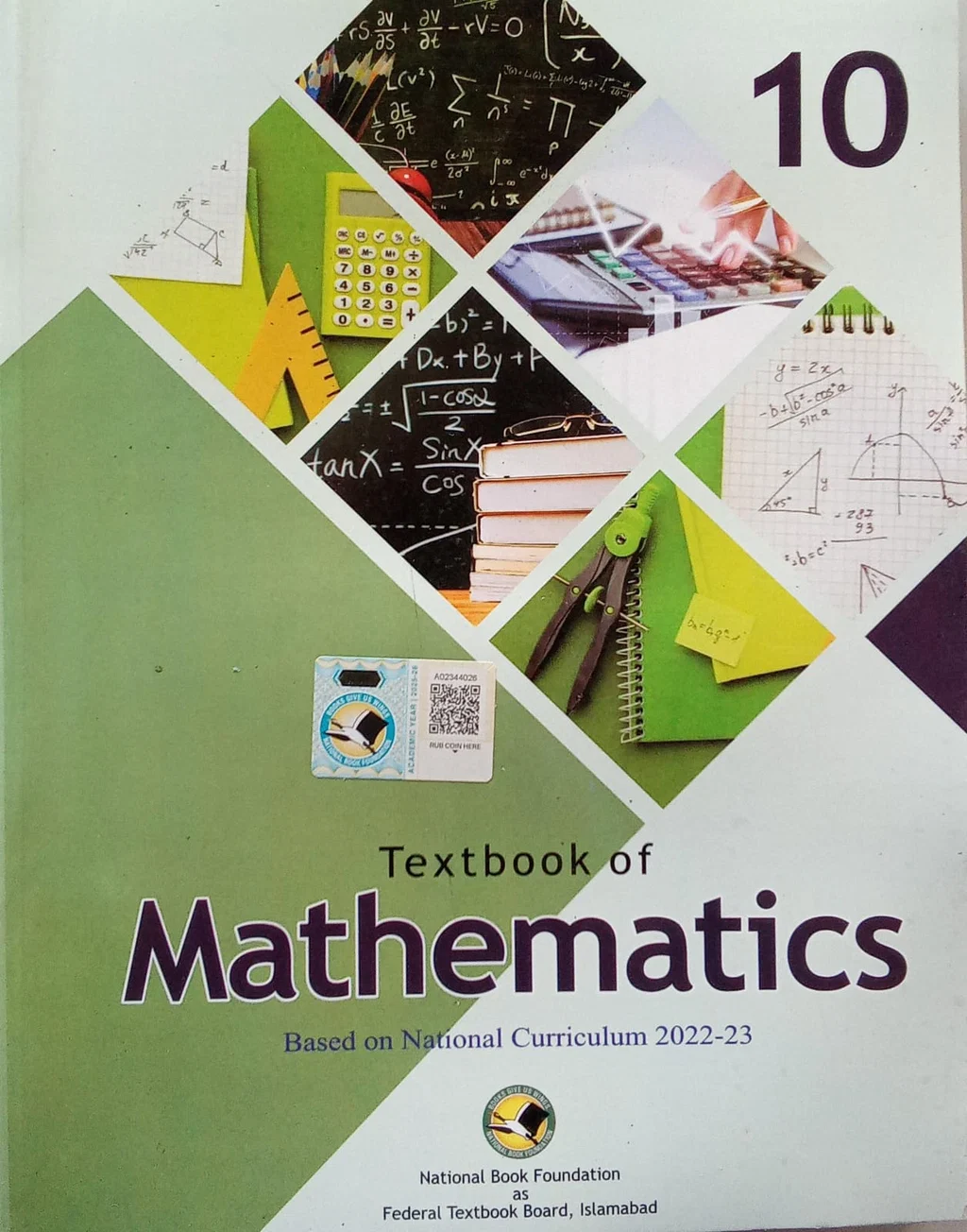
Textbook of Mathematics Grade 10 (FBISE / NBF)
Class 10 Mathematics Federal Board of Intermediate and Secondary Education (FBISE) (FBISE) 📚 Textbook of Mathematics Grade 10 (FBISE / NBF)

Mastery Guide: Matrices, Determinants, Multiplicative Inverses & Linear System Modeling

📖 Chapter 3: Matrices and Determinants 📅 Updated: Sep 20, 2026
FBISE Class 10 • Single National Curriculum

Mastery Guide: Matrices and Determinants

Matrix Taxonomy, Conformability, Determinants, Adjoints, Inverses, Matrix Inversion Method, Cramer's Rule & Applied Mathematical Modeling

📖 Unit Overview & Target Learning Outcomes

Matrices and determinants represent one of the most powerful and versatile branches of modern mathematics. They provide a unified, compact algebraic framework to organize large multi-variable datasets, represent geometric transformations, and solve complex systems of simultaneous equations that arise across physics, engineering, computer graphics, and economic planning.

  • Matrix Anatomy & Foundations: Define a matrix, identify rows ($m$), columns ($n$), and state its order ($m \times n$).
  • Taxonomy of Matrices: Identify and construct Row, Column, Rectangular, Square, Null/Zero, Diagonal, Scalar, and Identity matrices.
  • Transposition & Symmetry: Determine the transpose ($A^t$) and verify whether a matrix is Symmetric ($A^t = A$) or Skew-Symmetric ($A^t = -A$).
  • Matrix Operations: Apply conditions of conformability for matrix addition, subtraction, scalar multiplication, and row-by-column matrix multiplication.
  • Algebraic Laws Verification: Verify Commutative, Associative, and Distributive properties, and prove the Reversal Law for transposes: $(AB)^t = B^t A^t$.
  • Determinants & Inverses: Compute the determinant $|A| = ad - bc$ for $2 \times 2$ matrices, classify matrices as Singular ($|A| = 0$) or Non-Singular ($|A| \neq 0$), find the Adjoint $\text{adj}(A)$, and calculate the Multiplicative Inverse $A^{-1} = \frac{1}{|A|}\text{adj}(A)$.
  • Simultaneous Equation Solving: Formulate linear systems into matrix form $AX = B$ and solve using both the Matrix Inversion Method ($X = A^{-1}B$) and Cramer's Rule ($x = D_x/D, y = D_y/D$).
  • Real-World Mathematical Modeling: Formulate and resolve applied multi-variable word problems involving geometry, finance, mixtures, logistics, and unit pricing.

💡 Kid-Friendly Tips for Success & Memory Hooks

1. "RC Cola" Mnemonic for Order

Always count Rows first (horizontal lines), then Columns second (vertical pillars). Remember Rows × Columns &implies; R-C!

2. "Dive and Slide" Multiplication

In $AB$, take the horizontal row of $A$, "dive" across and "slide" down the vertical column of $B$, multiplying corresponding pairs and summing them up!

3. The Adjoint "Swap & Negate" Dance

To find the adjoint of a 2×2 matrix: Swap the main diagonal entries ($a \leftrightarrow d$) and flip the signs of off-diagonal entries ($+b \to -b, +c \to -c$).

4. Determinant Guardrail

Never attempt to divide by a determinant before checking if it equals zero! If $|A| = 0$, the matrix is Singular and its inverse does not exist.

🌍 Real-World Connections & Practical Engineering

  • 3D Video Games & CGI Animation: Every 3D character in games (like Unreal Engine or Unity) is made of thousands of vertices stored as matrix coordinates. When a character moves, jumps, or rotates, GPU graphics processors perform millions of matrix multiplications per second!
  • Google PageRank Search Engine: The entire World Wide Web is mapped as a giant matrix containing billions of web pages. Google's PageRank algorithm computes the dominant eigenvector of this link matrix to rank search results.
  • GPS Navigation & Satellite Triangulation: Your phone calculates your exact geographical coordinates on Earth by solving simultaneous matrix equations from 4 or more GPS satellite timing signals.
  • Cryptography & Secure Messaging: The Hill Cipher encodes secret text into numerical vectors and encrypts them by multiplying with an invertible secret key matrix $K$. Only someone with the inverse matrix $K^{-1}$ can decrypt the message!
  • Electrical Grids & Smart Cities: Power companies solve massive systems of matrix equations based on Kirchhoff's Voltage and Current Laws to balance electricity distribution and prevent blackouts.

🔑 Study Cues & Essential Conceptual Inquiries

  • Why is matrix multiplication generally not commutative ($AB \neq BA$), unlike ordinary numbers where $3 \times 5 = 5 \times 3$?
  • What is the geometric meaning of a zero determinant ($|A| = 0$)? Why does it collapse a 2D area into a 1D line or point?
  • Why must the main diagonal entries of a skew-symmetric matrix always be strictly zero?
  • How does Cramer's Rule geometrically distinguish between parallel lines (no solution) and coincident lines (infinite solutions)?

🌟 Section-by-Section Theoretical Mastery & Visuals

3.1 Foundations of Matrices & Orders

A matrix is a rectangular arrangement of numbers enclosed in square brackets $[ \; ]$. The numbers in the array are called the elements or entries of the matrix.

a₁₁ a₁₂ a₁₃ a₂₁ a₂₂ a₂₃ Row 1 (i=1) Row 2 (i=2) Col 1 (j=1) Col 2 (j=2) Col 3 (j=3) Matrix Order: 2 × 3 (2 Rows, 3 Columns)

Figure 1: Canonical Matrix Structure Showing Row (i) and Column (j) Element Addressing

📋 Table 1: Comprehensive Taxonomy & Structural Classification of Matrices
Matrix ClassificationStructural DefinitionDimensions ConstraintCanonical ExampleDistinguishing Property
Row MatrixMatrix having exactly one horizontal row$1 \times n$ ($m = 1$)$\begin{bmatrix} 2 & -1 & 5 \end{bmatrix}$Single row vector
Column MatrixMatrix having exactly one vertical column$m \times 1$ ($n = 1$)$\begin{bmatrix} 4 \\ 0 \\ -3 \end{bmatrix}$Single column vector
Rectangular MatrixNumber of rows does not equal number of columns$m \neq n$$\begin{bmatrix} 1 & 2 & 3 \\ 4 & 5 & 6 \end{bmatrix}$ ($2 \\times 3$)Non-square array
Square MatrixNumber of rows equals number of columns$m = n$$\begin{bmatrix} 3 & -1 \\ 2 & 4 \end{bmatrix}$ ($2 \\times 2$)Equal dimensions; has principal diagonal
Null / Zero MatrixAll entries are identically zero$m \times n$ (any order)$\begin{bmatrix} 0 & 0 \\ 0 & 0 \end{bmatrix}$ ($O$)Additive identity ($A + O = A$)
Diagonal MatrixSquare matrix where all off-diagonal entries are 0, at least one diagonal entry $\neq 0$$n \times n$, $a_{ij}=0 \; (i \neq j)$$\begin{bmatrix} 5 & 0 \\ 0 & -2 \end{bmatrix}$Non-zero entries restricted to main diagonal
Scalar MatrixDiagonal matrix where all diagonal entries are identical non-zero constants $k \neq 1$$n \times n$, $a_{ii}=k \neq 0, 1$$\begin{bmatrix} 7 & 0 \\ 0 & 7 \end{bmatrix}$Uniform diagonal scaling ($k I$)
Identity / Unit MatrixScalar matrix where all main diagonal entries are exactly $1$$n \times n$, $a_{ii}=1, a_{ij}=0$$\begin{bmatrix} 1 & 0 \\ 0 & 1 \end{bmatrix}$ ($I_2$)Multiplicative identity ($A I = I A = A$)

3.2 Transposition, Symmetry & Matrix Arithmetic

Transposition interchanges rows into columns ($A^t$). Two matrices $A$ and $B$ are conformable for addition only if they have identical orders, whereas they are conformable for multiplication $AB$ if and only if the number of columns of $A$ equals the number of rows of $B$.

📋 Table 2: Transposition, Symmetry & Skew-Symmetry Classification Matrix
Type / ConceptAlgebraic ConditionIndex Relation ($a_{ij}$)Diagonal Elements RequirementCanonical Example
Transpose Matrix ($A^t$)Interchanging rows into columns$a_{ij}^t = a_{ji}$Diagonal elements remain unchanged ($a_{ii}$ invariant)$\begin{bmatrix} 1 & 2 \\ 3 & 4 \end{bmatrix}^t = \begin{bmatrix} 1 & 3 \\ 2 & 4 \end{bmatrix}$
Symmetric Matrix$A^t = A$$a_{ij} = a_{ji}$ for all $i, j$Can take any real values$\begin{bmatrix} 2 & 5 \\ 5 & 8 \end{bmatrix} = A^t$
Skew-Symmetric Matrix$A^t = -A$$a_{ij} = -a_{ji}$ for all $i, j$Must be strictly ZERO ($a_{ii} = -a_{ii} \implies a_{ii} = 0$)$\begin{bmatrix} 0 & 3 \\ -3 & 0 \end{bmatrix} = -A^t$
Symmetric Decomposition$A = \frac{A + A^t}{2} + \frac{A - A^t}{2}$Sum of Symmetric + Skew-SymmetricUnique decomposition for any square matrix$\text{Sym}(A) + \text{Skew}(A) = A$
[ a₁₁ a₁₂ ] Row 1 of Matrix A × b₁₁ b₂₁ Col 1 of B = a₁₁·b₁₁ + a₁₂·b₂₁ Product Entry c₁₁

Figure 2: Row-by-Column "Dive and Slide" Dot-Product Calculation

📋 Table 3: Matrix Arithmetic Operations, Conformability & Dimensional Rules
OperationConformability RequirementAlgebraic Definition / RuleResulting Matrix OrderKey Mathematical Insight
Matrix Addition ($A + B$)Same order: Order($A$) = Order($B$) ($m \times n$)$c_{ij} = a_{ij} + b_{ij}$ (Entry-wise addition)$m \times n$Commutative ($A+B = B+A$) & Associative
Matrix Subtraction ($A - B$)Same order: Order($A$) = Order($B$) ($m \times n$)$c_{ij} = a_{ij} - b_{ij} = a_{ij} + (-b_{ij})$$m \times n$Non-commutative ($A-B \neq B-A$)
Scalar Multiplication ($k A$)None (Applies to any matrix)$c_{ij} = k \cdot a_{ij}$ (Multiply every element by $k$)Same as $A$ ($m \times n$)Distributes over matrix addition: $k(A+B) = kA + kB$
Matrix Multiplication ($A B$)Columns of $A$ = Rows of $B$ ($p = p$)$c_{ij} = \sum_{k=1}^p a_{ik} b_{kj}$ (Row $\times$ Column dot product)$m \times n$ from $(m \times p) \times (p \times n)$In general Non-Commutative ($AB \neq BA$)
📋 Table 4: Systematic Comparison of Matrix Algebraic Properties
Property NameMatrix AdditionMatrix MultiplicationScalar Multiplication
Closure Law$A + B$ is a matrix of order $m \times n$$A B$ is a matrix of order $m \times n$$k A$ is a matrix of order $m \times n$
Commutative Law$A + B = B + A$ (Always holds)$A B \neq B A$ (In general FAILS)$k A = A k$ (Scalar commutes)
Associative Law$(A + B) + C = A + (B + C)$$(A B) C = A (B C)$ (Always holds)$(c d) A = c (d A)$
Identity ElementNull matrix $O$: $A + O = O + A = A$Identity matrix $I$: $A I = I A = A$Scalar $1$: $1 \cdot A = A$
Inverse ElementAdditive inverse $-A$: $A + (-A) = O$Multiplicative inverse $A^{-1}$: $A A^{-1} = I$Reciprocal scalar $1/k$ ($k \neq 0$)
Distributive LawsN/A$A(B+C) = AB + AC$, $(A+B)C = AC + BC$$k(A+B) = kA + kB$, $(c+d)A = cA + dA$
Transpose Laws$(A + B)^t = A^t + B^t$$(A B)^t = B^t A^t$ (Reversal Law)$(k A)^t = k A^t$

3.3 Determinants, Adjoints & Multiplicative Inverses

The determinant $|A| = ad - bc$ measures scaling and invertibility. If $|A| \neq 0$, the multiplicative inverse is $A^{-1} = \frac{1}{|A|}\text{adj}(A)$.

a b c d (+ ad) (- bc) = ad - bc

Figure 3: 2×2 Determinant Calculation: Product of Main Diagonal minus Product of Secondary Diagonal

📋 Table 5: Determinants, Singularity & Inverse Invertibility Decision Matrix
Matrix Property / MetricSingular MatrixNon-Singular MatrixIdentity Matrix ($I_2$)Zero Matrix ($O_2$)
Determinant $|A|$$|A| = 0$$|A| \neq 0$$|I| = 1$$|O| = 0$
Adjoint $\text{adj}(A)$$\begin{bmatrix} d & -b \\ -c & a \end{bmatrix}$$\begin{bmatrix} d & -b \\ -c & a \end{bmatrix}$$\begin{bmatrix} 1 & 0 \\ 0 & 1 \end{bmatrix} = I$$\begin{bmatrix} 0 & 0 \\ 0 & 0 \end{bmatrix} = O$
Multiplicative Inverse ($A^{-1}$)Does NOT exist (Division by zero)$A^{-1} = \frac{1}{|A|}\text{adj}(A)$ exists$I^{-1} = I$Does NOT exist
Linear System $AX = B$Infinitely many or No solutionsUnique solution: $X = A^{-1} B$$X = B$Undefined / Degenerate
Geometric MappingCollapses 2D plane into line or pointPreserves 2D area (Area scaled by $|A|$)Preserves coordinates identicallyCollapses entire plane to origin $(0,0)$

3.4 Simultaneous Linear Systems & Applied Modeling

Simultaneous linear systems $AX = B$ can be solved using the Matrix Inversion Method ($X = A^{-1}B$) or Cramer's Rule ($x = D_x/D, y = D_y/D$).

📋 Table 6: Comparative Analysis of Simultaneous Linear System Solution Methods
Feature / DimensionMatrix Inversion Method ($X = A^{-1}B$)Cramer's Rule ($x = D_x/D, y = D_y/D$)Algebraic Elimination / Substitution
Algorithmic Formula$X = \frac{1}{|A|} \text{adj}(A) B$$x = \frac{\det(A_x)}{\det(A)}, \; y = \frac{\det(A_y)}{\det(A)}$Pairwise linear variable elimination
Key Intermediate Steps1. Compute $|A|$; 2. Compute $\text{adj}(A)$; 3. Multiply $\text{adj}(A) \cdot B$; 4. Scale by $1/|A|$1. Compute $D = |A|$; 2. Compute $D_x$; 3. Compute $D_y$; 4. Divide $x = D_x/D, y = D_y/D$Multiply equations by constants to eliminate $x$ or $y$
Singularity ConditionFails when $|A| = 0$ ($A^{-1}$ undefined)Fails when $D = 0$ (Division by zero)Results in $0 = k$ (No solution) or $0 = 0$ (Infinite)
Computational EfficiencyModerate (Requires matrix inverse & matrix-vector product)⚡ Fast & Direct (Requires 3 simple $2 \times 2$ determinants)Variable (Prone to manual sign slips)
GeneralizabilityScales to $n$ equations in linear algebra / softwareRequires higher-order determinants for $n > 2$Labor-intensive for large systems
📋 Table 7: Determinant Decision Matrix for Nature of Simultaneous Linear Solutions
System Determinants StateClassification / ConsistencyGeometric InterpretationNumber of SolutionsAlgebraic Characteristics
$D = |A| \neq 0$Consistent & IndependentTwo lines intersect at exactly one unique point $(x, y)$Unique Solution ($1$)Distinct slopes ($m_1 \neq m_2$)
$D = 0$ and $D_x = 0, D_y = 0$Consistent & DependentTwo lines are coincident (lie on top of each other)Infinitely Many SolutionsIdentical slopes & identical y-intercepts ($L_1 \equiv L_2$)
$D = 0$ and ($D_x \neq 0$ or $D_y \neq 0$)InconsistentTwo lines are strictly parallel with no common pointsNo Solution ($0$)Equal slopes ($m_1 = m_2$) but different intercepts ($c_1 \neq c_2$)
📋 Table 8: Applied Real-World Domains & Technological Matrix Implementations
Field / DomainApplied Matrix ProblemMathematical FormulationRole of Matrices & Determinants
Computer Graphics & Game Engines3D Object Rotation, Scaling & Translation$\begin{bmatrix} x' \\ y' \end{bmatrix} = \begin{bmatrix} \cos\theta & -\sin\theta \\ \sin\theta & \cos\theta \end{bmatrix} \begin{bmatrix} x \\ y \end{bmatrix}$Instant real-time geometric transformations of millions of polygons
Economics & Supply ChainsLeontief Input-Output & Production Balancing$(I - A) X = D \implies X = (I - A)^{-1} D$Equilibrium production scheduling across inter-dependent national industries
Electrical EngineeringKirchhoff Current & Loop Voltage Circuit Analysis$R I = V \implies I = R^{-1} V$Simultaneous branch currents and node voltages calculation in complex grids
Cryptography & SecurityHill Cipher Encryption & Decryption$C = K P \pmod{26}, \; P = K^{-1} C \pmod{26}$Modular invertible matrix encryption of confidential digital messages
Civil Engineering & Traffic FlowIntersection Traffic Flow Network Analysis$A X = B$ (Conservation of flow at nodes)Optimizing traffic signal timings and preventing urban gridlock

🎯 Unit Synthesis Summary

Chapter 3 establishes the complete algebraic theory of matrices and determinants: Matrices are classified by their orders ($m \times n$) and diagonal characteristics into row, column, rectangular, square, diagonal, scalar, and identity matrices. Matrix addition is commutative and associative, while matrix multiplication is associative and distributive but strictly non-commutative ($AB \neq BA$). Transposition and inversion follow the reversal laws: $(AB)^t = B^t A^t$ and $(AB)^{-1} = B^{-1} A^{-1}$. A square matrix is invertible if and only if its determinant is non-zero ($|A| \neq 0$). Finally, both the Matrix Inversion Method ($X = A^{-1}B$) and Cramer's Rule ($x = D_x/D, y = D_y/D$) provide exact, robust numerical procedures for solving systems of linear equations and modeling complex real-world applied problems across science and engineering.

📝 Part 2: Solved Textbook Exercises (Comprehensive FBISE Solution Manual)

Exercise 3.1 • Introduction, Matrix Orders, Equal Matrices & Matrix Types

Topic: Exercise 3.1 • Introduction & Order of Matrices FBISE Rubric: 4 Marks (SHORT_QUESTION)
Find the number of rows, number of columns, and the order of the following matrices: (a) $A = \begin{bmatrix} 2 & 3 \\ 0 & 5 \end{bmatrix}$ (b) $B = \begin{bmatrix} 1 & -1 & 2 \end{bmatrix}$ (c) $C = \begin{bmatrix} 4 \\ 2 \\ -1 \end{bmatrix}$ (d) $D = \begin{bmatrix} 2 & 1 & 0 \\ 3 & -1 & 4 \end{bmatrix}$
Exhaustive Step-by-Step Resolution:
**Step-by-Step Resolution:** - **(a)** Matrix $A = \begin{bmatrix} 2 & 3 \\ 0 & 5 \end{bmatrix}$: - Number of horizontal rows ($m$) = $2$ - Number of vertical columns ($n$) = $2$ - **Order of Matrix $A$:** $m \times n = 2 \times 2$. - **(b)** Matrix $B = \begin{bmatrix} 1 & -1 & 2 \end{bmatrix}$: - Number of horizontal rows ($m$) = $1$ - Number of vertical columns ($n$) = $3$ - **Order of Matrix $B$:** $m \times n = 1 \times 3$. - **(c)** Matrix $C = \begin{bmatrix} 4 \\ 2 \\ -1 \end{bmatrix}$: - Number of horizontal rows ($m$) = $3$ - Number of vertical columns ($n$) = $1$ - **Order of Matrix $C$:** $m \times n = 3 \times 1$. - **(d)** Matrix $D = \begin{bmatrix} 2 & 1 & 0 \\ 3 & -1 & 4 \end{bmatrix}$: - Number of horizontal rows ($m$) = $2$ - Number of vertical columns ($n$) = $3$ - **Order of Matrix $D$:** $m \times n = 2 \times 3$.
Topic: Exercise 3.1 • Equal Matrices FBISE Rubric: 4 Marks (SHORT_QUESTION)
Which of the following pairs of matrices are equal? (a) $A = \begin{bmatrix} 2 & 3 \\ 1 & 5 \end{bmatrix}$ and $B = \begin{bmatrix} 2 & 2+1 \\ 1 & 4+1 \end{bmatrix}$ (b) $C = \begin{bmatrix} 3 & 4 \end{bmatrix}$ and $D = \begin{bmatrix} 3 \\ 4 \end{bmatrix}$ (c) $E = \begin{bmatrix} 1 & 0 \\ 0 & 1 \end{bmatrix}$ and $F = \begin{bmatrix} 1 & 0 \\ 0 & 2 \end{bmatrix}$ (d) $G = \begin{bmatrix} 5-2 & 3 \\ 2+1 & 4+2 \end{bmatrix}$ and $H = \begin{bmatrix} 3 & 3 \\ 3 & 6 \end{bmatrix}$
Exhaustive Step-by-Step Resolution:
**Two matrices are equal if and only if:** 1. They have the same order ($m \times n$). 2. Their corresponding entries are identical. - **(a)** $A = \begin{bmatrix} 2 & 3 \\ 1 & 5 \end{bmatrix}$, $B = \begin{bmatrix} 2 & 2+1 \\ 1 & 4+1 \end{bmatrix} = \begin{bmatrix} 2 & 3 \\ 1 & 5 \end{bmatrix}$. - Both have order $2 \times 2$ and all corresponding entries match ($2=2, 3=3, 1=1, 5=5$). - **Result:** **$A = B$ (Equal)**. - **(b)** $C = \begin{bmatrix} 3 & 4 \end{bmatrix}$ (order $1 \times 2$), $D = \begin{bmatrix} 3 \\ 4 \end{bmatrix}$ (order $2 \times 1$). - Since orders are different ($1 \times 2 \neq 2 \times 1$), they cannot be equal. - **Result:** **$C \neq D$ (Not Equal)**. - **(c)** $E = \begin{bmatrix} 1 & 0 \\ 0 & 1 \end{bmatrix}$, $F = \begin{bmatrix} 1 & 0 \\ 0 & 2 \end{bmatrix}$. - Both have order $2 \times 2$, but entry $e_{22} = 1 \neq f_{22} = 2$. - **Result:** **$E \neq F$ (Not Equal)**. - **(d)** $G = \begin{bmatrix} 5-2 & 3 \\ 2+1 & 4+2 \end{bmatrix} = \begin{bmatrix} 3 & 3 \\ 3 & 6 \end{bmatrix}$, $H = \begin{bmatrix} 3 & 3 \\ 3 & 6 \end{bmatrix}$. - Both have order $2 \times 2$ and all corresponding entries are equal. - **Result:** **$G = H$ (Equal)**.
Topic: Exercise 3.1 • Row & Column Matrices FBISE Rubric: 4 Marks (SHORT_QUESTION)
A student scores $8, 9, 10$ in three mathematics quizzes. Represent these scores as: (a) A row matrix (b) A column matrix
Exhaustive Step-by-Step Resolution:
**Step-by-Step Resolution:** - **(a) Row Matrix Representation:** - A row matrix has exactly one horizontal row ($1 \times 3$). - **Row Matrix:** $R = \begin{bmatrix} 8 & 9 & 10 \end{bmatrix}$. - **(b) Column Matrix Representation:** - A column matrix has exactly one vertical column ($3 \times 1$). - **Column Matrix:** $C = \begin{bmatrix} 8 \\ 9 \\ 10 \end{bmatrix}$.
Topic: Exercise 3.1 • Classification of Matrix Types FBISE Rubric: 4 Marks (SHORT_QUESTION)
Classify each of the following matrices with the most specific appropriate name: (a) $A = \begin{bmatrix} 0 & 0 \\ 0 & 0 \end{bmatrix}$ (b) $B = \begin{bmatrix} 5 & 0 \\ 0 & 5 \end{bmatrix}$ (c) $C = \begin{bmatrix} 1 & 0 \\ 0 & 1 \end{bmatrix}$ (d) $D = \begin{bmatrix} 3 & 0 \\ 0 & 7 \end{bmatrix}$ (e) $E = \begin{bmatrix} 4 & 5 & 6 \end{bmatrix}$
Exhaustive Step-by-Step Resolution:
**Classification Guide:** - **(a)** $A = \begin{bmatrix} 0 & 0 \\ 0 & 0 \end{bmatrix}$: All entries are zero $\implies$ **Null Matrix (or Zero Matrix)** of order $2 \times 2$. - **(b)** $B = \begin{bmatrix} 5 & 0 \\ 0 & 5 \end{bmatrix}$: A diagonal matrix whose non-zero diagonal entries are all identical constants ($k=5 \neq 0, 1$) $\implies$ **Scalar Matrix**. - **(c)** $C = \begin{bmatrix} 1 & 0 \\ 0 & 1 \end{bmatrix}$: A scalar matrix whose diagonal entries are all $1$ $\implies$ **Identity Matrix (or Unit Matrix)** denoted by $I_2$. - **(d)** $D = \begin{bmatrix} 3 & 0 \\ 0 & 7 \end{bmatrix}$: Non-diagonal elements are 0, and diagonal elements are non-zero but distinct $\implies$ **Diagonal Matrix**. - **(e)** $E = \begin{bmatrix} 4 & 5 & 6 \end{bmatrix}$: Contains only 1 horizontal row $\implies$ **Row Matrix** (order $1 \times 3$).
Topic: Exercise 3.1 • Symmetric & Skew-Symmetric Matrices FBISE Rubric: 4 Marks (SHORT_QUESTION)
Determine whether each of the following matrices is Symmetric, Skew-Symmetric, or neither: (a) $A = \begin{bmatrix} 1 & 2 \\ 2 & 3 \end{bmatrix}$ (b) $B = \begin{bmatrix} 0 & 2 \\ -2 & 0 \end{bmatrix}$ (c) $C = \begin{bmatrix} 0 & 1 & -2 \\ -1 & 0 & 3 \\ 2 & -3 & 0 \end{bmatrix}$ (d) $D = \begin{bmatrix} 2 & -1 \\ 3 & 4 \end{bmatrix}$ (e) $E = \begin{bmatrix} 1 & 2 & 3 \\ 2 & 4 & 5 \\ 3 & 5 & 6 \end{bmatrix}$
Exhaustive Step-by-Step Resolution:
**Rules:** - Matrix is **Symmetric** if $M^t = M$. - Matrix is **Skew-Symmetric** if $M^t = -M$ (and main diagonal entries are all 0). - **(a)** $A = \begin{bmatrix} 1 & 2 \\ 2 & 3 \end{bmatrix} \implies A^t = \begin{bmatrix} 1 & 2 \\ 2 & 3 \end{bmatrix} = A$. - **Conclusion:** **Symmetric Matrix**. - **(b)** $B = \begin{bmatrix} 0 & 2 \\ -2 & 0 \end{bmatrix} \implies B^t = \begin{bmatrix} 0 & -2 \\ 2 & 0 \end{bmatrix} = -\begin{bmatrix} 0 & 2 \\ -2 & 0 \end{bmatrix} = -B$. - **Conclusion:** **Skew-Symmetric Matrix**. - **(c)** $C = \begin{bmatrix} 0 & 1 & -2 \\ -1 & 0 & 3 \\ 2 & -3 & 0 \end{bmatrix} \implies C^t = \begin{bmatrix} 0 & -1 & 2 \\ 1 & 0 & -3 \\ -2 & 3 & 0 \end{bmatrix} = -C$. - **Conclusion:** **Skew-Symmetric Matrix**. - **(d)** $D = \begin{bmatrix} 2 & -1 \\ 3 & 4 \end{bmatrix} \implies D^t = \begin{bmatrix} 2 & 3 \\ -1 & 4 \end{bmatrix} \neq D \text{ and } \neq -D$. - **Conclusion:** **Neither Symmetric nor Skew-Symmetric**. - **(e)** $E = \begin{bmatrix} 1 & 2 & 3 \\ 2 & 4 & 5 \\ 3 & 5 & 6 \end{bmatrix} \implies E^t = \begin{bmatrix} 1 & 2 & 3 \\ 2 & 4 & 5 \\ 3 & 5 & 6 \end{bmatrix} = E$. - **Conclusion:** **Symmetric Matrix**.
Topic: Exercise 3.1 • Symmetric & Skew-Symmetric Matrix Construction FBISE Rubric: 4 Marks (SHORT_QUESTION)
Write one example each of a Symmetric matrix and a Skew-Symmetric matrix of order $3 \times 3$.
Exhaustive Step-by-Step Resolution:
**Step-by-Step Construction:** - **1. Symmetric Matrix of order $3 \times 3$:** - Must satisfy $A^t = A$ ($a_{ij} = a_{ji}$). - Let $A = \begin{bmatrix} 1 & 4 & 5 \\ 4 & 2 & 6 \\ 5 & 6 & 3 \end{bmatrix}$. - Transpose: $A^t = \begin{bmatrix} 1 & 4 & 5 \\ 4 & 2 & 6 \\ 5 & 6 & 3 \end{bmatrix} = A$. - Hence, $A$ is **Symmetric**. - **2. Skew-Symmetric Matrix of order $3 \times 3$:** - Must satisfy $B^t = -B$ ($b_{ij} = -b_{ji}$ and $b_{ii} = 0$). - Let $B = \begin{bmatrix} 0 & 3 & -4 \\ -3 & 0 & 2 \\ 4 & -2 & 0 \end{bmatrix}$. - Transpose: $B^t = \begin{bmatrix} 0 & -3 & 4 \\ 3 & 0 & -2 \\ -4 & 2 & 0 \end{bmatrix} = -\begin{bmatrix} 0 & 3 & -4 \\ -3 & 0 & 2 \\ 4 & -2 & 0 \end{bmatrix} = -B$. - Hence, $B$ is **Skew-Symmetric**.

Exercise 3.2 • Matrix Operations, Linear Combinations & Multiplication Properties

Topic: Exercise 3.2 • Finding Unknowns from Matrix Equations FBISE Rubric: 8 Marks (LONG_QUESTION)
Find the values of the unknown variables in each of the following matrix equality equations: (a) $\begin{bmatrix} x+3 & 1 \\ 4 & y-2 \end{bmatrix} = \begin{bmatrix} 5 & 1 \\ 4 & 6 \end{bmatrix}$ (b) $\begin{bmatrix} 2x & y+1 \\ 3 & 4 \end{bmatrix} = \begin{bmatrix} 8 & 5 \\ 3 & 4 \end{bmatrix}$ (c) $\begin{bmatrix} x-y & 2 \\ 3 & x+y \end{bmatrix} = \begin{bmatrix} 1 & 2 \\ 3 & 7 \end{bmatrix}$ (d) $\begin{bmatrix} 3x & 2y \\ 4z & 5 \end{bmatrix} = \begin{bmatrix} 9 & -6 \\ 12 & 5 \end{bmatrix}$ (e) $\begin{bmatrix} x+y & 3 \\ 2 & x-y \end{bmatrix} = \begin{bmatrix} 8 & 3 \\ 2 & 2 \end{bmatrix}$ (f) $\begin{bmatrix} 2x+3 & y-4 \\ 7 & 2 \end{bmatrix} = \begin{bmatrix} 11 & 1 \\ 7 & 2 \end{bmatrix}$ (g) $\begin{bmatrix} x^2 & 4 \\ 2 & y+3 \end{bmatrix} = \begin{bmatrix} 9 & 4 \\ 2 & 7 \end{bmatrix}$ (h) $\begin{bmatrix} x+2y & 5 \\ 1 & 2x-y \end{bmatrix} = \begin{bmatrix} 7 & 5 \\ 1 & 4 \end{bmatrix}$ (i) $\begin{bmatrix} 3x-y & 4 \\ 0 & x+2y \end{bmatrix} = \begin{bmatrix} 5 & 4 \\ 0 & 4 \end{bmatrix}$ (j) $\begin{bmatrix} 2x+y & 3 \\ -1 & x-2y \end{bmatrix} = \begin{bmatrix} 7 & 3 \\ -1 & 1 \end{bmatrix}$
Exhaustive Step-by-Step Resolution:
**Step-by-Step Algebraic Resolutions:** - **(a)** $\begin{bmatrix} x+3 & 1 \\ 4 & y-2 \end{bmatrix} = \begin{bmatrix} 5 & 1 \\ 4 & 6 \end{bmatrix}$: - Equating entries: $x + 3 = 5 \implies x = 5 - 3 = 2$. - $y - 2 = 6 \implies y = 6 + 2 = 8$. - **Result:** $x = 2, y = 8$. - **(b)** $\begin{bmatrix} 2x & y+1 \\ 3 & 4 \end{bmatrix} = \begin{bmatrix} 8 & 5 \\ 3 & 4 \end{bmatrix}$: - $2x = 8 \implies x = 4$. - $y + 1 = 5 \implies y = 4$. - **Result:** $x = 4, y = 4$. - **(c)** $\begin{bmatrix} x-y & 2 \\ 3 & x+y \end{bmatrix} = \begin{bmatrix} 1 & 2 \\ 3 & 7 \end{bmatrix}$: - $x - y = 1$ ...(1) and $x + y = 7$ ...(2). - Adding (1) & (2): $2x = 8 \implies x = 4$. - From (2): $4 + y = 7 \implies y = 3$. - **Result:** $x = 4, y = 3$. - **(d)** $\begin{bmatrix} 3x & 2y \\ 4z & 5 \end{bmatrix} = \begin{bmatrix} 9 & -6 \\ 12 & 5 \end{bmatrix}$: - $3x = 9 \implies x = 3$. - $2y = -6 \implies y = -3$. - $4z = 12 \implies z = 3$. - **Result:** $x = 3, y = -3, z = 3$. - **(e)** $\begin{bmatrix} x+y & 3 \\ 2 & x-y \end{bmatrix} = \begin{bmatrix} 8 & 3 \\ 2 & 2 \end{bmatrix}$: - $x + y = 8$ ...(1) and $x - y = 2$ ...(2). - Adding: $2x = 10 \implies x = 5$. - Subtraction: $2y = 6 \implies y = 3$. - **Result:** $x = 5, y = 3$. - **(f)** $\begin{bmatrix} 2x+3 & y-4 \\ 7 & 2 \end{bmatrix} = \begin{bmatrix} 11 & 1 \\ 7 & 2 \end{bmatrix}$: - $2x + 3 = 11 \implies 2x = 8 \implies x = 4$. - $y - 4 = 1 \implies y = 5$. - **Result:** $x = 4, y = 5$. - **(g)** $\begin{bmatrix} x^2 & 4 \\ 2 & y+3 \end{bmatrix} = \begin{bmatrix} 9 & 4 \\ 2 & 7 \end{bmatrix}$: - $x^2 = 9 \implies x = \pm \sqrt{9} = \pm 3$. - $y + 3 = 7 \implies y = 4$. - **Result:** $x = \pm 3, y = 4$. - **(h)** $\begin{bmatrix} x+2y & 5 \\ 1 & 2x-y \end{bmatrix} = \begin{bmatrix} 7 & 5 \\ 1 & 4 \end{bmatrix}$: - $x + 2y = 7$ ...(1) and $2x - y = 4 \implies y = 2x - 4$. - Substitute into (1): $x + 2(2x - 4) = 7 \implies 5x - 8 = 7 \implies 5x = 15 \implies x = 3$. - Then $y = 2(3) - 4 = 2$. - **Result:** $x = 3, y = 2$. - **(i)** $\begin{bmatrix} 3x-y & 4 \\ 0 & x+2y \end{bmatrix} = \begin{bmatrix} 5 & 4 \\ 0 & 4 \end{bmatrix}$: - $3x - y = 5 \implies y = 3x - 5$. - $x + 2y = 4 \implies x + 2(3x - 5) = 4 \implies 7x - 10 = 4 \implies 7x = 14 \implies x = 2$. - $y = 3(2) - 5 = 1$. - **Result:** $x = 2, y = 1$. - **(j)** $\begin{bmatrix} 2x+y & 3 \\ -1 & x-2y \end{bmatrix} = \begin{bmatrix} 7 & 3 \\ -1 & 1 \end{bmatrix}$: - $2x + y = 7$ ...(1) and $x - 2y = 1 \implies x = 2y + 1$. - Substitute into (1): $2(2y + 1) + y = 7 \implies 5y + 2 = 7 \implies 5y = 5 \implies y = 1$. - $x = 2(1) + 1 = 3$. - **Result:** $x = 3, y = 1$.
Topic: Exercise 3.2 • Additive Inverses of Matrices FBISE Rubric: 4 Marks (SHORT_QUESTION)
Find the additive inverse of each of the following matrices: $R = \begin{bmatrix} 2 & -3 \\ 4 & 1 \end{bmatrix}, \quad S = \begin{bmatrix} 1 & 0 & -2 \\ 3 & -1 & 4 \end{bmatrix}, \quad T = \begin{bmatrix} -5 \\ 7 \\ 0 \end{bmatrix}$
Exhaustive Step-by-Step Resolution:
**Definition:** The additive inverse of matrix $M$ is $-M = (-1) \cdot M$, obtained by reversing the sign of every entry. - **1. Additive Inverse of $R$:** $$-R = -\begin{bmatrix} 2 & -3 \\ 4 & 1 \end{bmatrix} = \begin{bmatrix} -2 & 3 \\ -4 & -1 \end{bmatrix}$$ *(Check: $R + (-R) = \begin{bmatrix} 0 & 0 \\ 0 & 0 \end{bmatrix} = O$)* - **2. Additive Inverse of $S$:** $$-S = -\begin{bmatrix} 1 & 0 & -2 \\ 3 & -1 & 4 \end{bmatrix} = \begin{bmatrix} -1 & 0 & 2 \\ -3 & 1 & -4 \end{bmatrix}$$ - **3. Additive Inverse of $T$:** $$-T = -\begin{bmatrix} -5 \\ 7 \\ 0 \end{bmatrix} = \begin{bmatrix} 5 \\ -7 \\ 0 \end{bmatrix}$$
Topic: Exercise 3.2 • Linear Combinations of Matrices FBISE Rubric: 4 Marks (SHORT_QUESTION)
If $A = \begin{bmatrix} 2 & 1 \\ 3 & 4 \end{bmatrix}, B = \begin{bmatrix} 0 & 2 \\ -1 & 4 \end{bmatrix}, C = \begin{bmatrix} 3 & -3 \\ 6 & 0 \end{bmatrix}$, evaluate: (i) $2A + \frac{1}{2}B - \frac{1}{3}C$ (ii) $A - \frac{1}{2}B$
Exhaustive Step-by-Step Resolution:
**Step-by-Step Evaluation:** - **(i) Evaluate $2A + \frac{1}{2}B - \frac{1}{3}C$:** - $2A = 2 \begin{bmatrix} 2 & 1 \\ 3 & 4 \end{bmatrix} = \begin{bmatrix} 4 & 2 \\ 6 & 8 \end{bmatrix}$ - $\frac{1}{2}B = \frac{1}{2} \begin{bmatrix} 0 & 2 \\ -1 & 4 \end{bmatrix} = \begin{bmatrix} 0 & 1 \\ -0.5 & 2 \end{bmatrix}$ - $\frac{1}{3}C = \frac{1}{3} \begin{bmatrix} 3 & -3 \\ 6 & 0 \end{bmatrix} = \begin{bmatrix} 1 & -1 \\ 2 & 0 \end{bmatrix}$ - Combining terms: $$2A + \frac{1}{2}B - \frac{1}{3}C = \begin{bmatrix} 4+0-1 & 2+1-(-1) \\ 6-0.5-2 & 8+2-0 \end{bmatrix} = \begin{bmatrix} 3 & 4 \\ 3.5 & 10 \end{bmatrix} = \begin{bmatrix} 3 & 4 \\ \frac{7}{2} & 10 \end{bmatrix}$$ - **(ii) Evaluate $A - \frac{1}{2}B$:** $$A - \frac{1}{2}B = \begin{bmatrix} 2 & 1 \\ 3 & 4 \end{bmatrix} - \begin{bmatrix} 0 & 1 \\ -\frac{1}{2} & 2 \end{bmatrix} = \begin{bmatrix} 2-0 & 1-1 \\ 3 - (-\frac{1}{2}) & 4-2 \end{bmatrix} = \begin{bmatrix} 2 & 0 \\ \frac{7}{2} & 2 \end{bmatrix}$$
Topic: Exercise 3.2 • Matrix Conformability & Arithmetic FBISE Rubric: 4 Marks (SHORT_QUESTION)
Given $A = \begin{bmatrix} 1 & 2 \\ 3 & 4 \end{bmatrix}, B = \begin{bmatrix} 2 & 0 \\ 1 & 3 \end{bmatrix}, C = \begin{bmatrix} 1 & 2 & 3 \end{bmatrix}, D = \begin{bmatrix} 4 \\ 5 \\ 6 \end{bmatrix}$: (i) Compute $A + B$ and $B + A$ (ii) Explain why $A + C$ is not possible (iii) Compute $C \cdot D$ (iv) Compute $D \cdot C$
Exhaustive Step-by-Step Resolution:
**Step-by-Step Resolution:** - **(i)** $A + B = \begin{bmatrix} 1+2 & 2+0 \\ 3+1 & 4+3 \end{bmatrix} = \begin{bmatrix} 3 & 2 \\ 4 & 7 \end{bmatrix}$. - $B + A = \begin{bmatrix} 2+1 & 0+2 \\ 1+3 & 3+4 \end{bmatrix} = \begin{bmatrix} 3 & 2 \\ 4 & 7 \end{bmatrix}$. ($A+B = B+A$). - **(ii) Conformability for Addition:** - Order of $A = 2 \times 2$. Order of $C = 1 \times 3$. - Addition is defined only for matrices of the same order. Since $2 \times 2 \neq 1 \times 3$, $A+C$ is **not conformable for addition**. - **(iii) Product $C \cdot D$:** - Order: $(1 \times 3) \times (3 \times 1) \implies 1 \times 1$. $$C \cdot D = \begin{bmatrix} 1 & 2 & 3 \end{bmatrix} \begin{bmatrix} 4 \\ 5 \\ 6 \end{bmatrix} = [1(4) + 2(5) + 3(6)] = [4 + 10 + 18] = [32]$$ - **(iv) Product $D \cdot C$:** - Order: $(3 \times 1) \times (1 \times 3) \implies 3 \times 3$. $$D \cdot C = \begin{bmatrix} 4 \\ 5 \\ 6 \end{bmatrix} \begin{bmatrix} 1 & 2 & 3 \end{bmatrix} = \begin{bmatrix} 4(1) & 4(2) & 4(3) \\ 5(1) & 5(2) & 5(3) \\ 6(1) & 6(2) & 6(3) \end{bmatrix} = \begin{bmatrix} 4 & 8 & 12 \\ 5 & 10 & 15 \\ 6 & 12 & 18 \end{bmatrix}$$
Topic: Exercise 3.2 • Verification of Addition Properties & Transpose FBISE Rubric: 4 Marks (SHORT_QUESTION)
Verify the following properties using the given matrices: (a) Commutative Law of Addition for $A = \begin{bmatrix} 3 & -2 \\ 1 & 5 \end{bmatrix}, B = \begin{bmatrix} 4 & 1 \\ -2 & 3 \end{bmatrix}$ (b) Transpose Addition Property $(A+B)^t = A^t + B^t$ for $A = \begin{bmatrix} 2 & 3 \\ 1 & 0 \end{bmatrix}, B = \begin{bmatrix} 1 & -2 \\ 4 & 5 \end{bmatrix}$
Exhaustive Step-by-Step Resolution:
**Step-by-Step Proofs:** - **(a) Commutative Law ($A+B = B+A$):** - $\text{LHS} = A + B = \begin{bmatrix} 3+4 & -2+1 \\ 1+(-2) & 5+3 \end{bmatrix} = \begin{bmatrix} 7 & -1 \\ -1 & 8 \end{bmatrix}$ - $\text{RHS} = B + A = \begin{bmatrix} 4+3 & 1+(-2) \\ -2+1 & 3+5 \end{bmatrix} = \begin{bmatrix} 7 & -1 \\ -1 & 8 \end{bmatrix}$ - Since $\text{LHS} = \text{RHS}$, the commutative law holds. - **(b) Transpose Law $(A+B)^t = A^t + B^t$:** - $A + B = \begin{bmatrix} 2+1 & 3-2 \\ 1+4 & 0+5 \end{bmatrix} = \begin{bmatrix} 3 & 1 \\ 5 & 5 \end{bmatrix}$ - $\text{LHS} = (A+B)^t = \begin{bmatrix} 3 & 5 \\ 1 & 5 \end{bmatrix}$ - $A^t = \begin{bmatrix} 2 & 1 \\ 3 & 0 \end{bmatrix}, \quad B^t = \begin{bmatrix} 1 & 4 \\ -2 & 5 \end{bmatrix}$ - $\text{RHS} = A^t + B^t = \begin{bmatrix} 2+1 & 1+4 \\ 3-2 & 0+5 \end{bmatrix} = \begin{bmatrix} 3 & 5 \\ 1 & 5 \end{bmatrix}$ - Since $\text{LHS} = \text{RHS}$, $(A+B)^t = A^t + B^t$ is verified.
Topic: Exercise 3.2 • Solving for Unknown Matrix Z FBISE Rubric: 4 Marks (SHORT_QUESTION)
Solve for matrix $Z$ in each of the following matrix equations: (i) $2Z + \begin{bmatrix} 1 & 2 \\ 3 & 4 \end{bmatrix} = \begin{bmatrix} 5 & 6 \\ 7 & 8 \end{bmatrix}$ (ii) $3Z - \begin{bmatrix} 2 & -1 \\ 4 & 0 \end{bmatrix} = \begin{bmatrix} 7 & 2 \\ -1 & 3 \end{bmatrix}$
Exhaustive Step-by-Step Resolution:
**Step-by-Step Resolution:** - **(i)** $2Z + \begin{bmatrix} 1 & 2 \\ 3 & 4 \end{bmatrix} = \begin{bmatrix} 5 & 6 \\ 7 & 8 \end{bmatrix}$: - Isolate $2Z$: $$2Z = \begin{bmatrix} 5 & 6 \\ 7 & 8 \end{bmatrix} - \begin{bmatrix} 1 & 2 \\ 3 & 4 \end{bmatrix} = \begin{bmatrix} 5-1 & 6-2 \\ 7-3 & 8-4 \end{bmatrix} = \begin{bmatrix} 4 & 4 \\ 4 & 4 \end{bmatrix}$$ - Divide by 2: $$Z = \frac{1}{2} \begin{bmatrix} 4 & 4 \\ 4 & 4 \end{bmatrix} = \begin{bmatrix} 2 & 2 \\ 2 & 2 \end{bmatrix}$$ - **(ii)** $3Z - \begin{bmatrix} 2 & -1 \\ 4 & 0 \end{bmatrix} = \begin{bmatrix} 7 & 2 \\ -1 & 3 \end{bmatrix}$: - Isolate $3Z$: $$3Z = \begin{bmatrix} 7 & 2 \\ -1 & 3 \end{bmatrix} + \begin{bmatrix} 2 & -1 \\ 4 & 0 \end{bmatrix} = \begin{bmatrix} 7+2 & 2+(-1) \\ -1+4 & 3+0 \end{bmatrix} = \begin{bmatrix} 9 & 1 \\ 3 & 3 \end{bmatrix}$$ - Divide by 3: $$Z = \frac{1}{3} \begin{bmatrix} 9 & 1 \\ 3 & 3 \end{bmatrix} = \begin{bmatrix} 3 & \frac{1}{3} \\ 1 & 1 \end{bmatrix}$$
Topic: Exercise 3.2 • Matrix Multiplication Computations FBISE Rubric: 8 Marks (LONG_QUESTION)
Perform the indicated matrix multiplications (parts i to xv): (i) $\begin{bmatrix} 1 & 2 \end{bmatrix} \begin{bmatrix} 3 \\ 4 \end{bmatrix}$ (ii) $\begin{bmatrix} 2 \\ 3 \end{bmatrix} \begin{bmatrix} 4 & 5 \end{bmatrix}$ (iii) $\begin{bmatrix} 1 & 2 \\ 3 & 4 \end{bmatrix} \begin{bmatrix} 5 \\ 6 \end{bmatrix}$ (iv) $\begin{bmatrix} 2 & 0 \\ 1 & 3 \end{bmatrix} \begin{bmatrix} 1 & 2 \\ 3 & 4 \end{bmatrix}$ (v) $\begin{bmatrix} 1 & 2 \\ 3 & 4 \end{bmatrix} \begin{bmatrix} 2 & 0 \\ 1 & 3 \end{bmatrix}$ (vi) $\begin{bmatrix} 1 & 0 & 2 \\ 2 & -1 & 3 \end{bmatrix} \begin{bmatrix} 1 \\ 2 \\ 3 \end{bmatrix}$ (vii) $\begin{bmatrix} 2 & 1 \\ 3 & 0 \\ 1 & 2 \end{bmatrix} \begin{bmatrix} 1 & 2 \\ 3 & 4 \end{bmatrix}$ (viii) $\begin{bmatrix} 1 & 2 & 3 \end{bmatrix} \begin{bmatrix} 1 & 0 \\ 2 & 1 \\ 0 & 3 \end{bmatrix}$ (ix) $\begin{bmatrix} 3 & -1 \\ 2 & 4 \end{bmatrix} \begin{bmatrix} 1 & 0 \\ 0 & 1 \end{bmatrix}$ (x) $\begin{bmatrix} 2 & 3 \\ 4 & 5 \end{bmatrix} \begin{bmatrix} 0 & 0 \\ 0 & 0 \end{bmatrix}$ (xi) $\begin{bmatrix} 1 & 2 \\ -1 & 3 \end{bmatrix} \begin{bmatrix} 2 & 1 \\ 0 & 4 \end{bmatrix}$ (xii) $\begin{bmatrix} 2 & 1 \\ 0 & 4 \end{bmatrix} \begin{bmatrix} 1 & 2 \\ -1 & 3 \end{bmatrix}$ (xiii) $\begin{bmatrix} 3 & 1 \\ 2 & 0 \end{bmatrix} \begin{bmatrix} 1 & 2 & 3 \\ 4 & 5 & 6 \end{bmatrix}$ (xiv) $\begin{bmatrix} 1 & -1 \\ 2 & 3 \end{bmatrix}^2$ (xv) $\begin{bmatrix} 2 & 0 \\ 0 & 2 \end{bmatrix} \begin{bmatrix} 3 & 4 \\ 5 & 6 \end{bmatrix}$
Exhaustive Step-by-Step Resolution:
**Complete Step-by-Step Matrix Product Resolutions:** - **(i)** $[1(3) + 2(4)] = [3 + 8] = [11]$. (Order: $1 \times 1$) - **(ii)** $\begin{bmatrix} 2(4) & 2(5) \\ 3(4) & 3(5) \end{bmatrix} = \begin{bmatrix} 8 & 10 \\ 12 & 15 \end{bmatrix}$. (Order: $2 \times 2$) - **(iii)** $\begin{bmatrix} 1(5) + 2(6) \\ 3(5) + 4(6) \end{bmatrix} = \begin{bmatrix} 5+12 \\ 15+24 \end{bmatrix} = \begin{bmatrix} 17 \\ 39 \end{bmatrix}$. (Order: $2 \times 1$) - **(iv)** $\begin{bmatrix} 2(1)+0(3) & 2(2)+0(4) \\ 1(1)+3(3) & 1(2)+3(4) \end{bmatrix} = \begin{bmatrix} 2 & 4 \\ 10 & 14 \end{bmatrix}$. (Order: $2 \times 2$) - **(v)** $\begin{bmatrix} 1(2)+2(1) & 1(0)+2(3) \\ 3(2)+4(1) & 3(0)+4(3) \end{bmatrix} = \begin{bmatrix} 4 & 6 \\ 10 & 12 \end{bmatrix}$. (Order: $2 \times 2$) - **(vi)** $\begin{bmatrix} 1(1)+0(2)+2(3) \\ 2(1)+(-1)(2)+3(3) \end{bmatrix} = \begin{bmatrix} 1+0+6 \\ 2-2+9 \end{bmatrix} = \begin{bmatrix} 7 \\ 9 \end{bmatrix}$. (Order: $2 \times 1$) - **(vii)** $\begin{bmatrix} 2(1)+1(3) & 2(2)+1(4) \\ 3(1)+0(3) & 3(2)+0(4) \\ 1(1)+2(3) & 1(2)+2(4) \end{bmatrix} = \begin{bmatrix} 5 & 8 \\ 3 & 6 \\ 7 & 10 \end{bmatrix}$. (Order: $3 \times 2$) - **(viii)** $[1(1)+2(2)+3(0) \quad 1(0)+2(1)+3(3)] = [1+4+0 \quad 0+2+9] = \begin{bmatrix} 5 & 11 \end{bmatrix}$. (Order: $1 \times 2$) - **(ix)** Any matrix multiplied by Identity matrix gives itself: $\begin{bmatrix} 3 & -1 \\ 2 & 4 \end{bmatrix} I = \begin{bmatrix} 3 & -1 \\ 2 & 4 \end{bmatrix}$. (Order: $2 \times 2$) - **(x)** Any matrix multiplied by Null matrix gives the Null matrix: $\begin{bmatrix} 0 & 0 \\ 0 & 0 \end{bmatrix}$. (Order: $2 \times 2$) - **(xi)** $\begin{bmatrix} 1(2)+2(0) & 1(1)+2(4) \\ -1(2)+3(0) & -1(1)+3(4) \end{bmatrix} = \begin{bmatrix} 2 & 9 \\ -2 & 11 \end{bmatrix}$. (Order: $2 \times 2$) - **(xii)** $\begin{bmatrix} 2(1)+1(-1) & 2(2)+1(3) \\ 0(1)+4(-1) & 0(2)+4(3) \end{bmatrix} = \begin{bmatrix} 1 & 7 \\ -4 & 12 \end{bmatrix}$. (Order: $2 \times 2$) - **(xiii)** $\begin{bmatrix} 3(1)+1(4) & 3(2)+1(5) & 3(3)+1(6) \\ 2(1)+0(4) & 2(2)+0(5) & 2(3)+0(6) \end{bmatrix} = \begin{bmatrix} 7 & 11 & 15 \\ 2 & 4 & 6 \end{bmatrix}$. (Order: $2 \times 3$) - **(xiv)** $\begin{bmatrix} 1 & -1 \\ 2 & 3 \end{bmatrix} \begin{bmatrix} 1 & -1 \\ 2 & 3 \end{bmatrix} = \begin{bmatrix} 1(1)+(-1)(2) & 1(-1)+(-1)(3) \\ 2(1)+3(2) & 2(-1)+3(3) \end{bmatrix} = \begin{bmatrix} -1 & -4 \\ 8 & 7 \end{bmatrix}$. (Order: $2 \times 2$) - **(xv)** Scalar matrix $2I \cdot M = 2M = 2 \begin{bmatrix} 3 & 4 \\ 5 & 6 \end{bmatrix} = \begin{bmatrix} 6 & 8 \\ 10 & 12 \end{bmatrix}$. (Order: $2 \times 2$)
Topic: Exercise 3.2 • Verification of Algebraic Matrix Multiplications FBISE Rubric: 8 Marks (LONG_QUESTION)
Given $A = \begin{bmatrix} 1 & 2 \\ 3 & 4 \end{bmatrix}, B = \begin{bmatrix} 2 & 0 \\ 1 & 3 \end{bmatrix}, C = \begin{bmatrix} 1 & 1 \\ 0 & 2 \end{bmatrix}$, verify: (i) Associative Law: $A(BC) = (AB)C$ (ii) Left Distributive Law: $A(B+C) = AB + AC$ (iii) Reversal Law for Transpose: $(AB)^t = B^t A^t$ (iv) Non-commutativity: $AB \neq BA$
Exhaustive Step-by-Step Resolution:
**Detailed Verification Steps:** - **(i) Associative Law $A(BC) = (AB)C$:** - $BC = \begin{bmatrix} 2 & 0 \\ 1 & 3 \end{bmatrix} \begin{bmatrix} 1 & 1 \\ 0 & 2 \end{bmatrix} = \begin{bmatrix} 2(1)+0 & 2(1)+0(2) \\ 1(1)+3(0) & 1(1)+3(2) \end{bmatrix} = \begin{bmatrix} 2 & 2 \\ 1 & 7 \end{bmatrix}$ - $\text{LHS} = A(BC) = \begin{bmatrix} 1 & 2 \\ 3 & 4 \end{bmatrix} \begin{bmatrix} 2 & 2 \\ 1 & 7 \end{bmatrix} = \begin{bmatrix} 1(2)+2(1) & 1(2)+2(7) \\ 3(2)+4(1) & 3(2)+4(7) \end{bmatrix} = \begin{bmatrix} 4 & 16 \\ 10 & 34 \end{bmatrix}$ - $AB = \begin{bmatrix} 1 & 2 \\ 3 & 4 \end{bmatrix} \begin{bmatrix} 2 & 0 \\ 1 & 3 \end{bmatrix} = \begin{bmatrix} 4 & 6 \\ 10 & 12 \end{bmatrix}$ - $\text{RHS} = (AB)C = \begin{bmatrix} 4 & 6 \\ 10 & 12 \end{bmatrix} \begin{bmatrix} 1 & 1 \\ 0 & 2 \end{bmatrix} = \begin{bmatrix} 4(1)+0 & 4(1)+6(2) \\ 10(1)+0 & 10(1)+12(2) \end{bmatrix} = \begin{bmatrix} 4 & 16 \\ 10 & 34 \end{bmatrix}$ - Since $\text{LHS} = \text{RHS}$, associative law holds. - **(ii) Left Distributive Law $A(B+C) = AB + AC$:** - $B+C = \begin{bmatrix} 3 & 1 \\ 1 & 5 \end{bmatrix}$ - $\text{LHS} = A(B+C) = \begin{bmatrix} 1 & 2 \\ 3 & 4 \end{bmatrix} \begin{bmatrix} 3 & 1 \\ 1 & 5 \end{bmatrix} = \begin{bmatrix} 5 & 11 \\ 13 & 23 \end{bmatrix}$ - $AB = \begin{bmatrix} 4 & 6 \\ 10 & 12 \end{bmatrix}$ - $AC = \begin{bmatrix} 1 & 2 \\ 3 & 4 \end{bmatrix} \begin{bmatrix} 1 & 1 \\ 0 & 2 \end{bmatrix} = \begin{bmatrix} 1 & 5 \\ 3 & 11 \end{bmatrix}$ - $\text{RHS} = AB + AC = \begin{bmatrix} 4+1 & 6+5 \\ 10+3 & 12+11 \end{bmatrix} = \begin{bmatrix} 5 & 11 \\ 13 & 23 \end{bmatrix}$ - $\text{LHS} = \text{RHS}$ (Verified). - **(iii) Reversal Law for Transpose $(AB)^t = B^t A^t$:** - $\text{LHS} = (AB)^t = \begin{bmatrix} 4 & 6 \\ 10 & 12 \end{bmatrix}^t = \begin{bmatrix} 4 & 10 \\ 6 & 12 \end{bmatrix}$ - $B^t = \begin{bmatrix} 2 & 1 \\ 0 & 3 \end{bmatrix}, \quad A^t = \begin{bmatrix} 1 & 3 \\ 2 & 4 \end{bmatrix}$ - $\text{RHS} = B^t A^t = \begin{bmatrix} 2(1)+1(2) & 2(3)+1(4) \\ 0(1)+3(2) & 0(3)+3(4) \end{bmatrix} = \begin{bmatrix} 4 & 10 \\ 6 & 12 \end{bmatrix}$ - $\text{LHS} = \text{RHS}$ (Verified). - **(iv) Non-commutativity $AB \neq BA$:** - $AB = \begin{bmatrix} 4 & 6 \\ 10 & 12 \end{bmatrix}$ - $BA = \begin{bmatrix} 2 & 0 \\ 1 & 3 \end{bmatrix} \begin{bmatrix} 1 & 2 \\ 3 & 4 \end{bmatrix} = \begin{bmatrix} 2 & 4 \\ 10 & 14 \end{bmatrix}$ - Since $\begin{bmatrix} 4 & 6 \\ 10 & 12 \end{bmatrix} \neq \begin{bmatrix} 2 & 4 \\ 10 & 14 \end{bmatrix}$, matrix multiplication is in general **not commutative** ($AB \neq BA$).

Exercise 3.3 • Determinants, Adjoints, Multiplicative Inverses, Matrix Inversion & Cramer's Rule

Topic: Exercise 3.3 • Determinants, Singularity & Unknowns FBISE Rubric: 4 Marks (SHORT_QUESTION)
(a) Evaluate determinants and identify whether each matrix is Singular or Non-Singular: $A = \begin{bmatrix} 2 & 3 \\ 4 & 6 \end{bmatrix}, \quad B = \begin{bmatrix} 1 & 2 \\ 3 & 4 \end{bmatrix}, \quad C = \begin{bmatrix} 5 & -2 \\ -10 & 4 \end{bmatrix}, \quad D = \begin{bmatrix} 3 & 1 \\ 2 & 5 \end{bmatrix}$ (b) Find $k$ if $P = \begin{bmatrix} k & 3 \\ 2 & 5 \end{bmatrix}$ has determinant $|P| = 9$. (c) Find $x$ if $|T| = 3$ and $\text{adj}(T) = \begin{bmatrix} 5 & x \\ 3 & 2 \end{bmatrix}$.
Exhaustive Step-by-Step Resolution:
**Step-by-Step Resolution:** - **(a) Determinant Evaluations:** - $|A| = (2)(6) - (3)(4) = 12 - 12 = 0 \implies$ **Singular Matrix**. - $|B| = (1)(4) - (2)(3) = 4 - 6 = -2 \neq 0 \implies$ **Non-Singular Matrix**. - $|C| = (5)(4) - (-2)(-10) = 20 - 20 = 0 \implies$ **Singular Matrix**. - $|D| = (3)(5) - (1)(2) = 15 - 2 = 13 \neq 0 \implies$ **Non-Singular Matrix**. - **(b) Finding $k$ for $|P| = 9$:** $$|P| = (k)(5) - (3)(2) = 5k - 6$$ $$5k - 6 = 9 \implies 5k = 15 \implies k = 3$$ - **(c) Finding $x$ from Adjoint:** - Let $T = \begin{bmatrix} a & b \\ c & d \end{bmatrix}$. Then $\text{adj}(T) = \begin{bmatrix} d & -b \\ -c & a \end{bmatrix}$. - Comparing with $\text{adj}(T) = \begin{bmatrix} 5 & x \\ 3 & 2 \end{bmatrix}$: $$d = 5, \quad a = 2, \quad -c = 3 \implies c = -3, \quad -b = x \implies b = -x$$ - Thus $T = \begin{bmatrix} 2 & -x \\ -3 & 5 \end{bmatrix}$. - Given $|T| = 3$: $$|T| = (2)(5) - (-x)(-3) = 10 - 3x = 3$$ $$3x = 10 - 3 = 7 \implies x = \frac{7}{3}$$
Topic: Exercise 3.3 • Multiplicative Inverses of Matrices FBISE Rubric: 4 Marks (SHORT_QUESTION)
Find the multiplicative inverse of each matrix (if it exists): (a) $R = \begin{bmatrix} 2 & 1 \\ 3 & 4 \end{bmatrix}$ (b) $S = \begin{bmatrix} -1 & 2 \\ 3 & -4 \end{bmatrix}$ (c) $U = \begin{bmatrix} 4 & 2 \\ 2 & 1 \end{bmatrix}$ (d) For matrix $R$, verify that $R R^{-1} = R^{-1} R = I$.
Exhaustive Step-by-Step Resolution:
**Formula:** $M^{-1} = \frac{1}{|M|} \text{adj}(M) = \frac{1}{ad - bc} \begin{bmatrix} d & -b \\ -c & a \end{bmatrix}$. - **(a) Inverse of $R = \begin{bmatrix} 2 & 1 \\ 3 & 4 \end{bmatrix}$:** - $|R| = (2)(4) - (1)(3) = 8 - 3 = 5 \neq 0$ (Non-singular). - $\text{adj}(R) = \begin{bmatrix} 4 & -1 \\ -3 & 2 \end{bmatrix}$. - $$R^{-1} = \frac{1}{5} \begin{bmatrix} 4 & -1 \\ -3 & 2 \end{bmatrix} = \begin{bmatrix} \frac{4}{5} & -\frac{1}{5} \\ -\frac{3}{5} & \frac{2}{5} \end{bmatrix}$$ - **(b) Inverse of $S = \begin{bmatrix} -1 & 2 \\ 3 & -4 \end{bmatrix}$:** - $|S| = (-1)(-4) - (2)(3) = 4 - 6 = -2 \neq 0$. - $\text{adj}(S) = \begin{bmatrix} -4 & -2 \\ -3 & -1 \end{bmatrix}$. - $$S^{-1} = \frac{1}{-2} \begin{bmatrix} -4 & -2 \\ -3 & -1 \end{bmatrix} = \begin{bmatrix} 2 & 1 \\ \frac{3}{2} & \frac{1}{2} \end{bmatrix}$$ - **(c) Inverse of $U = \begin{bmatrix} 4 & 2 \\ 2 & 1 \end{bmatrix}$:** - $|U| = (4)(1) - (2)(2) = 4 - 4 = 0$. - Since $|U| = 0$ ($U$ is singular), **the multiplicative inverse $U^{-1}$ does not exist**. - **(d) Verify $R R^{-1} = I$:** $$R R^{-1} = \begin{bmatrix} 2 & 1 \\ 3 & 4 \end{bmatrix} \left( \frac{1}{5} \begin{bmatrix} 4 & -1 \\ -3 & 2 \end{bmatrix} \right) = \frac{1}{5} \begin{bmatrix} 2(4)+1(-3) & 2(-1)+1(2) \\ 3(4)+4(-3) & 3(-1)+4(2) \end{bmatrix} = \frac{1}{5} \begin{bmatrix} 5 & 0 \\ 0 & 5 \end{bmatrix} = \begin{bmatrix} 1 & 0 \\ 0 & 1 \end{bmatrix} = I$$
Topic: Exercise 3.3 • Reversal Law for Inverses & Determinant Properties FBISE Rubric: 4 Marks (SHORT_QUESTION)
(a) For $Y = \begin{bmatrix} 2 & 1 \\ 3 & 2 \end{bmatrix}$ and $Z = \begin{bmatrix} 1 & 0 \\ 2 & 3 \end{bmatrix}$, verify the Reversal Law for Inverses: $(YZ)^{-1} = Z^{-1} Y^{-1}$. (b) If $A = \begin{bmatrix} 3 & 2 \\ 1 & 4 \end{bmatrix}$, verify that $|A^{-1}| = \frac{1}{|A|}$ and $|\text{adj}(A)| = |A|$.
Exhaustive Step-by-Step Resolution:
**Step-by-Step Proofs:** - **(a) Verification of $(YZ)^{-1} = Z^{-1} Y^{-1}$:** - $YZ = \begin{bmatrix} 2 & 1 \\ 3 & 2 \end{bmatrix} \begin{bmatrix} 1 & 0 \\ 2 & 3 \end{bmatrix} = \begin{bmatrix} 2(1)+1(2) & 2(0)+1(3) \\ 3(1)+2(2) & 3(0)+2(3) \end{bmatrix} = \begin{bmatrix} 4 & 3 \\ 7 & 6 \end{bmatrix}$ - $|YZ| = (4)(6) - (3)(7) = 24 - 21 = 3$. - $\text{LHS} = (YZ)^{-1} = \frac{1}{3} \begin{bmatrix} 6 & -3 \\ -7 & 4 \end{bmatrix}$ - $|Z| = (1)(3) - (0)(2) = 3 \implies Z^{-1} = \frac{1}{3} \begin{bmatrix} 3 & 0 \\ -2 & 1 \end{bmatrix}$ - $|Y| = (2)(2) - (1)(3) = 1 \implies Y^{-1} = \begin{bmatrix} 2 & -1 \\ -3 & 2 \end{bmatrix}$ - $\text{RHS} = Z^{-1} Y^{-1} = \frac{1}{3} \begin{bmatrix} 3 & 0 \\ -2 & 1 \end{bmatrix} \begin{bmatrix} 2 & -1 \\ -3 & 2 \end{bmatrix} = \frac{1}{3} \begin{bmatrix} 6+0 & -3+0 \\ -4-3 & 2+2 \end{bmatrix} = \frac{1}{3} \begin{bmatrix} 6 & -3 \\ -7 & 4 \end{bmatrix}$ - $\text{LHS} = \text{RHS}$ (Verified). - **(b) Verification of Determinant Properties for $A = \begin{bmatrix} 3 & 2 \\ 1 & 4 \end{bmatrix}$:** - $|A| = (3)(4) - (2)(1) = 12 - 2 = 10$. - $\text{adj}(A) = \begin{bmatrix} 4 & -2 \\ -1 & 3 \end{bmatrix} \implies |\text{adj}(A)| = (4)(3) - (-2)(-1) = 12 - 2 = 10 = |A|$. - $A^{-1} = \frac{1}{10} \begin{bmatrix} 4 & -2 \\ -1 & 3 \end{bmatrix} = \begin{bmatrix} 0.4 & -0.2 \\ -0.1 & 0.3 \end{bmatrix}$. - $|A^{-1}| = (0.4)(0.3) - (-0.2)(-0.1) = 0.12 - 0.02 = 0.10 = \frac{1}{10} = \frac{1}{|A|}$. (Verified).
Topic: Exercise 3.3 • Matrix Forms of Linear Systems FBISE Rubric: 4 Marks (SHORT_QUESTION)
(a) Convert the matrix equation $\begin{bmatrix} 2 & 3 \\ 1 & -1 \end{bmatrix} \begin{bmatrix} x \\ y \end{bmatrix} = \begin{bmatrix} 7 \\ 1 \end{bmatrix}$ into a system of linear equations. (b) Convert the system $3x + 2y = 8, \quad 2x - y = 3$ into matrix equation form $AX = B$. (c) Find the value of $k$ for which the coefficient matrix of $\begin{cases} 2x + ky = 7 \\ 4x + 6y = 10 \end{cases}$ is singular.
Exhaustive Step-by-Step Resolution:
**Step-by-Step Translations:** - **(a)** Performing matrix multiplication on LHS: $$\begin{bmatrix} 2x + 3y \\ x - y \end{bmatrix} = \begin{bmatrix} 7 \\ 1 \end{bmatrix} \implies \begin{cases} 2x + 3y = 7 \\ x - y = 1 \end{cases}$$ - **(b)** Formulate $A X = B$: $$\begin{bmatrix} 3 & 2 \\ 2 & -1 \end{bmatrix} \begin{bmatrix} x \\ y \end{bmatrix} = \begin{bmatrix} 8 \\ 3 \end{bmatrix}$$ where $A = \begin{bmatrix} 3 & 2 \\ 2 & -1 \end{bmatrix}, X = \begin{bmatrix} x \\ y \end{bmatrix}, B = \begin{bmatrix} 8 \\ 3 \end{bmatrix}$. - **(c) Finding $k$ for Singularity:** - Coefficient matrix: $A = \begin{bmatrix} 2 & k \\ 4 & 6 \end{bmatrix}$. - For $A$ to be singular, $|A| = 0$: $$|A| = (2)(6) - (k)(4) = 12 - 4k = 0$$ $$4k = 12 \implies k = 3$$
Topic: Exercise 3.3 • Matrix Inversion Method & Cramer's Rule FBISE Rubric: 8 Marks (LONG_QUESTION)
Solve each of the following simultaneous linear systems by: (1) Matrix Inversion Method ($X = A^{-1}B$) (2) Cramer\'s Rule ($x = \frac{D_x}{D}, y = \frac{D_y}{D}$) (i) $2x - y = 5, \quad 3x + 2y = 11$ (ii) $3x + 4y = 10, \quad 2x - y = 3$ (iii) $4x + 3y = 18, \quad x - 2y = -1$ (iv) $5x - 2y = 16, \quad 2x + 3y = 14$
Exhaustive Step-by-Step Resolution:
**Complete Step-by-Step Dual-Method Solutions:** --- ### **System (i): $2x - y = 5, \quad 3x + 2y = 11$** - **Method 1: Matrix Inversion Method:** - Matrix form: $\begin{bmatrix} 2 & -1 \\ 3 & 2 \end{bmatrix} \begin{bmatrix} x \\ y \end{bmatrix} = \begin{bmatrix} 5 \\ 11 \end{bmatrix}$ - $|A| = (2)(2) - (-1)(3) = 4 + 3 = 7 \neq 0$ - $\text{adj}(A) = \begin{bmatrix} 2 & 1 \\ -3 & 2 \end{bmatrix}$ - $X = A^{-1}B = \frac{1}{7} \begin{bmatrix} 2 & 1 \\ -3 & 2 \end{bmatrix} \begin{bmatrix} 5 \\ 11 \end{bmatrix} = \frac{1}{7} \begin{bmatrix} 2(5)+1(11) \\ -3(5)+2(11) \end{bmatrix} = \frac{1}{7} \begin{bmatrix} 21 \\ 7 \end{bmatrix} = \begin{bmatrix} 3 \\ 1 \end{bmatrix}$ - **Solution:** $x = 3, y = 1$. - **Method 2: Cramer\'s Rule:** - $D = \begin{vmatrix} 2 & -1 \\ 3 & 2 \end{vmatrix} = 4 - (-3) = 7$ - $D_x = \begin{vmatrix} 5 & -1 \\ 11 & 2 \end{vmatrix} = 10 - (-11) = 21 \implies x = \frac{D_x}{D} = \frac{21}{7} = 3$ - $D_y = \begin{vmatrix} 2 & 5 \\ 3 & 11 \end{vmatrix} = 22 - 15 = 7 \implies y = \frac{D_y}{D} = \frac{7}{7} = 1$ - **Solution:** $x = 3, y = 1$. --- ### **System (ii): $3x + 4y = 10, \quad 2x - y = 3$** - **Method 1: Matrix Inversion Method:** - $|A| = \begin{vmatrix} 3 & 4 \\ 2 & -1 \end{vmatrix} = -3 - 8 = -11 \neq 0$ - $\text{adj}(A) = \begin{bmatrix} -1 & -4 \\ -2 & 3 \end{bmatrix}$ - $X = -\frac{1}{11} \begin{bmatrix} -1 & -4 \\ -2 & 3 \end{bmatrix} \begin{bmatrix} 10 \\ 3 \end{bmatrix} = -\frac{1}{11} \begin{bmatrix} -10 - 12 \\ -20 + 9 \end{bmatrix} = -\frac{1}{11} \begin{bmatrix} -22 \\ -11 \end{bmatrix} = \begin{bmatrix} 2 \\ 1 \end{bmatrix}$ - **Solution:** $x = 2, y = 1$. - **Method 2: Cramer\'s Rule:** - $D = -11$ - $D_x = \begin{vmatrix} 10 & 4 \\ 3 & -1 \end{vmatrix} = -10 - 12 = -22 \implies x = \frac{-22}{-11} = 2$ - $D_y = \begin{vmatrix} 3 & 10 \\ 2 & 3 \end{vmatrix} = 9 - 20 = -11 \implies y = \frac{-11}{-11} = 1$ - **Solution:** $x = 2, y = 1$. --- ### **System (iii): $4x + 3y = 18, \quad x - 2y = -1$** - **Method 1: Matrix Inversion Method:** - $|A| = \begin{vmatrix} 4 & 3 \\ 1 & -2 \end{vmatrix} = -8 - 3 = -11 \neq 0$ - $\text{adj}(A) = \begin{bmatrix} -2 & -3 \\ -1 & 4 \end{bmatrix}$ - $X = -\frac{1}{11} \begin{bmatrix} -2 & -3 \\ -1 & 4 \end{bmatrix} \begin{bmatrix} 18 \\ -1 \end{bmatrix} = -\frac{1}{11} \begin{bmatrix} -36 + 3 \\ -18 - 4 \end{bmatrix} = -\frac{1}{11} \begin{bmatrix} -33 \\ -22 \end{bmatrix} = \begin{bmatrix} 3 \\ 2 \end{bmatrix}$ - **Solution:** $x = 3, y = 2$. - **Method 2: Cramer\'s Rule:** - $D = -11$ - $D_x = \begin{vmatrix} 18 & 3 \\ -1 & -2 \end{vmatrix} = -36 - (-3) = -33 \implies x = \frac{-33}{-11} = 3$ - $D_y = \begin{vmatrix} 4 & 18 \\ 1 & -1 \end{vmatrix} = -4 - 18 = -22 \implies y = \frac{-22}{-11} = 2$ - **Solution:** $x = 3, y = 2$. --- ### **System (iv): $5x - 2y = 16, \quad 2x + 3y = 14$** - **Method 1: Matrix Inversion Method:** - $|A| = \begin{vmatrix} 5 & -2 \\ 2 & 3 \end{vmatrix} = 15 - (-4) = 19 \neq 0$ - $\text{adj}(A) = \begin{bmatrix} 3 & 2 \\ -2 & 5 \end{bmatrix}$ - $X = \frac{1}{19} \begin{bmatrix} 3 & 2 \\ -2 & 5 \end{bmatrix} \begin{bmatrix} 16 \\ 14 \end{bmatrix} = \frac{1}{19} \begin{bmatrix} 48 + 28 \\ -32 + 70 \end{bmatrix} = \frac{1}{19} \begin{bmatrix} 76 \\ 38 \end{bmatrix} = \begin{bmatrix} 4 \\ 2 \end{bmatrix}$ - **Solution:** $x = 4, y = 2$. - **Method 2: Cramer\'s Rule:** - $D = 19$ - $D_x = \begin{vmatrix} 16 & -2 \\ 14 & 3 \end{vmatrix} = 48 - (-28) = 76 \implies x = \frac{76}{19} = 4$ - $D_y = \begin{vmatrix} 5 & 16 \\ 2 & 14 \end{vmatrix} = 70 - 32 = 38 \implies y = \frac{38}{19} = 2$ - **Solution:** $x = 4, y = 2$.

Exercise 3.4 • Applied Matrix Modeling & Real-World Word Problems

Topic: Exercise 3.4 • Applied Word Problems: Geometry & Point Scoring FBISE Rubric: 4 Marks (SHORT_QUESTION)
Solve using matrices: (a) Two acute angles of a right triangle differ by $12^\circ$. Find the measure of each acute angle. (b) In a 20-question quiz, a student earns Rs. 10 for each correct answer and loses Rs. 5 for each incorrect answer. If the student earned a net prize of Rs. 125, find the number of correct and incorrect answers.
Exhaustive Step-by-Step Resolution:
**Step-by-Step Modeling & Solutions:** - **(a) Right Triangle Angles:** - Let acute angles be $x$ and $y$ (in degrees, with $x > y$). - In a right triangle, sum of acute angles is $90^\circ$: $x + y = 90$. - Difference is $12^\circ$: $x - y = 12$. - Matrix Form: $\begin{bmatrix} 1 & 1 \\ 1 & -1 \end{bmatrix} \begin{bmatrix} x \\ y \end{bmatrix} = \begin{bmatrix} 90 \\ 12 \end{bmatrix}$. - $D = \begin{vmatrix} 1 & 1 \\ 1 & -1 \end{vmatrix} = -1 - 1 = -2$. - $D_x = \begin{vmatrix} 90 & 1 \\ 12 & -1 \end{vmatrix} = -90 - 12 = -102 \implies x = \frac{-102}{-2} = 51^\circ$. - $D_y = \begin{vmatrix} 1 & 90 \\ 1 & 12 \end{vmatrix} = 12 - 90 = -78 \implies y = \frac{-78}{-2} = 39^\circ$. - **Final Answer:** The two acute angles are **$51^\circ$** and **$39^\circ$**. - **(b) Quiz Scoring:** - Let correct answers = $x$ and incorrect answers = $y$. - Total questions: $x + y = 20$. - Total earnings: $10x - 5y = 125$. - Matrix Form: $\begin{bmatrix} 1 & 1 \\ 10 & -5 \end{bmatrix} \begin{bmatrix} x \\ y \end{bmatrix} = \begin{bmatrix} 20 \\ 125 \end{bmatrix}$. - $D = (1)(-5) - (1)(10) = -5 - 10 = -15$. - $D_x = \begin{vmatrix} 20 & 1 \\ 125 & -5 \end{vmatrix} = -100 - 125 = -225 \implies x = \frac{-225}{-15} = 15$. - $D_y = \begin{vmatrix} 1 & 20 \\ 10 & 125 \end{vmatrix} = 125 - 200 = -75 \implies y = \frac{-75}{-15} = 5$. - **Final Answer:** **15 correct answers** and **5 incorrect answers**.
Topic: Exercise 3.4 • Applied Word Problems: Unit Costs & Perimeter Dimensions FBISE Rubric: 4 Marks (SHORT_QUESTION)
Solve using matrices: (a) Asad bought 3 books and 4 notebooks for Rs. 560. Iman bought 2 books and 5 notebooks for Rs. 490. Find the unit cost of one book and one notebook. (b) The length of a rectangular plot is 4 times its width. If the perimeter is 150 m, find the length and width of the plot.
Exhaustive Step-by-Step Resolution:
**Step-by-Step Modeling & Solutions:** - **(a) Unit Costs of Books and Notebooks:** - Let cost of one book = Rs. $x$ and cost of one notebook = Rs. $y$. - Equations: $$\begin{cases} 3x + 4y = 560 \\ 2x + 5y = 490 \end{cases}$$ - Matrix Form: $\begin{bmatrix} 3 & 4 \\ 2 & 5 \end{bmatrix} \begin{bmatrix} x \\ y \end{bmatrix} = \begin{bmatrix} 560 \\ 490 \end{bmatrix}$. - $D = (3)(5) - (4)(2) = 15 - 8 = 7$. - $D_x = \begin{vmatrix} 560 & 4 \\ 490 & 5 \end{vmatrix} = 2800 - 1960 = 840 \implies x = \frac{840}{7} = 120$. - $D_y = \begin{vmatrix} 3 & 560 \\ 2 & 490 \end{vmatrix} = 1470 - 1120 = 350 \implies y = \frac{350}{7} = 50$. - **Final Answer:** **Cost of 1 book = Rs. 120**, **Cost of 1 notebook = Rs. 50**. - **(b) Rectangular Plot Dimensions:** - Let length = $l$ and width = $w$. - Length is 4 times width: $l = 4w \implies l - 4w = 0$. - Perimeter $2(l+w) = 150 \implies l + w = 75$. - Matrix Form: $\begin{bmatrix} 1 & -4 \\ 1 & 1 \end{bmatrix} \begin{bmatrix} l \\ w \end{bmatrix} = \begin{bmatrix} 0 \\ 75 \end{bmatrix}$. - $D = (1)(1) - (-4)(1) = 1 + 4 = 5$. - $D_l = \begin{vmatrix} 0 & -4 \\ 75 & 1 \end{vmatrix} = 0 - (-300) = 300 \implies l = \frac{300}{5} = 60\text{ m}$. - $D_w = \begin{vmatrix} 1 & 0 \\ 1 & 75 \end{vmatrix} = 75 - 0 = 75 \implies w = \frac{75}{5} = 15\text{ m}$. - **Final Answer:** **Length = 60 m**, **Width = 15 m**.
Topic: Exercise 3.4 • Applied Word Problems: Transportation & Metallurgy Mixtures FBISE Rubric: 4 Marks (SHORT_QUESTION)
Solve using matrices: (a) Two trucks (a 10-ton truck and a 12-ton truck) carried a total of 176 tons of gravel in 16 combined trips. Find the number of trips made by each truck. (b) A metallurgist needs to make 100 kg of a 70% aluminum alloy by melting a 60% aluminum alloy with an 85% aluminum alloy. How many kilograms of each alloy should be used?
Exhaustive Step-by-Step Resolution:
**Step-by-Step Modeling & Solutions:** - **(a) Truck Freight Trips:** - Let $x$ = trips by 10-ton truck, $y$ = trips by 12-ton truck. - Total trips: $x + y = 16$. - Total gravel capacity: $10x + 12y = 176$. - Matrix Form: $\begin{bmatrix} 1 & 1 \\ 10 & 12 \end{bmatrix} \begin{bmatrix} x \\ y \end{bmatrix} = \begin{bmatrix} 16 \\ 176 \end{bmatrix}$. - $D = (1)(12) - (1)(10) = 12 - 10 = 2$. - $D_x = \begin{vmatrix} 16 & 1 \\ 176 & 12 \end{vmatrix} = 192 - 176 = 16 \implies x = \frac{16}{2} = 8\text{ trips}$. - $D_y = \begin{vmatrix} 1 & 16 \\ 10 & 176 \end{vmatrix} = 176 - 160 = 16 \implies y = \frac{16}{2} = 8\text{ trips}$. - **Final Answer:** **8 trips by 10-ton truck** and **8 trips by 12-ton truck**. - **(b) Aluminum Alloy Metallurgy Mixture:** - Let $x$ = mass (kg) of 60% alloy, $y$ = mass (kg) of 85% alloy. - Total mass: $x + y = 100$. - Pure aluminum balance: $0.60x + 0.85y = 0.70(100) = 70$. - Multiply 2nd equation by 100: $60x + 85y = 7000 \implies 12x + 17y = 1400$. - Matrix Form: $\begin{bmatrix} 1 & 1 \\ 12 & 17 \end{bmatrix} \begin{bmatrix} x \\ y \end{bmatrix} = \begin{bmatrix} 100 \\ 1400 \end{bmatrix}$. - $D = (1)(17) - (1)(12) = 5$. - $D_x = \begin{vmatrix} 100 & 1 \\ 1400 & 17 \end{vmatrix} = 1700 - 1400 = 300 \implies x = \frac{300}{5} = 60\text{ kg}$. - $D_y = \begin{vmatrix} 1 & 100 \\ 12 & 1400 \end{vmatrix} = 1400 - 1200 = 200 \implies y = \frac{200}{5} = 40\text{ kg}$. - **Final Answer:** **60 kg of 60% alloy** and **40 kg of 85% alloy**.
Topic: Exercise 3.4 • Applied Word Problems: Feed Formulation & Perimeter Dimensions FBISE Rubric: 4 Marks (SHORT_QUESTION)
Solve using matrices: (a) A cattle farmer prepares 350 kg of a 12% protein feed by mixing soybean meal (16% protein) and corn meal (9% protein). Find how many kilograms of each meal are required. (b) A rectangular building lot has a perimeter of 190 m, and its length exceeds its width by 25 m. Find the dimensions of the lot.
Exhaustive Step-by-Step Resolution:
**Step-by-Step Modeling & Solutions:** - **(a) Feed Formulation Mixture:** - Let $x$ = mass (kg) of soybean meal, $y$ = mass (kg) of corn meal. - Total mass: $x + y = 350$. - Protein balance: $0.16x + 0.09y = 0.12(350) = 42$. - Multiply 2nd equation by 100: $16x + 9y = 4200$. - Matrix Form: $\begin{bmatrix} 1 & 1 \\ 16 & 9 \end{bmatrix} \begin{bmatrix} x \\ y \end{bmatrix} = \begin{bmatrix} 350 \\ 4200 \end{bmatrix}$. - $D = (1)(9) - (1)(16) = -7$. - $D_x = \begin{vmatrix} 350 & 1 \\ 4200 & 9 \end{vmatrix} = 3150 - 4200 = -1050 \implies x = \frac{-1050}{-7} = 150\text{ kg}$. - $D_y = \begin{vmatrix} 1 & 350 \\ 16 & 4200 \end{vmatrix} = 4200 - 5600 = -1400 \implies y = \frac{-1400}{-7} = 200\text{ kg}$. - **Final Answer:** **150 kg of soybean meal** and **200 kg of corn meal**. - **(b) Building Lot Dimensions:** - Let length = $l$ and width = $w$. - Length exceeds width by 25 m: $l - w = 25$. - Perimeter: $2(l+w) = 190 \implies l + w = 95$. - Matrix Form: $\begin{bmatrix} 1 & -1 \\ 1 & 1 \end{bmatrix} \begin{bmatrix} l \\ w \end{bmatrix} = \begin{bmatrix} 25 \\ 95 \end{bmatrix}$. - $D = (1)(1) - (-1)(1) = 2$. - $D_l = \begin{vmatrix} 25 & -1 \\ 95 & 1 \end{vmatrix} = 25 - (-95) = 120 \implies l = \frac{120}{2} = 60\text{ m}$. - $D_w = \begin{vmatrix} 1 & 25 \\ 1 & 95 \end{vmatrix} = 95 - 25 = 70 \implies w = \frac{70}{2} = 35\text{ m}$. - **Final Answer:** **Length = 60 m**, **Width = 35 m**.

Miscellaneous Exercise 3 • Comprehensive Review, Proofs & Applied Wage Analysis

Topic: Miscellaneous Exercise 3 • Review Objective MCQ 1 FBISE Rubric: 1 Marks (MCQ)
The order of matrix [2 1 0] is:
Option A: 1 x 3
Option B: 3 x 1
Option C: 1 x 1
Option D: 3 x 3
Exhaustive Step-by-Step Resolution:
**Explanation:** A row matrix with 1 row and 3 columns has order 1 x 3.
Topic: Miscellaneous Exercise 3 • Review Objective MCQ 2 FBISE Rubric: 1 Marks (MCQ)
Which of the following is a scalar matrix?
Option A: [[2,0],[0,2]]
Option B: [[2,0],[0,3]]
Option C: [[1,0],[0,1]]
Option D: [[0,0],[0,0]]
Exhaustive Step-by-Step Resolution:
**Explanation:** In a scalar matrix, non-zero diagonal entries are identical non-zero numbers k != 1.
Topic: Miscellaneous Exercise 3 • Review Objective MCQ 3 FBISE Rubric: 1 Marks (MCQ)
The determinant of matrix [[4, 2], [6, 3]] is:
Option A: 0
Option B: 24
Option C: -12
Option D: 12
Exhaustive Step-by-Step Resolution:
**Explanation:** |A| = (4)(3) - (2)(6) = 12 - 12 = 0.
Topic: Miscellaneous Exercise 3 • Review Objective MCQ 4 FBISE Rubric: 1 Marks (MCQ)
If |A| = 0, then the matrix A is called:
Option A: Singular
Option B: Non-singular
Option C: Identity
Option D: Symmetric
Exhaustive Step-by-Step Resolution:
**Explanation:** A matrix whose determinant is 0 is defined as singular.
Topic: Miscellaneous Exercise 3 • Review Objective MCQ 5 FBISE Rubric: 1 Marks (MCQ)
The multiplicative inverse of matrix A exists only if:
Option A: |A| != 0
Option B: |A| = 0
Option C: A is a row matrix
Option D: A is rectangular
Exhaustive Step-by-Step Resolution:
**Explanation:** A^{-1} = adj(A)/|A| requires division by |A|, so |A| cannot be zero.
Topic: Miscellaneous Exercise 3 • Review Objective MCQ 6 FBISE Rubric: 1 Marks (MCQ)
If A is of order 2 x 3 and B is of order 3 x 2, the order of AB is:
Option A: 2 x 2
Option B: 3 x 3
Option C: 2 x 3
Option D: Not possible
Exhaustive Step-by-Step Resolution:
**Explanation:** (2 x 3) x (3 x 2) yields a 2 x 2 product matrix.
Topic: Miscellaneous Exercise 3 • Review Objective MCQ 7 FBISE Rubric: 1 Marks (MCQ)
For any square matrix A, (A^t)^t is equal to:
Option A: A
Option B: A^t
Option C: -A
Option D: I
Exhaustive Step-by-Step Resolution:
**Explanation:** Taking the transpose twice returns the original matrix.
Topic: Miscellaneous Exercise 3 • Review Objective MCQ 8 FBISE Rubric: 1 Marks (MCQ)
If A^t = -A, then matrix A is called:
Option A: Skew-Symmetric
Option B: Symmetric
Option C: Scalar
Option D: Diagonal
Exhaustive Step-by-Step Resolution:
**Explanation:** By definition, a matrix is skew-symmetric if A^t = -A.
Topic: Miscellaneous Exercise 3 • Review Objective MCQ 9 FBISE Rubric: 1 Marks (MCQ)
The adjoint of matrix [[a, b], [c, d]] is:
Option A: [[d, -b], [-c, a]]
Option B: [[-d, b], [c, -a]]
Option C: [[a, -c], [-b, d]]
Option D: [[d, c], [b, a]]
Exhaustive Step-by-Step Resolution:
**Explanation:** Swap main diagonal entries and change signs of off-diagonal entries.
Topic: Miscellaneous Exercise 3 • Review Objective MCQ 10 FBISE Rubric: 1 Marks (MCQ)
For any non-singular matrix A, A * A^{-1} is equal to:
Option A: I
Option B: O
Option C: A
Option D: A^t
Exhaustive Step-by-Step Resolution:
**Explanation:** Multiplying a matrix by its inverse yields the multiplicative identity matrix I.
Topic: Miscellaneous Exercise 3 • Review Objective MCQ 11 FBISE Rubric: 1 Marks (MCQ)
In Cramer's rule, the value of x is given by:
Option A: Dx / D
Option B: Dy / D
Option C: D / Dx
Option D: Dx * D
Exhaustive Step-by-Step Resolution:
**Explanation:** Cramer's rule specifies x = Dx / D where D != 0.
Topic: Miscellaneous Exercise 3 • Review Objective MCQ 12 FBISE Rubric: 1 Marks (MCQ)
If (AB)^t is computed, it is equal to:
Option A: B^t A^t
Option B: A^t B^t
Option C: AB
Option D: BA
Exhaustive Step-by-Step Resolution:
**Explanation:** Reversal law of transposes states (AB)^t = B^t A^t.
Topic: Miscellaneous Exercise 3 • Review Objective MCQ 13 FBISE Rubric: 1 Marks (MCQ)
The additive identity matrix of order 2 x 2 is:
Option A: [[0,0],[0,0]]
Option B: [[1,0],[0,1]]
Option C: [[1,1],[1,1]]
Option D: [0]
Exhaustive Step-by-Step Resolution:
**Explanation:** The null matrix O acts as the additive identity: A + O = A.
Topic: Miscellaneous Exercise 3 • Review Objective MCQ 14 FBISE Rubric: 1 Marks (MCQ)
If A is a square matrix of order 2 and |A| = 5, then |A^{-1}| is:
Option A: 1/5
Option B: 5
Option C: -5
Option D: 25
Exhaustive Step-by-Step Resolution:
**Explanation:** |A^{-1}| = 1 / |A| = 1/5.
Topic: Miscellaneous Exercise 3 • Review Objective MCQ 15 FBISE Rubric: 1 Marks (MCQ)
A diagonal matrix whose diagonal entries are all 1 is called:
Option A: Identity matrix
Option B: Scalar matrix
Option C: Null matrix
Option D: Row matrix
Exhaustive Step-by-Step Resolution:
**Explanation:** An identity matrix I has 1 on the principal diagonal and 0 elsewhere.
Topic: Miscellaneous Exercise 3 • Review Objective MCQ 16 FBISE Rubric: 1 Marks (MCQ)
Matrix multiplication is in general:
Option A: Not commutative
Option B: Commutative
Option C: Associative only for 1x1
Option D: Undefined
Exhaustive Step-by-Step Resolution:
**Explanation:** In general, AB != BA for matrices.
Topic: Miscellaneous Exercise 3 • Identity Inversion Verification FBISE Rubric: 4 Marks (SHORT_QUESTION)
Show that $P P^{-1} = P^{-1} P = I$ for the matrix $P = \begin{bmatrix} 5 & -1 \\ 2 & -4 \end{bmatrix}$.
Exhaustive Step-by-Step Resolution:
**Step-by-Step Resolution:** 1. **Calculate Determinant $|P|$:** $$|P| = (5)(-4) - (-1)(2) = -20 - (-2) = -20 + 2 = -18 \neq 0$$ 2. **Find Adjoint $\text{adj}(P)$:** $$\text{adj}(P) = \begin{bmatrix} -4 & 1 \\ -2 & 5 \end{bmatrix}$$ 3. **Compute Inverse $P^{-1}$:** $$P^{-1} = \frac{1}{-18} \begin{bmatrix} -4 & 1 \\ -2 & 5 \end{bmatrix}$$ 4. **Verify $P P^{-1}$:** $$P P^{-1} = \begin{bmatrix} 5 & -1 \\ 2 & -4 \end{bmatrix} \left( -\frac{1}{18} \begin{bmatrix} -4 & 1 \\ -2 & 5 \end{bmatrix} \right) = -\frac{1}{18} \begin{bmatrix} 5(-4)+(-1)(-2) & 5(1)+(-1)(5) \\ 2(-4)+(-4)(-2) & 2(1)+(-4)(5) \end{bmatrix} = -\frac{1}{18} \begin{bmatrix} -18 & 0 \\ 0 & -18 \end{bmatrix} = \begin{bmatrix} 1 & 0 \\ 0 & 1 \end{bmatrix} = I$$ 5. **Verify $P^{-1} P$:** $$P^{-1} P = -\frac{1}{18} \begin{bmatrix} -4 & 1 \\ -2 & 5 \end{bmatrix} \begin{bmatrix} 5 & -1 \\ 2 & -4 \end{bmatrix} = -\frac{1}{18} \begin{bmatrix} -4(5)+1(2) & -4(-1)+1(-4) \\ -2(5)+5(2) & -2(-1)+5(-4) \end{bmatrix} = -\frac{1}{18} \begin{bmatrix} -18 & 0 \\ 0 & -18 \end{bmatrix} = \begin{bmatrix} 1 & 0 \\ 0 & 1 \end{bmatrix} = I$$ - Since $P P^{-1} = P^{-1} P = I$, the proposition is proved.
Topic: Miscellaneous Exercise 3 • Singular & Dependent Linear Systems FBISE Rubric: 4 Marks (SHORT_QUESTION)
(a) Attempt to solve the system $\begin{cases} 5x - 4 = y \\ 2y + 8 = 10x \end{cases}$ using Matrix Inversion Method and interpret the result. (b) Solve $\begin{cases} 5x + 2y = 19 \\ 10x + 4y = 38 \end{cases}$ using Cramer\'s Rule and classify the nature of solutions.
Exhaustive Step-by-Step Resolution:
**Step-by-Step Analysis:** - **(a) System 1:** - Standard Form: $$5x - y = 4$$ $$10x - 2y = 8$$ - Coefficient matrix $A = \begin{bmatrix} 5 & -1 \\ 10 & -2 \end{bmatrix}$. - Determinant: $|A| = (5)(-2) - (-1)(10) = -10 - (-10) = 0$. - **Interpretation:** Since $|A| = 0$, matrix $A$ is singular and $A^{-1}$ does not exist. The two equations represent the exact same line ($10x - 2y = 8 \iff 5x - y = 4$). Hence, the system has **infinitely many dependent solutions (coincident lines)**. - **(b) System 2 via Cramer\'s Rule:** - $D = \begin{vmatrix} 5 & 2 \\ 10 & 4 \end{vmatrix} = (5)(4) - (2)(10) = 20 - 20 = 0$. - $D_x = \begin{vmatrix} 19 & 2 \\ 38 & 4 \end{vmatrix} = 76 - 76 = 0$. - $D_y = \begin{vmatrix} 5 & 19 \\ 10 & 38 \end{vmatrix} = 190 - 190 = 0$. - **Classification:** When $D = 0$ and $D_x = D_y = 0$, Cramer\'s rule indicates that the system is consistent with **infinitely many solutions**.
Topic: Miscellaneous Exercise 3 • Home Craft Industry Wage Modeling FBISE Rubric: 4 Marks (SHORT_QUESTION)
Haani and Massab operate home craft workshops. Haani employs 6 skilled and 80 unskilled workers with a total daily wage bill of Rs. 20,000. Massab employs 12 skilled and 160 unskilled workers with a total daily wage bill of Rs. 40,000. Formulate the matrix equation and examine if unique individual daily wages can be determined.
Exhaustive Step-by-Step Resolution:
**Step-by-Step Modeling & Analysis:** 1. **Define Variables:** - Let $x$ = daily wage of 1 skilled worker (Rs.). - Let $y$ = daily wage of 1 unskilled worker (Rs.). 2. **Formulate Equations:** - Haani\'s workshop: $6x + 80y = 20000$ - Massab\'s workshop: $12x + 160y = 40000$ 3. **Matrix Equation Form ($AX = B$):** $$\begin{bmatrix} 6 & 80 \\ 12 & 160 \end{bmatrix} \begin{bmatrix} x \\ y \end{bmatrix} = \begin{bmatrix} 20000 \\ 40000 \end{bmatrix}$$ 4. **Evaluate Determinant $|A|$:** $$|A| = (6)(160) - (80)(12) = 960 - 960 = 0$$ 5. **Conclusion:** - Since $|A| = 0$, matrix $A$ is singular and non-invertible. - Equation 2 is simply double of Equation 1 ($2 \times (6x + 80y = 20000)$). - Therefore, the system provides redundant information and **unique daily wages for skilled and unskilled workers cannot be uniquely determined** without additional independent data.

🗄️ Part 3: High-Yield Academic Question Bank & Objective Booster

The following objective questions (MCQs, Fill in the Blanks, True/False, and Match the Columns) provide comprehensive test preparation strictly aligned with the FBISE board examination standards.

Topic: Extra Exercise Q1 • Comprehensive Objective Booster MCQ FBISE Rubric: 1 Marks (MCQ)
If A is a 2x2 matrix and |A| = 7, then the determinant of the adjoint of A, |adj(A)|, is:
Option A: 7
Option B: 49
Option C: 1/7
Option D: 0
Exhaustive Step-by-Step Resolution:
**Explanation:** For any 2x2 matrix A, |adj(A)| = |A| = 7.
Topic: Extra Exercise Q2 • Comprehensive Objective Booster MCQ FBISE Rubric: 1 Marks (MCQ)
If A = [[3, 0], [0, 3]], then matrix A is an example of:
Option A: Scalar matrix
Option B: Identity matrix
Option C: Row matrix
Option D: Singular matrix
Exhaustive Step-by-Step Resolution:
**Explanation:** Diagonal entries are equal and non-zero (3), so it is a scalar matrix.
Topic: Extra Exercise Q3 • Comprehensive Objective Booster MCQ FBISE Rubric: 1 Marks (MCQ)
What is the transpose of a row matrix of order 1 x n?
Option A: Column matrix of order n x 1
Option B: Row matrix of order 1 x n
Option C: Square matrix of order n x n
Option D: Null matrix
Exhaustive Step-by-Step Resolution:
**Explanation:** Transposing interchanges rows and columns: 1 x n becomes n x 1.
Topic: Extra Exercise Q4 • Comprehensive Objective Booster MCQ FBISE Rubric: 1 Marks (MCQ)
If matrix A = [[0, 5], [-5, 0]], then A is:
Option A: Skew-Symmetric
Option B: Symmetric
Option C: Scalar
Option D: Identity
Exhaustive Step-by-Step Resolution:
**Explanation:** A^t = [[0, -5], [5, 0]] = -A, so A is skew-symmetric.
Topic: Extra Exercise Q5 • Comprehensive Objective Booster MCQ FBISE Rubric: 1 Marks (MCQ)
The product of two matrices A and B is conformable if and only if:
Option A: Columns of A = Rows of B
Option B: Rows of A = Columns of B
Option C: Order of A = Order of B
Option D: Both are square matrices
Exhaustive Step-by-Step Resolution:
**Explanation:** Conformability for multiplication requires inner dimensions to match: cols(A) = rows(B).
Topic: Extra Exercise Q6 • Comprehensive Objective Booster MCQ FBISE Rubric: 1 Marks (MCQ)
If A is an invertible matrix, then (A^{-1})^{-1} is equal to:
Option A: A
Option B: A^t
Option C: I
Option D: 1/A
Exhaustive Step-by-Step Resolution:
**Explanation:** The inverse of an inverse matrix is the original matrix itself.
Topic: Extra Exercise Q7 • Comprehensive Objective Booster MCQ FBISE Rubric: 1 Marks (MCQ)
If A = [[2, 3], [1, 4]], what is adj(A)?
Option A: [[4, -3], [-1, 2]]
Option B: [[2, -3], [-1, 4]]
Option C: [[-4, 3], [1, -2]]
Option D: [[4, 3], [1, 2]]
Exhaustive Step-by-Step Resolution:
**Explanation:** Swap main diagonal (2 and 4) and negate off-diagonals (3 and 1).
Topic: Extra Exercise Q8 • Comprehensive Objective Booster MCQ FBISE Rubric: 1 Marks (MCQ)
In the matrix equation AX = B, if |A| != 0, the unique solution vector X is given by:
Option A: A^{-1} B
Option B: B A^{-1}
Option C: B / A
Option D: adj(A) B
Exhaustive Step-by-Step Resolution:
**Explanation:** Pre-multiplying AX = B by A^{-1} gives X = A^{-1} B.
Topic: Extra Exercise Q9 • Comprehensive Objective Booster MCQ FBISE Rubric: 1 Marks (MCQ)
If A is a symmetric matrix, then A - A^t is equal to:
Option A: Null matrix O
Option B: Identity matrix I
Option C: 2A
Option D: Scalar matrix
Exhaustive Step-by-Step Resolution:
**Explanation:** Since A = A^t for symmetric matrix, A - A^t = A - A = O.
Topic: Extra Exercise Q10 • Comprehensive Objective Booster MCQ FBISE Rubric: 1 Marks (MCQ)
The determinant of the identity matrix I of any order is always:
Option A: 1
Option B: 0
Option C: -1
Option D: n
Exhaustive Step-by-Step Resolution:
**Explanation:** The determinant of any identity matrix is identically 1.
Topic: Extra Exercise Q11 • Fill in the Blank Booster FBISE Rubric: 1 Marks (FILL_IN_BLANK)
A matrix with equal number of rows and columns ($m = n$) is called a ________ matrix.
Exhaustive Step-by-Step Resolution:
**Explanation:** A matrix having m = n is defined as a square matrix.
Topic: Extra Exercise Q12 • Fill in the Blank Booster FBISE Rubric: 1 Marks (FILL_IN_BLANK)
A diagonal matrix whose diagonal entries are all identical non-zero constants $k eq 1$ is called a ________ matrix.
Exhaustive Step-by-Step Resolution:
**Explanation:** A scalar matrix has equal non-zero diagonal entries.
Topic: Extra Exercise Q13 • Fill in the Blank Booster FBISE Rubric: 1 Marks (FILL_IN_BLANK)
The determinant of a singular matrix is always equal to ________.
Exhaustive Step-by-Step Resolution:
**Explanation:** Singular matrices have |A| = 0 by definition.
Topic: Extra Exercise Q14 • Fill in the Blank Booster FBISE Rubric: 1 Marks (FILL_IN_BLANK)
The product of a matrix and its multiplicative inverse yields the ________ matrix.
Exhaustive Step-by-Step Resolution:
**Explanation:** A * A^{-1} = I.
Topic: Extra Exercise Q15 • Fill in the Blank Booster FBISE Rubric: 1 Marks (FILL_IN_BLANK)
According to the Reversal Law of Transposition, $(AB)^t = $ ________.
Exhaustive Step-by-Step Resolution:
**Explanation:** The transpose of a matrix product reverses the order of factors.
Topic: Extra Exercise Q16 • Fill in the Blank Booster FBISE Rubric: 1 Marks (FILL_IN_BLANK)
If $A^t = -A$, then $A$ is called a ________ matrix.
Exhaustive Step-by-Step Resolution:
**Explanation:** Skew-symmetric matrices satisfy A^t = -A.
Topic: Extra Exercise Q17 • Fill in the Blank Booster FBISE Rubric: 1 Marks (FILL_IN_BLANK)
In Cramer's rule for a 2x2 system, the unknown $y$ is computed as $y = $ ________.
Exhaustive Step-by-Step Resolution:
**Explanation:** Cramer's rule specifies y = Dy / D where D != 0.
Topic: Extra Exercise Q18 • Fill in the Blank Booster FBISE Rubric: 1 Marks (FILL_IN_BLANK)
The additive inverse of matrix $A$ is denoted by ________.
Exhaustive Step-by-Step Resolution:
**Explanation:** The additive inverse satisfies A + (-A) = O.
Topic: Extra Exercise Q19 • True / False Conceptual Booster FBISE Rubric: 1 Marks (TRUE_FALSE)
Matrix multiplication is commutative for all square matrices ($AB = BA$).
Exhaustive Step-by-Step Resolution:
**Explanation:** Matrix multiplication is generally non-commutative (AB != BA).
Topic: Extra Exercise Q20 • True / False Conceptual Booster FBISE Rubric: 1 Marks (TRUE_FALSE)
The determinant of an identity matrix of any order is always 1.
Exhaustive Step-by-Step Resolution:
**Explanation:** |I| = 1 for all identity matrices.
Topic: Extra Exercise Q21 • True / False Conceptual Booster FBISE Rubric: 1 Marks (TRUE_FALSE)
A rectangular matrix cannot have a multiplicative inverse.
Exhaustive Step-by-Step Resolution:
**Explanation:** Multiplicative inverses are defined strictly for non-singular square matrices.
Topic: Extra Exercise Q22 • True / False Conceptual Booster FBISE Rubric: 1 Marks (TRUE_FALSE)
If $|A| = 0$, the system $AX = B$ cannot have a unique solution.
Exhaustive Step-by-Step Resolution:
**Explanation:** A singular coefficient matrix implies either infinitely many solutions or no solution.
Topic: Extra Exercise Q23 • True / False Conceptual Booster FBISE Rubric: 1 Marks (TRUE_FALSE)
The main diagonal elements of every skew-symmetric matrix must all be zero.
Exhaustive Step-by-Step Resolution:
**Explanation:** Since a_{ii} = -a_{ii}, 2a_{ii} = 0 implies a_{ii} = 0.
Topic: Extra Exercise Q24 • True / False Conceptual Booster FBISE Rubric: 1 Marks (TRUE_FALSE)
For any matrix $A$, $(A^t)^t = A$.
Exhaustive Step-by-Step Resolution:
**Explanation:** Transposing twice returns the original matrix.
Topic: Extra Exercise Q25 • Match the Matrix Algebraic Properties FBISE Rubric: 5 Marks (MATCH_COLUMN)
Match each Matrix Property in Column A with its correct Mathematical Expression in Column B: **Column A:** 1. Reversal Law of Transpose 2. Multiplicative Inverse Formula 3. Cramer\'s Rule Formula for $x$ 4. Skew-Symmetric Condition 5. Multiplicative Identity Property **Column B:** A. $A^{-1} = \frac{1}{|A|}\text{adj}(A)$ B. $(AB)^t = B^t A^t$ C. $A I = I A = A$ D. $x = \frac{D_x}{D}$ E. $A^t = -A$
Column A:
1. Reversal Law of Transpose
2. Multiplicative Inverse Formula
3. Cramer's Rule Formula for x
4. Skew-Symmetric Condition
5. Multiplicative Identity Property
Column B:
A. A^{-1} = adj(A)/|A|
B. (AB)^t = B^t A^t
C. AI = IA = A
D. x = Dx / D
E. A^t = -A
Exhaustive Step-by-Step Resolution:
**Correct Pairings:** - **1 $\rightarrow$ B:** Reversal Law of Transpose is $(AB)^t = B^t A^t$. - **2 $\rightarrow$ A:** Multiplicative Inverse is $A^{-1} = \frac{1}{|A|}\text{adj}(A)$. - **3 $\rightarrow$ D:** Cramer\'s Rule for $x$ is $x = \frac{D_x}{D}$. - **4 $\rightarrow$ E:** Skew-Symmetric condition is $A^t = -A$. - **5 $\rightarrow$ C:** Multiplicative Identity property is $AI = IA = A$.
Topic: Extra Exercise Q26 • Match the Matrix Classifications FBISE Rubric: 5 Marks (MATCH_COLUMN)
Match each Matrix Example in Column A with its canonical Matrix Classification in Column B: **Column A:** 1. $\begin{bmatrix} 0 & 0 \\ 0 & 0 \end{bmatrix}$ 2. $\begin{bmatrix} 1 & 0 \\ 0 & 1 \end{bmatrix}$ 3. $\begin{bmatrix} 7 & 0 \\ 0 & 7 \end{bmatrix}$ 4. $\begin{bmatrix} 5 & 0 \\ 0 & -2 \end{bmatrix}$ 5. $\begin{bmatrix} 3 & 4 & 5 \end{bmatrix}$ **Column B:** A. Identity Matrix B. Scalar Matrix C. Null / Zero Matrix D. Row Matrix E. Diagonal Matrix
Column A:
1. [[0,0],[0,0]]
2. [[1,0],[0,1]]
3. [[7,0],[0,7]]
4. [[5,0],[0,-2]]
5. [3,4,5]
Column B:
A. Identity Matrix
B. Scalar Matrix
C. Null / Zero Matrix
D. Row Matrix
E. Diagonal Matrix
Exhaustive Step-by-Step Resolution:
**Correct Pairings:** - **1 $\rightarrow$ C:** Null/Zero matrix because all elements are 0. - **2 $\rightarrow$ A:** Identity matrix because diagonal elements are 1. - **3 $\rightarrow$ B:** Scalar matrix because diagonal elements are equal non-zero constants (7). - **4 $\rightarrow$ E:** Diagonal matrix because off-diagonals are 0 and diagonal elements are distinct. - **5 $\rightarrow$ D:** Row matrix because it contains only 1 row.
Self-Assessment Practice

Test Your Knowledge on Chapter 3: Mastery Guide: Matrices, Determinants, Multiplicative Inverses & Linear System Modeling

Practice textbook-aligned solved MCQs with instant answer feedback, step-by-step solutions, and timed test simulation.

🚀 Launch Chapter 3 Practice →
← Back to All Notes Practice Chapter 3 Questions →