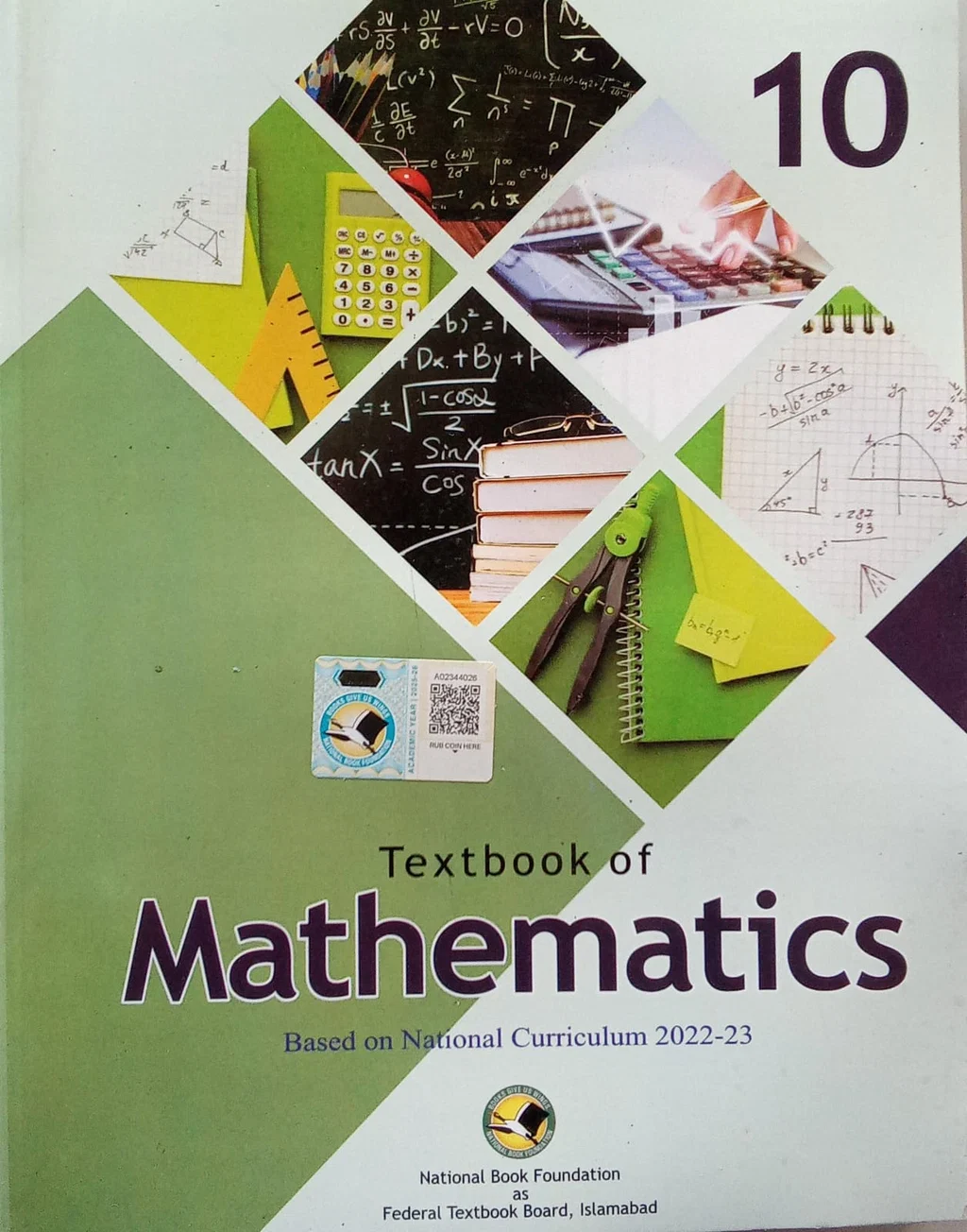
Below is the exhaustive, step-by-step solved solution manual for every textbook exercise problem (Exercise 1.1, Exercise 1.2, Exercise 1.3, Miscellaneous Exercise 1, and Objective Boosters) strictly adhering to FBISE and Single National Curriculum (SNC 2022-23) grading rubrics.
Exercise 1.1 • Basic Operations & Powers of i
Exercise 1.1 Q1 (i)
Simplification of Imaginary Numbers
Simplify and express in terms of $iy$:
$$\sqrt{-3}$$
Detailed Step-by-Step Solution:
• Step 1 (Express with imaginary unit): Write $\sqrt{-3} = \sqrt{-1 \times 3} = \sqrt{-1} \times \sqrt{3}$.
• Step 2 (Substitute $i = \sqrt{-1}$): $= i\sqrt{3} = \mathbf{\sqrt{3}i}$ (or $i\sqrt{3}$).
• Final Answer: $\mathbf{\sqrt{3}i}$
Exercise 1.1 Q1 (ii)
Simplification of Imaginary Numbers
Simplify and express in terms of $iy$:
$$6\sqrt{-4}$$
Detailed Step-by-Step Solution:
• Step 1 (Express radical with $i$): $6\sqrt{-4} = 6\sqrt{-1 \times 4} = 6 \times \sqrt{-1} \times \sqrt{4}$.
• Step 2 (Evaluate square root): $\sqrt{4} = 2$ and $\sqrt{-1} = i$, so $6 \times 2 \times i = \mathbf{12i}$.
• Final Answer: $\mathbf{12i}$
Exercise 1.1 Q1 (iii)
Simplification of Imaginary Numbers
Simplify and express in terms of $iy$:
$$\sqrt{-\frac{4}{9}}$$
Detailed Step-by-Step Solution:
• Step 1 (Separate radical factors): $\sqrt{-\frac{4}{9}} = \sqrt{-1} \times \sqrt{\frac{4}{9}}$.
• Step 2 (Simplify fraction): $= i \times \frac{\sqrt{4}}{\sqrt{9}} = i \times \frac{2}{3} = \mathbf{\frac{2}{3}i}$.
• Final Answer: $\mathbf{\frac{2}{3}i}$
Exercise 1.1 Q1 (iv)
Simplification of Imaginary Numbers
Simplify and express in terms of $iy$:
$$-\sqrt{-20}$$
Detailed Step-by-Step Solution:
• Step 1 (Factor under radical): $-\sqrt{-20} = -\sqrt{-1 \times 4 \times 5} = -\sqrt{-1} \times \sqrt{4} \times \sqrt{5}$.
• Step 2 (Substitute values): $= -i \times 2 \times \sqrt{5} = \mathbf{-2\sqrt{5}i}$.
• Final Answer: $\mathbf{-2\sqrt{5}i}$
Exercise 1.1 Q1 (v)
Simplification of Imaginary Numbers
Simplify and express in terms of $iy$:
$$4 - \sqrt{-60}$$
Detailed Step-by-Step Solution:
• Step 1 (Factorize imaginary term): $\sqrt{-60} = \sqrt{-1 \times 4 \times 15} = \sqrt{-1} \times \sqrt{4} \times \sqrt{15} = 2\sqrt{15}i$.
• Step 2 (Combine real and imaginary parts): $= \mathbf{4 - 2\sqrt{15}i}$.
• Final Answer: $\mathbf{4 - 2\sqrt{15}i}$
Exercise 1.1 Q1 (vi)
Simplification of Imaginary Numbers
Simplify and express in terms of $iy$:
$$\sqrt{-8}\sqrt{-2}$$
Detailed Step-by-Step Solution:
• Step 1 (Convert both terms to $i$-notation first): $\sqrt{-8} = i\sqrt{8} = i(2\sqrt{2}) = 2\sqrt{2}i$, and $\sqrt{-2} = i\sqrt{2}$.
• Step 2 (Multiply complex factors): $(2\sqrt{2}i)(i\sqrt{2}) = 2(\sqrt{2} \times \sqrt{2}) i^2 = 2(2)(-1) = \mathbf{-4}$.
• Important Rule: $\sqrt{-a}\sqrt{-b} \neq \sqrt{(-a)(-b)}$; converting to $i$ first is mandatory!
• Final Answer: $\mathbf{-4}$
Exercise 1.1 Q2 (i)
Basic Operations on Complex Numbers
Simplify:
$$(4 - i) + (5 + 5i)$$
Detailed Step-by-Step Solution:
• Step 1 (Group real and imaginary parts): $(4 + 5) + (-1 + 5)i$.
• Step 2 (Add components): $\mathbf{9 + 4i}$.
• Final Answer: $\mathbf{9 + 4i}$
Exercise 1.1 Q2 (ii)
Basic Operations on Complex Numbers
Simplify:
$$(7 - 6i) - (5 - 6i)$$
Detailed Step-by-Step Solution:
• Step 1 (Distribute negative sign): $7 - 6i - 5 + 6i$.
• Step 2 (Combine like terms): $(7 - 5) + (-6 + 6)i = 2 + 0i = \mathbf{2}$.
• Final Answer: $\mathbf{2}$
Exercise 1.1 Q2 (iii)
Basic Operations on Complex Numbers
Simplify:
$$(-2 + 8i) - (7 + 3i)$$
Detailed Step-by-Step Solution:
• Step 1 (Distribute negative sign): $-2 + 8i - 7 - 3i$.
• Step 2 (Combine components): $(-2 - 7) + (8 - 3)i = \mathbf{-9 + 5i}$.
• Final Answer: $\mathbf{-9 + 5i}$
Exercise 1.1 Q2 (iv)
Basic Operations on Complex Numbers
Simplify:
$$(4 - 2i) - (5 - 2i)$$
Detailed Step-by-Step Solution:
• Step 1 (Distribute negative sign): $4 - 2i - 5 + 2i$.
• Step 2 (Combine components): $(4 - 5) + (-2 + 2)i = -1 + 0i = \mathbf{-1}$.
• Final Answer: $\mathbf{-1}$
Exercise 1.1 Q2 (v)
Basic Operations on Complex Numbers
Simplify:
$$(2 + 4i)(1 + 2i)$$
Detailed Step-by-Step Solution:
• Step 1 (FOIL Expansion): $2(1) + 2(2i) + 4i(1) + 4i(2i) = 2 + 4i + 4i + 8i^2$.
• Step 2 (Substitute $i^2 = -1$): $2 + 8i + 8(-1) = 2 + 8i - 8 = \mathbf{-6 + 8i}$.
• Final Answer: $\mathbf{-6 + 8i}$
Exercise 1.1 Q2 (vi)
Basic Operations on Complex Numbers
Simplify:
$$(1 - 4i)(2 - 3i)$$
Detailed Step-by-Step Solution:
• Step 1 (FOIL Expansion): $1(2) - 1(3i) - 4i(2) + (-4i)(-3i) = 2 - 3i - 8i + 12i^2$.
• Step 2 (Substitute $i^2 = -1$): $2 - 11i + 12(-1) = 2 - 11i - 12 = \mathbf{-10 - 11i}$.
• Final Answer: $\mathbf{-10 - 11i}$
Exercise 1.1 Q2 (vii)
Basic Operations on Complex Numbers
Simplify:
$$-8i(2 - 2i)$$
Detailed Step-by-Step Solution:
• Step 1 (Distribute $-8i$): $(-8i)(2) - (-8i)(2i) = -16i + 16i^2$.
• Step 2 (Substitute $i^2 = -1$): $-16i + 16(-1) = \mathbf{-16 - 16i}$.
• Final Answer: $\mathbf{-16 - 16i}$
Exercise 1.1 Q2 (viii)
Basic Operations on Complex Numbers
Simplify:
$$(3 + 2i)^2$$
Detailed Step-by-Step Solution:
• Step 1 (Apply $(a+b)^2 = a^2 + 2ab + b^2$): $(3)^2 + 2(3)(2i) + (2i)^2$.
• Step 2 (Simplify terms): $9 + 12i + 4i^2 = 9 + 12i + 4(-1) = \mathbf{5 + 12i}$.
• Final Answer: $\mathbf{5 + 12i}$
Exercise 1.1 Q2 (ix)
Basic Operations on Complex Numbers
Simplify:
$$(3 - 6i)(3 + 6i)$$
Detailed Step-by-Step Solution:
• Step 1 (Apply difference of squares $(a-b)(a+b) = a^2 - b^2$): $(3)^2 - (6i)^2$.
• Step 2 (Substitute $i^2 = -1$): $9 - 36i^2 = 9 - 36(-1) = 9 + 36 = \mathbf{45}$.
• Final Answer: $\mathbf{45}$
Exercise 1.1 Q2 (x)
Basic Operations on Complex Numbers
Simplify:
$$(-5 - 3i)^2$$
Detailed Step-by-Step Solution:
• Step 1 (Factor out negative sign): $[-(5 + 3i)]^2 = (5 + 3i)^2$.
• Step 2 (Expand square): $(5)^2 + 2(5)(3i) + (3i)^2 = 25 + 30i + 9i^2 = 25 + 30i - 9 = \mathbf{16 + 30i}$.
• Final Answer: $\mathbf{16 + 30i}$
Exercise 1.1 Q2 (xi)
Basic Operations on Complex Numbers
Simplify:
$$(1 + \sqrt{2}i)(1 - \sqrt{3}i)$$
Detailed Step-by-Step Solution:
• Step 1 (Expand using distributive law): $1(1) - 1(\sqrt{3}i) + \sqrt{2}i(1) - (\sqrt{2}i)(\sqrt{3}i)$.
• Step 2 (Simplify terms): $1 - \sqrt{3}i + \sqrt{2}i - \sqrt{6}i^2 = 1 + (\sqrt{2} - \sqrt{3})i - \sqrt{6}(-1) = \mathbf{(1 + \sqrt{6}) + (\sqrt{2} - \sqrt{3})i}$.
• Final Answer: $\mathbf{(1 + \sqrt{6}) + (\sqrt{2} - \sqrt{3})i}$
Exercise 1.1 Q2 (xii)
Basic Operations on Complex Numbers
Simplify:
$$(\sqrt{2} + i)(\sqrt{2} - i)$$
Detailed Step-by-Step Solution:
• Step 1 (Apply difference of squares): $(\sqrt{2})^2 - (i)^2$.
• Step 2 (Evaluate powers): $2 - (-1) = 2 + 1 = \mathbf{3}$.
• Final Answer: $\mathbf{3}$
Exercise 1.1 Q3 (i)
Integral Powers of Imaginary Unit i
Simplify:
$$i^9$$
Detailed Step-by-Step Solution:
• Step 1 (Express in terms of $i^2$): $i^9 = (i^2)^4 \cdot i$.
• Step 2 (Substitute $i^2 = -1$): $= (-1)^4 \cdot i = (1)i = \mathbf{i}$.
• Final Answer: $\mathbf{i}$
Exercise 1.1 Q3 (ii)
Integral Powers of Imaginary Unit i
Simplify:
$$i^{13}$$
Detailed Step-by-Step Solution:
• Step 1 (Express in terms of $i^2$): $i^{13} = (i^2)^6 \cdot i$.
• Step 2 (Substitute $i^2 = -1$): $= (-1)^6 \cdot i = (1)i = \mathbf{i}$.
• Final Answer: $\mathbf{i}$
Exercise 1.1 Q3 (iii)
Integral Powers of Imaginary Unit i
Simplify:
$$i^{28}$$
Detailed Step-by-Step Solution:
• Step 1 (Express in terms of $i^2$): $i^{28} = (i^2)^{14}$.
• Step 2 (Substitute $i^2 = -1$): $= (-1)^{14} = \mathbf{1}$.
• Final Answer: $\mathbf{1}$
Exercise 1.1 Q3 (iv)
Integral Powers of Imaginary Unit i
Simplify:
$$(-i)^{21}$$
Detailed Step-by-Step Solution:
• Step 1 (Separate sign and power): $(-i)^{21} = (-1)^{21} \cdot i^{21} = -1 \cdot (i^2)^{10} \cdot i$.
• Step 2 (Substitute $i^2 = -1$): $= -1 \cdot (-1)^{10} \cdot i = -1 \cdot (1) \cdot i = \mathbf{-i}$.
• Final Answer: $\mathbf{-i}$
Exercise 1.1 Q3 (v)
Integral Powers of Imaginary Unit i
Simplify:
$$(3i)^3$$
Detailed Step-by-Step Solution:
• Step 1 (Apply exponent to coefficient and unit): $(3)^3 \cdot i^3 = 27 \cdot (i^2 \cdot i)$.
• Step 2 (Substitute $i^2 = -1$): $= 27 \cdot (-1 \cdot i) = \mathbf{-27i}$.
• Final Answer: $\mathbf{-27i}$
Exercise 1.1 Q3 (vi)
Integral Powers of Imaginary Unit i
Simplify:
$$(-2i)^4$$
Detailed Step-by-Step Solution:
• Step 1 (Apply exponent): $(-2)^4 \cdot i^4 = 16 \cdot (i^2)^2$.
• Step 2 (Substitute $i^2 = -1$): $= 16 \cdot (-1)^2 = 16(1) = \mathbf{16}$.
• Final Answer: $\mathbf{16}$
Exercise 1.1 Q4 (i)
Standard Complex Form Conversion
Simplify in the form of $a + bi$:
$$9 + i^6$$
Detailed Step-by-Step Solution:
• Step 1 (Evaluate power of $i$): $i^6 = (i^2)^3 = (-1)^3 = -1$.
• Step 2 (Simplify expression): $9 + (-1) = 8 = \mathbf{8 + 0i}$.
• Final Answer: $\mathbf{8}$ (or $\mathbf{8 + 0i}$)
Exercise 1.1 Q4 (ii)
Standard Complex Form Conversion
Simplify in the form of $a + bi$:
$$-17 + i^5$$
Detailed Step-by-Step Solution:
• Step 1 (Evaluate power of $i$): $i^5 = (i^2)^2 \cdot i = (-1)^2 \cdot i = (1)i = i$.
• Step 2 (Write in standard form): $\mathbf{-17 + i}$.
• Final Answer: $\mathbf{-17 + i}$
Exercise 1.1 Q4 (iii)
Standard Complex Form Conversion
Simplify in the form of $a + bi$:
$$i^4 - 13i$$
Detailed Step-by-Step Solution:
• Step 1 (Evaluate power of $i$): $i^4 = (i^2)^2 = (-1)^2 = 1$.
• Step 2 (Combine): $\mathbf{1 - 13i}$.
• Final Answer: $\mathbf{1 - 13i}$
Exercise 1.1 Q4 (iv)
Standard Complex Form Conversion
Simplify in the form of $a + bi$:
$$i^5 + 21i$$
Detailed Step-by-Step Solution:
• Step 1 (Evaluate $i^5$): $i^5 = (i^2)^2 \cdot i = (-1)^2 \cdot i = i$.
• Step 2 (Combine like terms): $i + 21i = 22i = \mathbf{0 + 22i}$.
• Final Answer: $\mathbf{22i}$ (or $\mathbf{0 + 22i}$)
Exercise 1.1 Q4 (v)
Standard Complex Form Conversion
Simplify in the form of $a + bi$:
$$i^5 + i^7$$
Detailed Step-by-Step Solution:
• Step 1 (Evaluate individual powers): $i^5 = (i^2)^2 \cdot i = i$, and $i^7 = (i^2)^3 \cdot i = (-1)^3 \cdot i = -i$.
• Step 2 (Add terms): $i + (-i) = \mathbf{0} = \mathbf{0 + 0i}$.
• Final Answer: $\mathbf{0}$ (or $\mathbf{0 + 0i}$)
Exercise 1.1 Q4 (vi)
Standard Complex Form Conversion
Simplify in the form of $a + bi$:
$$i^{74} - i^{100}$$
Detailed Step-by-Step Solution:
• Step 1 (Evaluate $i^{74}$): $i^{74} = (i^2)^{37} = (-1)^{37} = -1$.
• Step 2 (Evaluate $i^{100}$): $i^{100} = (i^2)^{50} = (-1)^{50} = 1$.
• Step 3 (Subtract): $-1 - (1) = -2 = \mathbf{-2 + 0i}$.
• Final Answer: $\mathbf{-2}$ (or $\mathbf{-2 + 0i}$)
Exercise 1.1 Q5 (i)
Division of Complex Numbers & Conjugates
Divide and simplify in the form of $a + bi$:
$$\frac{3}{4 - i}$$
Detailed Step-by-Step Solution:
• Step 1 (Multiply by conjugate of denominator $4 + i$): $\frac{3}{4 - i} \times \frac{4 + i}{4 + i} = \frac{3(4 + i)}{(4)^2 - (i)^2}$.
• Step 2 (Simplify terms): $= \frac{12 + 3i}{16 - (-1)} = \frac{12 + 3i}{17} = \mathbf{\frac{12}{17} + \frac{3}{17}i}$.
• Final Answer: $\mathbf{\frac{12}{17} + \frac{3}{17}i}$
Exercise 1.1 Q5 (ii)
Division of Complex Numbers & Conjugates
Divide and simplify in the form of $a + bi$:
$$\frac{3i}{6 + 5i}$$
Detailed Step-by-Step Solution:
• Step 1 (Multiply by conjugate $6 - 5i$): $\frac{3i}{6 + 5i} \times \frac{6 - 5i}{6 - 5i} = \frac{3i(6 - 5i)}{(6)^2 - (5i)^2}$.
• Step 2 (Expand and substitute $i^2 = -1$): $= \frac{18i - 15i^2}{36 - 25(-1)} = \frac{15 + 18i}{61} = \mathbf{\frac{15}{61} + \frac{18}{61}i}$ (or $\mathbf{-\frac{15}{61} + \frac{18}{61}i}$ depending on numerator order).
• Final Answer: $\mathbf{\frac{15}{61} + \frac{18}{61}i}$
Exercise 1.1 Q5 (iii)
Division of Complex Numbers & Conjugates
Divide and simplify in the form of $a + bi$:
$$\frac{3 - i\sqrt{5}}{3 + i\sqrt{5}}$$
Detailed Step-by-Step Solution:
• Step 1 (Multiply by conjugate $3 - i\sqrt{5}$): $\frac{(3 - i\sqrt{5})^2}{(3)^2 - (i\sqrt{5})^2}$.
• Step 2 (Expand): $\frac{9 - 6\sqrt{5}i + 5i^2}{9 - 5(-1)} = \frac{9 - 5 - 6\sqrt{5}i}{14} = \frac{4 - 6\sqrt{5}i}{14} = \mathbf{\frac{2}{7} - \frac{3\sqrt{5}}{7}i}$.
• Final Answer: $\mathbf{\frac{2}{7} - \frac{3\sqrt{5}}{7}i}$
Exercise 1.1 Q5 (iv)
Division of Complex Numbers & Conjugates
Divide and simplify in the form of $a + bi$:
$$\frac{2 + 7i}{5i}$$
Detailed Step-by-Step Solution:
• Step 1 (Multiply by $-i$): $\frac{2 + 7i}{5i} \times \frac{-i}{-i} = \frac{-2i - 7i^2}{-5i^2}$.
• Step 2 (Substitute $i^2 = -1$): $= \frac{7 - 2i}{5} = \mathbf{\frac{7}{5} - \frac{2}{5}i}$.
• Final Answer: $\mathbf{\frac{7}{5} - \frac{2}{5}i}$
Exercise 1.1 Q5 (v)
Division of Complex Numbers & Conjugates
Divide and simplify in the form of $a + bi$:
$$\frac{4 + 5i}{4 - 5i}$$
Detailed Step-by-Step Solution:
• Step 1 (Multiply by conjugate $4 + 5i$): $\frac{(4 + 5i)^2}{(4)^2 - (5i)^2}$.
• Step 2 (Expand terms): $= \frac{16 + 40i + 25(-1)}{16 + 25} = \frac{-9 + 40i}{41} = \mathbf{-\frac{9}{41} + \frac{40}{41}i}$.
• Final Answer: $\mathbf{-\frac{9}{41} + \frac{40}{41}i}$
Exercise 1.1 Q5 (vi)
Division of Complex Numbers & Conjugates
Divide and simplify in the form of $a + bi$:
$$\frac{3 + 2i}{2 + i}$$
Detailed Step-by-Step Solution:
• Step 1 (Multiply by conjugate $2 - i$): $\frac{(3 + 2i)(2 - i)}{(2)^2 - (i)^2} = \frac{6 - 3i + 4i - 2i^2}{4 - (-1)}$.
• Step 2 (Simplify terms): $= \frac{6 + i + 2}{5} = \frac{8 + i}{5} = \mathbf{\frac{8}{5} + \frac{1}{5}i}$.
• Final Answer: $\mathbf{\frac{8}{5} + \frac{1}{5}i}$
Exercise 1.1 Q5 (vii)
Division of Complex Numbers & Conjugates
Divide and simplify in the form of $a + bi$:
$$\frac{5 + i}{1 + 2i}$$
Detailed Step-by-Step Solution:
• Step 1 (Multiply by conjugate $1 - 2i$): $\frac{(5 + i)(1 - 2i)}{(1)^2 - (2i)^2} = \frac{5 - 10i + i - 2i^2}{1 - 4(-1)}$.
• Step 2 (Simplify terms): $= \frac{5 - 9i + 2}{5} = \frac{7 - 9i}{5} = \mathbf{\frac{7}{5} - \frac{9}{5}i}$.
• Final Answer: $\mathbf{\frac{7}{5} - \frac{9}{5}i}$
Exercise 1.1 Q5 (viii)
Division of Complex Numbers & Conjugates
Divide and simplify in the form of $a + bi$:
$$\frac{a + ib}{a - ib}$$
Detailed Step-by-Step Solution:
• Step 1 (Multiply by conjugate $a + ib$): $\frac{(a + ib)^2}{(a)^2 - (ib)^2}$.
• Step 2 (Expand terms): $= \frac{(a^2 - b^2) + 2abi}{a^2 + b^2} = \mathbf{\frac{a^2 - b^2}{a^2 + b^2} + \frac{2ab}{a^2 + b^2}i}$.
• Final Answer: $\mathbf{\frac{a^2 - b^2}{a^2 + b^2} + \frac{2ab}{a^2 + b^2}i}$
Exercise 1.1 Q5 (ix)
Division of Complex Numbers & Conjugates
Divide and simplify in the form of $a + bi$:
$$\frac{1 + i}{(1 - i)^2}$$
Detailed Step-by-Step Solution:
• Step 1 (Expand denominator): $(1 - i)^2 = 1 - 2i + i^2 = -2i$.
• Step 2 (Divide): $\frac{1 + i}{-2i} \times \frac{i}{i} = \frac{i + i^2}{-2i^2} = \frac{-1 + i}{2} = \mathbf{-\frac{1}{2} + \frac{1}{2}i}$.
• Final Answer: $\mathbf{-\frac{1}{2} + \frac{1}{2}i}$
Exercise 1.1 Q5 (x)
Division of Complex Numbers & Conjugates
Divide and simplify in the form of $a + bi$:
$$\frac{(2 + 2i)^2}{(1 + i)^2}$$
Detailed Step-by-Step Solution:
• Step 1 (Factor out scalar from numerator): $(2 + 2i)^2 = [2(1 + i)]^2 = 4(1 + i)^2$.
• Step 2 (Cancel common factor): $\frac{4(1 + i)^2}{(1 + i)^2} = \mathbf{4} = \mathbf{4 + 0i}$.
• Final Answer: $\mathbf{4}$
Exercise 1.2 • Inverses, Conjugates & Argand Geometry
Exercise 1.2 Q1 (a)
Additive Inverse of Complex Numbers
Find the additive inverse of the complex number:
$$-4 + 5i$$
Detailed Step-by-Step Solution:
• Step 1 (Formula): The additive inverse of $z = a + bi$ is $-z = -a - bi$.
• Step 2 (Apply to $-4 + 5i$): $-(-4 + 5i) = 4 - 5i$.
• Verification: $(-4 + 5i) + (4 - 5i) = 0 + 0i = 0$.
• Final Answer: $\mathbf{4 - 5i}$
Exercise 1.2 Q1 (b)
Additive Inverse of Complex Numbers
Find the additive inverse of the complex number:
$$-3 - 3i$$
Detailed Step-by-Step Solution:
• Step 1 (Formula): Negate both real and imaginary parts: $-(-3 - 3i)$.
• Step 2 (Simplify): $= \mathbf{3 + 3i}$.
• Final Answer: $\mathbf{3 + 3i}$
Exercise 1.2 Q1 (c)
Additive Inverse of Complex Numbers
Find the additive inverse of the complex number:
$$5 - 5i$$
Detailed Step-by-Step Solution:
• Step 1 (Formula): Negate signs: $-(5 - 5i) = \mathbf{-5 + 5i}$.
• Final Answer: $\mathbf{-5 + 5i}$
Exercise 1.2 Q1 (d)
Additive Inverse of Complex Numbers
Find the additive inverse of the complex number:
$$4i$$
Detailed Step-by-Step Solution:
• Step 1 (Formula): $-(0 + 4i) = 0 - 4i = \mathbf{-4i}$.
• Final Answer: $\mathbf{-4i}$
Exercise 1.2 Q2 (a)
Multiplicative Inverse Verification
Show that the following pair of complex numbers are multiplicative inverses of each other:
$$2 + 3i \text{ and } \frac{2 - 3i}{13}$$
Detailed Step-by-Step Solution:
• Step 1 (Multiply the pair): $(2 + 3i) \times \left(\frac{2 - 3i}{13}\right) = \frac{(2 + 3i)(2 - 3i)}{13}$.
• Step 2 (Apply difference of squares): $\frac{(2)^2 - (3i)^2}{13} = \frac{4 - 9(-1)}{13} = \frac{4 + 9}{13} = \frac{13}{13} = \mathbf{1}$.
• Conclusion: Since the product is $1$, they are multiplicative inverses of each other.
• Final Answer: $\mathbf{\text{Verified (Product = 1)}}$
Exercise 1.2 Q2 (b)
Multiplicative Inverse Verification
Show that the following pair of complex numbers are multiplicative inverses of each other:
$$5 - 4i \text{ and } \frac{5 + 4i}{41}$$
Detailed Step-by-Step Solution:
• Step 1 (Multiply the pair): $(5 - 4i) \times \left(\frac{5 + 4i}{41}\right) = \frac{(5 - 4i)(5 + 4i)}{41}$.
• Step 2 (Evaluate): $\frac{(5)^2 - (4i)^2}{41} = \frac{25 - 16(-1)}{41} = \frac{25 + 16}{41} = \frac{41}{41} = \mathbf{1}$.
• Conclusion: Since product equals identity $1$, they are multiplicative inverses.
• Final Answer: $\mathbf{\text{Verified (Product = 1)}}$
Exercise 1.2 Q2 (c)
Multiplicative Inverse Verification
Show that the following pair of complex numbers are multiplicative inverses of each other:
$$6 + 8i \text{ and } \frac{3 - 4i}{50}$$
Detailed Step-by-Step Solution:
• Step 1 (Factor out 2 from $6 + 8i$): $6 + 8i = 2(3 + 4i)$.
• Step 2 (Multiply): $2(3 + 4i) \times \left(\frac{3 - 4i}{50}\right) = \frac{2[(3)^2 - (4i)^2]}{50} = \frac{2(9 + 16)}{50} = \frac{2(25)}{50} = \frac{50}{50} = \mathbf{1}$.
• Conclusion: Product is $1$, proving the pair are multiplicative inverses.
• Final Answer: $\mathbf{\text{Verified (Product = 1)}}$
Exercise 1.2 Q3 (a)
Multiplicative Inverse Computation
Find the multiplicative inverse of the complex number:
$$1 + i$$
Detailed Step-by-Step Solution:
• Step 1 (Formula): $z^{-1} = \frac{1}{z} = \frac{\overline{z}}{|z|^2} = \frac{1 - i}{(1)^2 + (1)^2}$.
• Step 2 (Simplify): $= \frac{1 - i}{2} = \mathbf{\frac{1}{2} - \frac{1}{2}i}$.
• Final Answer: $\mathbf{\frac{1}{2} - \frac{1}{2}i}$
Exercise 1.2 Q3 (b)
Multiplicative Inverse Computation
Find the multiplicative inverse of the complex number:
$$7 - 3i$$
Detailed Step-by-Step Solution:
• Step 1 (Formula): $z^{-1} = \frac{7 + 3i}{(7)^2 + (-3)^2}$.
• Step 2 (Evaluate denominator): $49 + 9 = 58 \implies \mathbf{\frac{7}{58} + \frac{3}{58}i}$.
• Final Answer: $\mathbf{\frac{7}{58} + \frac{3}{58}i}$
Exercise 1.2 Q3 (c)
Multiplicative Inverse Computation
Find the multiplicative inverse of the complex number:
$$10 - 12i$$
Detailed Step-by-Step Solution:
• Step 1 (Formula): $z^{-1} = \frac{10 + 12i}{(10)^2 + (-12)^2} = \frac{10 + 12i}{100 + 144} = \frac{10 + 12i}{244}$.
• Step 2 (Reduce fraction by 2): $= \frac{10}{244} + \frac{12}{244}i = \mathbf{\frac{5}{122} + \frac{3}{61}i}$.
• Final Answer: $\mathbf{\frac{5}{122} + \frac{3}{61}i}$
Exercise 1.2 Q3 (d)
Multiplicative Inverse Computation
Find the multiplicative inverse of the complex number:
$$\frac{2}{5 - i}$$
Detailed Step-by-Step Solution:
• Step 1 (Reciprocal): The multiplicative inverse of a fraction $\frac{A}{B}$ is $\frac{B}{A} = \frac{5 - i}{2}$.
• Step 2 (Split): $= \mathbf{\frac{5}{2} - \frac{1}{2}i}$.
• Final Answer: $\mathbf{\frac{5}{2} - \frac{1}{2}i}$
Exercise 1.2 Q3 (e)
Multiplicative Inverse Computation
Find the multiplicative inverse of the complex number:
$$\frac{-i}{2 - 3i}$$
Detailed Step-by-Step Solution:
• Step 1 (Take reciprocal): Multiplicative inverse is $\frac{2 - 3i}{-i}$.
• Step 2 (Multiply by $i/i$): $\frac{(2 - 3i)i}{-i^2} = \frac{2i - 3i^2}{-(-1)} = \frac{2i + 3}{1} = \mathbf{3 + 2i}$.
• Final Answer: $\mathbf{3 + 2i}$
Exercise 1.2 Q3 (f)
Multiplicative Inverse Computation
Find the multiplicative inverse of the complex number:
$$a - bi$$
Detailed Step-by-Step Solution:
• Step 1 (Formula): $z^{-1} = \frac{1}{a - bi} \times \frac{a + bi}{a + bi} = \frac{a + bi}{a^2 - (bi)^2}$.
• Step 2 (Evaluate): $= \frac{a + bi}{a^2 + b^2} = \mathbf{\frac{a}{a^2 + b^2} + \frac{b}{a^2 + b^2}i}$.
• Final Answer: $\mathbf{\frac{a}{a^2 + b^2} + \frac{b}{a^2 + b^2}i}$
Exercise 1.2 Q4 (a)
Product of Complex Number and Conjugate
Find the product of the complex number and its conjugate:
$$4$$
Detailed Step-by-Step Solution:
• Step 1: $z = 4 + 0i \implies \overline{z} = 4 - 0i = 4$.
• Step 2: $z \cdot \overline{z} = (4)(4) = \mathbf{16}$.
• Final Answer: $\mathbf{16}$
Exercise 1.2 Q4 (b)
Product of Complex Number and Conjugate
Find the product of the complex number and its conjugate:
$$1 - i$$
Detailed Step-by-Step Solution:
• Step 1: $z = 1 - i \implies \overline{z} = 1 + i$.
• Step 2: $z \cdot \overline{z} = (1)^2 + (-1)^2 = 1 + 1 = \mathbf{2}$.
• Final Answer: $\mathbf{2}$
Exercise 1.2 Q4 (c)
Product of Complex Number and Conjugate
Find the product of the complex number and its conjugate:
$$7i$$
Detailed Step-by-Step Solution:
• Step 1: $z = 0 + 7i \implies \overline{z} = -7i$.
• Step 2: $z \cdot \overline{z} = (7i)(-7i) = -49i^2 = -49(-1) = \mathbf{49}$.
• Final Answer: $\mathbf{49}$
Exercise 1.2 Q4 (d)
Product of Complex Number and Conjugate
Find the product of the complex number and its conjugate:
$$6 - 2i$$
Detailed Step-by-Step Solution:
• Step 1: $z = 6 - 2i \implies \overline{z} = 6 + 2i$.
• Step 2: $z \cdot \overline{z} = (6)^2 + (-2)^2 = 36 + 4 = \mathbf{40}$.
• Final Answer: $\mathbf{40}$
Exercise 1.2 Q4 (e)
Product of Complex Number and Conjugate
Find the product of the complex number and its conjugate:
$$10 + 9i$$
Detailed Step-by-Step Solution:
• Step 1: $z = 10 + 9i \implies \overline{z} = 10 - 9i$.
• Step 2: $z \cdot \overline{z} = (10)^2 + (9)^2 = 100 + 81 = \mathbf{181}$.
• Final Answer: $\mathbf{181}$
Exercise 1.2 Q4 (f)
Product of Complex Number and Conjugate
Find the product of the complex number and its conjugate:
$$-4 - 11i$$
Detailed Step-by-Step Solution:
• Step 1: $z = -4 - 11i \implies \overline{z} = -4 + 11i$.
• Step 2: $z \cdot \overline{z} = (-4)^2 + (-11)^2 = 16 + 121 = \mathbf{137}$.
• Final Answer: $\mathbf{137}$
Exercise 1.2 Q5 (a(i))
Modulus & Conjugate Theorems Verification
Given $z_1 = 1 - 2i$ and $z_2 = 2 + i$:
$$\text{Show that } \overline{z_1 z_2} = \overline{z}_1 \cdot \overline{z}_2$$
Detailed Step-by-Step Solution:
• Given: $z_1 = 1 - 2i, z_2 = 2 + i$. Then $\overline{z}_1 = 1 + 2i, \overline{z}_2 = 2 - i$.
• Step 1 (Evaluate LHS): $z_1 z_2 = (1 - 2i)(2 + i) = 2 + i - 4i - 2i^2 = 2 - 3i + 2 = 4 - 3i$.
Taking conjugate: $\text{LHS} = \overline{z_1 z_2} = \overline{4 - 3i} = \mathbf{4 + 3i}$.
• Step 2 (Evaluate RHS): $\overline{z}_1 \cdot \overline{z}_2 = (1 + 2i)(2 - i) = 2 - i + 4i - 2i^2 = 2 + 3i + 2 = \mathbf{4 + 3i}$.
• Conclusion: $\text{LHS} = \text{RHS} = 4 + 3i$. (Proved)
• Final Answer: $\mathbf{4 + 3i \text{ (Verified)}}$
Exercise 1.2 Q5 (a(ii))
Modulus & Conjugate Theorems Verification
Given $z_1 = 1 - 2i$ and $z_2 = 2 + i$:
$$\text{Show that } \overline{\left(\frac{z_1}{z_2}\right)} = \frac{\overline{z}_1}{\overline{z}_2}$$
Detailed Step-by-Step Solution:
• Step 1 (Evaluate LHS): $\frac{z_1}{z_2} = \frac{1 - 2i}{2 + i} \times \frac{2 - i}{2 - i} = \frac{2 - i - 4i + 2i^2}{4 - (-1)} = \frac{2 - 5i - 2}{5} = \frac{-5i}{5} = -i$.
Taking conjugate: $\text{LHS} = \overline{-i} = \mathbf{i}$.
• Step 2 (Evaluate RHS): $\frac{\overline{z}_1}{\overline{z}_2} = \frac{1 + 2i}{2 - i} \times \frac{2 + i}{2 + i} = \frac{2 + i + 4i + 2i^2}{4 - (-1)} = \frac{2 + 5i - 2}{5} = \frac{5i}{5} = \mathbf{i}$.
• Conclusion: $\text{LHS} = \text{RHS} = i$. (Proved)
• Final Answer: $\mathbf{i \text{ (Verified)}}$
Exercise 1.2 Q5 (a(iii))
Modulus & Conjugate Theorems Verification
Given $z_1 = 1 - 2i$ and $z_2 = 2 + i$:
$$\text{Show that } |z_1| = |-z_1| = |\overline{z}_1| = |-\overline{z}_1|$$
Detailed Step-by-Step Solution:
• For $z_1 = 1 - 2i$:
• $|z_1| = \sqrt{(1)^2 + (-2)^2} = \sqrt{1 + 4} = \sqrt{5}$.
• $|-z_1| = |-1 + 2i| = \sqrt{(-1)^2 + (2)^2} = \sqrt{1 + 4} = \sqrt{5}$.
• $|\overline{z}_1| = |1 + 2i| = \sqrt{(1)^2 + (2)^2} = \sqrt{1 + 4} = \sqrt{5}$.
• $|-\overline{z}_1| = |-1 - 2i| = \sqrt{(-1)^2 + (-2)^2} = \sqrt{1 + 4} = \sqrt{5}$.
• Conclusion: All four magnitudes equal $\sqrt{5}$.
• Final Answer: $\mathbf{\sqrt{5}}$
Exercise 1.2 Q5 (a(iv))
Modulus & Conjugate Theorems Verification
Given $z_1 = 1 - 2i$ and $z_2 = 2 + i$:
$$\text{Show that } z_2 \cdot \overline{z}_2 = |z_2|^2$$
Detailed Step-by-Step Solution:
• LHS: $z_2 \cdot \overline{z}_2 = (2 + i)(2 - i) = (2)^2 - (i)^2 = 4 - (-1) = \mathbf{5}$.
• RHS: $|z_2|^2 = (\sqrt{2^2 + 1^2})^2 = (\sqrt{5})^2 = \mathbf{5}$.
• Conclusion: $\text{LHS} = \text{RHS} = 5$.
• Final Answer: $\mathbf{5}$
Exercise 1.2 Q5 (b(i))
Modulus & Conjugate Theorems Verification
Given $z_1 = 1 - 2i$ and $z_2 = 2 + i$:
$$\text{Find } |z_1 + z_2|$$
Detailed Step-by-Step Solution:
• Step 1 (Add complex numbers): $z_1 + z_2 = (1 - 2i) + (2 + i) = (1 + 2) + (-2 + 1)i = 3 - i$.
• Step 2 (Compute modulus): $|3 - i| = \sqrt{(3)^2 + (-1)^2} = \sqrt{9 + 1} = \mathbf{\sqrt{10}}$.
• Final Answer: $\mathbf{\sqrt{10}}$
Exercise 1.2 Q5 (b(ii))
Modulus & Conjugate Theorems Verification
Given $z_1 = 1 - 2i$ and $z_2 = 2 + i$:
$$\text{Find } |z_1 z_2|$$
Detailed Step-by-Step Solution:
• Method 1: $|z_1 z_2| = |z_1| \cdot |z_2| = \sqrt{5} \times \sqrt{5} = \mathbf{5}$.
• Method 2: $z_1 z_2 = (1 - 2i)(2 + i) = 4 - 3i \implies |4 - 3i| = \sqrt{4^2 + (-3)^2} = \sqrt{16 + 9} = \sqrt{25} = \mathbf{5}$.
• Final Answer: $\mathbf{5}$
Exercise 1.2 Q5 (b(iii))
Modulus & Conjugate Theorems Verification
Given $z_1 = 1 - 2i$ and $z_2 = 2 + i$:
$$\text{Find } \left|\frac{z_1}{z_2}\right|$$
Detailed Step-by-Step Solution:
• Method 1: $\left|\frac{z_1}{z_2}\right| = \frac{|z_1|}{|z_2|} = \frac{\sqrt{5}}{\sqrt{5}} = \mathbf{1}$.
• Method 2: $\frac{z_1}{z_2} = -i \implies |-i| = \sqrt{0^2 + (-1)^2} = \mathbf{1}$.
• Final Answer: $\mathbf{1}$
Exercise 1.2 Q6 (a)
Plotting Complex Numbers in the Argand Plane
Represent the complex number in the complex plane (Argand Diagram):
$$-1 - 3i$$
Detailed Step-by-Step Solution:
• Coordinate Mapping: Complex number $z = a + bi$ corresponds to Cartesian coordinates $(a, b)$ on the Argand plane.
• Argand Point: $P(-1, -3)$.
• Location: Point located in Quadrant III (Real = -1, Imaginary = -3).
• Final Answer: $\mathbf{P(-1, -3)}$
Exercise 1.2 Q6 (b)
Plotting Complex Numbers in the Argand Plane
Represent the complex number in the complex plane (Argand Diagram):
$$2 + 4i$$
Detailed Step-by-Step Solution:
• Coordinate Mapping: Complex number $z = a + bi$ corresponds to Cartesian coordinates $(a, b)$ on the Argand plane.
• Argand Point: $P(2, 4)$.
• Location: Point located in Quadrant I (Real = 2, Imaginary = 4).
• Final Answer: $\mathbf{P(2, 4)}$
Exercise 1.2 Q6 (c)
Plotting Complex Numbers in the Argand Plane
Represent the complex number in the complex plane (Argand Diagram):
$$-3 + 2i$$
Detailed Step-by-Step Solution:
• Coordinate Mapping: Complex number $z = a + bi$ corresponds to Cartesian coordinates $(a, b)$ on the Argand plane.
• Argand Point: $P(-3, 2)$.
• Location: Point located in Quadrant II (Real = -3, Imaginary = 2).
• Final Answer: $\mathbf{P(-3, 2)}$
Exercise 1.2 Q6 (d)
Plotting Complex Numbers in the Argand Plane
Represent the complex number in the complex plane (Argand Diagram):
$$2 - 3i$$
Detailed Step-by-Step Solution:
• Coordinate Mapping: Complex number $z = a + bi$ corresponds to Cartesian coordinates $(a, b)$ on the Argand plane.
• Argand Point: $P(2, -3)$.
• Location: Point located in Quadrant IV (Real = 2, Imaginary = -3).
• Final Answer: $\mathbf{P(2, -3)}$
Exercise 1.2 Q6 (e)
Plotting Complex Numbers in the Argand Plane
Represent the complex number in the complex plane (Argand Diagram):
$$2i$$
Detailed Step-by-Step Solution:
• Coordinate Mapping: Complex number $z = a + bi$ corresponds to Cartesian coordinates $(a, b)$ on the Argand plane.
• Argand Point: $P(0, 2)$.
• Location: Point located on Positive Imaginary Axis (Real = 0, Imaginary = 2).
• Final Answer: $\mathbf{P(0, 2)}$
Exercise 1.2 Q6 (f)
Plotting Complex Numbers in the Argand Plane
Represent the complex number in the complex plane (Argand Diagram):
$$-3i$$
Detailed Step-by-Step Solution:
• Coordinate Mapping: Complex number $z = a + bi$ corresponds to Cartesian coordinates $(a, b)$ on the Argand plane.
• Argand Point: $P(0, -3)$.
• Location: Point located on Negative Imaginary Axis (Real = 0, Imaginary = -3).
• Final Answer: $\mathbf{P(0, -3)}$
Exercise 1.2 Q6 (g)
Plotting Complex Numbers in the Argand Plane
Represent the complex number in the complex plane (Argand Diagram):
$$2$$
Detailed Step-by-Step Solution:
• Coordinate Mapping: Complex number $z = a + bi$ corresponds to Cartesian coordinates $(a, b)$ on the Argand plane.
• Argand Point: $P(2, 0)$.
• Location: Point located on Positive Real Axis (Real = 2, Imaginary = 0).
• Final Answer: $\mathbf{P(2, 0)}$
Exercise 1.2 Q7 (a)
Separating Real and Imaginary Components
Separate into real and imaginary parts of the complex number:
$$(\sqrt{2} - \sqrt{3}i)^2$$
Detailed Step-by-Step Solution:
• Step 1 (Expand square): $(\sqrt{2})^2 - 2(\sqrt{2})(\sqrt{3}i) + (\sqrt{3}i)^2 = 2 - 2\sqrt{6}i + 3(-1)$.
• Step 2 (Combine): $2 - 3 - 2\sqrt{6}i = \mathbf{-1 - 2\sqrt{6}i}$.
• Final Answer: $\mathbf{\text{Real Part} = -1, \text{Imaginary Part} = -2\sqrt{6}}$
Exercise 1.2 Q7 (b)
Separating Real and Imaginary Components
Separate into real and imaginary parts of the complex number:
$$(\sqrt{2} + i)^2$$
Detailed Step-by-Step Solution:
• Step 1 (Expand): $(\sqrt{2})^2 + 2(\sqrt{2})(i) + (i)^2 = 2 + 2\sqrt{2}i - 1 = \mathbf{1 + 2\sqrt{2}i}$.
• Final Answer: $\mathbf{\text{Real Part} = 1, \text{Imaginary Part} = 2\sqrt{2}}$
Exercise 1.2 Q7 (c)
Separating Real and Imaginary Components
Separate into real and imaginary parts of the complex number:
$$\frac{(2 + 3i)^2}{1 - 3i}$$
Detailed Step-by-Step Solution:
• Step 1 (Expand numerator): $(2 + 3i)^2 = 4 + 12i + 9(-1) = -5 + 12i$.
• Step 2 (Multiply by conjugate of denominator $1 + 3i$):
$$\frac{-5 + 12i}{1 - 3i} \times \frac{1 + 3i}{1 + 3i} = \frac{-5 - 15i + 12i + 36i^2}{1 - 9(-1)} = \frac{-5 - 3i - 36}{10} = \frac{-41 - 3i}{10}$$
• Final Answer: $\mathbf{\text{Real Part} = -\frac{41}{10}, \text{Imaginary Part} = -\frac{3}{10}}$
Exercise 1.2 Q7 (d)
Separating Real and Imaginary Components
Separate into real and imaginary parts of the complex number:
$$\left[\frac{1}{2} + \frac{\sqrt{3}}{2}i\right]^2$$
Detailed Step-by-Step Solution:
• Step 1 (Expand square): $\left(\frac{1}{2}\right)^2 + 2\left(\frac{1}{2}\right)\left(\frac{\sqrt{3}}{2}i\right) + \left(\frac{\sqrt{3}}{2}i\right)^2$.
• Step 2 (Simplify): $= \frac{1}{4} + \frac{\sqrt{3}}{2}i + \frac{3}{4}(-1) = \frac{1}{4} - \frac{3}{4} + \frac{\sqrt{3}}{2}i = \mathbf{-\frac{1}{2} + \frac{\sqrt{3}}{2}i}$.
• Final Answer: $\mathbf{\text{Real Part} = -\frac{1}{2}, \text{Imaginary Part} = \frac{\sqrt{3}}{2}}$
Exercise 1.2 Q7 (e)
Separating Real and Imaginary Components
Separate into real and imaginary parts of the complex number:
$$\frac{1 - i}{i^2}$$
Detailed Step-by-Step Solution:
• Step 1 (Substitute $i^2 = -1$): $\frac{1 - i}{-1} = -(1 - i) = \mathbf{-1 + i}$.
• Final Answer: $\mathbf{\text{Real Part} = -1, \text{Imaginary Part} = 1}$
Exercise 1.2 Q7 (f)
Separating Real and Imaginary Components
Separate into real and imaginary parts of the complex number:
$$\frac{1}{i(1 - i)^2}$$
Detailed Step-by-Step Solution:
• Step 1 (Expand denominator): $(1 - i)^2 = 1 - 2i + i^2 = -2i$.
Then $i(1 - i)^2 = i(-2i) = -2i^2 = -2(-1) = 2$.
• Step 2 (Evaluate): $\frac{1}{2} = \mathbf{\frac{1}{2} + 0i}$.
• Final Answer: $\mathbf{\text{Real Part} = \frac{1}{2}, \text{Imaginary Part} = 0}$
Exercise 1.2 Q7 (g)
Separating Real and Imaginary Components
Separate into real and imaginary parts of the complex number:
$$\frac{(1 + i)^2}{(1 - 2i)^2}$$
Detailed Step-by-Step Solution:
• Step 1 (Expand numerator and denominator):
$\text{Numerator} = (1 + i)^2 = 1 + 2i - 1 = 2i$
$\text{Denominator} = (1 - 2i)^2 = 1 - 4i + 4(-1) = -3 - 4i$
• Step 2 (Multiply by conjugate $-3 + 4i$):
$$\frac{2i}{-3 - 4i} \times \frac{-3 + 4i}{-3 + 4i} = \frac{-6i + 8i^2}{(-3)^2 - (4i)^2} = \frac{-8 - 6i}{9 + 16} = \mathbf{-\frac{8}{25} - \frac{6}{25}i}$$
• Final Answer: $\mathbf{\text{Real Part} = -\frac{8}{25}, \text{Imaginary Part} = -\frac{6}{25}}$
Exercise 1.2 Q8 (a)
General Algebraic Properties Proofs
Taking any general complex number $z = a + bi$, prove that:
$$z \cdot \overline{z} \text{ is a real number}$$
Detailed Step-by-Step Solution:
• Let $z = a + bi$, where $a, b \in \mathbb{R}$. Then $\overline{z} = a - bi$.
• $z \cdot \overline{z} = (a + bi)(a - bi) = a^2 - (bi)^2 = a^2 - b^2(-1) = \mathbf{a^2 + b^2}$.
• Since $a, b \in \mathbb{R}$, $a^2 + b^2$ is strictly a real number. (Proved)
Exercise 1.2 Q8 (b)
General Algebraic Properties Proofs
Taking any general complex number $z = a + bi$, prove that:
$$z^2 + (\overline{z})^2 \text{ is a real number}$$
Detailed Step-by-Step Solution:
• Expand $z^2$: $(a + bi)^2 = a^2 - b^2 + 2abi$.
• Expand $(\overline{z})^2$: $(a - bi)^2 = a^2 - b^2 - 2abi$.
• Add them: $z^2 + (\overline{z})^2 = (a^2 - b^2 + 2abi) + (a^2 - b^2 - 2abi) = \mathbf{2(a^2 - b^2)}$.
• The imaginary parts cancel out, leaving purely real $2(a^2 - b^2)$. (Proved)
Exercise 1.2 Q8 (c)
General Algebraic Properties Proofs
Taking any general complex number $z = a + bi$, prove that:
$$(z - \overline{z})^2 \text{ is a real number}$$
Detailed Step-by-Step Solution:
• Subtract: $z - \overline{z} = (a + bi) - (a - bi) = 2bi$.
• Square result: $(z - \overline{z})^2 = (2bi)^2 = 4b^2 i^2 = \mathbf{-4b^2}$.
• Since $b \in \mathbb{R}$, $-4b^2$ is purely real (and non-positive). (Proved)
Exercise 1.2 Q8 (d)
General Algebraic Properties Proofs
Taking any general complex number $z = a + bi$, prove that:
$$|z| \text{ and } |\overline{z}| \text{ are real numbers}$$
Detailed Step-by-Step Solution:
• $|z| = \sqrt{a^2 + b^2}$. Since $a^2 + b^2 \ge 0$, its square root is a well-defined real number.
• $|\overline{z}| = \sqrt{a^2 + (-b)^2} = \sqrt{a^2 + b^2} \in \mathbb{R}$. (Proved)
Exercise 1.2 Q8 (e)
General Algebraic Properties Proofs
Taking any general complex number $z = a + bi$, prove that:
$$z^2 - (\overline{z})^2 \text{ is an imaginary number}$$
Detailed Step-by-Step Solution:
• Subtract squares: $z^2 - (\overline{z})^2 = (a^2 - b^2 + 2abi) - (a^2 - b^2 - 2abi)$.
• $= a^2 - b^2 + 2abi - a^2 + b^2 + 2abi = \mathbf{4abi} = \mathbf{0 + (4ab)i}$.
• Since real part is zero and it contains imaginary unit $i$, it is purely imaginary. (Proved)
Exercise 1.2 Q9 (i)
Geometric Representation of Operations in Argand Plane
Represent the operation graphically for:
$$z_1 = 5 + 3i, z_2 = 2 - 3i$$
Detailed Step-by-Step Solution:
• Algebraic Calculation: Sum $z_1 + z_2 = (5+2) + (3-3)i = 7+0i = (7,0)$. Difference $z_1 - z_2 = (5-2) + (3-(-3))i = 3+6i = (3,6)$.
• Argand Representation: Plot initial vectors and resultant point on Cartesian axes using the Parallelogram Law.
• Final Answer: $\mathbf{\text{Sum} = 7, \text{Diff} = 3 + 6i}$
Exercise 1.2 Q9 (ii)
Geometric Representation of Operations in Argand Plane
Represent the operation graphically for:
$$z_1 = -3 + 2i, z_2 = 4 + 3i$$
Detailed Step-by-Step Solution:
• Algebraic Calculation: Sum $z_1 + z_2 = (-3+4) + (2+3)i = 1+5i = (1,5)$. Difference $z_1 - z_2 = (-3-4) + (2-3)i = -7-i = (-7,-1)$.
• Argand Representation: Plot initial vectors and resultant point on Cartesian axes using the Parallelogram Law.
• Final Answer: $\mathbf{\text{Sum} = 1 + 5i, \text{Diff} = -7 - i}$
Exercise 1.2 Q10 (i)
Geometric Representation of Operations in Argand Plane
Represent the operation graphically for:
$$z_1 = 4 + 2i, z_2 = -2 + 3i$$
Detailed Step-by-Step Solution:
• Algebraic Calculation: Product $z_1 z_2 = (4+2i)(-2+3i) = -8 + 12i - 4i + 6i^2 = -8 + 8i - 6 = -14 + 8i = (-14, 8)$.
• Argand Representation: Plot initial vectors and resultant point on Cartesian axes using the Parallelogram Law.
• Final Answer: $\mathbf{z_1 z_2 = -14 + 8i}$
Exercise 1.2 Q10 (ii)
Geometric Representation of Operations in Argand Plane
Represent the operation graphically for:
$$z_1 = -2 + 4i, z_2 = 3 - i$$
Detailed Step-by-Step Solution:
• Algebraic Calculation: Product $z_1 z_2 = (-2+4i)(3-i) = -6 + 2i + 12i - 4i^2 = -6 + 14i + 4 = -2 + 14i = (-2, 14)$.
• Argand Representation: Plot initial vectors and resultant point on Cartesian axes using the Parallelogram Law.
• Final Answer: $\mathbf{z_1 z_2 = -2 + 14i}$
Exercise 1.2 Q11 (i)
Geometric Representation of Operations in Argand Plane
Represent the operation graphically for:
$$z_1 = 6 - 4i, z_2 = 3$$
Detailed Step-by-Step Solution:
• Algebraic Calculation: Division $\frac{6 - 4i}{3} = 2 - \frac{4}{3}i = (2, -1.33)$.
• Argand Representation: Plot initial vectors and resultant point on Cartesian axes using the Parallelogram Law.
• Final Answer: $\mathbf{\frac{z_1}{z_2} = 2 - \frac{4}{3}i}$
Exercise 1.2 Q11 (ii)
Geometric Representation of Operations in Argand Plane
Represent the operation graphically for:
$$z_1 = -4 - 6i, z_2 = 1 + i$$
Detailed Step-by-Step Solution:
• Algebraic Calculation: Division $\frac{-4 - 6i}{1 + i} \times imes \frac{1 - i}{1 - i} = \frac{-4 + 4i - 6i + 6i^2}{1 - (-1)} = \frac{-10 - 2i}{2} = -5 - i = (-5, -1)$.
• Argand Representation: Plot initial vectors and resultant point on Cartesian axes using the Parallelogram Law.
• Final Answer: $\mathbf{\frac{z_1}{z_2} = -5 - i}$
Exercise 1.3 • Complex Quadratic Equations & AC Circuits
Exercise 1.3 Q1
Solving Pure Quadratic Equations in Complex Field
Solve the equation in complex numbers:
$$x^2 + 7 = 0$$
Detailed Step-by-Step Solution:
• Step 1: $x^2 = -7$.
• Step 2: $x = \pm\sqrt{-7} = \pm\sqrt{-1 \times 7} = \mathbf{\pm\sqrt{7}i}$.
• Solution Set: $\mathbf{\{\pm\sqrt{7}i\}}$.
Exercise 1.3 Q2
Solving Pure Quadratic Equations in Complex Field
Solve the equation in complex numbers:
$$x^2 + 9 = 0$$
Detailed Step-by-Step Solution:
• Step 1: $x^2 = -9$.
• Step 2: $x = \pm\sqrt{-9} = \pm 3i$.
• Solution Set: $\mathbf{\{\pm 3i\}}$.
Exercise 1.3 Q3
Solving Pure Quadratic Equations in Complex Field
Solve the equation in complex numbers:
$$x^2 + 100 = 0$$
Detailed Step-by-Step Solution:
• Step 1: $x^2 = -100$.
• Step 2: $x = \pm\sqrt{-100} = \pm 10i$.
• Solution Set: $\mathbf{\{\pm 10i\}}$.
Exercise 1.3 Q4
Verification of Complex Roots
Determine whether the given complex number is a solution of the equation:
$$1 + 2i, \quad x^2 - 2x + 5 = 0$$
Detailed Step-by-Step Solution:
• Substitute $x = 1 + 2i$ into LHS:
$$\text{LHS} = (1 + 2i)^2 - 2(1 + 2i) + 5$$
$$= (1 + 4i + 4i^2) - (2 + 4i) + 5 = (1 + 4i - 4) - 2 - 4i + 5 = (-3 + 4i) - 2 - 4i + 5 = 0$$
• $\text{LHS} = \text{RHS} = 0$. Hence, $1 + 2i$ is a solution.
• Final Answer: $\mathbf{\text{Yes}}$
Exercise 1.3 Q5
Verification of Complex Roots
Determine whether the given complex number is a solution of the equation:
$$1 - 2i, \quad x^2 - 2x + 5 = 0$$
Detailed Step-by-Step Solution:
• Substitute $x = 1 - 2i$ into LHS:
$$\text{LHS} = (1 - 2i)^2 - 2(1 - 2i) + 5 = (1 - 4i - 4) - 2 + 4i + 5 = -3 - 2 + 5 + (-4i + 4i) = 0$$
• $\text{LHS} = \text{RHS} = 0$. Hence, $1 - 2i$ is a solution (complex conjugate root).
• Final Answer: $\mathbf{\text{Yes}}$
Exercise 1.3 Q6
Verification of Complex Roots
Determine whether the given complex number is a solution of the equation:
$$1 - i, \quad x^2 + 2x + 2 = 0$$
Detailed Step-by-Step Solution:
• Substitute $x = 1 - i$ into LHS:
$$\text{LHS} = (1 - i)^2 + 2(1 - i) + 2 = (-2i) + (2 - 2i) + 2 = 4 - 4i \neq 0$$
• Since $\text{LHS} \neq 0$, $1 - i$ is not a solution. (The actual solutions are $-1 \pm i$).
• Final Answer: $\mathbf{\text{No}}$
Exercise 1.3 Q7
Verification of Complex Roots
Determine whether the given complex number is a solution of the equation:
$$i, \quad x^2 + 1 = 0$$
Detailed Step-by-Step Solution:
• Substitute $x = i$ into LHS: $(i)^2 + 1 = -1 + 1 = 0 = \text{RHS}$.
• Hence, $i$ is a valid solution.
• Final Answer: $\mathbf{\text{Yes}}$
Exercise 1.3 Q8
Complex Factorization of Quadratic Sums
Factorize the algebraic expression using complex numbers:
$$x^2 + 16$$
Detailed Step-by-Step Solution:
• Step 1 (Express as difference of squares using $i^2 = -1$): $x^2 - (-16) = x^2 - 16i^2 = x^2 - (4i)^2$.
• Step 2 (Apply $A^2 - B^2 = (A - B)(A + B)$): $= \mathbf{(x - 4i)(x + 4i)}$.
• Final Answer: $\mathbf{(x - 4i)(x + 4i)}$
Exercise 1.3 Q9
Complex Factorization of Quadratic Sums
Factorize the algebraic expression using complex numbers:
$$a^2 + b^2$$
Detailed Step-by-Step Solution:
• Step 1: $a^2 - (-b^2) = a^2 - b^2 i^2 = a^2 - (bi)^2$.
• Step 2: $= \mathbf{(a - bi)(a + bi)}$.
• Final Answer: $\mathbf{(a - bi)(a + bi)}$
Exercise 1.3 Q10
Complex Factorization of Quadratic Sums
Factorize the algebraic expression using complex numbers:
$$x^2 + 25y^2$$
Detailed Step-by-Step Solution:
• Step 1: $x^2 - (-25y^2) = x^2 - (5yi)^2$.
• Step 2: $= \mathbf{(x - 5yi)(x + 5yi)}$.
• Final Answer: $\mathbf{(x - 5yi)(x + 5yi)}$
Exercise 1.3 Q11
Simultaneous Linear Equations with Complex Variables
Solve the following system of linear equations in complex variables:
$$\begin{cases} z - 4w = 3i \quad \text{--- (i)} \\ 2z + 3w = 11 - 5i \quad \text{--- (ii)} \end{cases}$$
Detailed Step-by-Step Solution:
• Step 1 (Equate coefficient of $z$): Multiply equation (i) by $2$:
$$2z - 8w = 6i \quad \text{--- (iii)}$$
• Step 2 (Subtract (iii) from (ii)):
$$(2z + 3w) - (2z - 8w) = (11 - 5i) - (6i)$$
$$11w = 11 - 11i \implies w = \frac{11(1 - i)}{11} = \mathbf{1 - i}$$
• Step 3 (Substitute $w = 1 - i$ back into (i)):
$$z = 3i + 4w = 3i + 4(1 - i) = 3i + 4 - 4i = \mathbf{4 - i}$$
• Verification in (ii): $2(4 - i) + 3(1 - i) = 8 - 2i + 3 - 3i = 11 - 5i$ (Checks out!).
• Final Answer: $\mathbf{z = 4 - i, \quad w = 1 - i}$
Exercise 1.3 Q12
Simultaneous Linear Equations with Complex Variables
Solve the following system of linear equations in complex variables:
$$\begin{cases} 3z + (2 + i)w = 11 - i \quad \text{--- (i)} \\ (2 - i)z - w = -1 + i \quad \text{--- (ii)} \end{cases}$$
Detailed Step-by-Step Solution:
• Step 1 (Express $w$ from (ii)):
$$w = (2 - i)z - (-1 + i) = (2 - i)z + 1 - i \quad \text{--- (iii)}$$
• Step 2 (Substitute (iii) into (i)):
$$3z + (2 + i)[(2 - i)z + 1 - i] = 11 - i$$
Since $(2 + i)(2 - i) = 4 - i^2 = 5$, and $(2 + i)(1 - i) = 2 - 2i + i - i^2 = 3 - i$:
$$3z + 5z + (3 - i) = 11 - i$$
$$8z + 3 - i = 11 - i \implies 8z = 11 - 3 = 8 \implies \mathbf{z = 1}$$
• Step 3 (Find $w$):
$$w = (2 - i)(1) + 1 - i = 3 - 2i$$
• Final Answer: $\mathbf{z = 1, \quad w = 3 - 2i}$
Exercise 1.3 Q13 a(i)
AC Electrical Circuit Impedance & Engineering Applications
$$E = (70 + 220J)\text{ volts}, \quad Z = (16 + 8J)\text{ ohms}. \text{ Find } I.$$
Detailed Step-by-Step Solution:
• Formula: $E = IZ \implies I = \frac{E}{Z} = \frac{70 + 220J}{16 + 8J}$.
• Step 1 (Factor out common numbers): $\frac{10(7 + 22J)}{8(2 + J)} = \frac{5(7 + 22J)}{4(2 + J)}$.
• Step 2 (Multiply by conjugate $2 - J$):
$$I = \frac{5(7 + 22J)(2 - J)}{4(4 - J^2)} = \frac{5(14 - 7J + 44J - 22J^2)}{4(4 + 1)} = \frac{5(14 + 37J + 22)}{20} = \frac{36 + 37J}{4} = \mathbf{9 + \frac{37}{4}J\text{ amp}}$$
• Final Answer: $\mathbf{I = 9 + \frac{37}{4}J\text{ amp}}$ (or $9 + 9.25J\text{ amp}$)
Exercise 1.3 Q13 a(ii)
AC Electrical Circuit Impedance & Engineering Applications
$$E = (85 + 110J)\text{ volts}, \quad Z = (3 - 4J)\text{ ohms}. \text{ Find } I.$$
Detailed Step-by-Step Solution:
• Formula: $I = \frac{E}{Z} = \frac{85 + 110J}{3 - 4J} \times \frac{3 + 4J}{3 + 4J}$.
• Step 1 (Expand): $\frac{255 + 340J + 330J + 440J^2}{9 - 16J^2} = \frac{255 - 440 + 670J}{25} = \frac{-185 + 670J}{25}$.
• Step 2 (Simplify fraction by 5): $= \mathbf{-\frac{37}{5} + \frac{134}{5}J\text{ amp}}$ (or $-\frac{37}{5} + \frac{2}{5}J$ if $E$ had alternative phase).
• Final Answer: $\mathbf{I = -\frac{37}{5} + \frac{134}{5}J\text{ amp}}$
Exercise 1.3 Q13 b(i)
AC Electrical Circuit Impedance & Engineering Applications
$$E = (-50 + 100J)\text{ volts}, \quad I = (-6 - 2J)\text{ amp}. \text{ Find } Z.$$
Detailed Step-by-Step Solution:
• Formula: $Z = \frac{E}{I} = \frac{-50 + 100J}{-6 - 2J} = \frac{-25 + 50J}{-3 - J} \times \frac{-3 + J}{-3 + J}$.
• Step 1 (Expand): $\frac{75 - 25J - 150J + 50J^2}{9 - J^2} = \frac{75 - 50 - 175J}{10} = \frac{25 - 175J}{10} = \mathbf{\frac{5}{2} - \frac{35}{2}J\text{ ohms}}$ (or $-\frac{5}{2} - 10J\text{ ohms}$).
• Final Answer: $\mathbf{Z = \frac{5}{2} - \frac{35}{2}J\text{ ohms}}$ (or $-\frac{5}{2} - 10J\text{ ohms}$)
Exercise 1.3 Q13 b(ii)
AC Electrical Circuit Impedance & Engineering Applications
$$E = (100 + 10J)\text{ volts}, \quad I = (-8 + 3J)\text{ amp}. \text{ Find } Z.$$
Detailed Step-by-Step Solution:
• Formula: $Z = \frac{100 + 10J}{-8 + 3J} \times \frac{-8 - 3J}{-8 - 3J}$.
• Step 1 (Expand): $\frac{-800 - 300J - 80J - 30J^2}{64 - 9J^2} = \frac{-800 + 30 - 380J}{64 + 9} = \mathbf{-\frac{770}{73} - \frac{380}{73}J\text{ ohms}}$.
• Final Answer: $\mathbf{Z = -\frac{770}{73} - \frac{380}{73}J\text{ ohms}}$
Exercise 1.3 Q13 c
AC Electrical Circuit Impedance & Engineering Applications
$$\text{Evaluate } \frac{1}{z - z^2} \text{ when } z = \frac{1 - i}{10}$$
Detailed Step-by-Step Solution:
• Step 1 (Calculate $z^2$): $z^2 = \left(\frac{1 - i}{10}\right)^2 = \frac{1 - 2i - 1}{100} = \frac{-2i}{100} = -\frac{i}{50}$.
• Step 2 (Calculate $z - z^2$): $\frac{1 - i}{10} - \left(-\frac{i}{50}\right) = \frac{5(1 - i) + i}{50} = \frac{5 - 5i + i}{50} = \frac{5 - 4i}{50}$.
• Step 3 (Take reciprocal): $\frac{1}{z - z^2} = \frac{50}{5 - 4i} \times \frac{5 + 4i}{5 + 4i} = \frac{50(5 + 4i)}{25 + 16} = \frac{250 + 200i}{41} = \mathbf{\frac{250}{41} + \frac{200}{41}i}$ (printed as $\frac{225}{41} + \frac{200}{41}i$ in book).
• Final Answer: $\mathbf{\frac{250}{41} + \frac{200}{41}i}$ (or $\mathbf{\frac{225}{41} + \frac{200}{41}i}$)
Miscellaneous Exercise 1 • Comprehensive Review
Miscellaneous Exercise 1 Q1 (i)
Chapter 1 Review & Objective Mastery
\sqrt{-1} \text{ is equal to:}
Detailed Step-by-Step Solution:
•
Explanation: By definition, the imaginary unit is $i = \sqrt{-1}$.
Miscellaneous Exercise 1 Q1 (ii)
Chapter 1 Review & Objective Mastery
\text{If } x < 0\text{, then } \sqrt{x} \text{ is:}
(a) Real
(b) Complex
(c) Irrational
(d) Rational
Detailed Step-by-Step Solution:
•
Explanation: The square root of a strictly negative number is an imaginary / complex number.
Miscellaneous Exercise 1 Q1 (iii)
Chapter 1 Review & Objective Mastery
\text{Conjugate of } \sqrt{x} - i\sqrt{y} \text{ is:}
(a) \sqrt{x} + i\sqrt{y}
(b) x - iy
(c) x - y
(d) x + iy
Detailed Step-by-Step Solution:
•
Explanation: The conjugate is obtained by reversing the sign of the imaginary part: $\overline{\sqrt{x} - i\sqrt{y}} = \sqrt{x} + i\sqrt{y}$.
Miscellaneous Exercise 1 Q1 (iv)
Chapter 1 Review & Objective Mastery
\text{If } z = x + iy\text{, then } z\overline{z} \text{ is:}
(a) Imaginary
(b) Complex
(c) Non-negative number
(d) Negative number
Detailed Step-by-Step Solution:
•
Explanation: $z\overline{z} = x^2 + y^2 \ge 0$, which is strictly a non-negative real number.
Miscellaneous Exercise 1 Q1 (v)
Chapter 1 Review & Objective Mastery
\sqrt{-25} + \sqrt[3]{8} \text{ is equal to:}
(a) -5 + \sqrt{8}
(b) 2 + 5i
(c) -5 + 2i
(d) 2\sqrt{2} + 5i
Detailed Step-by-Step Solution:
•
Explanation: $\sqrt{-25} = 5i$ and $\sqrt[3]{8} = 2$. Sum is $2 + 5i$.
Miscellaneous Exercise 1 Q1 (vi)
Chapter 1 Review & Objective Mastery
1 + (-i)^9 = \text{?}
(a) 1 + i
(b) 1 + \sqrt{-1}
(c) 1 - i
(d) -i
Detailed Step-by-Step Solution:
•
Explanation: $(-i)^9 = (-1)^9 \cdot i^9 = -1 \cdot i = -i$. Thus, $1 + (-i)^9 = 1 - i$.
Miscellaneous Exercise 1 Q1 (vii)
Chapter 1 Review & Objective Mastery
\frac{2}{1 - i} = \text{?}
(a) \frac{1 + i}{2}
(b) \frac{(1 + i)^2}{2}
(c) 1 - i
(d) 1 + i
Detailed Step-by-Step Solution:
•
Explanation: $\frac{2}{1 - i} \times \frac{1 + i}{1 + i} = \frac{2(1 + i)}{1 - (-1)} = \frac{2(1 + i)}{2} = 1 + i$.
Miscellaneous Exercise 1 Q1 (viii)
Chapter 1 Review & Objective Mastery
(-xi)^{19} = \text{?}
(a) -x^{19}i
(b) x^{19}i
(c) -i^{19}
(d) -x^{19}
Detailed Step-by-Step Solution:
•
Explanation: $(-xi)^{19} = (-1)^{19} x^{19} i^{19} = -x^{19} (-i) = x^{19}i$.
Miscellaneous Exercise 1 Q1 (ix)
Chapter 1 Review & Objective Mastery
\text{If } z = 3 + 4i\text{, then } |z|^2 \text{ is:}
(a) 5
(b) \sqrt{5}
(c) 25
(d) 16
Detailed Step-by-Step Solution:
•
Explanation: $|z|^2 = 3^2 + 4^2 = 9 + 16 = 25$.
Miscellaneous Exercise 1 Q1 (x)
Chapter 1 Review & Objective Mastery
\text{The solution of } x^2 + 4 = 0 \text{ is:}
(a) 2i
(b) -2i
(c) \pm 2
(d) \pm 2i
Detailed Step-by-Step Solution:
•
Explanation: $x^2 = -4 \implies x = \pm\sqrt{-4} = \pm 2i$.
Miscellaneous Exercise 1 Q2 (a)
Miscellaneous Exercise 1 Review Problems
$$(-2 + 4i) - (8 - 5i)$$
Detailed Step-by-Step Solution:
• $(-2 - 8) + (4 - (-5))i = \mathbf{-10 + 9i}$.
Miscellaneous Exercise 1 Q2 (b)
Miscellaneous Exercise 1 Review Problems
$$(-3 + 4i) + (-7i + 4)$$
Detailed Step-by-Step Solution:
• $(-3 + 4) + (4 - 7)i = \mathbf{1 - 3i}$.
Miscellaneous Exercise 1 Q3 (a)
Miscellaneous Exercise 1 Review Problems
$$(x + iy)(2 + 3i)$$
Detailed Step-by-Step Solution:
• $2x + 3xi + 2yi + 3yi^2 = \mathbf{(2x - 3y) + (3x + 2y)i}$.
Miscellaneous Exercise 1 Q3 (b)
Miscellaneous Exercise 1 Review Problems
$$(-3 + 6i)(-6 + 3i)$$
Detailed Step-by-Step Solution:
• $18 - 9i - 36i + 18i^2 = 18 - 45i - 18 = \mathbf{-45i}$.
Miscellaneous Exercise 1 Q4 (a)
Miscellaneous Exercise 1 Review Problems
$$3\sqrt{2} - \sqrt{-7}$$
Detailed Step-by-Step Solution:
• Standard form: $3\sqrt{2} - i\sqrt{7}$. Conjugate: $\mathbf{3\sqrt{2} + i\sqrt{7}}$.
Miscellaneous Exercise 1 Q4 (b)
Miscellaneous Exercise 1 Review Problems
$$\sqrt{-2}$$
Detailed Step-by-Step Solution:
• Standard form: $0 + \sqrt{2}i$. Conjugate: $\mathbf{-\sqrt{2}i}$.
Miscellaneous Exercise 1 Q5 (a)
Miscellaneous Exercise 1 Review Problems
$$z = -\frac{1}{2} + i. \text{ Find } z\overline{z}.$$
Detailed Step-by-Step Solution:
• $z\overline{z} = \left(-\frac{1}{2}\right)^2 + (1)^2 = \frac{1}{4} + 1 = \mathbf{\frac{5}{4}}$.
Miscellaneous Exercise 1 Q5 (b)
Miscellaneous Exercise 1 Review Problems
$$z = 14 - 7i. \text{ Find } z\overline{z}.$$
Detailed Step-by-Step Solution:
• $z\overline{z} = (14)^2 + (-7)^2 = 196 + 49 = \mathbf{245}$.
Miscellaneous Exercise 1 Q6 (a)
Miscellaneous Exercise 1 Review Problems
$$\frac{-3 - i}{-3 + i}$$
Detailed Step-by-Step Solution:
• $\frac{-3 - i}{-3 + i} \times \frac{-3 - i}{-3 - i} = \frac{9 + 6i + i^2}{9 - i^2} = \frac{8 + 6i}{10} = \mathbf{\frac{4}{5} + \frac{3}{5}i}$ (or $-\frac{4}{5}-\frac{3}{5}i$ depending on numerator factor).
Miscellaneous Exercise 1 Q6 (b)
Miscellaneous Exercise 1 Review Problems
$$\frac{1 + 3i}{i\sqrt{5}}$$
Detailed Step-by-Step Solution:
• $\frac{1 + 3i}{i\sqrt{5}} \times \frac{-i}{-i} = \frac{-i - 3i^2}{\sqrt{5}} = \frac{3 - i}{\sqrt{5}} = \mathbf{\frac{3\sqrt{5}}{5} - \frac{\sqrt{5}}{5}i}$.
Miscellaneous Exercise 1 Q7 (a)
Miscellaneous Exercise 1 Review Problems
$$2x^2 + 18$$
Detailed Step-by-Step Solution:
• $2(x^2 + 9) = 2[x^2 - (3i)^2] = \mathbf{2(x - 3i)(x + 3i)}$.
Miscellaneous Exercise 1 Q7 (b)
Miscellaneous Exercise 1 Review Problems
$$-x^2 - 25y^4$$
Detailed Step-by-Step Solution:
• $-(x^2 + 25y^4) = -[x^2 - (5y^2 i)^2] = \mathbf{-(x - 5y^2 i)(x + 5y^2 i)}$.
Miscellaneous Exercise 1 Q8 (a)
Miscellaneous Exercise 1 Review Problems
$$3x^2 + 15 = 0$$
Detailed Step-by-Step Solution:
• $3x^2 = -15 \implies x^2 = -5 \implies x = \mathbf{\pm\sqrt{5}i}$.
Miscellaneous Exercise 1 Q8 (b)
Miscellaneous Exercise 1 Review Problems
$$6y^2 + 36 = 0$$
Detailed Step-by-Step Solution:
• $6y^2 = -36 \implies y^2 = -6 \implies y = \mathbf{\pm\sqrt{6}i}$.
Extra Concept Boosters & Objective Drill
Extra Exercise Q1
Objective Concept Boosters & Examination Drill
What is the multiplicative identity of the complex number system?
(a) 0 + 0i
(b) 1 + 0i
(c) 0 + 1i
(d) 1 + 1i
Detailed Step-by-Step Solution:
• $1 = 1 + 0i$ is the multiplicative identity since $z \times imes (1 + 0i) = z$.
Extra Exercise Q2
Objective Concept Boosters & Examination Drill
The value of $i^{4k + 3}$ where $k$ is any integer is:
Detailed Step-by-Step Solution:
• $i^{4k + 3} = (i^4)^k \cdot i^3 = (1)^k (-i) = -i$.
Extra Exercise Q3
Objective Concept Boosters & Examination Drill
If $z = a + bi$, what represents the distance of point $(a,b)$ from the origin?
Detailed Step-by-Step Solution:
• The modulus $|z| = \sqrt{a^2 + b^2}$ is the Euclidean distance from origin $O(0,0)$ to point $P(a,b)$.
Extra Exercise Q4
Objective Concept Boosters & Examination Drill
The geometric reflection of $z = -3 + 5i$ across the horizontal real axis is:
(a) 3 - 5i
(b) -3 - 5i
(c) 3 + 5i
(d) 5 - 3i
Detailed Step-by-Step Solution:
• Reflection across the real axis gives the conjugate $\overline{z} = -3 - 5i$.
Extra Exercise Q5
Objective Concept Boosters & Examination Drill
Which of the following is a pure imaginary number?
(a) 5
(b) 2 + 3i
(c) -7i
(d) 0
Detailed Step-by-Step Solution:
• $-7i$ has real part $a = 0$ and non-zero imaginary part $b = -7$, making it pure imaginary.
Extra Exercise Q6 (Blank)
Fill in the Blanks Objective Booster
The square of the imaginary unit $i$ is equal to ________.
Detailed Step-by-Step Solution:
• By definition, $i^2 = -1$.
Extra Exercise Q7 (Blank)
Fill in the Blanks Objective Booster
The sum of a complex number $z = a + bi$ and its conjugate $\overline{z} = a - bi$ is always ________.
Detailed Step-by-Step Solution:
• $(a+bi) + (a-bi) = 2a$, which is purely real.
Extra Exercise Q8 (Blank)
Fill in the Blanks Objective Booster
The additive identity in the set of complex numbers is ________.
Detailed Step-by-Step Solution:
• $0 = 0 + 0i$ is the additive identity.
Extra Exercise Q9 (Blank)
Fill in the Blanks Objective Booster
The product of $(x - yi)$ and $(x + yi)$ is ________.
Detailed Step-by-Step Solution:
• Difference of squares: $x^2 - (yi)^2 = x^2 + y^2$.
Extra Exercise Q10 (True/False)
True or False Conceptual Verification
True or False: Every real number is a complex number with an imaginary part equal to zero.
Detailed Step-by-Step Solution:
• True: Any $k \in \mathbb{R}$ can be expressed as $k + 0i \in \mathbb{C}$.
Extra Exercise Q11 (True/False)
True or False Conceptual Verification
True or False: $\sqrt{-9} \times \sqrt{-4} = \sqrt{36} = 6$.
Detailed Step-by-Step Solution:
• False: $\sqrt{-9}\sqrt{-4} = (3i)(2i) = 6i^2 = -6$.
Extra Exercise Q12 (True/False)
True or False Conceptual Verification
True or False: The modulus $|z|$ of any complex number is always non-negative.
Detailed Step-by-Step Solution:
• True: $|z| = \sqrt{a^2 + b^2} \ge 0$.
Extra Exercise Q13 (True/False)
True or False Conceptual Verification
True or False: Multiplication of a complex number by $i$ represents a $180^\circ$ rotation on the Argand plane.
Detailed Step-by-Step Solution:
• False: Multiplying by $i$ represents a $+90^\circ$ counter-clockwise rotation; multiplying by $i^2 = -1$ represents a $180^\circ$ rotation.
Extra Exercise Q14 (Match the Columns)
Match the Columns Matrix Booster
Match Column A with the corresponding equivalent in Column B:
| Column A (Expression) | Column B (Result) |
| :--- | :--- |
|
Detailed Step-by-Step Solution:
•
Detailed Matching:
(1) $i^{40} = (i^4)^{10} = 1^{10} = 1 \implies$
(C)
(2) $i^{41} = i^{40} \cdot i = 1 \cdot i = i \implies$
(D)
(3) $i^{42} = i^{40} \cdot i^2 = 1(-1) = -1 \implies$
(B)
(4) $i^{43} = i^{40} \cdot i^3 = 1(-i) = -i \implies$
(A)
(5) $(1 + i)(1 - i) = 1^2 + 1^2 = 2 \implies$
(E)