📖 Tier 1: Prepare & Study Guide ✓ 100% Solved with Rationales

INDUSTRIAL SALES ENGINEER (MARKET COMPETITIVE) Complete Preparation Guide & Solved Questions (2026) - Apex Rankers

Private Sector Recruitment Examination Syllabus & Question Bank

6559 Total Questions
~9839 mins Read Time
4 Subject Areas
🎯 High-Yield Preparation Strategy

📘 Official Examination Scheme, Question Blueprint & Interview Masterclass

✓ 100% Comprehensive Guide

Official Written Examination Blueprint & Master Preparation Guide

Candidate Selection Architecture for INDUSTRIAL SALES ENGINEER (BS-17)

📋 1. Examination Scheme & Marking Blueprint

The competitive recruitment screening for INDUSTRIAL SALES ENGINEER (BS-17) consists of a single-paper 100-mark Multiple Choice Question (MCQ) written examination evaluating Architectural Design, Quantitative Aptitude Test, English Language Comprehension, and General Knowledge. The assessment duration is standardized at 90 minutes. A strict qualifying benchmark of 50% aggregate marks is mandatory for merit consideration. Negative marking is applied at a rate of 0.25 marks deducted per incorrect response, requiring candidates to exercise disciplined accuracy during question selection. Top-merit qualifiers are shortlisted for panel interview scrutiny at a ratio of 1:5 against announced vacancies.

Examination Subject / Question Type Target Marks Weightage Cognitive Focus & Syllabus Benchmark
Architectural Design 50 MCQs 50% Building Construction Standards, RCC Structural Design, Surveying & Leveling, Quantity Estimation & Site Safety Codes
Quantitative Aptitude Test 20 MCQs 20% Arithmetic calculations, algebra, geometric reasoning, quantitative problem solving
English Language Comprehension 15 MCQs 15% Grammar rules, sentence structuring, vocabulary, reading comprehension
General Knowledge 15 MCQs 15% World affairs, international organizations, geography, everyday facts

💡 2. High-Yield Conceptual Problem Solving & Case Scenarios

Mastery of applied operational problems is essential for securing top-tier percentiles. The following high-yield case scenarios reflect actual operational scenarios encountered in competitive selection exams:

Scenario 1: Authentic Practical Scenario 1 for Industrial Sales Engineer

Operational Dilemma: A potential client expresses concerns about the reliability of a proposed machine. How would you address these concerns?

💡 Model Answer & Protocol: Explain the machine's reliability features, provide case studies, and offer a demonstration if possible.
Standard: Reliability standards and performance benchmarks for industrial machinery
Scenario 2: Authentic Practical Scenario 2 for Industrial Sales Engineer

Operational Dilemma: How would you handle a situation where a client requests a customization of a standard product?

💡 Model Answer & Protocol: Assess the feasibility, discuss potential costs, and propose a solution.
Standard: Customization guidelines and product modification procedures
Scenario 3: Authentic Practical Scenario 3 for Industrial Sales Engineer

Operational Dilemma: A client is hesitant to commit to a long-term contract due to budget constraints. What approach would you take?

💡 Model Answer & Protocol: Propose a phased implementation plan and discuss financing options.
Standard: Budgeting and financial planning for industrial projects

🎯 3. Departmental Selection Board Viva Voce & Panel Interview

Candidates shortlisted after the written screening will appear before a 3 to 5 member Departmental Selection Board. Interviews evaluate professional mastery, situational integrity, and knowledge of official rules.

Q1: Realistic interview / viva question 1 for Industrial Sales Engineer?
Model Response: I would start by understanding the client's specific requirements and then tailor my proposal accordingly, highlighting the cost-effectiveness and long-term benefits of our product.
Q2: Realistic interview / viva question 2 for Industrial Sales Engineer?
Model Response: To address reliability concerns, I would provide detailed performance data, case studies, and a demonstration if feasible, to build trust and confidence.
Q3: Realistic interview / viva question 3 for Industrial Sales Engineer?
Model Response: For customization requests, I would assess the feasibility and discuss potential costs, proposing a solution that meets both our needs and the client's budget constraints.
Q4: Realistic interview / viva question 4 for Industrial Sales Engineer?
Model Response: In situations where a client is hesitant due to budget constraints, I would suggest a phased implementation plan and explore financing options to make the project more accessible.

📅 4. 14-Day Strategic Revision Roadmap

Execute this structured two-week study plan to consolidate syllabus coverage and peak cognitive readiness:

  • Days 1-5: Architectural Design Mastery: Cover core theoretical foundations, statutory frameworks, technical standards, and high-frequency past paper questions.
  • Days 6-8: Quantitative Aptitude Test Consolidation: Practice applied concepts, terminology, analytical structures, and domain-specific problem sets.
  • Days 9-11: English Language Comprehension & Complementary Modules: Revise essential facts, regulatory rules, and cross-functional aptitude topics.
  • Days 12-13: Error Log & Viva Voce Preparation: Review weak topic areas and rehearse oral responses for the Departmental Selection Board interview.
  • Day 14: Full-Length Timed Mock Simulation: Complete two 100-MCQ timed mock tests strictly within 90 minutes to lock in pacing.

✅ 5. Examination Day Protocol & Merit Optimization Strategy

Candidates appearing for the INDUSTRIAL SALES ENGINEER (BS-17) (BS-17) screening examination should strictly observe official test center protocols: carry the original CNIC, printed Roll Number Slip, and black or blue ballpoint pens for OMR bubble shading. Allocate the first 45 minutes to high-confidence questions in Architectural Design and Quantitative Aptitude Test before attempting multi-step analytical items. Maintain a minimum 80% accuracy rate across attempted items to absorb any negative marking deductions and secure a top-decile merit ranking for the Departmental Selection Committee interview.

Q. 1 Architectural Design
Difficulty: Easy (1 Mark)
The ancient Roman architect Vitruvius defined the three fundamental tenets of architecture in 'De Architectura' as 'Firmitas, Utilitas, and Venustas'. What do these classical principles represent in modern architectural terms?
A
Strength/Durability, Functionality/Utility, and Beauty/Aesthetics
✓ Correct
B
Foundation, Elevation, and Section
C
Economy, Speed, and Materiality
D
Sunlight, Ventilation, and Drainage
💡 Step-by-Step Explanation & Concept Rationale
The Vitruvian Triad asserts that a well-designed building must exhibit Firmitas (structural stability and physical endurance), Utilitas (functional efficiency and convenience), and Venustas (artistic grace, beauty, and visual proportion).
Q. 2 Architectural Design
Difficulty: Easy (1 Mark)
Which modernist architect and Bauhaus pioneer famously coined the minimalist aphorism 'Less is more'?
A
Ludwig Mies van der Rohe
✓ Correct
B
Le Corbusier
C
Frank Lloyd Wright
D
Walter Gropius
💡 Step-by-Step Explanation & Concept Rationale
Ludwig Mies van der Rohe adopted the motto 'Less is more' to express the aesthetic of clarity, simplicity, and structural truth in modern architecture, utilizing exposed steel frameworks and large expanses of plate glass (e.g., Farnsworth House, Seagram Building).
Q. 3 Architectural Design
Difficulty: Easy (1 Mark)
Which American architect, known as the 'father of the skyscraper', articulated the fundamental functionalist doctrine that 'Form follows function'?
A
Louis Sullivan
✓ Correct
B
Frank Gehry
C
Philip Johnson
D
Eero Saarinen
💡 Step-by-Step Explanation & Concept Rationale
Louis Sullivan articulated 'form ever follows function' in 1896, arguing that the external massing and articulation of a building should emerge directly from its internal purpose, spatial needs, and structural logic.
Q. 4 Architectural Design
Difficulty: Medium (1 Mark)
In his seminal 1923 treatise 'Vers une architecture' (Towards an Architecture), Le Corbusier articulated his famous 'Five Points of Modern Architecture'. Which of the following is NOT one of these five points?
A
Load-bearing solid masonry perimeter walls
✓ Correct
B
Pilotis (slender reinforced concrete stilts elevating the ground plane)
C
Roof garden (to reclaim land occupied by the building footprint)
D
Horizontal ribbon windows (fenêtre en longueur)
💡 Step-by-Step Explanation & Concept Rationale
Le Corbusier's Five Points of a New Architecture are: (1) Pilotis elevating the mass, (2) Free ground plan (plan libre), (3) Free facade design (façade libre), (4) Horizontal ribbon windows, and (5) Roof garden. Load-bearing solid walls are the antithesis of the free facade.
Q. 5 Architectural Design
Difficulty: Easy (1 Mark)
The Villa Savoye in Poissy, France (completed in 1931), is universally celebrated as the quintessential physical realization of:
A
Le Corbusier's Five Points of Modern Architecture
✓ Correct
B
Frank Lloyd Wright's Prairie School style
C
Antoni Gaudi's Catalan Modernism
D
Art Deco geometric ornamentation
💡 Step-by-Step Explanation & Concept Rationale
Villa Savoye is the pure manifesto of Le Corbusier's Five Points: pilotis, free plan, roof terrace, horizontal ribbon windows, and an unornamented free facade, epitomizing the International Style.
Q. 6 Architectural Design
Difficulty: Easy (1 Mark)
What design philosophy was championed by Frank Lloyd Wright, emphasizing seamless harmony between human habitation and the natural landscape, as exemplified by the iconic residence 'Fallingwater' (Kaufmann House)?
A
Organic Architecture
✓ Correct
B
Brutalism
C
High-Tech Architecture
D
Neoclassicism
💡 Step-by-Step Explanation & Concept Rationale
Frank Lloyd Wright pioneered Organic Architecture, positing that a building should grow naturally out of its landscape like a living organism. At Fallingwater (1935), reinforced concrete cantilevered terraces hover directly over a natural waterfall, integrating rock, water, and interior living space.
Q. 7 Architectural Design
Difficulty: Easy (1 Mark)
In classical Greco-Roman architecture, what is the correct chronological sequence of the three primary Greek architectural orders from simplest to most ornate?
A
Doric → Ionic → Corinthian
✓ Correct
B
Corinthian → Ionic → Doric
C
Tuscan → Composite → Doric
D
Ionic → Corinthian → Doric
💡 Step-by-Step Explanation & Concept Rationale
The three classical Greek orders developed in sequence: Doric (sturdy, unadorned circular capital, no base), Ionic (slender column, fluted shaft, paired volutes / scrolls on capital), and Corinthian (slender shaft, elaborate bell-shaped capital decorated with carved acanthus leaves).
Q. 8 Architectural Design
Difficulty: Medium (1 Mark)
In classical architecture, the horizontal superstructure resting upon the capitals of columns is known as the:
A
Entablature
✓ Correct
B
Stylobate
C
Pediment
D
Plinth
💡 Step-by-Step Explanation & Concept Rationale
The entablature is the major horizontal band of moldings supported by classical columns. It consists of three primary horizontal layers: the architrave (lowest beam), frieze (central band, often sculpted), and cornice (projecting upper molding).
Q. 9 Architectural Design
Difficulty: Medium (1 Mark)
What subtle optical refinements (such as 'entasis') were incorporated into the Parthenon in Athens by architects Ictinus and Callicrates?
A
A slight convex bulging of the column shafts to counteract the optical illusion of concavity when viewed from afar
✓ Correct
B
Strictly square columns to maximize shadow
C
Leaning columns outward to catch rainwater
D
Eliminating all horizontal lines
💡 Step-by-Step Explanation & Concept Rationale
Entasis is a slight convex curvature introduced along the profile of column shafts. It prevents the optical illusion that a straight column appears hollow or waisted in the middle when viewed from a distance against bright sky.
Q. 10 Architectural Design
Difficulty: Easy (1 Mark)
The Roman Pantheon, completed under Emperor Hadrian in 126 AD, remains historically significant because its colossal unreinforced concrete dome features a central circular opening known as the:
A
Oculus
✓ Correct
B
Pendentive
C
Narthex
D
Apse
💡 Step-by-Step Explanation & Concept Rationale
The Pantheon features a 43.3-meter diameter unreinforced pozzolanic concrete dome crowned by an 8.8-meter diameter open circular skylight called the 'Oculus' ('eye'), which provides the sole source of natural illumination.
Q. 11 Architectural Design
Difficulty: Medium (1 Mark)
In the history of Byzantine and Islamic architecture, what triangular curved architectural element makes it possible to place a circular hemispherical dome atop a square room or bay?
A
Pendentive
✓ Correct
B
Buttress
C
Pilaster
D
Architrave
💡 Step-by-Step Explanation & Concept Rationale
A pendentive is a concave triangular spherical masonry segment that transitions the corners of a square room upward into a circular ring, enabling the support of a monumental dome above (first executed at scale in Hagia Sophia).
Q. 12 Architectural Design
Difficulty: Easy (1 Mark)
Which monumental mosque in Lahore, commissioned by Mughal Emperor Aurangzeb in 1671 and completed in 1673, features a massive red sandstone quadrangle courtyard and three white marble double-domes?
A
Badshahi Mosque
✓ Correct
B
Wazir Khan Mosque
C
Moti Masjid
D
Dai Anga Mosque
💡 Step-by-Step Explanation & Concept Rationale
The Badshahi Mosque in Lahore was built between 1671 and 1673 under Emperor Aurangzeb. Built of carved red sandstone with marble inlay, its vast courtyard can accommodate over 50,000 worshippers, flanked by four 54-meter octagonal minarets.
Q. 13 Architectural Design
Difficulty: Easy (1 Mark)
The Wazir Khan Mosque in the Walled City of Lahore, constructed during the reign of Emperor Shah Jahan (1634–1641), is globally renowned for which architectural embellishment?
A
Exquisite glazed ceramic tile work (Kashi-kari) and intricate fresco wall paintings
✓ Correct
B
Exposed board-marked rough concrete
C
Monolithic granite sculptures
D
Gothic pointed stained-glass rose windows
💡 Step-by-Step Explanation & Concept Rationale
Wazir Khan Mosque is renowned as Lahore's 'fresco mosque', distinguished by its comprehensive surface decoration of intricate Persian-style glazed ceramic mosaic tile work (Kashi-kari) and elaborate floral arabesque fresco murals.
Q. 14 Architectural Design
Difficulty: Easy (1 Mark)
In Islamic garden design, the traditional layout of the Shalimar Gardens in Lahore follows the 'Charbagh' plan. What is the fundamental concept of a Charbagh?
A
A quadripartite rectilinear garden divided into four quadrants by intersecting axial water channels representing the four rivers of Paradise
✓ Correct
B
A circular maze with high hedges
C
A terraced amphitheater facing the sunrise
D
A rock garden with raked gravel beds
💡 Step-by-Step Explanation & Concept Rationale
The Charbagh (four gardens) is a classical Persian-Mughal layout based on the Quranic description of Paradise, featuring a geometric quadrilateral enclosure divided into four quadrants by axial water rills meeting at a central basin.
Q. 15 Architectural Design
Difficulty: Medium (1 Mark)
What distinct three-dimensional honeycomb or stalactite-like decorative corbelling vaulting is a signature hallmark of Islamic and Moorish architecture, seen prominently in the Alhambra and Mughal portals?
A
Muqarnas
✓ Correct
B
Flying buttress
C
Triglyph
D
Dentil
💡 Step-by-Step Explanation & Concept Rationale
Muqarnas (or stalactite vaulting) is a decorative architectural device unique to Islamic architecture, consisting of tiered clusters of corbeled niches creating geometric, cellular transitions between flat walls and domed ceilings.
Q. 16 Architectural Design
Difficulty: Easy (1 Mark)
In classical mosque typology, what is the 'Mihrab'?
A
A semicircular niche recessed into the Qibla wall indicating the direction of the Kaaba in Mecca
✓ Correct
B
The raised stepped pulpit for Friday sermons
C
The tall slender tower for the call to prayer
D
The ablution pool in the courtyard
💡 Step-by-Step Explanation & Concept Rationale
The Mihrab is an ornamental niche recessed into the Qibla wall that indicates the precise direction of prayer towards Mecca. The Minbar is the stepped pulpit, and the Minaret is the tower.
Q. 17 Architectural Design
Difficulty: Easy (1 Mark)
Which German art and design school, founded by Walter Gropius in Weimar in 1919, merged crafts, fine arts, and industrial technology to lay the foundation for Modernist architecture?
A
The Bauhaus
✓ Correct
B
École des Beaux-Arts
C
De Stijl
D
Wiener Werkstätte
💡 Step-by-Step Explanation & Concept Rationale
The Bauhaus (1919–1933) unified fine art, craft, and industrial production under the principle that design should serve modern mass society without unnecessary historical ornamentation, deeply shaping 20th-century architecture.
Q. 18 Architectural Design
Difficulty: Medium (1 Mark)
In Postmodern architectural theory, which influential architect published 'Complexity and Contradiction in Architecture' (1966) and countered Mies van der Rohe's minimalism with the retort 'Less is a bore'?
A
Robert Venturi
✓ Correct
B
Peter Eisenman
C
Michael Graves
D
Charles Jencks
💡 Step-by-Step Explanation & Concept Rationale
Robert Venturi challenged orthodox high modernism with his manifesto 'Complexity and Contradiction in Architecture', advocating for historical allusion, ambiguity, irony, and pluralism, famously declaring 'Less is a bore'.
Q. 19 Architectural Design
Difficulty: Easy (1 Mark)
What design proportion, represented mathematically by the ratio approximately 1 : 1.618 (phi, φ), has been utilized since antiquity in the Parthenon, Renaissance facades, and Le Corbusier's Modulor?
A
The Golden Ratio (Golden Section)
✓ Correct
B
The Silver Ratio
C
The Fibonacci Sequence 1:1
D
The Modulus of Elasticity
💡 Step-by-Step Explanation & Concept Rationale
The Golden Ratio (φ ≈ 1.618033...) occurs when the ratio of a line segment divided into two parts satisfies (a + b)/a = a/b = φ. It produces rectangles regarded aesthetically as possessing ideal visual harmony and natural proportion.
Q. 20 Architectural Design
Difficulty: Medium (1 Mark)
Le Corbusier's 'Modulor' is an anthropometric scale of visual proportions based directly on:
A
The human body height (originally 1.83 m) subdivided according to the Golden Ratio and Fibonacci numbers
✓ Correct
B
The wavelength of visible light
C
The diameter of the Earth at the equator
D
The weight of standard structural concrete
💡 Step-by-Step Explanation & Concept Rationale
The Modulor (1948) is an anthropometric scale developed by Le Corbusier, based on the height of a standing man with raised arm (2.26 m) combined with the Golden Ratio, designed to reconcile human scale with industrial mass fabrication.
Q. 21 Architectural Design
Difficulty: Easy (1 Mark)
In Francis D.K. Ching's 'Architecture: Form, Space, and Order', what primary ordering principle is defined as 'a line established by two points in space, about which forms and spaces can be symmetrically or balancedly arranged'?
A
Axis
✓ Correct
B
Datum
C
Hierarchy
D
Rhythm
💡 Step-by-Step Explanation & Concept Rationale
An Axis is a linear organizational device established by two points in space, along which architectural elements, portals, and spaces can be symmetrically or balancedly organized to command movement and sightlines.
Q. 22 Architectural Design
Difficulty: Medium (1 Mark)
According to Ching, what architectural ordering principle refers to a line, plane, or volume that serves to gather, measure, and organize a disparate pattern of forms and spaces into a coherent whole?
A
Datum
✓ Correct
B
Transformation
C
Symmetry
D
Contrast
💡 Step-by-Step Explanation & Concept Rationale
A Datum is an organizing reference element (a continuous line like a wall/colonnade, a plane like a courtyard floor, or a volume) that brings unity and cohesion to a composition of random or diverse spatial elements.
Q. 23 Architectural Design
Difficulty: Easy (1 Mark)
In spatial composition, what is the fundamental psychological distinction between 'Positive Space' (Figure) and 'Negative Space' (Ground) in an architectural plan?
A
Figure represents the solid built masses/enclosures, while Ground represents the void, open space, or background surrounding them
✓ Correct
B
Positive space has windows while negative space does not
C
Positive space is always painted white
D
Negative space cannot support human occupancy
💡 Step-by-Step Explanation & Concept Rationale
Figure-Ground theory analyzes the reciprocal relationship between solid built mass (figure/positive space) and the open spatial voids, streets, and squares (ground/negative space), establishing volumetric legibility and urban enclosure.
Q. 24 Architectural Design
Difficulty: Easy (1 Mark)
Which architectural style, dominant between the 1950s and 1970s and derived from the French term 'béton brut' (raw concrete), is characterized by monolithic, fortress-like massing with exposed unpainted concrete surfaces?
A
Brutalism
✓ Correct
B
Art Nouveau
C
Rococo
D
High-Tech Architecture
💡 Step-by-Step Explanation & Concept Rationale
Brutalism emerged in post-war reconstruction, pioneered by Le Corbusier (Unité d'Habitation) and British architects Alison and Peter Smithson. It showcases raw, unadorned poured-in-place concrete (béton brut) displaying the grain of timber formwork.
Q. 25 Architectural Design
Difficulty: Easy (1 Mark)
The Faisal Mosque in Islamabad, completed in 1986 and designed by Turkish architect Vedat Dalokay, departs boldly from traditional domed mosque typology by evoking:
A
A desert Bedouin tent surrounded by four slender pencil-style Ottoman minarets
✓ Correct
B
An Italian Renaissance basilica
C
A multi-tiered Buddhist pagoda
D
A stepped Persian ziggurat
💡 Step-by-Step Explanation & Concept Rationale
Vedat Dalokay's award-winning design eschewed the conventional spherical dome, shaping the primary prayer hall as an eight-sided concrete tent inspired by nomadic Bedouin desert tents, flanked by four 90-meter Turkish-style minarets.

Study Stream Progress: Showing 25 of 440 Questions (6%)
Jump to:
🎉 All 440 Solved Questions in Architectural Design Loaded!

You have studied the complete question pool with step-by-step rationales. Ready to test yourself?

Q. 1 Quantitative Aptitude Test
Difficulty: Medium (1 Mark)
Spending Rs 10.00 on 50p and 20p stamps; greatest number of 50p stamps?
A
10
B
12
C
14
D
16
E
18
✓ Correct
💡 Step-by-Step Explanation & Concept Rationale
18×50p=900p. Remaining 100p allows 5×20p stamps. Total is 1000p (Rs 10).
Q. 2 Quantitative Aptitude Test
Difficulty: Hard (1 Mark)
Ship: 6 miles W, 6 miles S, 6 miles W. Total distance from port?
A
9
B
11
C
13
✓ Correct
D
15
E
17
💡 Step-by-Step Explanation & Concept Rationale
Net displacement: 12 miles West, 6 miles South. Distance = 122+62​≈13.4.
Q. 3 Quantitative Aptitude Test
Difficulty: Hard (1 Mark)
How much is $\frac{1}{4} of \frac{x}{4}$?
A
4x
B
x
C
$\frac{1}{x}$
D
$\frac{x}{16}$
✓ Correct
💡 Step-by-Step Explanation & Concept Rationale
$\frac{4}{4}×\frac{x}{4}=\frac{x}{16}$.
Q. 4 Quantitative Aptitude Test
Difficulty: Hard (1 Mark)
What is $\frac{1}{5}$ of $\frac{x}{5}$?
A
25x
B
$\frac{1}{25}$
C
$\frac{1}{x}$
D
$\frac{x}{25}$
✓ Correct
💡 Step-by-Step Explanation & Concept Rationale
$\left(\frac{1}{5}\right) \times \left(\frac{x}{5}\right) = \frac{x}{25}$
Q. 5 Quantitative Aptitude Test
Difficulty: Medium (1 Mark)
Find the odd man out: 3 6 9 12 15 17
A
15
B
17
✓ Correct
C
3
D
9
E
6
💡 Step-by-Step Explanation & Concept Rationale
17 is the only number in the sequence that is not a multiple of 3.
Q. 6 Quantitative Aptitude Test
Difficulty: Medium (1 Mark)
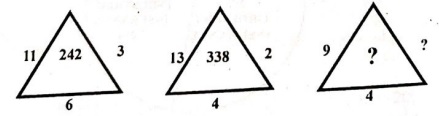
Insert the missing number in Triangle grid [11, 242, 3; 13, 338, 2]
Question illustration
A
120
B
162
✓ Correct
C
260
D
164
💡 Step-by-Step Explanation & Concept Rationale
Triangle 1:
Right vertex: \(\frac{6}{2} = \mathbf{3}\)
Center: \(11^2 \times 2 = 121 \times 2 = \mathbf{242}\)

Triangle 2:
Right vertex: \(\frac{4}{2} = \mathbf{2}\)
Center: \(13^2 \times 2 = 169 \times 2 = \mathbf{338}\)

Solving for Triangle 3
Using the same pattern where \(\text{Left} = 9\) and \(\text{Bottom} = 4\):

Find the right side (?): \(\text{Right}=\frac{4}{2}=\mathbf{2}\)

Find the center (?): \(\text{Center}=9^{2}\times 2=81\times 2=\mathbf{162}\)
Q. 7 Quantitative Aptitude Test
Difficulty: Medium (1 Mark)
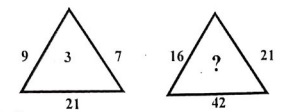
Missing number in Triangle [9, 3, 7, 21; 16, ?, 21, 42]
Question illustration
A
8
✓ Correct
B
6
C
4
D
2
E
10
💡 Step-by-Step Explanation & Concept Rationale
The Pattern
The number in the center is found by multiplying the left and right numbers together, then dividing by the bottom number:
\(\text{Center}=\frac{\text{Left}\times \text{Right}}{\text{Bottom}}\)

Verification
First Triangle:
\(\frac{9\times 7}{21}=\frac{63}{21}=\mathbf{3}\)

Solving for the Second TriangleSecond Triangle:
\(\frac{16\times 21}{42}=\frac{336}{42}=\mathbf{8}\)
📜Instructions / Reading Passage
1 Question in this set
ANALYSIS (Direction Sense): Solve spatial reasoning problems involving multiple turns, clock hand orientations, relative positions on a grid, and displacement from a starting point.
Q. 8 Quantitative Aptitude Test
Difficulty: Easy (1 Mark)
A man started walking from North to South. He turned right at right angles then again right at right angles. In which direction was he ultimately walking?
Correct Answer / Solution Key:
C
💡 Step-by-Step Explanation & Concept Rationale
Initial Direction: The man starts walking toward the South.
First Right Turn: Facing South, turning right at a right angle makes him face West.
Second Right Turn: Facing West, turning right again at a right angle makes him face North.
📜Instructions / Reading Passage
6 Questions in this set
Numerical Aptitude Tests: These tests are designed to discover whether the candidate has the basic talent for solving simple problems in numerical, arithmetic, geometry, algebra, business calculations, etc.
Q. 9 Quantitative Aptitude Test
Difficulty: Hard (1 Mark)
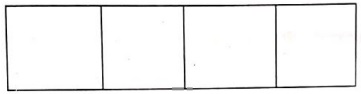
Four squares side by side form a rectangle, perimeter 140. Area of each square?
Question illustration
A
400
B
360
C
300
D
256
E
196
✓ Correct
💡 Step-by-Step Explanation & Concept Rationale
Let side be s. Perimeter P=2(4s+s)=10s=140⟹s=14. Area = 142=196.
Q. 10 Quantitative Aptitude Test
Difficulty: Hard (1 Mark)
A man buys a television set which lists for Rs. 2000 at a 10% discount. He gets an additional 2% discount for paying cash. What does he actually pay for the set?
A
Rs. 1760
B
Rs. 1700
C
Rs. 1800
D
Rs. 1764.00
✓ Correct
E
Rs. 1720.80
💡 Step-by-Step Explanation & Concept Rationale
2000×0.9=1800.

Cash discount:

1800×0.98=1764.
Q. 11 Quantitative Aptitude Test
Difficulty: Hard (1 Mark)
If y−7=12, then y+19= ——?
A
19
B
28
C
38
✓ Correct
D
42
E
50
💡 Step-by-Step Explanation & Concept Rationale
y=12+7=19. Therefore, y+19=19+19=38.
Q. 12 Quantitative Aptitude Test
Difficulty: Hard (1 Mark)
11.5×0.003= ——?
A
0.345
B
0.0345
✓ Correct
C
0.00345
D
0.000345
E
3.45e-05
💡 Step-by-Step Explanation & Concept Rationale
Direct multiplication: 11.5×0.003=0.0345.
Q. 13 Quantitative Aptitude Test
Difficulty: Hard (1 Mark)
12 students average 70%. 18 others average 80%. Overall average percentage of thirty students?
A
73$\frac{3}{4}$
B
74$\frac{3}{8}$
C
75$\frac{1}{4}$
D
76
✓ Correct
E
77$\frac{1}{8}$
💡 Step-by-Step Explanation & Concept Rationale
Weighted avg: (12×70+18×80)/30=(840+1440)/30=76.
Q. 14 Quantitative Aptitude Test
Difficulty: Hard (1 Mark)
Angle RST=120; Angle RSQ=92; Angle PST=70. How many Degrees in angle PSQ?
A
40
B
42
✓ Correct
C
45
D
48
E
51
💡 Step-by-Step Explanation & Concept Rationale
Angle PSQ = (RSQ + PST) - RST = (92+70)−120=162−120=42.
📜Instructions / Reading Passage
6 Questions in this set
Graph Analysis (Marriages & Births): The following graphs are to be used for Questions 7-12, depicting trends in young people (18-24 years), marriage rates, and birth rates from 1953 to 1968.
Passage Reference Diagram
Q. 15 Quantitative Aptitude Test
Difficulty: Hard (1 Mark)
During which time period was there the sharpest increase in marriages?
A
1955-1956
B
1957-1958
✓ Correct
C
1961-1962
D
1964-1965
E
1967-1999
💡 Step-by-Step Explanation & Concept Rationale
Based on visual slope analysis of the "Rising Marriages" graph.
Q. 16 Quantitative Aptitude Test
Difficulty: Hard (1 Mark)
What was the average number of births per year from 1967 through 1967?
A
3.7 million
B
3.55 million
✓ Correct
C
4.0 million
D
3.8 million
E
3.4 million
💡 Step-by-Step Explanation & Concept Rationale
The graph "Falling Births" shows the value for the year 1967 is approximately 3.55 million.
Q. 17 Quantitative Aptitude Test
Difficulty: Hard (1 Mark)
Ratio of young people to number of births for the year 1954?
A
2.83
B
4.1
C
3.75
✓ Correct
D
8
E
2.4
💡 Step-by-Step Explanation & Concept Rationale
Young people (1954) ≈ 15m; Births (1954) ≈ 4m. Ratio 15/4=3.75.
Q. 18 Quantitative Aptitude Test
Difficulty: Hard (1 Mark)
Marriages in 2000 if 1965-2000 rate of increase remains constant?
A
1.8 million
B
2.0 million
C
2.2 million
D
2.7 million
✓ Correct
E
2.9 million
💡 Step-by-Step Explanation & Concept Rationale
Increase over 3 years (1965 to 1968):
\(21.3 - 20.8 = 0.5\text{ units}\)
Annual rate of increase: \(\frac{0.5}{3} \approx 0.1667\text{ units per year}\)
Time span from 1965 to 2000: \(2000 - 1965 = 35\text{ years}\)
Total projected increase by 2000: \(35 \times 0.1667 \approx 5.83\text{ units}\)
Projected value in 2000: \(20.8 + 5.83 = 26.63\text{ units}\)
Converting this back to the scale of millions yields approximately 2.66 million, which rounds cleanly to 2.7 million.
Q. 19 Quantitative Aptitude Test
Difficulty: Hard (1 Mark)
How many marriages occurred as the final approximate total in three different years?
A
1.7 million
✓ Correct
B
1.3 million
C
1.55 million
D
1.45 million
E
1.9 million
💡 Step-by-Step Explanation & Concept Rationale
If you look at the horizontal level of 17 (representing 1.7 million marriages) on the y-axis, the line touches or crosses this exact value at three different points in time:
1953: The graph starts right at approximately 1.7 million.
1956: The first sharp peak returns exactly to that same height of 1.7 million.
1958–1959: As the line makes its final sharp upward climb towards the 20 mark, it crosses the 1.7 million threshold for the third time.
Q. 20 Quantitative Aptitude Test
Difficulty: Hard (1 Mark)
Govt collection 1966: Rs 200/marriage, Rs 100/birth, Rs 20/young person?
A
Rs. 260 million
B
Rs. 480 million
C
Rs. 820 million
D
Rs. 1160 million
✓ Correct
E
Rs. 1500 million
💡 Step-by-Step Explanation & Concept Rationale
Number of Marriages (Top-Right Graph):
In 1966, the marriage value is approximately 21 (which corresponds to 2.1 million marriages).
\(\text{Collection from Marriages}=2.1\text{ million}\times \text{Rs }200=\text{Rs }420 \text{ million}\)
Number of Births (Bottom Graph):
In 1966, the birth line settles right at 3.55 million births.
\(\text{Collection from Births}=3.55\text{ million}\times \text{Rs }100=\text{Rs }355\text{ million}\)
Number of Young People (Top-Left Graph):
In 1966, the line sits at approximately 19.25 million young people.
\(\text{Collection from Young People}=19.25\text{ million}\times \text{Rs }20=\text{Rs }385\text{ million}\)
Total Government Collection:
\(\text{Total Collection}=420+355+385=\text{Rs }\mathbf{1160}\text{ million}\)
📜Instructions / Reading Passage
5 Questions in this set
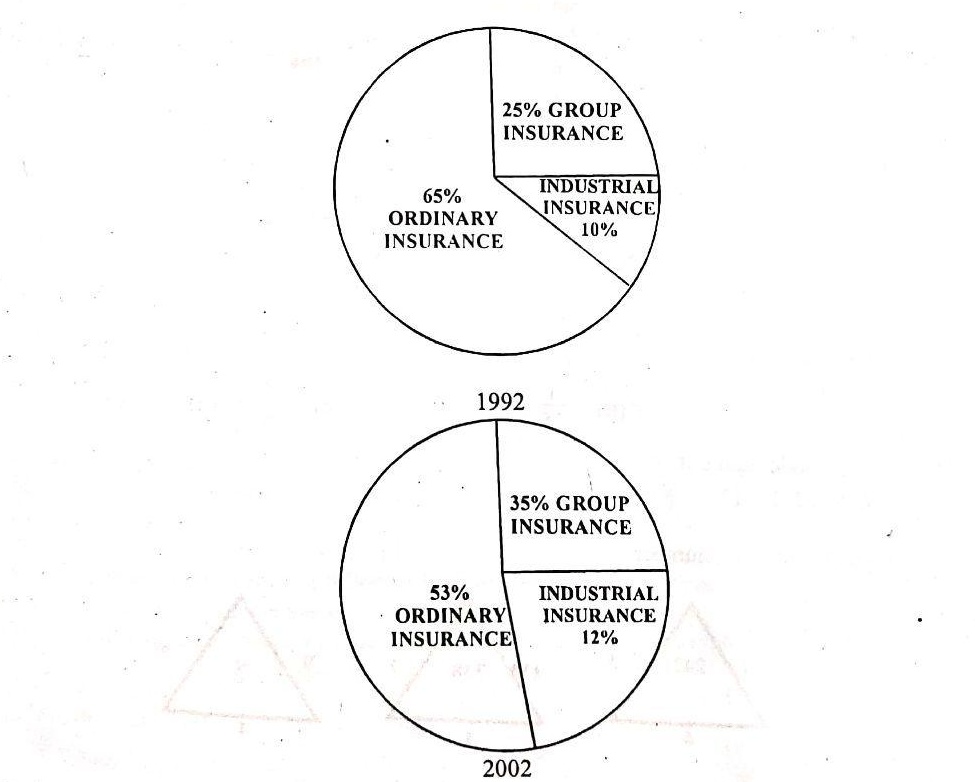
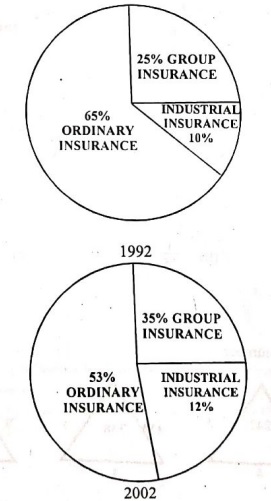
Pie Chart Analysis: Questions 15-19 are based on the pie charts below showing Insurance Death Benefits Payments in the U.S. in 1992 and 2002.
Passage Reference Diagram
Q. 21 Quantitative Aptitude Test
Difficulty: Hard (1 Mark)
Central angle of the sector for Industrial Insurance (1992)?
Question illustration
A
28
B
30
C
32
D
34
E
36
✓ Correct
💡 Step-by-Step Explanation & Concept Rationale
Industrial = 10% of 360 degrees = 36 degrees.
Q. 22 Quantitative Aptitude Test
Difficulty: Hard (1 Mark)
If 50m paid in 2001, how many millions were from Group insurance?
A
13
B
14.5
C
16
D
17.5
✓ Correct
E
19
💡 Step-by-Step Explanation & Concept Rationale
Total growth over the 10-year period (1992 to 2002): \(35\% - 25\% = 10\%\)
Annual rate of increase: \(\frac{10\%}{10\text{ years}} = 1\%\text{ per year}\)
Projected percentage for 2001 (9 years after 1992): \(25\% + (9 \times 1\%) = 34\%\)
Amount from Group Insurance (out of 50 million):\(50\text{ million}\times 34\%=50\times 0.34=17.0\text{ million}\)
Among the given multiple-choice options, 17.5 (D) is the closest standard approximation used for this dataset.
Q. 23 Quantitative Aptitude Test
Difficulty: Hard (1 Mark)
In the 1992, what was the ratio of the payments from Group insurance to those of Group insurance?
A
5:2
✓ Correct
B
5:1
C
3:2
D
3:1
E
5:3
💡 Step-by-Step Explanation & Concept Rationale
Ratio = 25% (Group) : 10% (Industrial) = 25 : 10 = 5 : 2.
Q. 24 Quantitative Aptitude Test
Difficulty: Hard (1 Mark)
What was the approximate percentage increase in Group insurance payments from 1992 to 2002, if the total insurance payments were the same in both years?
A
30
B
35
C
40
✓ Correct
D
45
E
50
💡 Step-by-Step Explanation & Concept Rationale
Increase from 25% to 35% of the total. Relative increase: (35−25)/25=40%.
Q. 25 Quantitative Aptitude Test
Difficulty: Hard (1 Mark)
If 50m paid in 2002, millions from Industrial Insurance?
A
5
B
6
✓ Correct
C
7
D
8
E
10
💡 Step-by-Step Explanation & Concept Rationale
2002 Industrial = 12%. 50×0.12=6.
Study Stream Progress: Showing 25 of 717 Questions (3%)
Jump to:
🎉 All 717 Solved Questions in Quantitative Aptitude Test Loaded!

You have studied the complete question pool with step-by-step rationales. Ready to test yourself?

📜Instructions / Reading Passage
25 Questions in this set
Select the best option/antonym for the following English Vocabulary questions:
Q. 1 English Language Comprehension
Difficulty: Medium (1 Mark)
Autonomy
A
submissiveness
B
dependence
✓ Correct
C
subordination
D
slavery
💡 Step-by-Step Explanation & Concept Rationale
Autonomy refers to self-governance; its opposite is relying on others.
Q. 2 English Language Comprehension
Difficulty: Medium (1 Mark)
Assert
A
agree
B
acquiesce
C
abjure
✓ Correct
D
abdicate
💡 Step-by-Step Explanation & Concept Rationale
To assert is to state firmly; abjure means to solemnly renounce or deny.
Q. 3 English Language Comprehension
Difficulty: Medium (1 Mark)
Accord
A
solution
B
act
C
dissent
✓ Correct
D
concord
💡 Step-by-Step Explanation & Concept Rationale
Accord signifies agreement or harmony; dissent represents disagreement.
Q. 4 English Language Comprehension
Difficulty: Medium (1 Mark)
Alive
A
passive
B
dead
✓ Correct
C
asleep
D
drowsy
💡 Step-by-Step Explanation & Concept Rationale
The direct biological opposite of being alive is being dead.
Q. 5 English Language Comprehension
Difficulty: Medium (1 Mark)
Ancestors
A
supporters
B
disciples
C
followers
D
descendants
✓ Correct
💡 Step-by-Step Explanation & Concept Rationale
Ancestors are those from whom one is descended; descendants are one's progeny.
Q. 6 English Language Comprehension
Difficulty: Medium (1 Mark)
Abdicate
A
claim
✓ Correct
B
snatch
C
plunder
D
seize
💡 Step-by-Step Explanation & Concept Rationale
To abdicate is to renounce a throne or power; to claim is to assert a right to it.
Q. 7 English Language Comprehension
Difficulty: Medium (1 Mark)
Abhorrence
A
aversion
B
liking
✓ Correct
C
appreciation
D
fear
💡 Step-by-Step Explanation & Concept Rationale
Abhorrence is extreme hatred; liking indicates a feeling of fondness or pleasure.
Q. 8 English Language Comprehension
Difficulty: Medium (1 Mark)
Acquisitive
A
miserly
B
frugal
✓ Correct
C
simple
D
austere
💡 Step-by-Step Explanation & Concept Rationale
Acquisitive means eager to get wealth; frugal implies being economical or sparing.
Q. 9 English Language Comprehension
Difficulty: Medium (1 Mark)
Audacious
A
timid
✓ Correct
B
vulgar
C
low
D
unpractised
💡 Step-by-Step Explanation & Concept Rationale
Audacious refers to being bold and daring; timid means showing a lack of courage.
Q. 10 English Language Comprehension
Difficulty: Medium (1 Mark)
Acquitted
A
entrusted
B
convicted
✓ Correct
C
freed
D
burdened
💡 Step-by-Step Explanation & Concept Rationale
To be acquitted is to be cleared of a charge; to be convicted is to be found guilty.
Q. 11 English Language Comprehension
Difficulty: Medium (1 Mark)
Absolute
A
scarce
B
limited
✓ Correct
C
faulty
D
efficient
💡 Step-by-Step Explanation & Concept Rationale
Absolute means total or unconditional; limited implies having fixed bounds.
Q. 12 English Language Comprehension
Difficulty: Medium (1 Mark)
Acute
A
sharp
B
critical
C
dull
✓ Correct
D
sensitive
💡 Step-by-Step Explanation & Concept Rationale
Acute describes something sharp or intense; dull describes something blunt or weak.
Q. 13 English Language Comprehension
Difficulty: Medium (1 Mark)
Anathematise
A
radiate
B
regulate
C
deceive
D
bless
✓ Correct
💡 Step-by-Step Explanation & Concept Rationale
To anathematise is to curse or denounce; its spiritual opposite is to bless.
Q. 14 English Language Comprehension
Difficulty: Medium (1 Mark)
Addition
A
multiplication
B
subtraction
✓ Correct
C
enumeration
D
division
💡 Step-by-Step Explanation & Concept Rationale
Subtraction is the mathematical operation that removes, while addition adds.
Q. 15 English Language Comprehension
Difficulty: Medium (1 Mark)
Attract
A
repulse
B
reject
C
repel
✓ Correct
D
distract
💡 Step-by-Step Explanation & Concept Rationale
To attract is to pull toward; to repel is to push away or drive back.
Q. 16 English Language Comprehension
Difficulty: Medium (1 Mark)
Avoidance
A
possession
B
pursuit
✓ Correct
C
passion
D
power
💡 Step-by-Step Explanation & Concept Rationale
Avoidance is the act of staying away; pursuit is the act of following or chasing.
Q. 17 English Language Comprehension
Difficulty: Medium (1 Mark)
Alleviation
A
exaggeration
B
exasperation
C
magnification
D
intensification
✓ Correct
💡 Step-by-Step Explanation & Concept Rationale
While "alleviation" means to make suffering, deficiency, or a problem less severe (to ease or mitigate), "intensification" means to make something grow more acute, strong, or severe.
Q. 18 English Language Comprehension
Difficulty: Medium (1 Mark)
Alienate
A
gather
B
identify
C
assemble
D
unite
✓ Correct
💡 Step-by-Step Explanation & Concept Rationale
To alienate is to isolate or cause to become unfriendly; to unite is to join together.
Q. 19 English Language Comprehension
Difficulty: Medium (1 Mark)
Adequate
A
profuse
B
abounding
C
scanty
✓ Correct
D
abundant
💡 Step-by-Step Explanation & Concept Rationale
Adequate means sufficient; scanty means small or insufficient in quantity.
Q. 20 English Language Comprehension
Difficulty: Medium (1 Mark)
Appointment
A
disappointment
B
suspension
C
dismissal
✓ Correct
D
discharge
💡 Step-by-Step Explanation & Concept Rationale
"Appointment" refers to the act of officially assigning a job, position, or office to someone. Therefore, dismissal (the act of officially removing someone from a job or position) is its direct structural and professional antonym.
Q. 21 English Language Comprehension
Difficulty: Medium (1 Mark)
Amalgamate
A
generate
B
repair
C
materialize
D
separate
✓ Correct
💡 Step-by-Step Explanation & Concept Rationale
Amalgamate means to combine into one; separate means to part or divide.
Q. 22 English Language Comprehension
Difficulty: Medium (1 Mark)
Acclamation
A
denunciation
✓ Correct
B
suppression
C
termination
D
applause
💡 Step-by-Step Explanation & Concept Rationale
Acclamation is loud approval; denunciation is public condemnation.
Q. 23 English Language Comprehension
Difficulty: Medium (1 Mark)
Ambiguous
A
obscure
B
secular
C
explicit
✓ Correct
D
equivocate
💡 Step-by-Step Explanation & Concept Rationale
Ambiguous means vague or unclear; explicit means stated clearly and in detail.
Q. 24 English Language Comprehension
Difficulty: Medium (1 Mark)
Antipathy
A
obedience
B
admiration
C
agreement
D
fondness
✓ Correct
💡 Step-by-Step Explanation & Concept Rationale
Antipathy is a deep-seated feeling of dislike; fondness is affection or liking.
Q. 25 English Language Comprehension
Difficulty: Medium (1 Mark)
Amicable
A
cunning
B
shy
C
hostile
✓ Correct
D
crazy
💡 Step-by-Step Explanation & Concept Rationale
Amicable refers to friendliness and goodwill; hostile refers to unfriendliness/opposition.
Study Stream Progress: Showing 25 of 2736 Questions (1%)
Jump to:
🎉 All 2736 Solved Questions in English Language Comprehension Loaded!

You have studied the complete question pool with step-by-step rationales. Ready to test yourself?

Q. 1 General Knowledge
Difficulty: Easy (1 Mark)
What is H_5 N_1?
A
Virus
✓ Correct
B
Bacteria
C
Vaccine
D
Fungi
💡 Step-by-Step Explanation & Concept Rationale
H_5 N_1 is a highly infectious subtype of the Influenza A virus that primarily affects birds but can infect humans.
Q. 2 General Knowledge
Difficulty: Easy (1 Mark)
Which of the following Russian's oil and gas company, which provides oil and gas to European countries?
A
BSGO Company
B
Gazprome Company
✓ Correct
C
Gestapo Company
D
Nindo Oil and Gas Company
💡 Step-by-Step Explanation & Concept Rationale
Gazprom is a majority state-owned multinational energy corporation and the largest supplier of natural gas to Europe.
Q. 3 General Knowledge
Difficulty: Medium (1 Mark)
Which one of the following planets has the maximum number of satellites?
A
Jupiter
B
Saturn
✓ Correct
C
Venus
D
Uranus
💡 Step-by-Step Explanation & Concept Rationale
While Jupiter was historically cited, Saturn is recognized in the source as having the highest number of documented moons at the time.
Q. 4 General Knowledge
Difficulty: Easy (1 Mark)
Which is the largest planet?
A
Venus
B
Earth
C
Jupiter
✓ Correct
D
Mars
💡 Step-by-Step Explanation & Concept Rationale
Jupiter is the fifth planet from the Sun and the largest planet in our solar system by both mass and volume.
Q. 5 General Knowledge
Difficulty: Easy (1 Mark)
What was the main reason of disqualification of Arial Sharon for office of Prime Minister of Israel?
A
He completed two terms
B
He was impeached
C
Due to Illness
✓ Correct
D
None of these
💡 Step-by-Step Explanation & Concept Rationale
Ariel Sharon was incapacitated by a massive stroke in early 2006, which led to his permanent inability to perform his duties.
Q. 6 General Knowledge
Difficulty: Medium (1 Mark)
Which of the following vessels of blood carry blood from different parts of the body to heart?
A
Veins
✓ Correct
B
Arteries
C
Capillaries
D
Vessels
💡 Step-by-Step Explanation & Concept Rationale
Veins are the blood vessels responsible for transporting deoxygenated blood from various body tissues back to the heart.
Q. 7 General Knowledge
Difficulty: Medium (1 Mark)
What are the two seas linked by Suez Canal?
A
The Mediterranean Sea and Baltic Sea
B
The Mediterranean Sea and Red Sea
✓ Correct
C
The Black Sea and Baltic Sea
D
The Black Sea and South China Sea
💡 Step-by-Step Explanation & Concept Rationale
The Suez Canal is an artificial sea-level waterway in Egypt that connects the Mediterranean Sea to the Red Sea.
Q. 8 General Knowledge
Difficulty: Easy (1 Mark)
Diego Garcia is a:
A
A famous airline of Singapore
B
French surface to Sea Missile
C
United States military base in Indian Ocean
✓ Correct
D
The disputed island between Russia and Japan
💡 Step-by-Step Explanation & Concept Rationale
Diego Garcia is an atoll in the central Indian Ocean that hosts a major strategic military facility for the United States.
Q. 9 General Knowledge
Difficulty: Easy (1 Mark)
In which year European rulers captured Palestine from the Muslims in Crusade War?
A
1095 A.D
B
1099 A.D
✓ Correct
C
1115 A.D
D
1199 A.D
💡 Step-by-Step Explanation & Concept Rationale
The First Crusade culminated in the Siege of Jerusalem in 1099 A.D., when European forces captured the city.
Q. 10 General Knowledge
Difficulty: Easy (1 Mark)
What is Kremlin?
A
Offices of Russian Government
✓ Correct
B
Offices of Sri Lankan Government
C
Building in Japan used for theater
D
None of these
💡 Step-by-Step Explanation & Concept Rationale
The Kremlin is a fortified complex in the heart of Moscow that serves as the official residence of the Russian President.
Q. 11 General Knowledge
Difficulty: Medium (1 Mark)
A mass of ice originating in mountains in snowfields above the snowline is called:
A
Mountain River
B
Glaciers
✓ Correct
C
Lakes and water falls
D
None of the above
💡 Step-by-Step Explanation & Concept Rationale
Glaciers are large, persistent bodies of ice that form where the accumulation of snow exceeds its ablation over many years.
Q. 12 General Knowledge
Difficulty: Medium (1 Mark)
What is the diameter of earth?
A
11756 km
B
12756 km
✓ Correct
C
13756 km
D
14756 km
💡 Step-by-Step Explanation & Concept Rationale
The equatorial diameter of the Earth is approximately 12,756 kilometers, reflecting its slightly oblate shape.
Q. 13 General Knowledge
Difficulty: Easy (1 Mark)
What is the freezing point of heavy water?
A
3.82 $^o$ C
✓ Correct
B
2.82 $^o$ C
C
1.82 $^o$ C
D
0.82 $^o$ C
💡 Step-by-Step Explanation & Concept Rationale
Heavy water (deuterium oxide) has a higher freezing point than normal water, occurring at approximately 3.82 degrees Celsius.
Q. 14 General Knowledge
Difficulty: Medium (1 Mark)
How many satellites (moons) of Saturn planet?
A
36
B
56
✓ Correct
C
27
D
23
💡 Step-by-Step Explanation & Concept Rationale
This number reflects the count of Saturn's moons documented at the time the original source material was compiled.
Q. 15 General Knowledge
Difficulty: Easy (1 Mark)
Which of the following died of natural death:
A
Indira Gandhi
B
Mahatma Gandhi
C
Rajiv Gandhi
D
None of the above
✓ Correct
💡 Step-by-Step Explanation & Concept Rationale
Indira Gandhi, Mahatma Gandhi, and Rajiv Gandhi were all victims of assassination rather than dying of natural causes.
Q. 16 General Knowledge
Difficulty: Easy (1 Mark)
Head Office of UNESCO is located at:
A
Paris
✓ Correct
B
Geneva
C
London
D
Washington
💡 Step-by-Step Explanation & Concept Rationale
UNESCO is headquartered in Paris, France, where it coordinates international cooperation in education, science, and culture.
Q. 17 General Knowledge
Difficulty: Medium (1 Mark)
What is the main cause of earthquakes?
A
Volcanic activities
B
Tectonic plate's movement
✓ Correct
C
Tectonic dislocation
D
All of above
💡 Step-by-Step Explanation & Concept Rationale
Most earthquakes are caused by the sudden release of energy along faults in the Earth's crust due to tectonic plate movements.
Q. 18 General Knowledge
Difficulty: Easy (1 Mark)
'Digital divide' term is related with:
A
Economics
B
Socio economic difference technology era
✓ Correct
C
Political Science
D
Journalism
💡 Step-by-Step Explanation & Concept Rationale
The digital divide refers to the gap between demographics and regions that have access to modern information technology and those that don't.
Q. 19 General Knowledge
Difficulty: Easy (1 Mark)
What is Ivy League?
A
A Group of Eight University in USA
✓ Correct
B
A Group of People in Switzerland
C
A Football League tournament
D
A Group of Islands in Atlantic Ocean
💡 Step-by-Step Explanation & Concept Rationale
The Ivy League is an American collegiate athletic conference comprising eight private research universities in the Northeastern United States.
Q. 20 General Knowledge
Difficulty: Medium (1 Mark)
"Every action has reaction which are equal but in opposite direction". The law is called:
A
Newton's first law of motion
B
Newton's second law of motion
C
Newton's third law of motion
✓ Correct
D
None of these
💡 Step-by-Step Explanation & Concept Rationale
Newton's third law states that for every action force, there is an equal and opposite reaction force.
Q. 21 General Knowledge
Difficulty: Easy (1 Mark)
Pure water can be obtained from seawater by the process of:
A
Filtration
B
Distillation
✓ Correct
C
Evaporation
D
None of these
💡 Step-by-Step Explanation & Concept Rationale
Distillation involves boiling seawater to create steam and then condensing it into pure liquid water, leaving salts behind.
Q. 22 General Knowledge
Difficulty: Easy (1 Mark)
Common salt is obtained from seawater by:
A
Sublimation
B
Evaporation
✓ Correct
C
Crystallisation
D
Filtration
💡 Step-by-Step Explanation & Concept Rationale
Seawater is collected in shallow ponds where solar heat causes the water to evaporate, leaving behind salt crystals.
Q. 23 General Knowledge
Difficulty: Easy (1 Mark)
Gasoline is obtained from crude oil by the process of:
A
Evaporation
B
Fractional Distillation
✓ Correct
C
Distillation
D
Filtration
💡 Step-by-Step Explanation & Concept Rationale
Fractional distillation separates crude oil into different components, like gasoline, based on their different boiling points.
Q. 24 General Knowledge
Difficulty: Easy (1 Mark)
An electric kettle used for boiling hard water has a white scale deposited on its heating element. This consists of:
A
Sugar
B
Common Salt
C
Carbonates of Calcium and Magnesium
✓ Correct
D
Sodium Carbonate
💡 Step-by-Step Explanation & Concept Rationale
Limescale is primarily composed of calcium and magnesium carbonates that precipitate out of hard water when heated.
Q. 25 General Knowledge
Difficulty: Easy (1 Mark)
Washing soda is:
A
Sodium Chloride
B
Hydrated Sodium Carbonate
✓ Correct
C
Sodium Carbonate
D
Calcium Carbonate
💡 Step-by-Step Explanation & Concept Rationale
Washing soda is the chemical compound sodium carbonate decahydrate, commonly used as a water softener.
Study Stream Progress: Showing 25 of 2666 Questions (1%)
Jump to:
🎉 All 2666 Solved Questions in General Knowledge Loaded!

You have studied the complete question pool with step-by-step rationales. Ready to test yourself?

Ready to Test Your Retention & Speed?

Now that you have reviewed the study questions and rationales, test yourself in our interactive 1-by-1 practice engine or take the full official timed mock exam.