
Q. 1
Quantitative Aptitude Test
Difficulty: Medium
(1 Mark)
Spending Rs 10.00 on 50p and 20p stamps; greatest number of 50p stamps?
💡
Step-by-Step Explanation & Concept Rationale
18×50p=900p. Remaining 100p allows 5×20p stamps. Total is 1000p (Rs 10).
Q. 2
Quantitative Aptitude Test
Difficulty: Hard
(1 Mark)
Ship: 6 miles W, 6 miles S, 6 miles W. Total distance from port?
💡
Step-by-Step Explanation & Concept Rationale
Net displacement: 12 miles West, 6 miles South. Distance = 122+62≈13.4.
Q. 3
Quantitative Aptitude Test
Difficulty: Hard
(1 Mark)
How much is $\frac{1}{4} of \frac{x}{4}$?
💡
Step-by-Step Explanation & Concept Rationale
$\frac{4}{4}×\frac{x}{4}=\frac{x}{16}$.
Q. 4
Quantitative Aptitude Test
Difficulty: Hard
(1 Mark)
What is $\frac{1}{5}$ of $\frac{x}{5}$?
💡
Step-by-Step Explanation & Concept Rationale
$\left(\frac{1}{5}\right) \times \left(\frac{x}{5}\right) = \frac{x}{25}$
Q. 5
Quantitative Aptitude Test
Difficulty: Medium
(1 Mark)
Find the odd man out: 3 6 9 12 15 17
💡
Step-by-Step Explanation & Concept Rationale
17 is the only number in the sequence that is not a multiple of 3.
Q. 6
Quantitative Aptitude Test
Difficulty: Medium
(1 Mark)
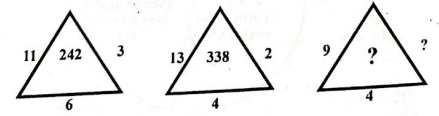
Insert the missing number in Triangle grid [11, 242, 3; 13, 338, 2]
💡
Step-by-Step Explanation & Concept Rationale
Triangle 1:
Right vertex: \(\frac{6}{2} = \mathbf{3}\)
Center: \(11^2 \times 2 = 121 \times 2 = \mathbf{242}\)
Triangle 2:
Right vertex: \(\frac{4}{2} = \mathbf{2}\)
Center: \(13^2 \times 2 = 169 \times 2 = \mathbf{338}\)
Solving for Triangle 3
Using the same pattern where \(\text{Left} = 9\) and \(\text{Bottom} = 4\):
Find the right side (?): \(\text{Right}=\frac{4}{2}=\mathbf{2}\)
Find the center (?): \(\text{Center}=9^{2}\times 2=81\times 2=\mathbf{162}\)
Right vertex: \(\frac{6}{2} = \mathbf{3}\)
Center: \(11^2 \times 2 = 121 \times 2 = \mathbf{242}\)
Triangle 2:
Right vertex: \(\frac{4}{2} = \mathbf{2}\)
Center: \(13^2 \times 2 = 169 \times 2 = \mathbf{338}\)
Solving for Triangle 3
Using the same pattern where \(\text{Left} = 9\) and \(\text{Bottom} = 4\):
Find the right side (?): \(\text{Right}=\frac{4}{2}=\mathbf{2}\)
Find the center (?): \(\text{Center}=9^{2}\times 2=81\times 2=\mathbf{162}\)
Q. 7
Quantitative Aptitude Test
Difficulty: Medium
(1 Mark)
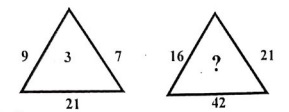
Missing number in Triangle [9, 3, 7, 21; 16, ?, 21, 42]
💡
Step-by-Step Explanation & Concept Rationale
The Pattern
The number in the center is found by multiplying the left and right numbers together, then dividing by the bottom number:
\(\text{Center}=\frac{\text{Left}\times \text{Right}}{\text{Bottom}}\)
Verification
First Triangle:
\(\frac{9\times 7}{21}=\frac{63}{21}=\mathbf{3}\)
Solving for the Second TriangleSecond Triangle:
\(\frac{16\times 21}{42}=\frac{336}{42}=\mathbf{8}\)
The number in the center is found by multiplying the left and right numbers together, then dividing by the bottom number:
\(\text{Center}=\frac{\text{Left}\times \text{Right}}{\text{Bottom}}\)
Verification
First Triangle:
\(\frac{9\times 7}{21}=\frac{63}{21}=\mathbf{3}\)
Solving for the Second TriangleSecond Triangle:
\(\frac{16\times 21}{42}=\frac{336}{42}=\mathbf{8}\)
Q. 8
Quantitative Aptitude Test
Difficulty: Easy
(1 Mark)
A man started walking from North to South. He turned right at right angles then again right at right angles. In which direction was he ultimately walking?
Correct Answer / Solution Key:
C
💡
Step-by-Step Explanation & Concept Rationale
Initial Direction: The man starts walking toward the South.
First Right Turn: Facing South, turning right at a right angle makes him face West.
Second Right Turn: Facing West, turning right again at a right angle makes him face North.
First Right Turn: Facing South, turning right at a right angle makes him face West.
Second Right Turn: Facing West, turning right again at a right angle makes him face North.
Q. 9
Quantitative Aptitude Test
Difficulty: Hard
(1 Mark)
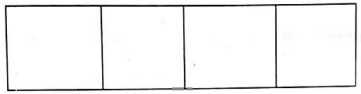
Four squares side by side form a rectangle, perimeter 140. Area of each square?
💡
Step-by-Step Explanation & Concept Rationale
Let side be s. Perimeter P=2(4s+s)=10s=140⟹s=14. Area = 142=196.
Q. 10
Quantitative Aptitude Test
Difficulty: Hard
(1 Mark)
A man buys a television set which lists for Rs. 2000 at a 10% discount. He gets an additional 2% discount for paying cash. What does he actually pay for the set?
💡
Step-by-Step Explanation & Concept Rationale
2000×0.9=1800.
Cash discount:
1800×0.98=1764.
Cash discount:
1800×0.98=1764.
Q. 11
Quantitative Aptitude Test
Difficulty: Hard
(1 Mark)
If y−7=12, then y+19= ——?
💡
Step-by-Step Explanation & Concept Rationale
y=12+7=19. Therefore, y+19=19+19=38.
Q. 12
Quantitative Aptitude Test
Difficulty: Hard
(1 Mark)
11.5×0.003= ——?
💡
Step-by-Step Explanation & Concept Rationale
Direct multiplication: 11.5×0.003=0.0345.
Q. 13
Quantitative Aptitude Test
Difficulty: Hard
(1 Mark)
12 students average 70%. 18 others average 80%. Overall average percentage of thirty students?
💡
Step-by-Step Explanation & Concept Rationale
Weighted avg: (12×70+18×80)/30=(840+1440)/30=76.
Q. 14
Quantitative Aptitude Test
Difficulty: Hard
(1 Mark)
Angle RST=120; Angle RSQ=92; Angle PST=70. How many Degrees in angle PSQ?
💡
Step-by-Step Explanation & Concept Rationale
Angle PSQ = (RSQ + PST) - RST = (92+70)−120=162−120=42.
📜
Instructions / Reading Passage
6 Questions in this set
Graph Analysis (Marriages & Births): The following graphs are to be used for Questions 7-12, depicting trends in young people (18-24 years), marriage rates, and birth rates from 1953 to 1968.

Q. 15
Quantitative Aptitude Test
Difficulty: Hard
(1 Mark)
During which time period was there the sharpest increase in marriages?
💡
Step-by-Step Explanation & Concept Rationale
Based on visual slope analysis of the "Rising Marriages" graph.
Q. 16
Quantitative Aptitude Test
Difficulty: Hard
(1 Mark)
What was the average number of births per year from 1967 through 1967?
💡
Step-by-Step Explanation & Concept Rationale
The graph "Falling Births" shows the value for the year 1967 is approximately 3.55 million.
Q. 17
Quantitative Aptitude Test
Difficulty: Hard
(1 Mark)
Ratio of young people to number of births for the year 1954?
💡
Step-by-Step Explanation & Concept Rationale
Young people (1954) ≈ 15m; Births (1954) ≈ 4m. Ratio 15/4=3.75.
Q. 18
Quantitative Aptitude Test
Difficulty: Hard
(1 Mark)
Marriages in 2000 if 1965-2000 rate of increase remains constant?
💡
Step-by-Step Explanation & Concept Rationale
Increase over 3 years (1965 to 1968):
\(21.3 - 20.8 = 0.5\text{ units}\)
Annual rate of increase: \(\frac{0.5}{3} \approx 0.1667\text{ units per year}\)
Time span from 1965 to 2000: \(2000 - 1965 = 35\text{ years}\)
Total projected increase by 2000: \(35 \times 0.1667 \approx 5.83\text{ units}\)
Projected value in 2000: \(20.8 + 5.83 = 26.63\text{ units}\)
Converting this back to the scale of millions yields approximately 2.66 million, which rounds cleanly to 2.7 million.
\(21.3 - 20.8 = 0.5\text{ units}\)
Annual rate of increase: \(\frac{0.5}{3} \approx 0.1667\text{ units per year}\)
Time span from 1965 to 2000: \(2000 - 1965 = 35\text{ years}\)
Total projected increase by 2000: \(35 \times 0.1667 \approx 5.83\text{ units}\)
Projected value in 2000: \(20.8 + 5.83 = 26.63\text{ units}\)
Converting this back to the scale of millions yields approximately 2.66 million, which rounds cleanly to 2.7 million.
Q. 19
Quantitative Aptitude Test
Difficulty: Hard
(1 Mark)
How many marriages occurred as the final approximate total in three different years?
💡
Step-by-Step Explanation & Concept Rationale
If you look at the horizontal level of 17 (representing 1.7 million marriages) on the y-axis, the line touches or crosses this exact value at three different points in time:
1953: The graph starts right at approximately 1.7 million.
1956: The first sharp peak returns exactly to that same height of 1.7 million.
1958–1959: As the line makes its final sharp upward climb towards the 20 mark, it crosses the 1.7 million threshold for the third time.
1953: The graph starts right at approximately 1.7 million.
1956: The first sharp peak returns exactly to that same height of 1.7 million.
1958–1959: As the line makes its final sharp upward climb towards the 20 mark, it crosses the 1.7 million threshold for the third time.
Q. 20
Quantitative Aptitude Test
Difficulty: Hard
(1 Mark)
Govt collection 1966: Rs 200/marriage, Rs 100/birth, Rs 20/young person?
💡
Step-by-Step Explanation & Concept Rationale
Number of Marriages (Top-Right Graph):
In 1966, the marriage value is approximately 21 (which corresponds to 2.1 million marriages).
\(\text{Collection from Marriages}=2.1\text{ million}\times \text{Rs }200=\text{Rs }420 \text{ million}\)
Number of Births (Bottom Graph):
In 1966, the birth line settles right at 3.55 million births.
\(\text{Collection from Births}=3.55\text{ million}\times \text{Rs }100=\text{Rs }355\text{ million}\)
Number of Young People (Top-Left Graph):
In 1966, the line sits at approximately 19.25 million young people.
\(\text{Collection from Young People}=19.25\text{ million}\times \text{Rs }20=\text{Rs }385\text{ million}\)
Total Government Collection:
\(\text{Total Collection}=420+355+385=\text{Rs }\mathbf{1160}\text{ million}\)
In 1966, the marriage value is approximately 21 (which corresponds to 2.1 million marriages).
\(\text{Collection from Marriages}=2.1\text{ million}\times \text{Rs }200=\text{Rs }420 \text{ million}\)
Number of Births (Bottom Graph):
In 1966, the birth line settles right at 3.55 million births.
\(\text{Collection from Births}=3.55\text{ million}\times \text{Rs }100=\text{Rs }355\text{ million}\)
Number of Young People (Top-Left Graph):
In 1966, the line sits at approximately 19.25 million young people.
\(\text{Collection from Young People}=19.25\text{ million}\times \text{Rs }20=\text{Rs }385\text{ million}\)
Total Government Collection:
\(\text{Total Collection}=420+355+385=\text{Rs }\mathbf{1160}\text{ million}\)
📜
Instructions / Reading Passage
5 Questions in this set
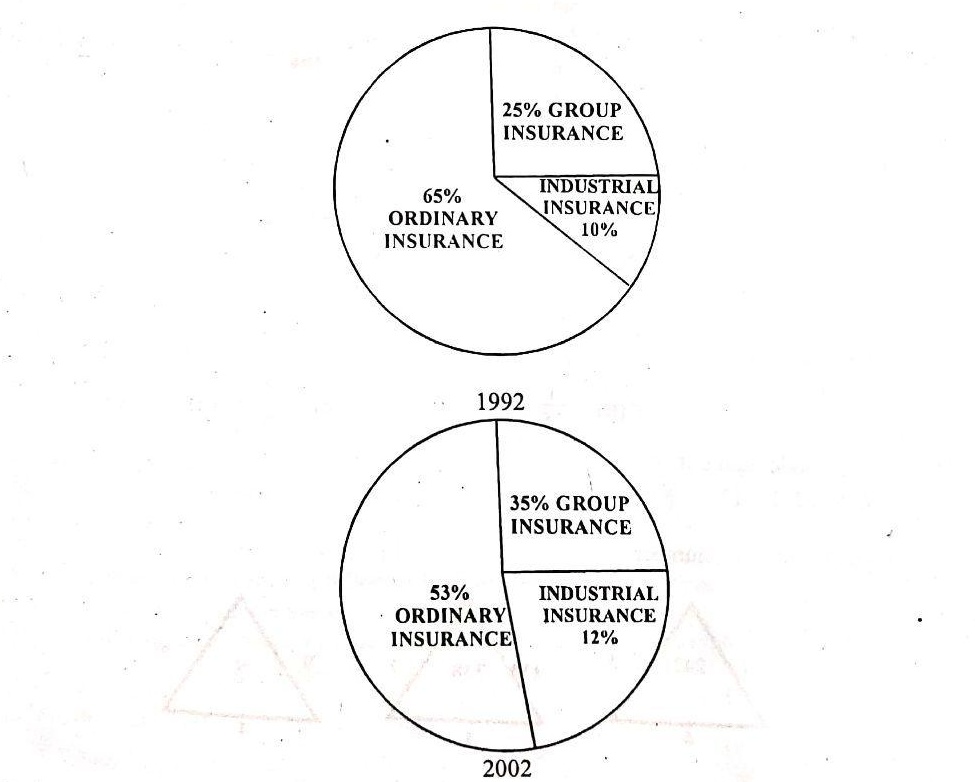
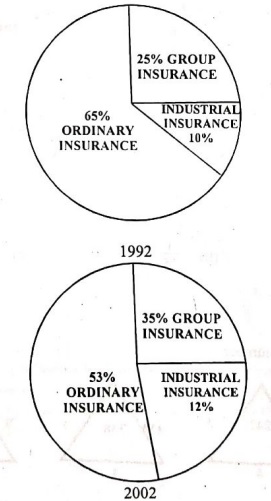
Pie Chart Analysis: Questions 15-19 are based on the pie charts below showing Insurance Death Benefits Payments in the U.S. in 1992 and 2002.
Q. 21
Quantitative Aptitude Test
Difficulty: Hard
(1 Mark)
Central angle of the sector for Industrial Insurance (1992)?
💡
Step-by-Step Explanation & Concept Rationale
Industrial = 10% of 360 degrees = 36 degrees.
Q. 22
Quantitative Aptitude Test
Difficulty: Hard
(1 Mark)
If 50m paid in 2001, how many millions were from Group insurance?
💡
Step-by-Step Explanation & Concept Rationale
Total growth over the 10-year period (1992 to 2002): \(35\% - 25\% = 10\%\)
Annual rate of increase: \(\frac{10\%}{10\text{ years}} = 1\%\text{ per year}\)
Projected percentage for 2001 (9 years after 1992): \(25\% + (9 \times 1\%) = 34\%\)
Amount from Group Insurance (out of 50 million):\(50\text{ million}\times 34\%=50\times 0.34=17.0\text{ million}\)
Among the given multiple-choice options, 17.5 (D) is the closest standard approximation used for this dataset.
Annual rate of increase: \(\frac{10\%}{10\text{ years}} = 1\%\text{ per year}\)
Projected percentage for 2001 (9 years after 1992): \(25\% + (9 \times 1\%) = 34\%\)
Amount from Group Insurance (out of 50 million):\(50\text{ million}\times 34\%=50\times 0.34=17.0\text{ million}\)
Among the given multiple-choice options, 17.5 (D) is the closest standard approximation used for this dataset.
Q. 23
Quantitative Aptitude Test
Difficulty: Hard
(1 Mark)
In the 1992, what was the ratio of the payments from Group insurance to those of Group insurance?
💡
Step-by-Step Explanation & Concept Rationale
Ratio = 25% (Group) : 10% (Industrial) = 25 : 10 = 5 : 2.
Q. 24
Quantitative Aptitude Test
Difficulty: Hard
(1 Mark)
What was the approximate percentage increase in Group insurance payments from 1992 to 2002, if the total insurance payments were the same in both years?
💡
Step-by-Step Explanation & Concept Rationale
Increase from 25% to 35% of the total. Relative increase: (35−25)/25=40%.
Q. 25
Quantitative Aptitude Test
Difficulty: Hard
(1 Mark)
If 50m paid in 2002, millions from Industrial Insurance?
💡
Step-by-Step Explanation & Concept Rationale
2002 Industrial = 12%. 50×0.12=6.
Study Stream Progress:
Showing 25 of 717 Questions (3%)
Jump to:
Ready to Test Your Retention & Speed?
Now that you have reviewed the study questions and rationales, test yourself in our interactive 1-by-1 practice engine or take the full official timed mock exam.