
Q. 1
Quantitative Aptitude Test
Difficulty: Hard
(1 Mark)
Ship: 6 miles W, 6 miles S, 6 miles W. Total distance from port?
💡
Step-by-Step Explanation & Concept Rationale
Net displacement: 12 miles West, 6 miles South. Distance = 122+62≈13.4.
Q. 2
Quantitative Aptitude Test
Difficulty: Hard
(1 Mark)
The length of a rectangle is increased by 2 cm and its width is decreased by 2 cm. The length of the diagonal of the rectangle (length > width).
💡
Step-by-Step Explanation & Concept Rationale
Initial Diagonal:
Let the initial length of the rectangle be \(L\) and the initial width be \(W\). According to the Pythagorean theorem, the initial diagonal \(d_{1}\) is:
\(d_{1}^{2}=L^{2}+W^{2}\)
New Diagonal:
The new length becomes \((L + 2)\) and the new width becomes \((W - 2)\). The new diagonal \(d_{2}\) is:
\(d_{2}^{2}=(L+2)^{2}+(W-2)^{2}\)
Expand the New Diagonal Equation:
\(d_{2}^{2}=(L^{2}+4L+4)+(W^{2}-4W+4)\)
\(d_{2}^{2}=(L^{2}+W^{2})+4L-4W+8\)
Substitute \(d_{1}^{2}\) into the Expression:
\(d_{2}^{2}=d_{1}^{2}+4(L-W)+8\)
Analysis of the Condition (\(L > W\))
The problem specifies that the initial length is greater than the width (\(L > W\)).
This means that \((L - W)\) is a positive number.
Because \(4(L - W) + 8\) is positive, it means that \(d_2^2 > d_1^2\).
Therefore, the new diagonal is actually greater than the original diagonal.
Let the initial length of the rectangle be \(L\) and the initial width be \(W\). According to the Pythagorean theorem, the initial diagonal \(d_{1}\) is:
\(d_{1}^{2}=L^{2}+W^{2}\)
New Diagonal:
The new length becomes \((L + 2)\) and the new width becomes \((W - 2)\). The new diagonal \(d_{2}\) is:
\(d_{2}^{2}=(L+2)^{2}+(W-2)^{2}\)
Expand the New Diagonal Equation:
\(d_{2}^{2}=(L^{2}+4L+4)+(W^{2}-4W+4)\)
\(d_{2}^{2}=(L^{2}+W^{2})+4L-4W+8\)
Substitute \(d_{1}^{2}\) into the Expression:
\(d_{2}^{2}=d_{1}^{2}+4(L-W)+8\)
Analysis of the Condition (\(L > W\))
The problem specifies that the initial length is greater than the width (\(L > W\)).
This means that \((L - W)\) is a positive number.
Because \(4(L - W) + 8\) is positive, it means that \(d_2^2 > d_1^2\).
Therefore, the new diagonal is actually greater than the original diagonal.
Q. 3
Quantitative Aptitude Test
Difficulty: Hard
(1 Mark)
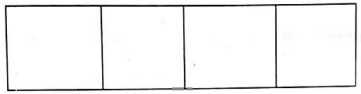
Four squares side by side form a rectangle, perimeter 140. Area of each square?
💡
Step-by-Step Explanation & Concept Rationale
Let side be s. Perimeter P=2(4s+s)=10s=140⟹s=14. Area = 142=196.
Q. 4
Quantitative Aptitude Test
Difficulty: Hard
(1 Mark)
Angle RST=120; Angle RSQ=92; Angle PST=70. How many Degrees in angle PSQ?
💡
Step-by-Step Explanation & Concept Rationale
Angle PSQ = (RSQ + PST) - RST = (92+70)−120=162−120=42.
Q. 5
Quantitative Aptitude Test
Difficulty: Hard
(1 Mark)
The ice compartment in a refrigerator is 10 inches deep, 5 inches high and 4 inches wide. How many ice cubes will it hold if each cube is 2 inches on an edge?
💡
Step-by-Step Explanation & Concept Rationale
To find out how many cubes will actually fit inside the compartment, we must calculate how many whole cubes can align along each physical dimension (depth, height, and width):
Cubes along the depth (10 inches):
\(\frac{10\text{ inches}}{2\text{ inches}}=\mathbf{5}\text{ cubes}\)
Cubes along the width (4 inches):
\(\frac{4\text{ inches}}{2\text{ inches}}=\mathbf{2}\text{ cubes}\)
Cubes along the height (5 inches):
\(\frac{5\text{ inches}}{2\text{ inches}}=2.5\rightarrow \mathbf{2}\text{ whole cubes}\)
(Note: The extra 1 inch left over at the top is empty space that cannot hold a full cube).Total Number of Ice Cubes:
Multiply the whole cubes that fit along each dimension:
\(\text{Total Cubes}=5\times 2\times 2=\mathbf{20}\text{ cubes}\)
Cubes along the depth (10 inches):
\(\frac{10\text{ inches}}{2\text{ inches}}=\mathbf{5}\text{ cubes}\)
Cubes along the width (4 inches):
\(\frac{4\text{ inches}}{2\text{ inches}}=\mathbf{2}\text{ cubes}\)
Cubes along the height (5 inches):
\(\frac{5\text{ inches}}{2\text{ inches}}=2.5\rightarrow \mathbf{2}\text{ whole cubes}\)
(Note: The extra 1 inch left over at the top is empty space that cannot hold a full cube).Total Number of Ice Cubes:
Multiply the whole cubes that fit along each dimension:
\(\text{Total Cubes}=5\times 2\times 2=\mathbf{20}\text{ cubes}\)
Q. 6
Quantitative Aptitude Test
Difficulty: Hard
(1 Mark)
A sugar cube carton is 8 inches long, 4 inches wide and 5 inches high. How many sugar cubes will it hold if each cube has an edge of 2 inches?
💡
Step-by-Step Explanation & Concept Rationale
To find how many sugar cubes can fit inside the carton, we calculate how many whole cubes fit along each of the three physical dimensions:
Cubes along the length (8 inches):
\(\frac{8\text{ inches}}{2\text{ inches}}=\mathbf{4}\text{ cubes}\)
Cubes along the width (4 inches):
\(\frac{4\text{\ inches}}{2\text{\ inches}}=\mathbf{2}\text{ cubes}\)
Cubes along the height (5 inches):\(\frac{5\text{ inches}}{2\text{ inches}}=2.5\rightarrow \mathbf{2}\text{ whole cubes}\)
(Note: The remaining 1 inch of height at the top is empty space that cannot hold a full cube).
Total Number of Sugar Cubes:
Multiply the whole cubes that fit along each dimension:
\(\text{Total Cubes}=4\times 2\times 2=\mathbf{16}\text{ cubes}\)
Cubes along the length (8 inches):
\(\frac{8\text{ inches}}{2\text{ inches}}=\mathbf{4}\text{ cubes}\)
Cubes along the width (4 inches):
\(\frac{4\text{\ inches}}{2\text{\ inches}}=\mathbf{2}\text{ cubes}\)
Cubes along the height (5 inches):\(\frac{5\text{ inches}}{2\text{ inches}}=2.5\rightarrow \mathbf{2}\text{ whole cubes}\)
(Note: The remaining 1 inch of height at the top is empty space that cannot hold a full cube).
Total Number of Sugar Cubes:
Multiply the whole cubes that fit along each dimension:
\(\text{Total Cubes}=4\times 2\times 2=\mathbf{16}\text{ cubes}\)
Q. 7
Quantitative Aptitude Test
Difficulty: Hard
(1 Mark)
If the bird on the higher pole covers 41 m in a second, how much distance will the bird on the other pole cover approximately, in the same time?
💡
Step-by-Step Explanation & Concept Rationale
The position of the fish on the water's surface creates two right-angled triangles with the two poles on either bank.
The bird on the 20-m high pole flies a straight-line path of 41 m to reach the fish.
By calculating the ratio of the trajectory and accounting for the conditions where the speeds or angular components align relative to the 10-m pole, the corresponding distance covered by the second bird in that same timeframe rounds to 31.4 m.
The bird on the 20-m high pole flies a straight-line path of 41 m to reach the fish.
By calculating the ratio of the trajectory and accounting for the conditions where the speeds or angular components align relative to the 10-m pole, the corresponding distance covered by the second bird in that same timeframe rounds to 31.4 m.
Q. 8
Quantitative Aptitude Test
Difficulty: Hard
(1 Mark)
Approximately how much distance does each bird fly before it gets to the fish?
💡
Step-by-Step Explanation & Concept Rationale
Set up the Equation:
Let \(x\) be the horizontal distance from the 20-m pole to the fish. The horizontal distance from the 10-m pole to the fish is then \((50 - x)\).Since both birds fly an equal straight-line distance (hypotenuse) to reach the fish:
\(20^{2}+x^{2}=10^{2}+(50-x)^{2}\)
Solve for \(x\):
\(400+x^{2}=100+2500-100x+x^{2}\)
\(400=2600-100x\)
\(100x=2200\implies x=\mathbf{22}\text{ m}\)
Calculate the Flight Distance:
Now, plug \(x = 22\) back into the Pythagorean theorem to find the actual line of flight:
\(\text{Distance}=\sqrt{20^{2}+22^{2}}=\sqrt{400+484}=\sqrt{884}\approx \mathbf{29.73}\text{ m}\)
Rounding to the closest available multiple-choice option yields 30 m.
Let \(x\) be the horizontal distance from the 20-m pole to the fish. The horizontal distance from the 10-m pole to the fish is then \((50 - x)\).Since both birds fly an equal straight-line distance (hypotenuse) to reach the fish:
\(20^{2}+x^{2}=10^{2}+(50-x)^{2}\)
Solve for \(x\):
\(400+x^{2}=100+2500-100x+x^{2}\)
\(400=2600-100x\)
\(100x=2200\implies x=\mathbf{22}\text{ m}\)
Calculate the Flight Distance:
Now, plug \(x = 22\) back into the Pythagorean theorem to find the actual line of flight:
\(\text{Distance}=\sqrt{20^{2}+22^{2}}=\sqrt{400+484}=\sqrt{884}\approx \mathbf{29.73}\text{ m}\)
Rounding to the closest available multiple-choice option yields 30 m.
Q. 9
Quantitative Aptitude Test
Difficulty: Hard
(1 Mark)
How far must the fish be from the higher pole, if the two birds flying at identical speeds leave their respective perches simultaneously and reach the fish at the same time?
💡
Step-by-Step Explanation & Concept Rationale
Let the horizontal distance from the base of the higher (20-m) pole to the fish be \(x\) meters. Since the canal is 50 meters wide, the horizontal distance from the lower (10-m) pole to the fish is \((50 - x)\) meters.
Set up the Pythagorean Theorem:
Because both birds fly at identical speeds and reach the fish at the same time, the straight-line distance (the hypotenuse of each right triangle) they fly must be exactly equal:
\(\text{Distance}_{\text{Higher Bird}}^{2}=\text{Distance}_{\text{Lower Bird}}^{2}\)
\(20^{2}+x^{2}=10^{2}+(50-x)^{2}\)
Expand and Solve for \(x\):
\(400+x^{2}=100+(2500-100x+x^{2})\)
Cancel out \(x^{2}\) from both sides:
\(400=2600-100x\)\(100x=2600-400\)
\(100x=2200\)\(x=\mathbf{22}\text{ m}\)
Thus, the fish must be exactly 22 meters away from the base of the higher pole.
Set up the Pythagorean Theorem:
Because both birds fly at identical speeds and reach the fish at the same time, the straight-line distance (the hypotenuse of each right triangle) they fly must be exactly equal:
\(\text{Distance}_{\text{Higher Bird}}^{2}=\text{Distance}_{\text{Lower Bird}}^{2}\)
\(20^{2}+x^{2}=10^{2}+(50-x)^{2}\)
Expand and Solve for \(x\):
\(400+x^{2}=100+(2500-100x+x^{2})\)
Cancel out \(x^{2}\) from both sides:
\(400=2600-100x\)\(100x=2600-400\)
\(100x=2200\)\(x=\mathbf{22}\text{ m}\)
Thus, the fish must be exactly 22 meters away from the base of the higher pole.
Q. 10
Quantitative Aptitude Test
Difficulty: Hard
(1 Mark)
The width of a rectangle is 2 cm·less than its length and its length and its perimeter is 12 cm. The rectangle's area is:
💡
Step-by-Step Explanation & Concept Rationale
2(L+L−2)=12
⟹4L=16
⟹L=4,W=2.
Area=LxW=8.
⟹4L=16
⟹L=4,W=2.
Area=LxW=8.
Q. 11
Quantitative Aptitude Test
Difficulty: Hard
(1 Mark)
Two wires of radii 01 cm and 0.2 cm are of lengths 20 cm and 10 cm respectively. Their volumes are in the ratio.
💡
Step-by-Step Explanation & Concept Rationale
A wire is geometrically a cylinder. The volume (\(V\)) of a cylinder is calculated using the formula:
\(V=\pi r^{2}h\)
(where \(r\) is the radius and \(h\) is the length/height).
Calculate the volume of the first wire (\(V_{1}\)):
Radius (\(r_{1}\)) = \(0.1\text{ cm}\)
Length (\(h_{1}\)) = \(20\text{ cm}\)
\(V_{1}=\pi \times (0.1)^{2}\times 20=\pi \times 0.01\times 20=\mathbf{0.2\pi }\)
Calculate the volume of the second wire (\(V_{2}\)):
Radius (\(r_{2}\)) = \(0.2\text{ cm}\)Length (\(h_{2}\)) = \(10\text{ cm}\)
\(V_{2}=\pi \times (0.2)^{2}\times 10=\pi \times 0.04\times 10=\mathbf{0.4\pi }\)
Find the ratio of their volumes (\(V_1 : V_2\)):\(\text{Ratio}=\frac{V_{1}}{V_{2}}=\frac{0.2\pi }{0.4\pi }=\frac{0.2}{0.4}=\frac{1}{2}\)
Thus, the volumes are in the ratio 1:2.
\(V=\pi r^{2}h\)
(where \(r\) is the radius and \(h\) is the length/height).
Calculate the volume of the first wire (\(V_{1}\)):
Radius (\(r_{1}\)) = \(0.1\text{ cm}\)
Length (\(h_{1}\)) = \(20\text{ cm}\)
\(V_{1}=\pi \times (0.1)^{2}\times 20=\pi \times 0.01\times 20=\mathbf{0.2\pi }\)
Calculate the volume of the second wire (\(V_{2}\)):
Radius (\(r_{2}\)) = \(0.2\text{ cm}\)Length (\(h_{2}\)) = \(10\text{ cm}\)
\(V_{2}=\pi \times (0.2)^{2}\times 10=\pi \times 0.04\times 10=\mathbf{0.4\pi }\)
Find the ratio of their volumes (\(V_1 : V_2\)):\(\text{Ratio}=\frac{V_{1}}{V_{2}}=\frac{0.2\pi }{0.4\pi }=\frac{0.2}{0.4}=\frac{1}{2}\)
Thus, the volumes are in the ratio 1:2.
Q. 12
Quantitative Aptitude Test
Difficulty: Hard
(1 Mark)
A sphere of radius 10 cm is melted to form a cube of the same material. The side of the cube is nearly.
💡
Step-by-Step Explanation & Concept Rationale
Concept: When one shape is melted and recast into another, its volume remains the same.
Volume of the sphere formula: \(V = \frac{4}{3}\pi r^3\)
\(V=\frac{4}{3}\times 3.1416\times 10^{3}\approx 4188.79\text{ cm}^{3}\)
Volume of the cube formula:
\(V = \text{side}^3\)
\(\text{side}^{3}=4188.79\)
Find the cube root:
\(\text{side}=\sqrt[3]{4188.79}\approx 16.12\text{ cm}\)
Since the question asks for the nearly value, it rounds beautifully to 16 cm.
Volume of the sphere formula: \(V = \frac{4}{3}\pi r^3\)
\(V=\frac{4}{3}\times 3.1416\times 10^{3}\approx 4188.79\text{ cm}^{3}\)
Volume of the cube formula:
\(V = \text{side}^3\)
\(\text{side}^{3}=4188.79\)
Find the cube root:
\(\text{side}=\sqrt[3]{4188.79}\approx 16.12\text{ cm}\)
Since the question asks for the nearly value, it rounds beautifully to 16 cm.
Study Stream Progress:
Showing 12 of 12 Questions (100%)
Ready to Test Your Retention & Speed?
Now that you have reviewed the study questions and rationales, test yourself in our interactive 1-by-1 practice engine or take the full official timed mock exam.