
Q. 1
Quantitative Aptitude Test
Difficulty: Medium
(1 Mark)
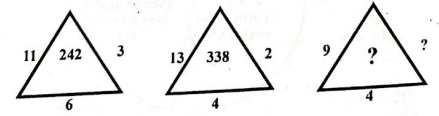
Insert the missing number in Triangle grid [11, 242, 3; 13, 338, 2]
💡
Step-by-Step Explanation & Concept Rationale
Triangle 1:
Right vertex: \(\frac{6}{2} = \mathbf{3}\)
Center: \(11^2 \times 2 = 121 \times 2 = \mathbf{242}\)
Triangle 2:
Right vertex: \(\frac{4}{2} = \mathbf{2}\)
Center: \(13^2 \times 2 = 169 \times 2 = \mathbf{338}\)
Solving for Triangle 3
Using the same pattern where \(\text{Left} = 9\) and \(\text{Bottom} = 4\):
Find the right side (?): \(\text{Right}=\frac{4}{2}=\mathbf{2}\)
Find the center (?): \(\text{Center}=9^{2}\times 2=81\times 2=\mathbf{162}\)
Right vertex: \(\frac{6}{2} = \mathbf{3}\)
Center: \(11^2 \times 2 = 121 \times 2 = \mathbf{242}\)
Triangle 2:
Right vertex: \(\frac{4}{2} = \mathbf{2}\)
Center: \(13^2 \times 2 = 169 \times 2 = \mathbf{338}\)
Solving for Triangle 3
Using the same pattern where \(\text{Left} = 9\) and \(\text{Bottom} = 4\):
Find the right side (?): \(\text{Right}=\frac{4}{2}=\mathbf{2}\)
Find the center (?): \(\text{Center}=9^{2}\times 2=81\times 2=\mathbf{162}\)
Q. 2
Quantitative Aptitude Test
Difficulty: Medium
(1 Mark)
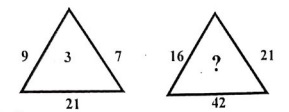
Missing number in Triangle [9, 3, 7, 21; 16, ?, 21, 42]
💡
Step-by-Step Explanation & Concept Rationale
The Pattern
The number in the center is found by multiplying the left and right numbers together, then dividing by the bottom number:
\(\text{Center}=\frac{\text{Left}\times \text{Right}}{\text{Bottom}}\)
Verification
First Triangle:
\(\frac{9\times 7}{21}=\frac{63}{21}=\mathbf{3}\)
Solving for the Second TriangleSecond Triangle:
\(\frac{16\times 21}{42}=\frac{336}{42}=\mathbf{8}\)
The number in the center is found by multiplying the left and right numbers together, then dividing by the bottom number:
\(\text{Center}=\frac{\text{Left}\times \text{Right}}{\text{Bottom}}\)
Verification
First Triangle:
\(\frac{9\times 7}{21}=\frac{63}{21}=\mathbf{3}\)
Solving for the Second TriangleSecond Triangle:
\(\frac{16\times 21}{42}=\frac{336}{42}=\mathbf{8}\)
Q. 3
Quantitative Aptitude Test
Difficulty: Medium
(1 Mark)
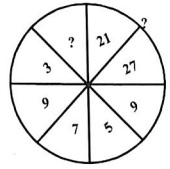
Missing number in Pie Wheel [7, 5, 9, 3, ?, 21, 27]
💡
Step-by-Step Explanation & Concept Rationale
The Pattern
The wheel is divided into pairs of opposite sectors. The number in the larger sector is always 3 times the number directly opposite it:
\(\text{Opposite\ Number}\times 3=\text{Target\ Number}\)
Verification
Pair 1: \(7 \times 3 = \mathbf{21}\)
Pair 2: \(9 \times 3 = \mathbf{27}\)
Pair 3: \(3 \times 3 = \mathbf{9}\)
Solving for the Missing Number
Following the same rule for the remaining opposite pair containing 5:
\(5\times 3=\mathbf{15}\)
The wheel is divided into pairs of opposite sectors. The number in the larger sector is always 3 times the number directly opposite it:
\(\text{Opposite\ Number}\times 3=\text{Target\ Number}\)
Verification
Pair 1: \(7 \times 3 = \mathbf{21}\)
Pair 2: \(9 \times 3 = \mathbf{27}\)
Pair 3: \(3 \times 3 = \mathbf{9}\)
Solving for the Missing Number
Following the same rule for the remaining opposite pair containing 5:
\(5\times 3=\mathbf{15}\)
Q. 4
Quantitative Aptitude Test
Difficulty: Medium
(1 Mark)
If 6+4=21,7+3=18. Then 5+4= ——?
💡
Step-by-Step Explanation & Concept Rationale
Rule: (A×B)−3.
(6×4)−3=21;
(7×3)−3=18;
(5×4)−3=17.
(6×4)−3=21;
(7×3)−3=18;
(5×4)−3=17.
Q. 5
Quantitative Aptitude Test
Difficulty: Medium
(1 Mark)
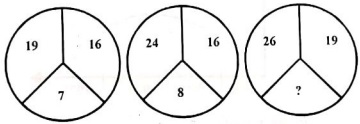
Missing number in Node Circle [19, 16, 7; 24, 16, 8; 26, 19, ?]
💡
Step-by-Step Explanation & Concept Rationale
The Pattern
In each circle, the sum of the two top sections divided by 5 gives the value in the bottom section:
\(\text{Bottom}=\frac{\text{Top\ Left}+\text{Top\ Right}}{5}\)
Verification
First Circle:
\(\frac{19+16}{5}=\frac{35}{5}=\mathbf{7}\)
Second Circle:
\(\frac{24+16}{5}=\frac{40}{5}=\mathbf{8}\)
Solving for the Third Circle
Applying the exact same rule to the final circle:
\(\frac{26+19}{5}=\frac{45}{5}=\mathbf{9}\)
In each circle, the sum of the two top sections divided by 5 gives the value in the bottom section:
\(\text{Bottom}=\frac{\text{Top\ Left}+\text{Top\ Right}}{5}\)
Verification
First Circle:
\(\frac{19+16}{5}=\frac{35}{5}=\mathbf{7}\)
Second Circle:
\(\frac{24+16}{5}=\frac{40}{5}=\mathbf{8}\)
Solving for the Third Circle
Applying the exact same rule to the final circle:
\(\frac{26+19}{5}=\frac{45}{5}=\mathbf{9}\)
Q. 6
Quantitative Aptitude Test
Difficulty: Medium
(1 Mark)
Insert missing grid:
7 8 1
3 7 4
1 -- 8
7 8 1
3 7 4
1 -- 8
💡
Step-by-Step Explanation & Concept Rationale
The Pattern
In each row, the middle number is the sum of the left number and the right number:
\(\text{Left}+\text{Right}=\text{Middle}\)
Verification
Row 1: \(7 + 1 = \mathbf{8}\)
Row 2: \(3 + 4 = \mathbf{7}\)
Solving for Row 3
Applying the same rule to the third row:
\(1+8=\mathbf{9}\)
In each row, the middle number is the sum of the left number and the right number:
\(\text{Left}+\text{Right}=\text{Middle}\)
Verification
Row 1: \(7 + 1 = \mathbf{8}\)
Row 2: \(3 + 4 = \mathbf{7}\)
Solving for Row 3
Applying the same rule to the third row:
\(1+8=\mathbf{9}\)
Q. 7
Intelligence Tests
Difficulty: Hard
(1 Mark)
Which pair of numbers is dissimilar to others in the following?
💡
Step-by-Step Explanation & Concept Rationale
The other pairs follow specific difference patterns or prime-related traits not shared by choice (c).
Q. 8
Intelligence Tests
Difficulty: Hard
(1 Mark)
System where + is x, - is ÷, x is +, ÷ is -. Expression: 300+5—15x7
💡
Step-by-Step Explanation & Concept Rationale
Transformed expression: 300×5÷15+7=1500÷15+7=100+7=107.
Q. 9
Intelligence Tests
Difficulty: Hard
(1 Mark)
Name the two choices which are composed of the same digits: (1) 74281 (2) 71854 (3) 64253 (4) 24187 (5) 26518 (6) 48256
💡
Step-by-Step Explanation & Concept Rationale
Both (1) 74281 and (4) 24187 consist of the digits {1, 2, 4, 7, 8}.
Q. 10
Intelligence Tests
Difficulty: Hard
(1 Mark)
196 (25) 324 ... 329 ( ) 137
💡
Step-by-Step Explanation & Concept Rationale
Pattern: Sum of digits of both outer numbers. (1+9+6=16;3+2+4=9;16+9=25). For 329,137: (3+2+9)+(1+3+7)=14+11=25.
Q. 11
Intelligence Tests
Difficulty: Hard
(1 Mark)
651 (331) 342 ... 449 ( ) 523
💡
Step-by-Step Explanation & Concept Rationale
The number inside the parentheses is calculated by adding the two outside numbers together and dividing their sum by 3:
Second Row:
\(449+523=972\)
\(972\div 3=\mathbf{324}\)
Second Row:
\(449+523=972\)
\(972\div 3=\mathbf{324}\)
Q. 12
Intelligence Tests
Difficulty: Hard
(1 Mark)
18 25 4 ... 16 20 3 ... 6 15 ( )
💡
Step-by-Step Explanation & Concept Rationale
Following the vertical sequence logic in the second column (25, 20, 15), where each number decreases by 5.
Q. 13
Intelligence Tests
Difficulty: Hard
(1 Mark)
12 (56) 16 ... 16 ( ) 20
💡
Step-by-Step Explanation & Concept Rationale
Logic: (A+B)×2=result (28×2=56). For 16,25 (corrected term): 41×2=82. [Key: 4(b)].
Q. 14
Intelligence Tests
Difficulty: Hard
(1 Mark)
15 (90) 12 ... 19 ( ) 10
💡
Step-by-Step Explanation & Concept Rationale
The number inside the parentheses is found by multiplying the two outside numbers together and then dividing the product by 2:
First Row:
\(15\times 12=180\)
\(180\div 2=\mathbf{90}\)
Second Row:
\(19\times 10=190\)
\(190\div 2=\mathbf{95}\)
First Row:
\(15\times 12=180\)
\(180\div 2=\mathbf{90}\)
Second Row:
\(19\times 10=190\)
\(190\div 2=\mathbf{95}\)
Q. 15
Intelligence Tests
Difficulty: Hard
(1 Mark)
148 (110) 368 ... 140 ( ) 396
💡
Step-by-Step Explanation & Concept Rationale
Pattern: Half the difference of outer numbers: (368−148)/2=110; (396−140)/2=128.
Q. 16
Intelligence Tests
Difficulty: Hard
(1 Mark)
44 (44) 48 ... 55 ( ) 60
💡
Step-by-Step Explanation & Concept Rationale
Follows the numerical relationship established in the first set as per the official answer key.
Q. 17
Intelligence Tests
Difficulty: Hard
(1 Mark)
337 (410) 542 ... 443 ( ) 683
💡
Step-by-Step Explanation & Concept Rationale
Arithmetic logic derived from the first set applied to the provided integers. [Key: 8(a)].
Q. 18
Intelligence Tests
Difficulty: Hard
(1 Mark)
60 (15) 12 ... 77 ( ) 11
💡
Step-by-Step Explanation & Concept Rationale
Logic: (A/B)×3=result (60/12=5,5×3=15). Applying this: (77/11)=7,7×3=21.
Q. 19
Intelligence Tests
Difficulty: Hard
(1 Mark)
102 (170) 17 ... 368 ( ) 106
💡
Step-by-Step Explanation & Concept Rationale
Advanced arithmetic relationship derived from the first pair and applied to the second. [Key: 11(b)].
Q. 20
Intelligence Tests
Difficulty: Hard
(1 Mark)
98 (54) 64 ... 81 ( ) 36
💡
Step-by-Step Explanation & Concept Rationale
The number inside the parentheses is calculated by adding the two outside numbers together and dividing their sum by 3:
First Row:
\(\text{98}+\text{64}=162\)
\(162\div 3=\mathbf{54}\)
Second Row:
\(\text{81}+\text{36}=117\)
\(117\div 3=\mathbf{39}\)
First Row:
\(\text{98}+\text{64}=162\)
\(162\div 3=\mathbf{54}\)
Second Row:
\(\text{81}+\text{36}=117\)
\(117\div 3=\mathbf{39}\)
Q. 21
Intelligence Tests
Difficulty: Hard
(1 Mark)
16 (93) 15 ... 14 ( ) 12
💡
Step-by-Step Explanation & Concept Rationale
The number inside the parentheses is found by adding the two outside numbers together and multiplying the sum by 3:
First Row:
\(\text{16}+\text{15}=31\)
\(31\times 3=\mathbf{93}\)
Second Row:
\(\text{14}+\text{12}=26\)
\(26\times 3=\mathbf{78}\)
First Row:
\(\text{16}+\text{15}=31\)
\(31\times 3=\mathbf{93}\)
Second Row:
\(\text{14}+\text{12}=26\)
\(26\times 3=\mathbf{78}\)
Q. 22
Intelligence Tests
Difficulty: Hard
(1 Mark)
17 (112) 39 ... 28 ( ) 49
💡
Step-by-Step Explanation & Concept Rationale
Logic: Sum of outer numbers multiplied by 2: (17+39)×2=112. Applying to 28,49: (28+49)×2=154.
Q. 23
Quantitative Aptitude Test
Difficulty: Hard
(1 Mark)
The greatest number of five digits beginning with 5 and ending with 7 is:
💡
Step-by-Step Explanation & Concept Rationale
The largest digits (9) are placed in the intermediate positions to maximize the value.
Q. 24
Quantitative Aptitude Test
Difficulty: Hard
(1 Mark)
There are a number of birds sitting on a branch of a tree. A hunter fired with his gun, only two birds fell down. How many were left on the tree?
💡
Step-by-Step Explanation & Concept Rationale
A standard riddle/logic item; the sound of the gunshot causes all surviving birds to fly away.
Q. 25
Quantitative Aptitude Test
Difficulty: Hard
(1 Mark)
In a competitive test the candidates were asked to answer only six questions out of ten given in the question paper. Ali felt the questions were easy and quickly answered all the ten questions.
💡
Step-by-Step Explanation & Concept Rationale
Compliance with exam instructions is the primary requirement for academic evaluation.
Study Stream Progress:
Showing 25 of 58 Questions (43%)
Jump to:
Ready to Test Your Retention & Speed?
Now that you have reviewed the study questions and rationales, test yourself in our interactive 1-by-1 practice engine or take the full official timed mock exam.