

Mastery Guide: Place Value, Decimal Arithmetic, Fraction Conversions & Percentage Applications
Instructional Blueprint: Unit 4 — Decimals and Percentages
- Read, write, compare, and order decimals up to 3 decimal places (tenths, hundredths, thousandths).
- Perform vertical addition and subtraction of decimals using placeholder zeros.
- Multiply and divide decimals by $10, 100, 1000$, whole numbers, and other decimals.
- Convert seamlessly between fractions, decimals, and percentages ($x\% = \frac{x}{100} = 0.0x$).
- Round off decimals to nearest whole numbers, tenths ($1$ d.p.), and hundredths ($2$ d.p.).
- Apply BODMAS order of operations to decimal expressions and solve real-world problems.
- 00-15m: Decimal Place Value Chart, Comparing & Number Line Ordering.
- 15-30m: Decimal Arithmetic ($+,-,\times,\div$) & Power-of-10 Point Shifts.
- 30-45m: The Magic Triangle: Fractions $\leftrightarrow$ Decimals $\leftrightarrow$ Percentages.
- 45-60m: Rounding, Estimation, BODMAS & Real-Life Percentage Applications.
- Struggling: Use $10 \times 10$ shaded grids for decimals and percentages to visualize tenths/hundredths.
- Advanced: Multi-step commercial word problems with discounts, percentages, and remainder splits.
Welcome to Decimals: Place Value up to Thousandths
A decimal number is a number that contains a decimal point. The digits to the left of the decimal point represent whole numbers, and the digits to the right represent fractional parts of a whole.
"A pencil is $10.4\text{ cm}$ long and an eraser is $6.8\text{ cm}$ long. How much longer is the pencil than the eraser?"
Solution: Difference $= 10.4\text{ cm} - 6.8\text{ cm} = \mathbf{3.6\text{ cm}}$. The pencil is $3.6\text{ cm}$ longer!
| Hundreds ($100$) | Tens ($10$) | Ones ($1$) | . | Tenths ($\frac{1}{10} = 0.1$) | Hundredths ($\frac{1}{100} = 0.01$) | Thousandths ($\frac{1}{1000} = 0.001$) |
|---|---|---|---|---|---|---|
| $5$ | $3$ | $8$ | . | $4$ | $7$ | $9$ |
In the number $538.479$:
• Value of $4 = \frac{4}{10} = 0.4$ ($4$ tenths)
• Value of $7 = \frac{7}{100} = 0.07$ ($7$ hundredths)
• Value of $9 = \frac{9}{1000} = 0.009$ ($9$ thousandths)
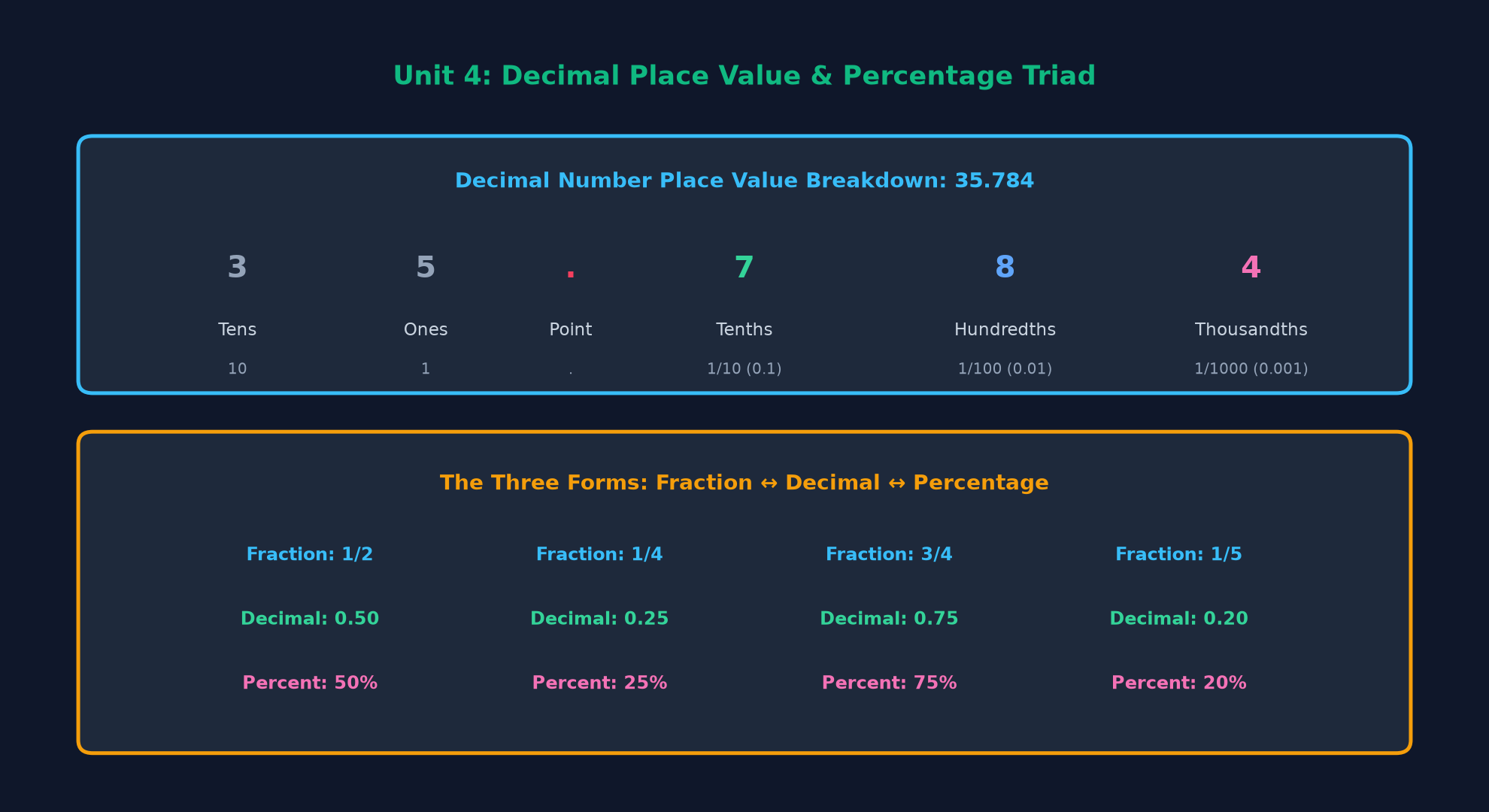
Figure 4.1: Decimal Place Value & 100-Square Percentage Visual Model
Comparing and Ordering Decimals
Step 1: Compare the whole number part first (e.g., in $35.66$ vs $34.56$, $35 > 34$, so $35.66 > 34.56$).
Step 2: If whole numbers are equal, compare tenths (e.g., in $2.58$ vs $2.53$, tenths are equal ($5=5$), so compare hundredths: $8 > 3 \implies \mathbf{2.58 > 2.53}$).
Step 3: Trailing zeros do NOT change the value: $4.8 = 4.80 = 4.800$.
Addition & Subtraction of Decimals: The "Line Up the Dots" Rule
To add or subtract decimals, always align the decimal points vertically. Fill in missing places with placeholder zeros so all numbers have the same number of decimal digits.
Add $4.131 + 8.3$:
Step 1: Write $8.3$ as $8.300$ (pad placeholder zeros).
Step 2: Line up dots & add:
$$\begin{array}{r@{\quad}l} 4.131 \\ +\; 8.300 \\ \hline \mathbf{12.431} \end{array}$$
Subtract $11.45 - 2.86$:
Step 1: Align vertically.
Step 2: Regroup/borrow across the decimal point:
$$\begin{array}{r@{\quad}l} 11.45 \\ -\; 2.86 \\ \hline \mathbf{8.59} \end{array}$$
An adult giraffe is $5.5\text{ m}$ tall and a baby giraffe is $1.8\text{ m}$ tall.
Difference $= 5.5 - 1.8 = \mathbf{3.7\text{ m}}$.
Multiplication of Decimals: Shifts, Whole Numbers & Decimal-by-Decimal
Rule 1: Multiplying by $10, 100, 1000$ (Move Right)
• $\times 10 \implies$ move $1$ place right: $4.256 \times 10 = \mathbf{42.56}$
• $\times 100 \implies$ move $2$ places right: $4.256 \times 100 = \mathbf{425.6}$
• $\times 1000 \implies$ move $3$ places right: $4.256 \times 1000 = \mathbf{4256}$
Rule 2: Multiplying Decimal by Decimal
Step 1: Multiply as whole numbers, ignoring decimal points.
Step 2: Count total decimal places in both factors.
Step 3: Place the decimal point in the product counting that many digits from right to left.
Multiply: $391 \times 245 = 95795$.
Total decimal places $= 2 + 2 = 4$.
$$\text{Area} = \mathbf{9.5795\text{ m}^2}$$
Division of Decimals: Shifts, Whole Numbers & Divisors with Decimals
Rule 1: Dividing by $10, 100, 1000$ (Move Left)
• $\div 10 \implies$ move $1$ place left: $382.4 \div 10 = \mathbf{38.24}$
• $\div 100 \implies$ move $2$ places left: $382.4 \div 100 = \mathbf{3.824}$
• $\div 1000 \implies$ move $3$ places left: $382.4 \div 1000 = \mathbf{0.3824}$
Rule 2: Dividing by a Decimal Divisor
Example: $67.5 \div 4.5 \implies \frac{67.5 \times 10}{4.5 \times 10} = \frac{675}{45} = \mathbf{15}$.
Dual Conversions: Fractions $\leftrightarrow$ Decimals
• $\frac{45}{2} = 45 \div 2 = \mathbf{22.5}$
• $\frac{19}{25} = \frac{19 \times 4}{25 \times 4} = \frac{76}{100} = \mathbf{0.76}$
• $\frac{1}{8} = 1 \div 8 = \mathbf{0.125}$ (Noman's pizza!)
• $0.45 = \frac{45}{100} = \mathbf{\frac{9}{20}}$
• $37.2 = \frac{372}{10} = \mathbf{\frac{186}{5} = 37\frac{1}{5}}$
• $55.5 = \frac{555}{10} = \mathbf{\frac{111}{2} = 55\frac{1}{2}}$
Rounding Off & Mental Estimation
• If digit is $\ge 5$ ($5, 6, 7, 8, 9$), ROUND UP (add $1$ to target digit).
• If digit is $< 5$ ($0, 1, 2, 3, 4$), ROUND DOWN / STAY SAME.
$9.65 \implies 6 \ge 5 \implies \mathbf{10}$
$4.444 \implies 4 < 5 \implies \mathbf{4}$
$47.125 \implies 2 < 5 \implies \mathbf{47.1}$
$2.150 \implies 5 \ge 5 \implies \mathbf{2.2}$
$47.125 \implies 5 \ge 5 \implies \mathbf{47.13}$
$90.267 \implies 7 \ge 5 \implies \mathbf{90.27}$
Order of Operations (BODMAS) with Decimals
Always follow the hierarchy: Brackets $\rightarrow$ Of $\rightarrow$ Division $\rightarrow$ Multiplication $\rightarrow$ Addition $\rightarrow$ Subtraction.
Step 1 (Brackets): $4.2 - 2 = 2.2 \implies 1.1 \times 10 + 2.2 \times 3.7$
Step 2 (Multiplication from left): $1.1 \times 10 = 11$, and $2.2 \times 3.7 = 8.14$
Step 3 (Addition): $11 + 8.14 = \mathbf{19.14}$
The Magic of Percentages ($\%$) & Conversions
The word percent comes from Latin per centum, meaning out of one hundred. The symbol $\%$ represents a fraction with denominator $100$.
| Conversion Type | Rule & Formula | Example |
|---|---|---|
| Fraction to Percentage | Multiply by $100\%$ | $\frac{23}{25} \times 100\% = 23 \times 4\% = \mathbf{92\%}$ |
| Percentage to Fraction | Write over $100$ and simplify | $42\% = \frac{42}{100} = \mathbf{\frac{21}{50}}$ |
| Decimal to Percentage | Multiply by $100$ (move dot 2 right) | $0.34 \times 100\% = \mathbf{34\%}$ |
| Percentage to Decimal | Divide by $100$ (move dot 2 left) | $71\% = \frac{71}{100} = \mathbf{0.71}$ |
| Percentage of a Quantity | $\frac{\text{Percent}}{100} \times \text{Total}$ | $72\%$ of $850 = \frac{72}{100} \times 850 = \mathbf{612}$ |
📝 Unit 4 Solved Exercises (100% Exhaustive & Complete Solutions)
(a) $0.4\ \underline{\hspace{20pt}}\ 0.5$: $4$ tenths $< 5$ tenths $\implies \mathbf{0.4 < 0.5}$
(b) $1.3\ \underline{\hspace{20pt}}\ 1.6$: Whole numbers equal, tenths $3 < 6 \implies \mathbf{1.3 < 1.6}$
(c) $34.56\ \underline{\hspace{20pt}}\ 35.66$: Whole numbers $34 < 35 \implies \mathbf{34.56 < 35.66}$
(d) $6.67\ \underline{\hspace{20pt}}\ 6.69$: Tenths equal, hundredths $7 < 9 \implies \mathbf{6.67 < 6.69}$
(e) $0.45\ \underline{\hspace{20pt}}\ 0.45$: Both numbers identical $\implies \mathbf{0.45 = 0.45}$
(f) $23.12\ \underline{\hspace{20pt}}\ 51.31$: Whole numbers $23 < 51 \implies \mathbf{23.12 < 51.31}$
(g) $71.2\ \underline{\hspace{20pt}}\ 71.02$: Pad zero: $71.20$ vs $71.02$. Tenths $2 > 0 \implies \mathbf{71.2 > 71.02}$
(h) $6.06\ \underline{\hspace{20pt}}\ 6.1$: Pad zero: $6.06$ vs $6.10$. Tenths $0 < 1 \implies \mathbf{6.06 < 6.1}$
(i) $4.8\ \underline{\hspace{20pt}}\ 4.80$: Trailing zeros do not change value $\implies \mathbf{4.8 = 4.80}$
(a) $0.23, 0.45, 0.12, 0.67$: $\implies \mathbf{0.67, 0.45, 0.23, 0.12}$
(b) $2.4, 2.7, 2.1, 2.9$: $\implies \mathbf{2.9, 2.7, 2.4, 2.1}$
(c) $14.56, 14.65, 14.12, 14.89$: $\implies \mathbf{14.89, 14.65, 14.56, 14.12}$
(d) $3.12, 3.21, 3.02, 3.20$: $\implies \mathbf{3.21, 3.20, 3.12, 3.02}$
(a) $0.8, 0.2, 0.5, 0.9$: $\implies \mathbf{0.2, 0.5, 0.8, 0.9}$
(b) $5.43, 5.34, 5.41, 5.14$: $\implies \mathbf{5.14, 5.34, 5.41, 5.43}$
(c) $11.02, 11.20, 11.12, 11.22$: $\implies \mathbf{11.02, 11.12, 11.20, 11.22}$
(d) $6.78, 6.87, 6.08, 6.80$: $\implies \mathbf{6.08, 6.78, 6.80, 6.87}$
(a) $4.131 + 8.3$: $4.131 + 8.300 = \mathbf{12.431}$
(b) $3.211 + 1.860$: $3.211 + 1.860 = \mathbf{5.071}$
(c) $12.45 + 6.321$: $12.450 + 6.321 = \mathbf{18.771}$
(d) $7.892 + 4.108$: $7.892 + 4.108 = \mathbf{12.000 = 12}$
(e) $15.6 + 9.875$: $15.600 + 9.875 = \mathbf{25.475}$
(f) $0.456 + 0.789$: $0.456 + 0.789 = \mathbf{1.245}$
(g) $23.14 + 16.9$: $23.14 + 16.90 = \mathbf{40.04}$
(h) $8.005 + 3.995$: $8.005 + 3.995 = \mathbf{12.000 = 12}$
(i) $45.123 + 12.877$: $45.123 + 12.877 = \mathbf{58.000 = 58}$
(j) $1.234 + 5.678$: $1.234 + 5.678 = \mathbf{6.912}$
(k) $67.8 + 23.456$: $67.800 + 23.456 = \mathbf{91.256}$
(l) $9.999 + 0.001$: $9.999 + 0.001 = \mathbf{10.000 = 10}$
(a) $9.410 - 2.392$: $9.410 - 2.392 = \mathbf{7.018}$
(b) $11.45 - 2.86$: $11.45 - 2.86 = \mathbf{8.59}$
(c) $15.678 - 9.456$: $15.678 - 9.456 = \mathbf{6.222}$
(d) $8.5 - 3.25$: $8.50 - 3.25 = \mathbf{5.25}$
(e) $20.005 - 12.789$: $20.005 - 12.789 = \mathbf{7.216}$
(f) $14.12 - 6.895$: $14.120 - 6.895 = \mathbf{7.225}$
(g) $7.8 - 4.356$: $7.800 - 4.356 = \mathbf{3.444}$
(h) $50.0 - 24.678$: $50.000 - 24.678 = \mathbf{25.322}$
(i) $6.789 - 1.234$: $6.789 - 1.234 = \mathbf{5.555}$
(j) $18.45 - 9.876$: $18.450 - 9.876 = \mathbf{8.574}$
(k) $10.01 - 4.567$: $10.010 - 4.567 = \mathbf{5.443}$
(l) $32.1 - 15.678$: $32.100 - 15.678 = \mathbf{16.422}$
(a) How much sugar did she use in total?
$$\text{Total Sugar} = 50.55 + 28.50 = \mathbf{79.05\text{ g}}$$
(b) How much more sugar was used for the cake than cupcakes?
$$\text{Difference} = 50.55 - 28.50 = \mathbf{22.05\text{ g}}$$
(a) $2.34 \times 10$: $\mathbf{23.4}$
(b) $5.678 \times 100$: $\mathbf{567.8}$
(c) $0.45 \times 1000$: $\mathbf{450}$
(d) $12.3 \times 10$: $\mathbf{123}$
(e) $0.009 \times 100$: $\mathbf{0.9}$
(f) $7.812 \times 1000$: $\mathbf{7812}$
(g) $65.4 \times 100$: $\mathbf{6540}$
(h) $0.123 \times 10$: $\mathbf{1.23}$
(i) $3.4 \times 1000$: $\mathbf{3400}$
(j) $98.76 \times 10$: $\mathbf{987.6}$
(k) $1.005 \times 100$: $\mathbf{100.5}$
(l) $0.06 \times 1000$: $\mathbf{60}$
(a) $4.23 \times 12$: $423 \times 12 = 5076 \implies \mathbf{50.76}$
(b) $6.15 \times 24$: $615 \times 24 = 14760 \implies \mathbf{147.60 = 147.6}$
(c) $12.5 \times 15$: $125 \times 15 = 1875 \implies \mathbf{187.5}$
(d) $3.456 \times 11$: $3456 \times 11 = 38016 \implies \mathbf{38.016}$
(e) $8.05 \times 32$: $805 \times 32 = 25760 \implies \mathbf{257.60 = 257.6}$
(f) $1.78 \times 45$: $178 \times 45 = 8010 \implies \mathbf{80.10 = 80.1}$
(g) $9.21 \times 18$: $921 \times 18 = 16578 \implies \mathbf{165.78}$
(h) $0.85 \times 25$: $85 \times 25 = 2125 \implies \mathbf{21.25}$
(i) $14.2 \times 50$: $142 \times 50 = 7100 \implies \mathbf{710.0 = 710}$
(j) $5.112 \times 16$: $5112 \times 16 = 81792 \implies \mathbf{81.792}$
(k) $7.4 \times 35$: $74 \times 35 = 2590 \implies \mathbf{259.0 = 259}$
(l) $2.65 \times 42$: $265 \times 42 = 11130 \implies \mathbf{111.30 = 111.3}$
(a) $2.3 \times 1.4$: $23 \times 14 = 322 \implies \mathbf{3.22}$
(b) $4.15 \times 2.3$: $415 \times 23 = 9545 \implies \mathbf{9.545}$
(c) $0.5 \times 0.7$: $5 \times 7 = 35 \implies \mathbf{0.35}$
(d) $6.12 \times 3.4$: $612 \times 34 = 20808 \implies \mathbf{20.808}$
(e) $1.25 \times 0.8$: $125 \times 8 = 1000 \implies \mathbf{1.000 = 1}$
(f) $7.8 \times 2.15$: $78 \times 215 = 16770 \implies \mathbf{16.770 = 16.77}$
(g) $0.45 \times 1.2$: $45 \times 12 = 540 \implies \mathbf{0.540 = 0.54}$
(h) $9.1 \times 4.2$: $91 \times 42 = 3822 \implies \mathbf{38.22}$
(i) $3.15 \times 2.45$: $315 \times 245 = 77175 \implies \mathbf{7.7175}$
(j) $0.12 \times 0.34$: $12 \times 34 = 408 \implies \mathbf{0.0408}$
(k) $5.6 \times 1.8$: $56 \times 18 = 1008 \implies \mathbf{10.08}$
(l) $8.25 \times 0.6$: $825 \times 6 = 4950 \implies \mathbf{4.950 = 4.95}$
• Cost of $10\text{ m} = 25.5 \times 10 = \mathbf{\text{Rs. } 255}$
• Cost of $100\text{ m} = 25.5 \times 100 = \mathbf{\text{Rs. } 2550}$
• Cost of $1000\text{ m} = 25.5 \times 1000 = \mathbf{\text{Rs. } 25500}$
(a) $45.6 \div 10$: $\mathbf{4.56}$
(b) $789.2 \div 100$: $\mathbf{7.892}$
(c) $123.4 \div 1000$: $\mathbf{0.1234}$
(d) $6.8 \div 10$: $\mathbf{0.68}$
(e) $54.1 \div 100$: $\mathbf{0.541}$
(f) $9.5 \div 1000$: $\mathbf{0.0095}$
(g) $345.0 \div 10$: $\mathbf{34.5}$
(h) $12.0 \div 100$: $\mathbf{0.12}$
(i) $8.0 \div 1000$: $\mathbf{0.008}$
(a) $24.8 \div 4$: $\mathbf{6.2}$
(b) $45.65 \div 5$: $\mathbf{9.13}$
(c) $18.9 \div 9$: $\mathbf{2.1}$
(d) $56.7 \div 7$: $\mathbf{8.1}$
(e) $3.75 \div 5$: $\mathbf{0.75}$
(f) $81.9 \div 3$: $\mathbf{27.3}$
(g) $14.4 \div 12$: $\mathbf{1.2}$
(h) $62.5 \div 25$: $\mathbf{2.5}$
(i) $9.45 \div 15$: $\mathbf{0.63}$
(a) $4.8 \div 0.6$: $\frac{48}{6} = \mathbf{8}$
(b) $12.5 \div 2.5$: $\frac{125}{25} = \mathbf{5}$
(c) $6.75 \div 1.5$: $\frac{67.5}{15} = \mathbf{4.5}$
(d) $14.4 \div 1.2$: $\frac{144}{12} = \mathbf{12}$
(e) $8.1 \div 0.9$: $\frac{81}{9} = \mathbf{9}$
(f) $15.75 \div 3.5$: $\frac{157.5}{35} = \mathbf{4.5}$
(g) $0.48 \div 0.08$: $\frac{48}{8} = \mathbf{6}$
(h) $2.25 \div 0.5$: $\frac{22.5}{5} = \mathbf{4.5}$
(i) $9.6 \div 3.2$: $\frac{96}{32} = \mathbf{3}$
(a) Each bottle holds $4.5\text{ litres}$?
$$\text{Number of bottles} = 67.5 \div 4.5 = \frac{675}{45} = \mathbf{15\text{ bottles}}$$
(b) Each bottle holds $2.5\text{ litres}$?
$$\text{Number of bottles} = 67.5 \div 2.5 = \frac{675}{25} = \mathbf{27\text{ bottles}}$$
(a) $\frac{45}{2}$: $45 \div 2 = \mathbf{22.5}$
(b) $\frac{19}{25}$: $\frac{19 \times 4}{100} = \mathbf{0.76}$
(c) $\frac{7}{40}$: $7 \div 40 = \mathbf{0.175}$
(d) $\frac{3}{8}$: $3 \div 8 = \mathbf{0.375}$
(e) $\frac{1}{4}$: $1 \div 4 = \mathbf{0.25}$
(f) $\frac{4}{5}$: $\frac{8}{10} = \mathbf{0.8}$
(g) $\frac{13}{20}$: $\frac{65}{100} = \mathbf{0.65}$
(h) $\frac{9}{50}$: $\frac{18}{100} = \mathbf{0.18}$
(i) $\frac{11}{4}$: $11 \div 4 = \mathbf{2.75}$
(j) $\frac{7}{8}$: $7 \div 8 = \mathbf{0.875}$
(k) $\frac{23}{5}$: $\frac{46}{10} = \mathbf{4.6}$
(l) $\frac{31}{100}$: $\mathbf{0.31}$
(i) $5.0$: $\frac{50}{10} = \mathbf{5\text{ (or }\frac{5}{1})}$
(ii) $2.1$: $\mathbf{\frac{21}{10}\text{ (or }2\frac{1}{10})}$
(iii) $24.0$: $\mathbf{24\text{ (or }\frac{24}{1})}$
(iv) $37.2$: $\frac{372}{10} = \mathbf{\frac{186}{5}\text{ (or }37\frac{1}{5})}$
(v) $75.0$: $\mathbf{75\text{ (or }\frac{75}{1})}$
(vi) $121.0$: $\mathbf{121\text{ (or }\frac{121}{1})}$
(vii) $55.5$: $\frac{555}{10} = \mathbf{\frac{111}{2}\text{ (or }55\frac{1}{2})}$
(viii) $625.0$: $\mathbf{625\text{ (or }\frac{625}{1})}$
(i) $9.02$: Tenths is $0 < 5 \implies \mathbf{9}$
(ii) $4.444$: Tenths is $4 < 5 \implies \mathbf{4}$
(iii) $7.89$: Tenths is $8 \ge 5 \implies \mathbf{8}$
(iv) $9.65$: Tenths is $6 \ge 5 \implies \mathbf{10}$
(v) $15.301$: Tenths is $3 < 5 \implies \mathbf{15}$
(a) $47.125$: 1 d.p.: $\mathbf{47.1}$ • 2 d.p.: $\mathbf{47.13}$
(b) $4.732$: 1 d.p.: $\mathbf{4.7}$ • 2 d.p.: $\mathbf{4.73}$
(c) $2.322$: 1 d.p.: $\mathbf{2.3}$ • 2 d.p.: $\mathbf{2.32}$
(d) $0.942$: 1 d.p.: $\mathbf{0.9}$ • 2 d.p.: $\mathbf{0.94}$
(e) $45.675$: 1 d.p.: $\mathbf{45.7}$ • 2 d.p.: $\mathbf{45.68}$
(f) $2.150$: 1 d.p.: $\mathbf{2.2}$ • 2 d.p.: $\mathbf{2.15}$
(g) $91.547$: 1 d.p.: $\mathbf{91.5}$ • 2 d.p.: $\mathbf{91.55}$
(h) $94.172$: 1 d.p.: $\mathbf{94.2}$ • 2 d.p.: $\mathbf{94.17}$
(i) $5.183$: 1 d.p.: $\mathbf{5.2}$ • 2 d.p.: $\mathbf{5.18}$
(j) $3.767$: 1 d.p.: $\mathbf{3.8}$ • 2 d.p.: $\mathbf{3.77}$
(k) $4.172$: 1 d.p.: $\mathbf{4.2}$ • 2 d.p.: $\mathbf{4.17}$
(l) $90.267$: 1 d.p.: $\mathbf{90.3}$ • 2 d.p.: $\mathbf{90.27}$
(a) $52.90 + 17.98$: $53 + 18 = \mathbf{71}$ (Actual: $70.88$)
(b) $630.1 + 280.9$: $630 + 281 = \mathbf{911}$ (Actual: $911.0$)
(c) $41.01 + 36.87$: $41 + 37 = \mathbf{78}$ (Actual: $77.88$)
(d) $307.2 + 357.6$: $307 + 358 = \mathbf{665}$ (Actual: $664.8$)
(e) $741.2 + 30.10$: $741 + 30 = \mathbf{771}$ (Actual: $771.30$)
(f) $845.1 + 396.9$: $845 + 397 = \mathbf{1242}$ (Actual: $1242.0$)
(g) $63.81 + 25.91$: $64 + 26 = \mathbf{90}$ (Actual: $89.72$)
(h) $21.35 + 83.05$: $21 + 83 = \mathbf{104}$ (Actual: $104.40$)
(i) $99.99 + 87.91$: $100 + 88 = \mathbf{188}$ (Actual: $187.90$)
(j) $943.6 + 834.6$: $944 + 835 = \mathbf{1779}$ (Actual: $1778.2$)
(k) $123.4 + 567.8$: $123 + 568 = \mathbf{691}$ (Actual: $691.2$)
(l) $737.8 + 721.2$: $738 + 721 = \mathbf{1459}$ (Actual: $1459.0$)
(a) $22.30 - 17.99$: $22 - 18 = \mathbf{4}$ (Actual: $4.31$)
(b) $78.92 - 69.11$: $79 - 69 = \mathbf{10}$ (Actual: $9.81$)
(c) $56.23 - 11.26$: $56 - 11 = \mathbf{45}$ (Actual: $44.97$)
(d) $234.6 - 159.8$: $235 - 160 = \mathbf{75}$ (Actual: $74.8$)
(e) $587.6 - 320.9$: $588 - 321 = \mathbf{267}$ (Actual: $266.7$)
(f) $402.3 - 292.1$: $402 - 292 = \mathbf{110}$ (Actual: $110.2$)
(g) $995.5 - 747.1$: $996 - 747 = \mathbf{249}$ (Actual: $248.4$)
(h) $673.1 - 430.5$: $673 - 431 = \mathbf{242}$ (Actual: $242.6$)
(i) $53.25 - 25.62$: $53 - 26 = \mathbf{27}$ (Actual: $27.63$)
(j) $544.1 - 41.45$: $544 - 41 = \mathbf{503}$ (Actual: $502.65$)
(k) $3.5 - 2.1$: $4 - 2 = \mathbf{2}$ (Actual: $1.4$)
(l) $9.355 - 7.316$: $9 - 7 = \mathbf{2}$ (Actual: $2.039$)
1. $0.25 + 3 \times 2.05 \div 0.5$:
Division: $2.05 \div 0.5 = 4.1$
Multiplication: $3 \times 4.1 = 12.3$
Addition: $0.25 + 12.3 = \mathbf{12.55}$
2. $2.5 \div 0.5 + 4 \times 2.5$:
Division: $2.5 \div 0.5 = 5$
Multiplication: $4 \times 2.5 = 10$
Addition: $5 + 10 = \mathbf{15}$
3. $14 + 2 \div 4 - 0.5 \times 3$:
Division: $2 \div 4 = 0.5$
Multiplication: $0.5 \times 3 = 1.5$
Addition & Subtraction: $14 + 0.5 - 1.5 = 14.5 - 1.5 = \mathbf{13}$
4. $9 + 2.5 \div 5 \times 0.3 - 1$:
Division: $2.5 \div 5 = 0.5$
Multiplication: $0.5 \times 0.3 = 0.15$
Addition & Subtraction: $9 + 0.15 - 1 = 9.15 - 1 = \mathbf{8.15}$
5. $0.8 \times 1.6 \div 0.04 + 2.95$:
Division: $1.6 \div 0.04 = 40$
Multiplication: $0.8 \times 40 = 32$
Addition: $32 + 2.95 = \mathbf{34.95}$
6. $13 \div 5.2 + 0.024 \times 8 + 0.3$:
Division: $13 \div 5.2 = 2.5$
Multiplication: $0.024 \times 8 = 0.192$
Addition: $2.5 + 0.192 + 0.3 = \mathbf{2.992}$
7. $\left(\frac{1}{5} + 1\right) \div \frac{2}{5} + 1.5 \times 3 - 4.2$:
Brackets: $\frac{1}{5} + 1 = 1.2$ (or $\frac{6}{5}$)
Division: $1.2 \div 0.4 = 3$
Multiplication: $1.5 \times 3 = 4.5$
Addition & Subtraction: $3 + 4.5 - 4.2 = 7.5 - 4.2 = \mathbf{3.3}$
8. $25 \times \frac{3}{5} + 9.5 - 5 \times 3 + (4.2 - 3.4)$:
Brackets: $4.2 - 3.4 = 0.8$
Multiplications: $25 \times \frac{3}{5} = 15$, and $5 \times 3 = 15$
Combine: $15 + 9.5 - 15 + 0.8 = 9.5 + 0.8 = \mathbf{10.3}$
(a) $\frac{4}{100}$: $\mathbf{4\%}$
(b) $\frac{35}{100}$: $\mathbf{35\%}$
(c) $\frac{76}{100}$: $\mathbf{76\%}$
(d) $\frac{12}{100}$: $\mathbf{12\%}$
(e) $\frac{28}{100}$: $\mathbf{28\%}$
(f) $\frac{47}{100}$: $\mathbf{47\%}$
(g) $\frac{45}{100}$: $\mathbf{45\%}$
(h) $\frac{66}{100}$: $\mathbf{66\%}$
(i) $\frac{89}{100}$: $\mathbf{89\%}$
(j) $\frac{1}{100}$: $\mathbf{1\%}$
(a) $13\%$: $\mathbf{\frac{13}{100}}$
(b) $24\%$: $\frac{24}{100} = \mathbf{\frac{6}{25}}$
(c) $46\%$: $\frac{46}{100} = \mathbf{\frac{23}{50}}$
(d) $55\%$: $\frac{55}{100} = \mathbf{\frac{11}{20}}$
(e) $68\%$: $\frac{68}{100} = \mathbf{\frac{17}{25}}$
(f) $72\%$: $\frac{72}{100} = \mathbf{\frac{18}{25}}$
(g) $87\%$: $\mathbf{\frac{87}{100}}$
(h) $98\%$: $\frac{98}{100} = \mathbf{\frac{49}{50}}$
(i) $11\%$: $\mathbf{\frac{11}{100}}$
(j) $10\%$: $\frac{10}{100} = \mathbf{\frac{1}{10}}$
(a) $15\%$: $\mathbf{0.15}$
(b) $26\%$: $\mathbf{0.26}$
(c) $47\%$: $\mathbf{0.47}$
(d) $52\%$: $\mathbf{0.52}$
(e) $63\%$: $\mathbf{0.63}$
(f) $74\%$: $\mathbf{0.74}$
(g) $85\%$: $\mathbf{0.85}$
(h) $96\%$: $\mathbf{0.96}$
(i) $17\%$: $\mathbf{0.17}$
(j) $18\%$: $\mathbf{0.18}$
(a) $\frac{1}{10}$: $\frac{1}{10} \times 100\% = \mathbf{10\%}$
(b) $\frac{2}{5}$: $\frac{2}{5} \times 100\% = \mathbf{40\%}$
(c) $\frac{4}{10}$: $\frac{4}{10} \times 100\% = \mathbf{40\%}$
(d) $\frac{9}{25}$: $\frac{9}{25} \times 100\% = \mathbf{36\%}$
(e) $\frac{3}{20}$: $\frac{3}{20} \times 100\% = \mathbf{15\%}$
(f) $\frac{21}{50}$: $\frac{21}{50} \times 100\% = \mathbf{42\%}$
(g) $\frac{1}{5}$: $\frac{1}{5} \times 100\% = \mathbf{20\%}$
(h) $\frac{7}{20}$: $\frac{7}{20} \times 100\% = \mathbf{35\%}$
(i) $\frac{9}{10}$: $\frac{9}{10} \times 100\% = \mathbf{90\%}$
(j) $\frac{6}{25}$: $\frac{6}{25} \times 100\% = \mathbf{24\%}$
(a) $0.06$: $0.06 \times 100\% = \mathbf{6\%}$
(b) $0.14$: $0.14 \times 100\% = \mathbf{14\%}$
(c) $0.23$: $0.23 \times 100\% = \mathbf{23\%}$
(d) $0.34$: $0.34 \times 100\% = \mathbf{34\%}$
(e) $0.43$: $0.43 \times 100\% = \mathbf{43\%}$
(f) $0.55$: $0.55 \times 100\% = \mathbf{55\%}$
(g) $0.63$: $0.63 \times 100\% = \mathbf{63\%}$
(h) $0.71$: $0.71 \times 100\% = \mathbf{71\%}$
(i) $0.98$: $0.98 \times 100\% = \mathbf{98\%}$
(j) $0.3$: $0.30 \times 100\% = \mathbf{30\%}$
(a) The number of absent students:
$$\text{Absent} = \frac{5}{100} \times 40 = \frac{200}{100} = \mathbf{2\text{ students}}$$
(b) The number of present students:
$$\text{Present} = 40 - 2 = \mathbf{38\text{ students}}$$
• Fraction form: $\frac{12}{100} = \mathbf{\frac{3}{25}}$
• Decimal form: $\mathbf{0.12}$
• Decimal form: $0.60 = \mathbf{0.6}$
• Fraction form: $\frac{60}{100} = \mathbf{\frac{3}{5}}$
• (Bonus volume calculation: $\frac{3}{5} \times 85 = 51\text{ litres empty}$)
• Percentage form: $\frac{1}{5} \times 100\% = \mathbf{20\%}$
• Decimal form: $1 \div 5 = \mathbf{0.2}$
• Fraction form: $\frac{160}{200} = \mathbf{\frac{4}{5}}$
• Decimal form: $160 \div 200 = \mathbf{0.8}$
• Percentage form: $\frac{4}{5} \times 100\% = \mathbf{80\%}$
(a) Putting $\underline{\hspace{30pt}}$ at the right of a decimal does not affect its value:
Correct Answer: ii) $0$
(b) When multiplying a decimal by $100$, we move the decimal point $2$ places to the $\underline{\hspace{30pt}}$:
Correct Answer: iv) right
(c) We represent the percentage by the symbol $\underline{\hspace{30pt}}$:
Correct Answer: iv) $\%$
(d) $20\%$ of $540$ is $\underline{\hspace{30pt}}$:
Calculation: $\frac{20}{100} \times 540 = 2 \times 54 = 108$
Correct Answer: ii) $108$
(e) The percentage is a special kind of fraction whose denominator is always $\underline{\hspace{30pt}}$:
Correct Answer: iii) $100$
(a) $0.5\ \underline{\hspace{20pt}}\ 0.8$: $\mathbf{0.5 < 0.8}$
(b) $1.8\ \underline{\hspace{20pt}}\ 1.4$: $\mathbf{1.8 > 1.4}$
(c) $45.67\ \underline{\hspace{20pt}}\ 45.77$: $\mathbf{45.67 < 45.77}$
(d) $7.78\ \underline{\hspace{20pt}}\ 7.70$: $\mathbf{7.78 > 7.70}$
(e) $1.56\ \underline{\hspace{20pt}}\ 1.56$: $\mathbf{1.56 = 1.56}$
(f) $34.23\ \underline{\hspace{20pt}}\ 62.42$: $\mathbf{34.23 < 62.42}$
(a) $5.242 + 9.003$: $\mathbf{14.245}$
(b) $3.622 + 22.971$: $\mathbf{26.593}$
(c) $4.32 + 90.16$: $\mathbf{94.48}$
(d) $13.12 + 86.57$: $\mathbf{99.69}$
(e) $58.57 + 6.118$: $58.570 + 6.118 = \mathbf{64.688}$
(f) $10.561 + 27.16$: $10.561 + 27.160 = \mathbf{37.721}$
(g) $92.93 - 31.33$: $\mathbf{61.60}$
(h) $8.25 - 4.97$: $\mathbf{3.28}$
(i) $4.63 - 1.21$: $\mathbf{3.42}$
(j) $22.92 - 2.001$: $22.920 - 2.001 = \mathbf{20.919}$
(k) $6.119 - 1.55$: $6.119 - 1.550 = \mathbf{4.569}$
(l) $20.36 - 6.211$: $20.360 - 6.211 = \mathbf{14.149}$
(a) How much tape was there in both of the rolls altogether?
$$\text{Total Tape} = 16.38 + 56.82 = \mathbf{73.20\text{ m}\text{ (or }73.2\text{ m)}}$$
(b) Which roll has more tape and how much?
$$\text{The second roll has more tape by } 56.82 - 16.38 = \mathbf{40.44\text{ metres}}$$
(a) How many pieces of cloth will be obtained?
$$\text{Number of pieces} = 43.5 \div 1.5 = \frac{435}{15} = \mathbf{29\text{ pieces}}$$
(b) What will be the total length of $12$ pieces of cloth of length $1.5\text{ metres}$?
$$\text{Total length} = 12 \times 1.5 = \mathbf{18.0\text{ metres}\text{ (or }18\text{ m)}}$$
(a) $32.855 \times 10$: $\mathbf{328.55}$
(b) $4.39 \times 100$: $\mathbf{439}$
(c) $5.98 \times 1000$: $\mathbf{5980}$
(d) $6.54 \times 21$: $654 \times 21 = 13734 \implies \mathbf{137.34}$
(e) $4.14 \times 43$: $414 \times 43 = 17802 \implies \mathbf{178.02}$
(f) $7.17 \times 6.5$: $717 \times 65 = 46605 \implies \mathbf{46.605}$
(g) $69.7 \times 2.31$: $697 \times 231 = 161007 \implies \mathbf{161.007}$
(h) $2.19 \times 4.87$: $219 \times 487 = 106653 \implies \mathbf{10.6653}$
(i) $4.13 \times 6.12$: $413 \times 612 = 252756 \implies \mathbf{25.2756}$
(j) $82.6 \div 100$: $\mathbf{0.826}$
(k) $3.12 \div 1.3$: $\frac{31.2}{13} = \mathbf{2.4}$
(l) $4.21 \div 2.5$: $\frac{42.1}{25} = \mathbf{1.684}$
(a) $63.11 + 2.809$: $63 + 3 = \mathbf{66}$ (Actual: $65.919$)
(b) $74.1 + 3.9$: $74 + 4 = \mathbf{78}$ (Actual: $78.0$)
(c) $521.2 + 479.8$: $521 + 480 = \mathbf{1001}$ (Actual: $1001.0$)
(d) $74.92 - 36.02$: $75 - 36 = \mathbf{39}$ (Actual: $38.90$)
(e) $324.6 - 241.6$: $325 - 242 = \mathbf{83}$ (Actual: $83.0$)
(f) $888.8 - 479.2$: $889 - 479 = \mathbf{410}$ (Actual: $409.6$)
| Decimals | Nearest Tenths (1 d.p.) | Nearest Hundredths (2 d.p.) |
|---|---|---|
| (a) $2.2342$ | $2.2$ | $2.23$ |
| (b) $3.1723$ | $3.2$ | $3.17$ |
| (c) $5.3671$ | $5.4$ | $5.37$ |
| (d) $9.5191$ | $9.5$ | $9.52$ |
| Item | Fractions | Decimals | Percent |
|---|---|---|---|
| a) | $\mathbf{\frac{21}{50}}$ (Given) | $0.42$ | $42\%$ |
| b) | $\frac{82}{100} = \frac{41}{50}$ | $0.82$ | $\mathbf{82\%}$ (Given) |
| c) | $\mathbf{\frac{7}{25}}$ (Given) | $0.28$ | $28\%$ |
| d) | $\frac{65}{100} = \frac{13}{20}$ | $\mathbf{0.65}$ (Given) | $65\%$ |
| e) | $\frac{25}{100} = \frac{1}{4}$ | $0.25$ | $\mathbf{25\%}$ (Given) |
• Fraction form: $\frac{432}{600} = \frac{72}{100} = \mathbf{\frac{18}{25}}$
• Decimal form: $432 \div 600 = \mathbf{0.72}$
(a) What is the number of students who wear glasses?
$$\text{Students wearing glasses} = \frac{25}{100} \times 32 = \frac{1}{4} \times 32 = \mathbf{8\text{ students}}$$
(b) How many students do not wear glasses?
$$\text{Students not wearing glasses} = 32 - 8 = \mathbf{24\text{ students}}$$
(a) How many questions are based on "Numbers and Operations"?
$$\text{Questions} = \frac{60}{100} \times 20 = \frac{6}{10} \times 20 = \mathbf{12\text{ questions}}$$
(b) Write the number of remaining questions in fraction and decimal form:
Remaining questions $= 20 - 12 = 8\text{ questions}$ (which is $40\%$).
• Fraction form: $\frac{8}{20} = \mathbf{\frac{2}{5}}$
• Decimal form: $\frac{8}{20} = \mathbf{0.4}$
🎯 Unit 4 Synthesis Summary
Decimals expand our place value system to represent precise parts of a whole (tenths, hundredths, thousandths). Adding and subtracting requires strict vertical alignment of decimal points with placeholder zeros. Multiplications and divisions by powers of ten ($10, 100, 1000$) shift the decimal point right and left, respectively. A percentage expresses a proportion out of $100$ ($x\% = \frac{x}{100} = 0.0x$). Mastering conversions between fractions, decimals, and percentages unlocks practical mathematical fluency for discounts, measurements, tests, and real-world finance.
More Chapter Notes for Class 5 (FBISE)
MathematicsTest Your Knowledge on Chapter 4: Mastery Guide: Place Value, Decimal Arithmetic, Fraction Conversions & Percentage Applications
Practice textbook-aligned solved MCQs with instant answer feedback, step-by-step solutions, and timed test simulation.
Class 5 Mathematics - Ch 4: Decimals and Percentages Chapter Mock Test
Test your complete conceptual mastery across all chapters under real board exam conditions with official timer, anti-cheat surveillance, and instant grading.