

Mastery Guide: Large Numbers, Place Value Systems, Arithmetic Operations & BODMAS Rule
Instructional Guide: Unit 1 Whole Numbers & Operations
- Read, write & understand place value up to 9-digit numbers ($1,000,000,000$).
- Compare & order whole numbers using $<, >, =$ and ascending/descending sequences.
- Perform fast mental math and column addition/subtraction with regrouping.
- Master Estimation & Rounding to the nearest 10, 100, and 1000.
- Multiply up to 5-digit numbers by 1-, 2-, and 3-digit numbers using standard & box grid methods.
- Divide numbers with 1- and 2-digit divisors; compute quotients and remainders.
- Discover number pattern rules, increasing/decreasing tables, and hundred charts.
- Calculate and visualize Square Numbers ($n^2$) and Cube Numbers ($n^3$).
- Commas are Breaths: Group 3 digits at a time from right to left in the International system!
- Rounding Rhyme: "5 or more, raise the score! 4 or less, let it rest!"
- Division Family: Dad (Divide) $\to$ Mom (Multiply) $\to$ Sister (Subtract) $\to$ Brother (Bring down).
- Counting national populations (Islamabad's census: $1,014,825$).
- Astrophysics: Speed of light in a vacuum ($299,792\text{ km/s}$).
- Shopping, budgeting for electronics, solar panels, and community charity.
🌟 1. Welcome to Giant Numbers (Up to 1,000,000,000!)
Have you ever wondered how to count all the stars in the night sky, or the population of a whole country? To do that, we use Large Whole Numbers!
Numbers are grouped into "Families" called Periods. In the International System, each family has 3 rooms (Ones, Tens, Hundreds), and we separate each family with a space or comma:
| Billions Family | Millions Family | Thousands Family | Units (Ones) Family | ||||||
|---|---|---|---|---|---|---|---|---|---|
| Billions (B) | Hundred Millions (H-M) | Ten Millions (T-M) | Millions (M) | Hundred Thousands (H-Th) | Ten Thousands (T-Th) | Thousands (Th) | Hundreds (H) | Tens (T) | Ones (O) |
| $1$ | $0$ | $0$ | $0$ | $0$ | $0$ | $0$ | $0$ | $0$ | $0$ |
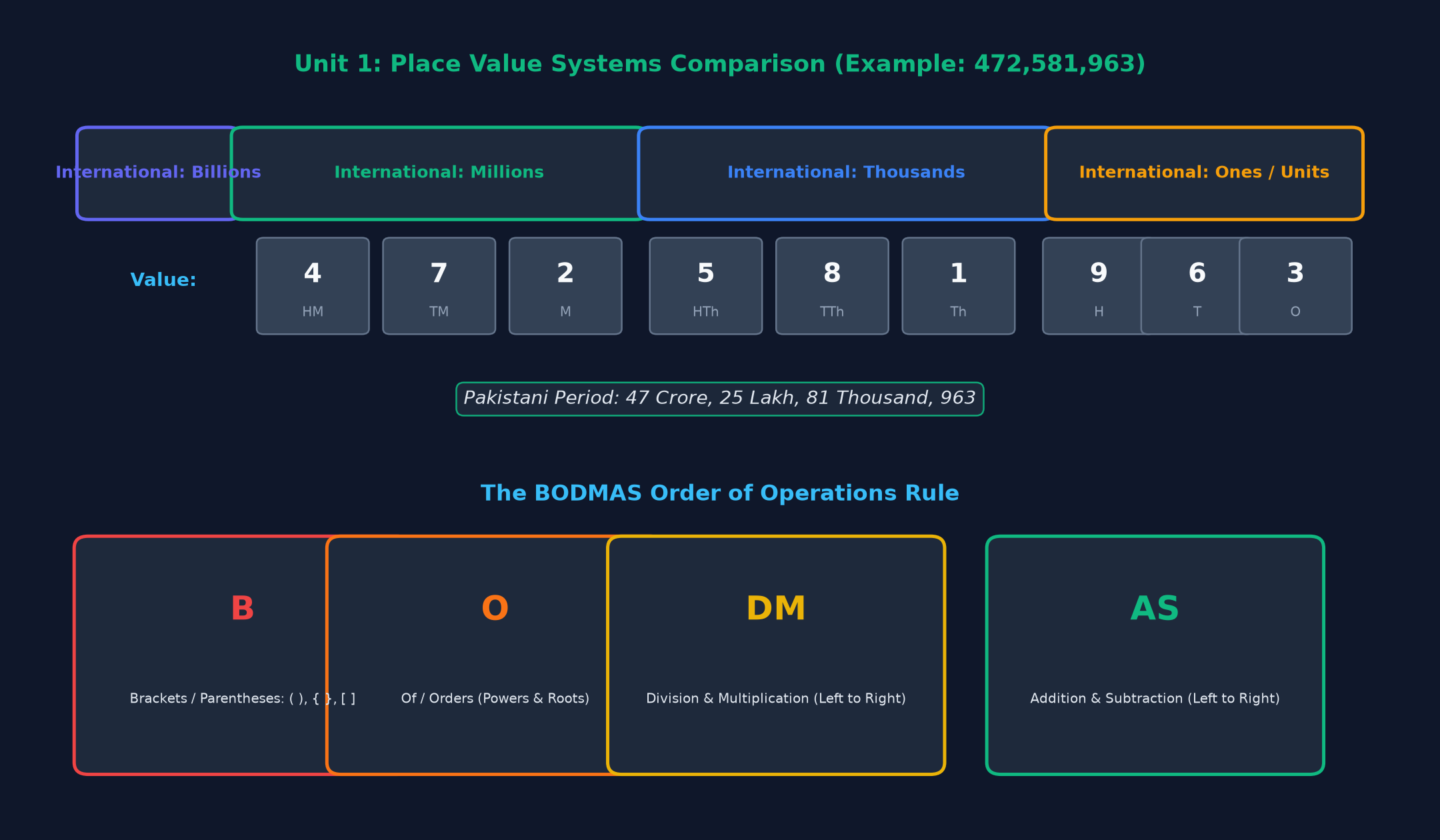
Figure 1.1: International and Pakistani Place Value Systems
Read each family together followed by the family name:
$\mathbf{5,987,516} \implies$ "Five million, nine hundred eighty-seven thousand, five hundred sixteen."
Write the number as the sum of the place values of all its digits:
$\mathbf{1,456,907} = 1,000,000 + 400,000 + 50,000 + 6,000 + 900 + 0 + 7$
🐊 2. Comparing and Ordering Numbers (The Hungry Alligator)
To compare two large numbers:
- Count the digits: The number with more digits is always larger ($120,312 > 69,311$ because 6 digits $> 5$ digits).
- Compare from left to right: If both have the same number of digits, start from the leftmost place value and compare digit by digit.
- Ascending Order: Arranging numbers from Smallest $\to$ Largest (climbing upstairs 🧗).
- Descending Order: Arranging numbers from Largest $\to$ Smallest (sliding downstairs 🛝).
⚡ 3. Fast Mental Math & Vertical Column Operations
To add $198$, simply add $200$ and subtract $2$! ($1436 + 198 = 1436 + 200 - 2 = 1636 - 2 = 1634$).
To subtract $1999$, subtract $2000$ and add $1$! ($12002 - 1999 = 12002 - 2000 + 1 = 10002 + 1 = 10003$).
🎯 4. Estimation & Rounding (The Secret to Superfast Predictions)
Estimation gives an approximate answer that is close to the exact value. It is super useful when shopping or planning!
Look at the ones digit:
If it is $0, 1, 2, 3, 4 \to$ Round DOWN.
If it is $5, 6, 7, 8, 9 \to$ Round UP.
Example: $65 \to 70$, $72 \to 70 \implies 70 + 70 = 140$.
Look at the tens digit:
Example: $387 \to 400$, $293 \to 300 \implies 400 + 300 = 700$.
Exact sum is $680$ (very close to our $700$ estimate!).
✖️ 5. Multiplication Mastery: Multiplying by $10, 100, 1000$ & Area Box Method
- Zero Rule for Multiplication: To multiply any number by $10$, add $1$ zero to its right end. To multiply by $100$, add $2$ zeros. To multiply by $1000$, add $3$ zeros ($381 \times 1000 = 381,000$).
- The Area / Box Grid Method: Break numbers into expanded form, write them along the top and left of a grid, multiply each mini-box, and add the partial products! ($243 \times 21 = (200+40+3) \times (20+1) = 4000 + 800 + 60 + 200 + 40 + 3 = 5,103$).
➗ 6. Long Division: The Family Rule
- Zero Rule for Division: Dividing a number ending in zeros by $10$ removes $1$ zero from the right ($49,000 \div 10 = 4,900$). Dividing by $100$ removes $2$ zeros ($49,000 \div 100 = 490$). Dividing by $1000$ removes $3$ zeros ($49,000 \div 1000 = 49$).
- The Golden Division Check Law: $$\mathbf{\text{Dividend} = (\text{Divisor} \times \text{Quotient}) + \text{Remainder}}$$
🔢 7. Secret Number Patterns & Sequences
A pattern is an ordered list of numbers that follows a secret rule!
- Increasing Patterns (Growing): Created by adding or multiplying a number ($10, 40, 160, 640 \dots \to \text{Rule: Multiply by } 4$).
- Decreasing Patterns (Shrinking): Created by subtracting or dividing ($352, 176, 88 \dots \to \text{Rule: Divide by } 2$).
- Position-to-Term Machines: If Position $1 \to 11$, Position $2 \to 22$, Position $3 \to 33$, the rule is $\text{Term} = 11 \times \text{Position}$.
🟦 8. Square Numbers ($n^2$) & Cube Numbers ($n^3$)
Formed when a number is multiplied by itself (forms a flat 2D square):
- $1^2 = 1 \times 1 = 1$
- $2^2 = 2 \times 2 = 4$
- $3^2 = 3 \times 3 = 9$
- $6^2 = 36$, $7^2 = 49$, $8^2 = 64$, $9^2 = 81$, $10^2 = 100$
- $11^2 = 121$, $12^2 = 144$, $15^2 = 225$
Formed when a number is multiplied by itself three times (forms a 3D block like a Rubik's cube):
- $1^3 = 1 \times 1 \times 1 = 1$
- $2^3 = 2 \times 2 \times 2 = 8$
- $3^3 = 3 \times 3 \times 3 = 27$
- $4^3 = 64$, $5^3 = 125$, $6^3 = 216$, $7^3 = 343$
- $8^3 = 512$, $9^3 = 729$, $10^3 = 1000$, $11^3 = 1331$
📝 Unit 1 Solved Exercises (Complete, Exhaustive & Step-by-Step)
(a) $290\text{ }014$: Two hundred ninety thousand, fourteen.
(b) $433\text{ }453$: Four hundred thirty-three thousand, four hundred fifty-three.
(c) $1\text{ }010\text{ }009$: One million, ten thousand, nine.
(d) $9\text{ }871\text{ }653$: Nine million, eight hundred seventy-one thousand, six hundred fifty-three.
(e) $1\text{ }242\text{ }140$: One million, two hundred forty-two thousand, one hundred forty.
(f) $2\text{ }688\text{ }069$: Two million, six hundred eighty-eight thousand, sixty-nine.
(g) $1\text{ }874\text{ }454$: One million, eight hundred seventy-four thousand, four hundred fifty-four.
(h) $6\text{ }495\text{ }523$: Six million, four hundred ninety-five thousand, five hundred twenty-three.
(i) Five million six hundred twenty two thousand three hundred forty-six: $\mathbf{5\text{ }622\text{ }346}$
(ii) Eight million nine hundred sixty two thousand seventy-three: $\mathbf{8\text{ }962\text{ }073}$
(iii) One million five hundred three thousand six hundred five: $\mathbf{1\text{ }503\text{ }605}$
(iv) Two million three hundred two thousand seven hundred sixty-five: $\mathbf{2\text{ }302\text{ }765}$
(v) Three million one hundred fifty two thousand two hundred forty-eight: $\mathbf{3\text{ }152\text{ }248}$
(vi) Six million three hundred three thousand five hundred six: $\mathbf{6\text{ }303\text{ }506}$
(a) $131\text{ }441$: $100\text{ }000 + 30\text{ }000 + 1\text{ }000 + 400 + 40 + 1$
(b) $6\text{ }000\text{ }900$: $6\text{ }000\text{ }000 + 900$
(c) $4\text{ }949\text{ }181$: $4\text{ }000\text{ }000 + 900\text{ }000 + 40\text{ }000 + 9\text{ }000 + 100 + 80 + 1$
(d) $6\text{ }466\text{ }456$: $6\text{ }000\text{ }000 + 400\text{ }000 + 60\text{ }000 + 6\text{ }000 + 400 + 50 + 6$
(e) $7\text{ }286\text{ }019$: $7\text{ }000\text{ }000 + 200\text{ }000 + 80\text{ }000 + 6\text{ }000 + 10 + 9$
(f) $9\text{ }479\text{ }321$: $9\text{ }000\text{ }000 + 400\text{ }000 + 70\text{ }000 + 9\text{ }000 + 300 + 20 + 1$
(g) $8\text{ }510\text{ }602$: $8\text{ }000\text{ }000 + 500\text{ }000 + 10\text{ }000 + 600 + 2$
(h) $1\text{ }202\text{ }001$: $1\text{ }000\text{ }000 + 200\text{ }000 + 2\text{ }000 + 1$
(a) Eight million seven thousand eight hundred $\longrightarrow$ $\mathbf{8\text{ }007\text{ }800}$
(b) Two hundred seventy-eight thousand seventy-eight $\longrightarrow$ $\mathbf{278\text{ }078}$
(c) Eight million eight hundred eight thousand eight hundred eight $\longrightarrow$ $\mathbf{8\text{ }808\text{ }808}$
(d) Two million seven thousand five hundred five $\longrightarrow$ $\mathbf{2\text{ }007\text{ }505}$
(e) Two million six thousand two $\longrightarrow$ $\mathbf{2\text{ }006\text{ }002}$
(a) $4\text{ }545\text{ }445$: Place = Hundred Thousands, Value = $\mathbf{500\text{ }000}$
(b) $9\text{ }846\text{ }532$: Place = Tens, Value = $\mathbf{30}$
(c) $6\text{ }782\text{ }456$: Place = Hundred Thousands, Value = $\mathbf{700\text{ }000}$
(d) $9\text{ }080\text{ }714$: Place = Ten Thousands, Value = $\mathbf{80\text{ }000}$
(e) $2\text{ }997\text{ }924$: Place = Hundred Thousands, Value = $\mathbf{900\text{ }000}$
(f) $8\text{ }425\text{ }419$: Place = Hundreds, Value = $\mathbf{400}$
(g) $7\text{ }817\text{ }656$: Place = Millions, Value = $\mathbf{7\text{ }000\text{ }000}$
(h) $1\text{ }701\text{ }232$: Place = Thousands, Value = $\mathbf{1\text{ }000}$
(i) $1\text{ }000$ steps forward: $1\text{ }434\text{ }501, \mathbf{1\text{ }435\text{ }501}, \mathbf{1\text{ }436\text{ }501}, \mathbf{1\text{ }437\text{ }501}, \mathbf{1\text{ }438\text{ }501}, \mathbf{1\text{ }439\text{ }501}$.
(ii) $10\text{ }000$ steps backward: $1\text{ }434\text{ }501, \mathbf{1\text{ }424\text{ }501}, \mathbf{1\text{ }414\text{ }501}, \mathbf{1\text{ }404\text{ }501}, \mathbf{1\text{ }394\text{ }501}, \mathbf{1\text{ }384\text{ }501}$.
(iii) $100$ steps backward: $1\text{ }434\text{ }501, \mathbf{1\text{ }434\text{ }401}, \mathbf{1\text{ }434\text{ }301}, \mathbf{1\text{ }434\text{ }201}, \mathbf{1\text{ }434\text{ }101}, \mathbf{1\text{ }434\text{ }001}$.
(iv) $100\text{ }000$ steps forward: $1\text{ }434\text{ }501, \mathbf{1\text{ }534\text{ }501}, \mathbf{1\text{ }634\text{ }501}, \mathbf{1\text{ }734\text{ }501}, \mathbf{1\text{ }834\text{ }501}, \mathbf{1\text{ }934\text{ }501}$.
(a) In words: One million, fourteen thousand, eight hundred twenty-five.
(b) Place value of each digit:
$1 \to \text{Millions } (1\text{ }000\text{ }000)$, $0 \to \text{Hundred Thousands } (0)$, $1 \to \text{Ten Thousands } (10\text{ }000)$, $4 \to \text{Thousands } (4\text{ }000)$, $8 \to \text{Hundreds } (800)$, $2 \to \text{Tens } (20)$, $5 \to \text{Ones } (5)$.
(c) In expanded form: $1\text{ }000\text{ }000 + 10\text{ }000 + 4\text{ }000 + 800 + 20 + 5$
(a) In words: Two hundred ninety-nine thousand, seven hundred ninety-two.
(b) Place value of each digit:
$2 \to \text{Hundred Thousands } (200\text{ }000)$, $9 \to \text{Ten Thousands } (90\text{ }000)$, $9 \to \text{Thousands } (9\text{ }000)$, $7 \to \text{Hundreds } (700)$, $9 \to \text{Tens } (90)$, $2 \to \text{Ones } (2)$.
(c) In expanded form: $200\text{ }000 + 90\text{ }000 + 9\text{ }000 + 700 + 90 + 2$
(a) $44\text{ }444$ [ $<$ ] $333\text{ }333$ (5 digits vs 6 digits)
(b) $69\text{ }312$ [ $>$ ] $68\text{ }311$ ($69\text{k} > 68\text{k}$)
(c) $344\text{ }121$ [ $<$ ] $345\text{ }333$ ($344\text{k} < 345\text{k}$)
(d) $120\text{ }312$ [ $>$ ] $69\text{ }311$ (6 digits vs 5 digits)
(e) $801\text{ }000$ [ $<$ ] $810\text{ }000$ ($801\text{k} < 810\text{k}$)
(f) $52\text{ }613$ [ $<$ ] $52\text{ }970$ ($613 < 970$)
(g) $800\text{ }002$ [ $<$ ] $800\text{ }020$ ($002 < 020$)
(h) $54\text{ }321$ [ $=$ ] $54\text{ }321$ (Identical numbers)
(i) $60\text{ }993$ [ $>$ ] $60\text{ }423$ ($993 > 423$)
(i) $15\text{ }150, 15\text{ }140, 15\text{ }101, 15\text{ }110, 15\text{ }000$
• Ascending: $\mathbf{15\text{ }000, 15\text{ }101, 15\text{ }110, 15\text{ }140, 15\text{ }150}$
• Descending: $\mathbf{15\text{ }150, 15\text{ }140, 15\text{ }110, 15\text{ }101, 15\text{ }000}$
(ii) $14\text{ }050, 12\text{ }100, 21\text{ }150, 19\text{ }888, 19\text{ }099$
• Ascending: $\mathbf{12\text{ }100, 14\text{ }050, 19\text{ }099, 19\text{ }888, 21\text{ }150}$
• Descending: $\mathbf{21\text{ }150, 19\text{ }888, 19\text{ }099, 14\text{ }050, 12\text{ }100}$
(iii) $5\text{ }150, 5\text{ }051, 15\text{ }150, 5\text{ }151, 1\text{ }515$
• Ascending: $\mathbf{1\text{ }515, 5\text{ }051, 5\text{ }150, 5\text{ }151, 15\text{ }150}$
• Descending: $\mathbf{15\text{ }150, 5\text{ }151, 5\text{ }150, 5\text{ }051, 1\text{ }515}$
(iv) $696\text{ }966, 696\text{ }900, 696\text{ }969, 696\text{ }960, 696\text{ }906$
• Ascending: $\mathbf{696\text{ }900, 696\text{ }906, 696\text{ }960, 696\text{ }966, 696\text{ }969}$
• Descending: $\mathbf{696\text{ }969, 696\text{ }966, 696\text{ }960, 696\text{ }906, 696\text{ }900}$
(v) $101\text{ }010, 100\text{ }100, 101\text{ }101, 100\text{ }110, 101\text{ }001$
• Ascending: $\mathbf{100\text{ }100, 100\text{ }110, 101\text{ }001, 101\text{ }010, 101\text{ }101}$
• Descending: $\mathbf{101\text{ }101, 101\text{ }010, 101\text{ }001, 100\text{ }110, 100\text{ }100}$
(a) $1436 + 198$: $1436 + 200 - 2 = \mathbf{1634}$
(b) $1214 + 1613$: $(1200+1600) + (14+13) = 2800 + 27 = \mathbf{2827}$
(c) $23\text{ }145 + 22\text{ }855$: $(23000 + 22000) + (145 + 855) = 45000 + 1000 = \mathbf{46\text{ }000}$
(d) $495 + 1980$: $500 + 1980 - 5 = 2480 - 5 = \mathbf{2475}$
(e) $159 + 2302$: $160 + 2302 - 1 = 2462 - 1 = \mathbf{2461}$
(f) $23\text{ }145 - 20\text{ }100$: $\mathbf{3\text{ }045}$
(g) $7930 - 410$: $7930 - 400 - 10 = 7530 - 10 = \mathbf{7520}$
(h) $3274 - 2254$: $(3274 - 2274) + 20 = 1000 + 20 = \mathbf{1020}$
(i) $12\text{ }002 - 1999$: $12002 - 2000 + 1 = 10002 + 1 = \mathbf{10\text{ }003}$
(a) $100\text{ }700 + 291\text{ }562 = \mathbf{392\text{ }262}$
(b) $417\text{ }381 + 309\text{ }201 = \mathbf{726\text{ }582}$
(c) $591\text{ }727 + 702\text{ }929 = \mathbf{1\text{ }294\text{ }656}$
(d) $319\text{ }898 + 428\text{ }888 = \mathbf{748\text{ }786}$
(e) $766\text{ }442 + 611\text{ }222 = \mathbf{1\text{ }377\text{ }664}$
(f) $542\text{ }001 + 621\text{ }416 = \mathbf{1\text{ }163\text{ }417}$
(a) $209\text{ }856 - 205\text{ }660 = \mathbf{4\text{ }196}$
(b) $788\text{ }991 - 206\text{ }070 = \mathbf{582\text{ }921}$
(c) $395\text{ }108 - 165\text{ }439 = \mathbf{229\text{ }669}$
(d) $673\text{ }265 - 656\text{ }600 = \mathbf{16\text{ }665}$
(e) $686\text{ }898 - 333\text{ }333 = \mathbf{353\text{ }565}$
(f) $744\text{ }762 - 565\text{ }656 = \mathbf{179\text{ }106}$
(a) $135\text{ }436 + 219\text{ }588 + 109\text{ }876 = \mathbf{464\text{ }900}$
(b) $128\text{ }701 + 153\text{ }130 - 200\text{ }874$: $281\text{ }831 - 200\text{ }874 = \mathbf{80\text{ }957}$
(c) $923\text{ }145 - 422\text{ }805 - 33\text{ }214$: $500\text{ }340 - 33\text{ }214 = \mathbf{467\text{ }126}$
(d) $540\text{ }782 - 301\text{ }980 + 400\text{ }045$: $238\text{ }802 + 400\text{ }045 = \mathbf{638\text{ }847}$
(a) Total population: $459\text{ }814 + 325\text{ }919 = \mathbf{785\text{ }733\text{ people}}$
(b) Which town has more and by how much: Town A has more by $459\text{ }814 - 325\text{ }919 = \mathbf{133\text{ }895\text{ people}}$.
Year 2 houses = $386\text{ }655 - 24\text{ }521 = 362\text{ }134$ houses.
Total in both years = $386\text{ }655 + 362\text{ }134 = \mathbf{748\text{ }789\text{ houses}}$.
(a) Total reward: $448\text{ }870 + 437\text{ }995 = \mathbf{\text{Rs. }886\text{ }865}$
(b) How much less in 2nd year: $448\text{ }870 - 437\text{ }995 = \mathbf{\text{Rs. }10\text{ }875}$
1. $65 + 72$: $70 + 70 = \mathbf{140}$ (Exact: 137)
2. $42 + 55$: $40 + 60 = \mathbf{100}$ (Exact: 97)
3. $31 + 84$: $30 + 80 = \mathbf{110}$ (Exact: 115)
4. $203 + 77$: $200 + 80 = \mathbf{280}$ (Exact: 280)
5. $301 + 93$: $300 + 90 = \mathbf{390}$ (Exact: 394)
6. $344 + 508$: $340 + 510 = \mathbf{850}$ (or to 100s: $300 + 500 = \mathbf{800}$, Exact: 852)
7. $503 + 309$: $500 + 310 = \mathbf{810}$ (or to 100s: $500 + 300 = \mathbf{800}$, Exact: 812)
8. $671 + 429$: $700 + 400 = \mathbf{1100}$ (Exact: 1100)
9. $401 + 503$: $400 + 500 = \mathbf{900}$ (Exact: 904)
10. $688 + 408$: $700 + 400 = \mathbf{1100}$ (Exact: 1096)
11. $33 - 19$: $30 - 20 = \mathbf{10}$ (Exact: 14)
12. $46 - 18$: $50 - 20 = \mathbf{30}$ (Exact: 28)
13. $47 - 12$: $50 - 10 = \mathbf{40}$ (Exact: 35)
14. $77 - 39$: $80 - 40 = \mathbf{40}$ (Exact: 38)
15. $403 - 113$: $400 - 100 = \mathbf{300}$ (Exact: 290)
16. $98 - 55$: $100 - 60 = \mathbf{40}$ (Exact: 43)
17. $87 - 44$: $90 - 40 = \mathbf{50}$ (Exact: 43)
18. $652 - 103$: $700 - 100 = \mathbf{600}$ (or $650 - 100 = \mathbf{550}$, Exact: 549)
19. $752 - 212$: $800 - 200 = \mathbf{600}$ (or $750 - 210 = \mathbf{540}$, Exact: 540)
20. $989 - 199$: $1000 - 200 = \mathbf{800}$ (Exact: 790)
21. $198 + 403 - 98$: $200 + 400 - 100 = \mathbf{500}$ (Exact: 503)
22. $532 - 204 + 111 - 45$: $530 - 200 + 110 - 50 = 330 + 60 = \mathbf{390}$ (or $500 - 200 + 100 - 50 = \mathbf{350}$, Exact: 394)
(a) $381$: $\times 10 = \mathbf{3\text{ }810}$, $\times 100 = \mathbf{38\text{ }100}$, $\times 1000 = \mathbf{381\text{ }000}$
(b) $4\text{ }090$: $\times 10 = \mathbf{40\text{ }900}$, $\times 100 = \mathbf{409\text{ }000}$, $\times 1000 = \mathbf{4\text{ }090\text{ }000}$
(c) $97\text{ }509$: $\times 10 = \mathbf{975\text{ }090}$, $\times 100 = \mathbf{9\text{ }750\text{ }900}$, $\times 1000 = \mathbf{97\text{ }509\text{ }000}$
(d) $269\text{ }472$: $\times 10 = \mathbf{2\text{ }694\text{ }720}$, $\times 100 = \mathbf{26\text{ }947\text{ }200}$, $\times 1000 = \mathbf{269\text{ }472\text{ }000}$
(e) $852\text{ }118$: $\times 10 = \mathbf{8\text{ }521\text{ }180}$, $\times 100 = \mathbf{85\text{ }211\text{ }800}$, $\times 1000 = \mathbf{852\text{ }118\text{ }000}$
(a) $49\text{ }000$: $\div 10 = \mathbf{4\text{ }900}$, $\div 100 = \mathbf{490}$, $\div 1000 = \mathbf{49}$
(b) $78\text{ }000$: $\div 10 = \mathbf{7\text{ }800}$, $\div 100 = \mathbf{780}$, $\div 1000 = \mathbf{78}$
(c) $65\text{ }000$: $\div 10 = \mathbf{6\text{ }500}$, $\div 100 = \mathbf{650}$, $\div 1000 = \mathbf{65}$
(d) $597\text{ }000$: $\div 10 = \mathbf{59\text{ }700}$, $\div 100 = \mathbf{5\text{ }970}$, $\div 1000 = \mathbf{597}$
(e) $210\text{ }000$: $\div 10 = \mathbf{21\text{ }000}$, $\div 100 = \mathbf{2\text{ }100}$, $\div 1000 = \mathbf{210}$
(a) $624 \times 23$: $624 \times 3 = 1872$, $624 \times 20 = 12480 \implies 1872 + 12480 = \mathbf{14\text{ }352}$
(b) $2\text{ }456 \times 90$: $2456 \times 9 \times 10 = 22104 \times 10 = \mathbf{221\text{ }040}$
(c) $1\text{ }092 \times 981$: $1092 \times 1 = 1092$, $1092 \times 80 = 87360$, $1092 \times 900 = 982800 \implies \mathbf{1\text{ }071\text{ }252}$
(d) $78\text{ }543 \times 49$: $78543 \times 9 = 706887$, $78543 \times 40 = 3141720 \implies \mathbf{3\text{ }848\text{ }607}$
(e) $45\text{ }201 \times 561 = \mathbf{25\text{ }357\text{ }761}$
(f) $111\text{ }256 \times 342 = \mathbf{38\text{ }049\text{ }552}$
(g) $790\text{ }902 \times 643 = \mathbf{508\text{ }550\text{ }086}$
(h) $356\text{ }219 \times 101$: $356219 \times 100 + 356219 = 35621900 + 356219 = \mathbf{35\text{ }978\text{ }119}$
(a) $13\text{ }440 \div 15$: $\mathbf{Quotient = 896, Remainder = 0}$
(b) $86\text{ }449 \div 29$: $\mathbf{Quotient = 2\text{ }981, Remainder = 0}$
(c) $32\text{ }536 \div 56$: $\mathbf{Quotient = 581, Remainder = 0}$
(d) $47\text{ }088 \div 48$: $\mathbf{Quotient = 981, Remainder = 0}$
(e) $56\text{ }780 \div 20$: $\mathbf{Quotient = 2\text{ }839, Remainder = 0}$
(f) $26\text{ }166 \div 98$: $\mathbf{Quotient = 267, Remainder = 0}$
(g) $73\text{ }810 \div 11$: $\mathbf{Quotient = 6\text{ }710, Remainder = 0}$
(h) $64\text{ }454 \div 32$: $\mathbf{Quotient = 2\text{ }014, Remainder = 6}$
(a) Each person gets: $\mathbf{\text{Rs. }1\text{ }254}$
(b) Money left over: $\mathbf{\text{Rs. }8}$
(a) Total number of pencils: $145 \times 5 = \mathbf{725\text{ pencils}}$
(b) Number of red pencils: Red boxes = $145 - 48 = 97$ boxes.
Red pencils = $97 \times 5 = \mathbf{485\text{ red pencils}}$.
(a) $10, 40, 160, 640, \dots$: Rule: Multiply by 4 $\implies \mathbf{2\text{ }560, 10\text{ }240, 40\text{ }960}$.
(b) $22, 220, 2\text{ }200, \dots$: Rule: Multiply by 10 $\implies \mathbf{22\text{ }000, 220\text{ }000, 2\text{ }200\text{ }000}$.
(c) $352, 176, 88, \dots$: Rule: Divide by 2 $\implies \mathbf{44, 22, 11}$.
(d) $780, 880, 980, \dots$: Rule: Add 100 $\implies \mathbf{1\text{ }080, 1\text{ }180, 1\text{ }280}$.
(e) $560, 540, 520, 500, \dots$: Rule: Subtract 20 $\implies \mathbf{480, 460, 440}$.
1. Horizontal Rows: $1, 2, 3, 4, 5 \dots \longrightarrow$ Rule: Add 1
2. Vertical Columns: $5, 15, 25, 35, 45 \dots \longrightarrow$ Rule: Add 10
3. Main Diagonal: $1, 12, 23, 34, 45, 56, 67, 78, 89, 100 \longrightarrow$ Rule: Add 11
4. Reverse Diagonal: $10, 19, 28, 37, 46, 55, 64, 73, 82, 91 \longrightarrow$ Rule: Add 9
5. Tens Column: $10, 20, 30, 40, 50, 60, 70, 80, 90, 100 \longrightarrow$ Rule: Multiples of 10
(a) Position: $1, 2, 3, 4, 5 \to$ Term: $4, 5, 6, 7, 8$:
Rule: $\mathbf{\text{Term} = \text{Position} + 3}$
(b) Position: $1, 2, 3, 4, 5 \to$ Term: $12, 22, 32, 42, 52$:
Rule: $\mathbf{\text{Term} = 10 \times \text{Position} + 2}$
(c) Position: $1, 2, 3, 4, 5 \to$ Term: $11, 22, 33, 44, 55$:
Rule: $\mathbf{\text{Term} = 11 \times \text{Position}}$
(d) Position: $1, 2, 3, 4, 5, 6 \to$ Term: $100, 200, 300, 400, 500, 600$:
Rule: $\mathbf{\text{Term} = 100 \times \text{Position}}$
(i) $6$: $6^2 = 6 \times 6 = \mathbf{36}$
(ii) $7$: $7^2 = 7 \times 7 = \mathbf{49}$
(iii) $9$: $9^2 = 9 \times 9 = \mathbf{81}$
(iv) $10$: $10^2 = 10 \times 10 = \mathbf{100}$
(v) $11$: $11^2 = 11 \times 11 = \mathbf{121}$
(vi) $15$: $15^2 = 15 \times 15 = \mathbf{225}$
(i) $1$: $1^3 = 1 \times 1 \times 1 = \mathbf{1}$
(ii) $5$: $5^3 = 5 \times 5 \times 5 = \mathbf{125}$
(iii) $7$: $7^3 = 7 \times 7 \times 7 = \mathbf{343}$
(iv) $9$: $9^3 = 9 \times 9 \times 9 = \mathbf{729}$
(v) $10$: $10^3 = 10 \times 10 \times 10 = \mathbf{1\text{ }000}$
(vi) $11$: $11^3 = 11 \times 11 \times 11 = \mathbf{1\text{ }331}$
- $1^2 = 1 \times 1 = 1$
- $2^2 = 2 \times 2 = 4$
- $3^2 = 3 \times 3 = 9$
- $4^2 = 4 \times 4 = 16$
- $5^2 = 5 \times 5 = 25$
- $6^2 = 6 \times 6 = 36$
- $7^2 = 7 \times 7 = 49$
- $8^2 = 8 \times 8 = 64$
- $9^2 = 9 \times 9 = 81$
- $10^2 = 10 \times 10 = 100$
- $1^3 = 1 \times 1 \times 1 = 1$
- $2^3 = 2 \times 2 \times 2 = 8$
- $3^3 = 3 \times 3 \times 3 = 27$
- $4^3 = 4 \times 4 \times 4 = 64$
- $5^3 = 5 \times 5 \times 5 = 125$
- $6^3 = 6 \times 6 \times 6 = 216$
- $7^3 = 7 \times 7 \times 7 = 343$
- $8^3 = 8 \times 8 \times 8 = 512$
- $9^3 = 9 \times 9 \times 9 = 729$
- $10^3 = 10 \times 10 \times 10 = 1000$
(a) We give space after every _____ digits in numbers:
(i) 2 (ii) 3 (iii) 4 (iv) 16 $\implies \mathbf{(ii)\text{ 3}}$
(b) The value of 2 in the number $6\text{ }985\text{ }621$ is:
(i) 2 (ii) 20 (iii) 200 (iv) 2000 $\implies \mathbf{(ii)\text{ 20}}$
(c) In $7\text{ }856\text{ }211$, the digit _____ is the thousands place digit:
(i) 2 (ii) 5 (iii) 6 (iv) 8 $\implies \mathbf{(iii)\text{ 6}}$
(d) When we multiply a number by _____ we place 3 zeros to its right end:
(i) 10 (ii) 100 (iii) 1 000 (iv) 1 $\implies \mathbf{(iii)\text{ 1 000}}$
(e) When we _____ a number by 10 we remove a zero from its right:
(i) add (ii) subtract (iii) multiply (iv) divide $\implies \mathbf{(iv)\text{ divide}}$
(f) The square of 12 is:
(i) 121 (ii) 142 (iii) 144 (iv) 148 $\implies \mathbf{(iii)\text{ 144}}$
(g) The cube of 20 is:
(i) 400 (ii) 4000 (iii) 800 (iv) 8000 $\implies \mathbf{(iv)\text{ 8000}}$ ($20 \times 20 \times 20$)
(a) $8\text{ }734\text{ }123$: Eight million, seven hundred thirty-four thousand, one hundred twenty-three.
(b) $6\text{ }965\text{ }129$: Six million, nine hundred sixty-five thousand, one hundred twenty-nine.
(c) $4\text{ }982\text{ }009$: Four million, nine hundred eighty-two thousand, nine.
(d) $9\text{ }012\text{ }011$: Nine million, twelve thousand, eleven.
(a) $212\text{ }121 + 56\text{ }234 = \mathbf{268\text{ }355}$
(b) $18\text{ }315 + 102\text{ }376 = \mathbf{120\text{ }691}$
(c) $727\text{ }191 + 92\text{ }921 = \mathbf{820\text{ }112}$
(d) $139\text{ }657 + 247\text{ }777 = \mathbf{387\text{ }434}$
(e) $532\text{ }481 + 100\text{ }008 = \mathbf{632\text{ }489}$
(f) $200\text{ }454 + 126\text{ }654 = \mathbf{327\text{ }108}$
(a) $675\text{ }921 - 31\text{ }412 = \mathbf{644\text{ }509}$
(b) $986\text{ }543 - 65\text{ }219 = \mathbf{921\text{ }324}$
(c) $108\text{ }761 - 70\text{ }021 = \mathbf{38\text{ }740}$
(d) $846\text{ }109 - 591\text{ }089 = \mathbf{255\text{ }020}$
(e) $865\text{ }439 - 761\text{ }212 = \mathbf{104\text{ }227}$
(f) $696\text{ }349 - 288\text{ }888 = \mathbf{407\text{ }461}$
(a) $12\text{ }356 \times 122 = \mathbf{1\text{ }507\text{ }432}$
(b) $65\text{ }781 \times 100 = \mathbf{6\text{ }578\text{ }100}$
(c) $262\text{ }825 \times 522 = \mathbf{137\text{ }194\text{ }650}$
(d) $837\text{ }564 \times 519 = \mathbf{434\text{ }695\text{ }716}$
(a) $66\text{ }693 \div 33 = \mathbf{2\text{ }021}$
(b) $35\text{ }788 \div 42 = \mathbf{852\text{ (Remainder } 4)}$
(c) $25\text{ }111 \div 69 = \mathbf{363\text{ (Remainder } 64)}$
(d) $28\text{ }000 \div 1000 = \mathbf{28}$
(e) $58\text{ }580 \div 10 = \mathbf{5\text{ }858}$
(f) $28\text{ }104 \div 28 = \mathbf{1\text{ }003\text{ (Remainder } 20)}$
(a) $50, 100, 150, 200, \dots$: Rule: Add 50 $\implies \mathbf{250, 300, 350}$.
(b) $180, 165, 150, 135, \dots$: Rule: Subtract 15 $\implies \mathbf{120, 105, 90}$.
(c) $18, 90, 450, 2\text{ }250, \dots$: Rule: Multiply by 5 $\implies \mathbf{11\text{ }250, 56\text{ }250, 281\text{ }250}$.
(d) $6\text{ }100\text{ }000, 610\text{ }000, 61\text{ }000, \dots$: Rule: Divide by 10 $\implies \mathbf{6\text{ }100, 610, 61}$.
$10 \times \mathbf{1} = 10$
$10 \times \mathbf{10} = 100$
$10 \times \mathbf{100} = 1\text{ }000$
$10 \times \mathbf{1\text{ }000} = 10\text{ }000$
$\mathbf{10\text{ }000} \div 10 = 1\text{ }000$
$\mathbf{10\text{ }000} \div 100 = 100$
$\mathbf{10\text{ }000} \div 1\text{ }000 = 10$
$\mathbf{10\text{ }000} \div 10\text{ }000 = 1$
(a) Total price of both items: $162\text{ }900 + 96\text{ }880 = \mathbf{\text{Rs. }259\text{ }780}$
(b) Price of 15 scanners and 3 laser printers:
15 scanners = $15 \times 162\text{ }900 = \text{Rs. }2\text{ }443\text{ }500$
3 laser printers = $3 \times 96\text{ }880 = \text{Rs. }290\text{ }640$
Total = $2\text{ }443\text{ }500 + 290\text{ }640 = \mathbf{\text{Rs. }2\text{ }734\text{ }140}$
(a) Blocks in each box: $\mathbf{1\text{ }260\text{ blocks}}$
(b) Blocks left over: $\mathbf{8\text{ blocks}}$
(a) Position: $1, 2, 3, 4 \to$ Term: $2, 4, 6, 8$:
Rule: $\mathbf{\text{Term} = 2 \times \text{Position}}$ (Multiples of 2 / Even numbers)
(b) Position: $1, 2, 3, 4 \to$ Term: $10, 25, 40, 55$:
Rule: $\mathbf{\text{Term} = 15 \times \text{Position} - 5}$ (Starting at 10, adding 15 each step)
(a) Total students appeared: $318\text{ }351 + 58\text{ }760 + 24\text{ }015 = \mathbf{401\text{ }126\text{ students}}$
(b) Students who did not pass: $58\text{ }760 + 24\text{ }015 = \mathbf{82\text{ }775\text{ students}}$
(a) Total bicycles sold: $50\text{ }436 + 73\text{ }471 + 58\text{ }471 = \mathbf{182\text{ }378\text{ bicycles}}$
(b) Bicycles left over: $192\text{ }786 - 182\text{ }378 = \mathbf{10\text{ }408\text{ bicycles}}$
🎯 Unit 1 Synthesis Summary
Whole numbers up to $1,000,000,000$ (One Billion) follow a 3-digit periodic place value architecture (Units, Thousands, Millions, Billions). Fast mental arithmetic and vertical column operations with carrying and borrowing resolve complex real-life transactions. Estimation gives quick, reasonable approximations by rounding to the nearest 10, 100, or 1000. Multiplication scales numbers via zero-padding and grid areas, while long division systematically computes quotients and remainders. Sequences follow mathematical input-output rules, and exponential geometric patterns form 2D Square ($n^2$) and 3D Cube ($n^3$) numbers.
More Chapter Notes for Class 5 (FBISE)
MathematicsTest Your Knowledge on Chapter 1: Mastery Guide: Large Numbers, Place Value Systems, Arithmetic Operations & BODMAS Rule
Practice textbook-aligned solved MCQs with instant answer feedback, step-by-step solutions, and timed test simulation.
Class 5 Mathematics - Ch 1: Whole Numbers and Operations Chapter Mock Test
Test your complete conceptual mastery across all chapters under real board exam conditions with official timer, anti-cheat surveillance, and instant grading.