📖 Tier 1: Prepare & Study Guide ✓ 100% Solved with Rationales

ELECTRICAL TECHNICIAN (BS-16) Complete Preparation Guide & Solved Questions (2026) - Apex Rankers

Direct Departmental Recruitment Examination Syllabus & Question Bank

6519 Total Questions
~9779 mins Read Time
4 Subject Areas
🎯 High-Yield Preparation Strategy

📘 Official Examination Scheme, Question Blueprint & Interview Masterclass

✓ 100% Comprehensive Guide

Official Written Examination Blueprint & Master Preparation Guide

Candidate Selection Architecture for ELECTRICAL TECHNICIAN (BS-16)

📋 1. Examination Scheme & Marking Blueprint

The competitive recruitment screening for ELECTRICAL TECHNICIAN (BS-16) consists of a single-paper 100-mark Multiple Choice Question (MCQ) written examination evaluating Practical Electrical & Power Systems, Quantitative Aptitude Test, English Language Comprehension, and General Knowledge. The assessment duration is standardized at 90 minutes. A strict qualifying benchmark of 50% aggregate marks is mandatory for merit consideration. Negative marking is applied at a rate of 0.25 marks deducted per incorrect response, requiring candidates to exercise disciplined accuracy during question selection. Top-merit qualifiers are shortlisted for panel interview scrutiny at a ratio of 1:5 against announced vacancies.

Examination Subject / Question Type Target Marks Weightage Cognitive Focus & Syllabus Benchmark
Practical Electrical & Power Systems 50 MCQs 50% HVAC & Refrigeration Cycles, Electrical Distribution & Protection Relays, Motor Controls & Wiring Standards, Industrial Troubleshooting
Quantitative Aptitude Test 20 MCQs 20% Arithmetic calculations, algebra, geometric reasoning, quantitative problem solving
English Language Comprehension 15 MCQs 15% Grammar rules, sentence structuring, vocabulary, reading comprehension
General Knowledge 15 MCQs 15% World affairs, international organizations, geography, everyday facts

💡 2. High-Yield Conceptual Problem Solving & Case Scenarios

Mastery of applied operational problems is essential for securing top-tier percentiles. The following high-yield case scenarios reflect actual operational scenarios encountered in competitive selection exams:

Scenario 1: Authentic Practical Scenario 1 for Electrical Technician

Operational Dilemma: A malfunctioning motor in the production line is causing delays. The technician needs to identify the issue and resolve it quickly.

💡 Model Answer & Protocol: First, the technician should check the power supply and fuses. Then, they should use a multimeter to measure the resistance and voltage across the motor windings. If necessary, they should replace faulty components or adjust settings.
Standard: Industry-standard electrical testing procedures and safety guidelines
Scenario 2: Authentic Practical Scenario 2 for Electrical Technician

Operational Dilemma: An electrical fire breaks out in the factory. The technician must respond immediately to extinguish the fire and prevent further damage.

💡 Model Answer & Protocol: The technician should first activate the fire alarm and evacuate personnel. They should then use appropriate fire extinguishing equipment to control the fire. After ensuring safety, they should document the incident and report to management.
Standard: Fire safety protocols and emergency response procedures
Scenario 3: Authentic Practical Scenario 3 for Electrical Technician

Operational Dilemma: A new piece of machinery requires installation and commissioning. The technician needs to ensure proper wiring and connections.

💡 Model Answer & Protocol: The technician should follow the manufacturer's instructions and local electrical codes. They should verify the correct wiring configuration and perform a thorough inspection before energizing the equipment.
Standard: Proper installation and commissioning practices for electrical systems

🎯 3. Departmental Selection Board Viva Voce & Panel Interview

Candidates shortlisted after the written screening will appear before a 3 to 5 member Departmental Selection Board. Interviews evaluate professional mastery, situational integrity, and knowledge of official rules.

Q1: What are the key steps in performing a routine electrical inspection?
Model Response: The technician should visually inspect connections, check for signs of wear, and use a multimeter to measure voltage and resistance.
Q2: How do you ensure safety when working with live electrical circuits?
Model Response: The technician should use insulated tools, wear protective gear, and follow lockout/tagout procedures to de-energize circuits.
Q3: Describe a situation where you had to troubleshoot a complex electrical fault.
Model Response: I would first isolate the affected area, use diagnostic tools to identify the fault, and then systematically replace or repair components until the issue is resolved.
Q4: What safety measures are in place to prevent electrical fires in the factory?
Model Response: The factory has regular inspections, proper wiring, and fire suppression systems. Additionally, employees are trained to handle electrical equipment safely and report any potential hazards promptly.

📅 4. 14-Day Strategic Revision Roadmap

Execute this structured two-week study plan to consolidate syllabus coverage and peak cognitive readiness:

  • Days 1-5: Practical Electrical & Power Systems Mastery: Cover core theoretical foundations, statutory frameworks, technical standards, and high-frequency past paper questions.
  • Days 6-8: Quantitative Aptitude Test Consolidation: Practice applied concepts, terminology, analytical structures, and domain-specific problem sets.
  • Days 9-11: English Language Comprehension & Complementary Modules: Revise essential facts, regulatory rules, and cross-functional aptitude topics.
  • Days 12-13: Error Log & Viva Voce Preparation: Review weak topic areas and rehearse oral responses for the Departmental Selection Board interview.
  • Day 14: Full-Length Timed Mock Simulation: Complete two 100-MCQ timed mock tests strictly within 90 minutes to lock in pacing.

✅ 5. Examination Day Protocol & Merit Optimization Strategy

Candidates appearing for the ELECTRICAL TECHNICIAN (BS-16) (BS-16) screening examination should strictly observe official test center protocols: carry the original CNIC, printed Roll Number Slip, and black or blue ballpoint pens for OMR bubble shading. Allocate the first 45 minutes to high-confidence questions in Practical Electrical & Power Systems and Quantitative Aptitude Test before attempting multi-step analytical items. Maintain a minimum 80% accuracy rate across attempted items to absorb any negative marking deductions and secure a top-decile merit ranking for the Departmental Selection Committee interview.
Q. 1 Practical Electrical & Power Systems
Difficulty: Medium (1 Mark)
Q1: In practical electrical wiring (Single & 3-Phase Wiring Standards), what is the installation rule for standard single-phase wiring u?
A
Standard single-phase wiring uses Brown for Live, Blue for Neutral, and Green/Yellow for Earth (IEC 60446).
✓ Correct
B
Directly shorting live phase conductors to earth ground
C
Using flammable paper insulation inside distribution conduits
D
Connecting single-pole switches on the neutral line
💡 Step-by-Step Explanation & Concept Rationale
Under Single & 3-Phase Wiring Standards: Standard single-phase wiring uses Brown for Live, Blue for Neutral, and Green/Yellow for Earth (IEC 60446).
Q. 2 Practical Electrical & Power Systems
Difficulty: Medium (1 Mark)
Q2: How is balanced 3-phase systems feature th correctly implemented in residential/industrial installations (Single & 3-Phase Wiring Standards)?
A
Balanced 3-phase systems feature three line voltages displaced by 120 degrees electrical.
✓ Correct
B
Directly shorting live phase conductors to earth ground
C
Using flammable paper insulation inside distribution conduits
D
Connecting single-pole switches on the neutral line
💡 Step-by-Step Explanation & Concept Rationale
Under Single & 3-Phase Wiring Standards: Balanced 3-phase systems feature three line voltages displaced by 120 degrees electrical.
Q. 3 Practical Electrical & Power Systems
Difficulty: Medium (1 Mark)
Q3: Under electrical wiring code (Single & 3-Phase Wiring Standards), which standard specifies staircase lighting uses two 2-wa?
A
Staircase lighting uses two 2-way SPDT switches connected via two traveler strapping wires.
✓ Correct
B
Directly shorting live phase conductors to earth ground
C
Using flammable paper insulation inside distribution conduits
D
Connecting single-pole switches on the neutral line
💡 Step-by-Step Explanation & Concept Rationale
Under Single & 3-Phase Wiring Standards: Staircase lighting uses two 2-way SPDT switches connected via two traveler strapping wires.
Q. 4 Practical Electrical & Power Systems
Difficulty: Medium (1 Mark)
Q4: In building electrical installations (Single & 3-Phase Wiring Standards), what requirement governs controlling lights from 3+ loc?
A
Controlling lights from 3+ locations requires Intermediate (4-terminal crossover) switches between 2-way switches.
✓ Correct
B
Directly shorting live phase conductors to earth ground
C
Using flammable paper insulation inside distribution conduits
D
Connecting single-pole switches on the neutral line
💡 Step-by-Step Explanation & Concept Rationale
Under Single & 3-Phase Wiring Standards: Controlling lights from 3+ locations requires Intermediate (4-terminal crossover) switches between 2-way switches.
Q. 5 Practical Electrical & Power Systems
Difficulty: Medium (1 Mark)
Q5: How does an electrician wire and troubleshoot ring main socket circuits lo in Single & 3-Phase Wiring Standards?
A
Ring main socket circuits loop from and return to the DB, providing two parallel current paths.
✓ Correct
B
Directly shorting live phase conductors to earth ground
C
Using flammable paper insulation inside distribution conduits
D
Connecting single-pole switches on the neutral line
💡 Step-by-Step Explanation & Concept Rationale
Under Single & 3-Phase Wiring Standards: Ring main socket circuits loop from and return to the DB, providing two parallel current paths.
Q. 6 Practical Electrical & Power Systems
Difficulty: Medium (1 Mark)
Q6: Under 3-phase and single-phase wiring regulations (Single & 3-Phase Wiring Standards), what rule dictates loop-in lighting wiring makes all?
A
Loop-in lighting wiring makes all cable joints accessible inside switches or ceiling roses.
✓ Correct
B
Directly shorting live phase conductors to earth ground
C
Using flammable paper insulation inside distribution conduits
D
Connecting single-pole switches on the neutral line
💡 Step-by-Step Explanation & Concept Rationale
Under Single & 3-Phase Wiring Standards: Loop-in lighting wiring makes all cable joints accessible inside switches or ceiling roses.
Q. 7 Practical Electrical & Power Systems
Difficulty: Medium (1 Mark)
Q7: In motor control and branch circuit wiring (Single & 3-Phase Wiring Standards), which standard applies to heavy thermal appliances (ac, g?
A
Heavy thermal appliances (AC, geysers) require dedicated 15A/16A power sockets with 4.0 mm² cables.
✓ Correct
B
Directly shorting live phase conductors to earth ground
C
Using flammable paper insulation inside distribution conduits
D
Connecting single-pole switches on the neutral line
💡 Step-by-Step Explanation & Concept Rationale
Under Single & 3-Phase Wiring Standards: Heavy thermal appliances (AC, geysers) require dedicated 15A/16A power sockets with 4.0 mm² cables.
Q. 8 Practical Electrical & Power Systems
Difficulty: Medium (1 Mark)
Q8: What is the safety and operational purpose of single-pole light control swi in Single & 3-Phase Wiring Standards?
A
Single-pole light control switches must ALWAYS be connected in series with the Live (Phase) wire.
✓ Correct
B
Directly shorting live phase conductors to earth ground
C
Using flammable paper insulation inside distribution conduits
D
Connecting single-pole switches on the neutral line
💡 Step-by-Step Explanation & Concept Rationale
Under Single & 3-Phase Wiring Standards: Single-pole light control switches must ALWAYS be connected in series with the Live (Phase) wire.
Q. 9 Practical Electrical & Power Systems
Difficulty: Medium (1 Mark)
Q9: In practical electrical wiring (Single & 3-Phase Wiring Standards), what is the installation rule for maximum allowable voltage drop?
A
Maximum allowable voltage drop is 3% for lighting circuits and 5% for power socket circuits.
✓ Correct
B
Directly shorting live phase conductors to earth ground
C
Using flammable paper insulation inside distribution conduits
D
Connecting single-pole switches on the neutral line
💡 Step-by-Step Explanation & Concept Rationale
Under Single & 3-Phase Wiring Standards: Maximum allowable voltage drop is 3% for lighting circuits and 5% for power socket circuits.
Q. 10 Practical Electrical & Power Systems
Difficulty: Medium (1 Mark)
Q10: How is conduit space fill factor must not correctly implemented in residential/industrial installations (Single & 3-Phase Wiring Standards)?
A
Conduit space fill factor must not exceed 40% to allow heat dissipation and easy cable pulling.
✓ Correct
B
Directly shorting live phase conductors to earth ground
C
Using flammable paper insulation inside distribution conduits
D
Connecting single-pole switches on the neutral line
💡 Step-by-Step Explanation & Concept Rationale
Under Single & 3-Phase Wiring Standards: Conduit space fill factor must not exceed 40% to allow heat dissipation and easy cable pulling.
Q. 11 Practical Electrical & Power Systems
Difficulty: Medium (1 Mark)
Q11: In practical electrical wiring (Industrial Motor Control & Wiring), what is the installation rule for power factor correction capaci?
A
Power factor correction capacitor banks connect in parallel to supply leading kVAR to inductive motor loads.
✓ Correct
B
Directly shorting live phase conductors to earth ground
C
Using flammable paper insulation inside distribution conduits
D
Connecting single-pole switches on the neutral line
💡 Step-by-Step Explanation & Concept Rationale
Under Industrial Motor Control & Wiring: Power factor correction capacitor banks connect in parallel to supply leading kVAR to inductive motor loads.
Q. 12 Practical Electrical & Power Systems
Difficulty: Medium (1 Mark)
Q12: How is flexible cords must match appliance correctly implemented in residential/industrial installations (Industrial Motor Control & Wiring)?
A
Flexible cords must match appliance ampacity: 0.75 mm² (6A), 1.5 mm² (16A), and 2.5 mm² (25A).
✓ Correct
B
Directly shorting live phase conductors to earth ground
C
Using flammable paper insulation inside distribution conduits
D
Connecting single-pole switches on the neutral line
💡 Step-by-Step Explanation & Concept Rationale
Under Industrial Motor Control & Wiring: Flexible cords must match appliance ampacity: 0.75 mm² (6A), 1.5 mm² (16A), and 2.5 mm² (25A).
Q. 13 Practical Electrical & Power Systems
Difficulty: Medium (1 Mark)
Q13: Under electrical wiring code (Industrial Motor Control & Wiring), which standard specifies industrial perforated metal cabl?
A
Industrial perforated metal cable trays must be continuously bonded to the Main Earthing Terminal.
✓ Correct
B
Directly shorting live phase conductors to earth ground
C
Using flammable paper insulation inside distribution conduits
D
Connecting single-pole switches on the neutral line
💡 Step-by-Step Explanation & Concept Rationale
Under Industrial Motor Control & Wiring: Industrial perforated metal cable trays must be continuously bonded to the Main Earthing Terminal.
Q. 14 Practical Electrical & Power Systems
Difficulty: Medium (1 Mark)
Q14: In building electrical installations (Industrial Motor Control & Wiring), what requirement governs star-delta starters reduce mot?
A
Star-Delta starters reduce motor starting inrush current to 1/3 by starting in Star before switching to Delta.
✓ Correct
B
Directly shorting live phase conductors to earth ground
C
Using flammable paper insulation inside distribution conduits
D
Connecting single-pole switches on the neutral line
💡 Step-by-Step Explanation & Concept Rationale
Under Industrial Motor Control & Wiring: Star-Delta starters reduce motor starting inrush current to 1/3 by starting in Star before switching to Delta.
Q. 15 Practical Electrical & Power Systems
Difficulty: Medium (1 Mark)
Q15: How does an electrician wire and troubleshoot direct-on-line (dol) starter in Industrial Motor Control & Wiring?
A
Direct-On-Line (DOL) starters connect motors across full line voltage with a contactor and thermal overload relay.
✓ Correct
B
Directly shorting live phase conductors to earth ground
C
Using flammable paper insulation inside distribution conduits
D
Connecting single-pole switches on the neutral line
💡 Step-by-Step Explanation & Concept Rationale
Under Industrial Motor Control & Wiring: Direct-On-Line (DOL) starters connect motors across full line voltage with a contactor and thermal overload relay.
Q. 16 Practical Electrical & Power Systems
Difficulty: Medium (1 Mark)
Q16: Under 3-phase and single-phase wiring regulations (Industrial Motor Control & Wiring), what rule dictates single-phasing occurs when one su?
A
Single-phasing occurs when one supply line opens, drawing excessive current on remaining lines and burning windings.
✓ Correct
B
Directly shorting live phase conductors to earth ground
C
Using flammable paper insulation inside distribution conduits
D
Connecting single-pole switches on the neutral line
💡 Step-by-Step Explanation & Concept Rationale
Under Industrial Motor Control & Wiring: Single-phasing occurs when one supply line opens, drawing excessive current on remaining lines and burning windings.
Q. 17 Practical Electrical & Power Systems
Difficulty: Medium (1 Mark)
Q17: In motor control and branch circuit wiring (Industrial Motor Control & Wiring), which standard applies to ceiling fan speed regulators us?
A
Ceiling fan speed regulators use non-dissipative capacitors or triac circuits to vary motor terminal voltage.
✓ Correct
B
Directly shorting live phase conductors to earth ground
C
Using flammable paper insulation inside distribution conduits
D
Connecting single-pole switches on the neutral line
💡 Step-by-Step Explanation & Concept Rationale
Under Industrial Motor Control & Wiring: Ceiling fan speed regulators use non-dissipative capacitors or triac circuits to vary motor terminal voltage.
Q. 18 Practical Electrical & Power Systems
Difficulty: Medium (1 Mark)
Q18: What is the safety and operational purpose of normally open (green) buttons in Industrial Motor Control & Wiring?
A
Normally Open (Green) buttons start contactors with 13-14 seal-in contacts; Normally Closed (Red) buttons stop circuits.
✓ Correct
B
Directly shorting live phase conductors to earth ground
C
Using flammable paper insulation inside distribution conduits
D
Connecting single-pole switches on the neutral line
💡 Step-by-Step Explanation & Concept Rationale
Under Industrial Motor Control & Wiring: Normally Open (Green) buttons start contactors with 13-14 seal-in contacts; Normally Closed (Red) buttons stop circuits.
Q. 19 Practical Electrical & Power Systems
Difficulty: Medium (1 Mark)
Q19: In practical electrical wiring (Industrial Motor Control & Wiring), what is the installation rule for photocells (cds ldrs) automati?
A
Photocells (CdS LDRs) automatically switch street lights ON at dusk and OFF at dawn with built-in time delay.
✓ Correct
B
Directly shorting live phase conductors to earth ground
C
Using flammable paper insulation inside distribution conduits
D
Connecting single-pole switches on the neutral line
💡 Step-by-Step Explanation & Concept Rationale
Under Industrial Motor Control & Wiring: Photocells (CdS LDRs) automatically switch street lights ON at dusk and OFF at dawn with built-in time delay.
Q. 20 Practical Electrical & Power Systems
Difficulty: Medium (1 Mark)
Q20: How is concealed pvc conduit embedded in b correctly implemented in residential/industrial installations (Industrial Motor Control & Wiring)?
A
Concealed PVC conduit embedded in brickwork provides superior mechanical isolation and fire resistance.
✓ Correct
B
Directly shorting live phase conductors to earth ground
C
Using flammable paper insulation inside distribution conduits
D
Connecting single-pole switches on the neutral line
💡 Step-by-Step Explanation & Concept Rationale
Under Industrial Motor Control & Wiring: Concealed PVC conduit embedded in brickwork provides superior mechanical isolation and fire resistance.
Q. 21 Practical Electrical & Power Systems
Difficulty: Easy (1 Mark)
Q21: In electrical installation practice #21, what is the purpose of a 'Ceiling Rose'?
A
To provide a secure, standardized connection point between fixed ceiling wiring and flexible pendant lamp cords
✓ Correct
B
To convert alternating current into 12V direct current
C
To act as a high-voltage lightning surge diverter
D
To amplify incoming line voltage
💡 Step-by-Step Explanation & Concept Rationale
A ceiling rose terminates fixed conduit wiring and connects flexible cords to light fittings.
Q. 22 Practical Electrical & Power Systems
Difficulty: Easy (1 Mark)
Q22: In electrical installation practice #22, what is the purpose of a 'Ceiling Rose'?
A
To provide a secure, standardized connection point between fixed ceiling wiring and flexible pendant lamp cords
✓ Correct
B
To convert alternating current into 12V direct current
C
To act as a high-voltage lightning surge diverter
D
To amplify incoming line voltage
💡 Step-by-Step Explanation & Concept Rationale
A ceiling rose terminates fixed conduit wiring and connects flexible cords to light fittings.
Q. 23 Practical Electrical & Power Systems
Difficulty: Easy (1 Mark)
Q23: In electrical installation practice #23, what is the purpose of a 'Ceiling Rose'?
A
To provide a secure, standardized connection point between fixed ceiling wiring and flexible pendant lamp cords
✓ Correct
B
To convert alternating current into 12V direct current
C
To act as a high-voltage lightning surge diverter
D
To amplify incoming line voltage
💡 Step-by-Step Explanation & Concept Rationale
A ceiling rose terminates fixed conduit wiring and connects flexible cords to light fittings.
Q. 24 Practical Electrical & Power Systems
Difficulty: Easy (1 Mark)
Q24: In electrical installation practice #24, what is the purpose of a 'Ceiling Rose'?
A
To provide a secure, standardized connection point between fixed ceiling wiring and flexible pendant lamp cords
✓ Correct
B
To convert alternating current into 12V direct current
C
To act as a high-voltage lightning surge diverter
D
To amplify incoming line voltage
💡 Step-by-Step Explanation & Concept Rationale
A ceiling rose terminates fixed conduit wiring and connects flexible cords to light fittings.
Q. 25 Practical Electrical & Power Systems
Difficulty: Easy (1 Mark)
Q25: In electrical installation practice #25, what is the purpose of a 'Ceiling Rose'?
A
To provide a secure, standardized connection point between fixed ceiling wiring and flexible pendant lamp cords
✓ Correct
B
To convert alternating current into 12V direct current
C
To act as a high-voltage lightning surge diverter
D
To amplify incoming line voltage
💡 Step-by-Step Explanation & Concept Rationale
A ceiling rose terminates fixed conduit wiring and connects flexible cords to light fittings.
Study Stream Progress: Showing 25 of 400 Questions (6%)
Jump to:
🎉 All 400 Solved Questions in Practical Electrical & Power Systems Loaded!

You have studied the complete question pool with step-by-step rationales. Ready to test yourself?

Q. 1 Quantitative Aptitude Test
Difficulty: Medium (1 Mark)
Spending Rs 10.00 on 50p and 20p stamps; greatest number of 50p stamps?
A
10
B
12
C
14
D
16
E
18
✓ Correct
💡 Step-by-Step Explanation & Concept Rationale
18×50p=900p. Remaining 100p allows 5×20p stamps. Total is 1000p (Rs 10).
Q. 2 Quantitative Aptitude Test
Difficulty: Hard (1 Mark)
Ship: 6 miles W, 6 miles S, 6 miles W. Total distance from port?
A
9
B
11
C
13
✓ Correct
D
15
E
17
💡 Step-by-Step Explanation & Concept Rationale
Net displacement: 12 miles West, 6 miles South. Distance = 122+62​≈13.4.
Q. 3 Quantitative Aptitude Test
Difficulty: Hard (1 Mark)
How much is $\frac{1}{4} of \frac{x}{4}$?
A
4x
B
x
C
$\frac{1}{x}$
D
$\frac{x}{16}$
✓ Correct
💡 Step-by-Step Explanation & Concept Rationale
$\frac{4}{4}×\frac{x}{4}=\frac{x}{16}$.
Q. 4 Quantitative Aptitude Test
Difficulty: Hard (1 Mark)
What is $\frac{1}{5}$ of $\frac{x}{5}$?
A
25x
B
$\frac{1}{25}$
C
$\frac{1}{x}$
D
$\frac{x}{25}$
✓ Correct
💡 Step-by-Step Explanation & Concept Rationale
$\left(\frac{1}{5}\right) \times \left(\frac{x}{5}\right) = \frac{x}{25}$
Q. 5 Quantitative Aptitude Test
Difficulty: Medium (1 Mark)
Find the odd man out: 3 6 9 12 15 17
A
15
B
17
✓ Correct
C
3
D
9
E
6
💡 Step-by-Step Explanation & Concept Rationale
17 is the only number in the sequence that is not a multiple of 3.
Q. 6 Quantitative Aptitude Test
Difficulty: Medium (1 Mark)
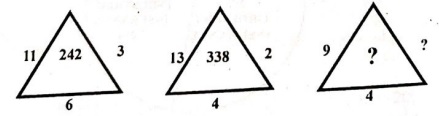
Insert the missing number in Triangle grid [11, 242, 3; 13, 338, 2]
Question illustration
A
120
B
162
✓ Correct
C
260
D
164
💡 Step-by-Step Explanation & Concept Rationale
Triangle 1:
Right vertex: \(\frac{6}{2} = \mathbf{3}\)
Center: \(11^2 \times 2 = 121 \times 2 = \mathbf{242}\)

Triangle 2:
Right vertex: \(\frac{4}{2} = \mathbf{2}\)
Center: \(13^2 \times 2 = 169 \times 2 = \mathbf{338}\)

Solving for Triangle 3
Using the same pattern where \(\text{Left} = 9\) and \(\text{Bottom} = 4\):

Find the right side (?): \(\text{Right}=\frac{4}{2}=\mathbf{2}\)

Find the center (?): \(\text{Center}=9^{2}\times 2=81\times 2=\mathbf{162}\)
Q. 7 Quantitative Aptitude Test
Difficulty: Medium (1 Mark)
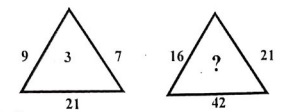
Missing number in Triangle [9, 3, 7, 21; 16, ?, 21, 42]
Question illustration
A
8
✓ Correct
B
6
C
4
D
2
E
10
💡 Step-by-Step Explanation & Concept Rationale
The Pattern
The number in the center is found by multiplying the left and right numbers together, then dividing by the bottom number:
\(\text{Center}=\frac{\text{Left}\times \text{Right}}{\text{Bottom}}\)

Verification
First Triangle:
\(\frac{9\times 7}{21}=\frac{63}{21}=\mathbf{3}\)

Solving for the Second TriangleSecond Triangle:
\(\frac{16\times 21}{42}=\frac{336}{42}=\mathbf{8}\)
📜Instructions / Reading Passage
1 Question in this set
ANALYSIS (Direction Sense): Solve spatial reasoning problems involving multiple turns, clock hand orientations, relative positions on a grid, and displacement from a starting point.
Q. 8 Quantitative Aptitude Test
Difficulty: Easy (1 Mark)
A man started walking from North to South. He turned right at right angles then again right at right angles. In which direction was he ultimately walking?
Correct Answer / Solution Key:
C
💡 Step-by-Step Explanation & Concept Rationale
Initial Direction: The man starts walking toward the South.
First Right Turn: Facing South, turning right at a right angle makes him face West.
Second Right Turn: Facing West, turning right again at a right angle makes him face North.
📜Instructions / Reading Passage
6 Questions in this set
Numerical Aptitude Tests: These tests are designed to discover whether the candidate has the basic talent for solving simple problems in numerical, arithmetic, geometry, algebra, business calculations, etc.
Q. 9 Quantitative Aptitude Test
Difficulty: Hard (1 Mark)
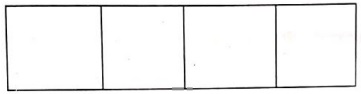
Four squares side by side form a rectangle, perimeter 140. Area of each square?
Question illustration
A
400
B
360
C
300
D
256
E
196
✓ Correct
💡 Step-by-Step Explanation & Concept Rationale
Let side be s. Perimeter P=2(4s+s)=10s=140⟹s=14. Area = 142=196.
Q. 10 Quantitative Aptitude Test
Difficulty: Hard (1 Mark)
A man buys a television set which lists for Rs. 2000 at a 10% discount. He gets an additional 2% discount for paying cash. What does he actually pay for the set?
A
Rs. 1760
B
Rs. 1700
C
Rs. 1800
D
Rs. 1764.00
✓ Correct
E
Rs. 1720.80
💡 Step-by-Step Explanation & Concept Rationale
2000×0.9=1800.

Cash discount:

1800×0.98=1764.
Q. 11 Quantitative Aptitude Test
Difficulty: Hard (1 Mark)
If y−7=12, then y+19= ——?
A
19
B
28
C
38
✓ Correct
D
42
E
50
💡 Step-by-Step Explanation & Concept Rationale
y=12+7=19. Therefore, y+19=19+19=38.
Q. 12 Quantitative Aptitude Test
Difficulty: Hard (1 Mark)
11.5×0.003= ——?
A
0.345
B
0.0345
✓ Correct
C
0.00345
D
0.000345
E
3.45e-05
💡 Step-by-Step Explanation & Concept Rationale
Direct multiplication: 11.5×0.003=0.0345.
Q. 13 Quantitative Aptitude Test
Difficulty: Hard (1 Mark)
12 students average 70%. 18 others average 80%. Overall average percentage of thirty students?
A
73$\frac{3}{4}$
B
74$\frac{3}{8}$
C
75$\frac{1}{4}$
D
76
✓ Correct
E
77$\frac{1}{8}$
💡 Step-by-Step Explanation & Concept Rationale
Weighted avg: (12×70+18×80)/30=(840+1440)/30=76.
Q. 14 Quantitative Aptitude Test
Difficulty: Hard (1 Mark)
Angle RST=120; Angle RSQ=92; Angle PST=70. How many Degrees in angle PSQ?
A
40
B
42
✓ Correct
C
45
D
48
E
51
💡 Step-by-Step Explanation & Concept Rationale
Angle PSQ = (RSQ + PST) - RST = (92+70)−120=162−120=42.
📜Instructions / Reading Passage
6 Questions in this set
Graph Analysis (Marriages & Births): The following graphs are to be used for Questions 7-12, depicting trends in young people (18-24 years), marriage rates, and birth rates from 1953 to 1968.
Passage Reference Diagram
Q. 15 Quantitative Aptitude Test
Difficulty: Hard (1 Mark)
During which time period was there the sharpest increase in marriages?
A
1955-1956
B
1957-1958
✓ Correct
C
1961-1962
D
1964-1965
E
1967-1999
💡 Step-by-Step Explanation & Concept Rationale
Based on visual slope analysis of the "Rising Marriages" graph.
Q. 16 Quantitative Aptitude Test
Difficulty: Hard (1 Mark)
What was the average number of births per year from 1967 through 1967?
A
3.7 million
B
3.55 million
✓ Correct
C
4.0 million
D
3.8 million
E
3.4 million
💡 Step-by-Step Explanation & Concept Rationale
The graph "Falling Births" shows the value for the year 1967 is approximately 3.55 million.
Q. 17 Quantitative Aptitude Test
Difficulty: Hard (1 Mark)
Ratio of young people to number of births for the year 1954?
A
2.83
B
4.1
C
3.75
✓ Correct
D
8
E
2.4
💡 Step-by-Step Explanation & Concept Rationale
Young people (1954) ≈ 15m; Births (1954) ≈ 4m. Ratio 15/4=3.75.
Q. 18 Quantitative Aptitude Test
Difficulty: Hard (1 Mark)
Marriages in 2000 if 1965-2000 rate of increase remains constant?
A
1.8 million
B
2.0 million
C
2.2 million
D
2.7 million
✓ Correct
E
2.9 million
💡 Step-by-Step Explanation & Concept Rationale
Increase over 3 years (1965 to 1968):
\(21.3 - 20.8 = 0.5\text{ units}\)
Annual rate of increase: \(\frac{0.5}{3} \approx 0.1667\text{ units per year}\)
Time span from 1965 to 2000: \(2000 - 1965 = 35\text{ years}\)
Total projected increase by 2000: \(35 \times 0.1667 \approx 5.83\text{ units}\)
Projected value in 2000: \(20.8 + 5.83 = 26.63\text{ units}\)
Converting this back to the scale of millions yields approximately 2.66 million, which rounds cleanly to 2.7 million.
Q. 19 Quantitative Aptitude Test
Difficulty: Hard (1 Mark)
How many marriages occurred as the final approximate total in three different years?
A
1.7 million
✓ Correct
B
1.3 million
C
1.55 million
D
1.45 million
E
1.9 million
💡 Step-by-Step Explanation & Concept Rationale
If you look at the horizontal level of 17 (representing 1.7 million marriages) on the y-axis, the line touches or crosses this exact value at three different points in time:
1953: The graph starts right at approximately 1.7 million.
1956: The first sharp peak returns exactly to that same height of 1.7 million.
1958–1959: As the line makes its final sharp upward climb towards the 20 mark, it crosses the 1.7 million threshold for the third time.
Q. 20 Quantitative Aptitude Test
Difficulty: Hard (1 Mark)
Govt collection 1966: Rs 200/marriage, Rs 100/birth, Rs 20/young person?
A
Rs. 260 million
B
Rs. 480 million
C
Rs. 820 million
D
Rs. 1160 million
✓ Correct
E
Rs. 1500 million
💡 Step-by-Step Explanation & Concept Rationale
Number of Marriages (Top-Right Graph):
In 1966, the marriage value is approximately 21 (which corresponds to 2.1 million marriages).
\(\text{Collection from Marriages}=2.1\text{ million}\times \text{Rs }200=\text{Rs }420 \text{ million}\)
Number of Births (Bottom Graph):
In 1966, the birth line settles right at 3.55 million births.
\(\text{Collection from Births}=3.55\text{ million}\times \text{Rs }100=\text{Rs }355\text{ million}\)
Number of Young People (Top-Left Graph):
In 1966, the line sits at approximately 19.25 million young people.
\(\text{Collection from Young People}=19.25\text{ million}\times \text{Rs }20=\text{Rs }385\text{ million}\)
Total Government Collection:
\(\text{Total Collection}=420+355+385=\text{Rs }\mathbf{1160}\text{ million}\)
📜Instructions / Reading Passage
5 Questions in this set
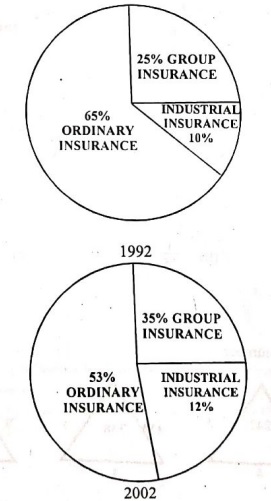
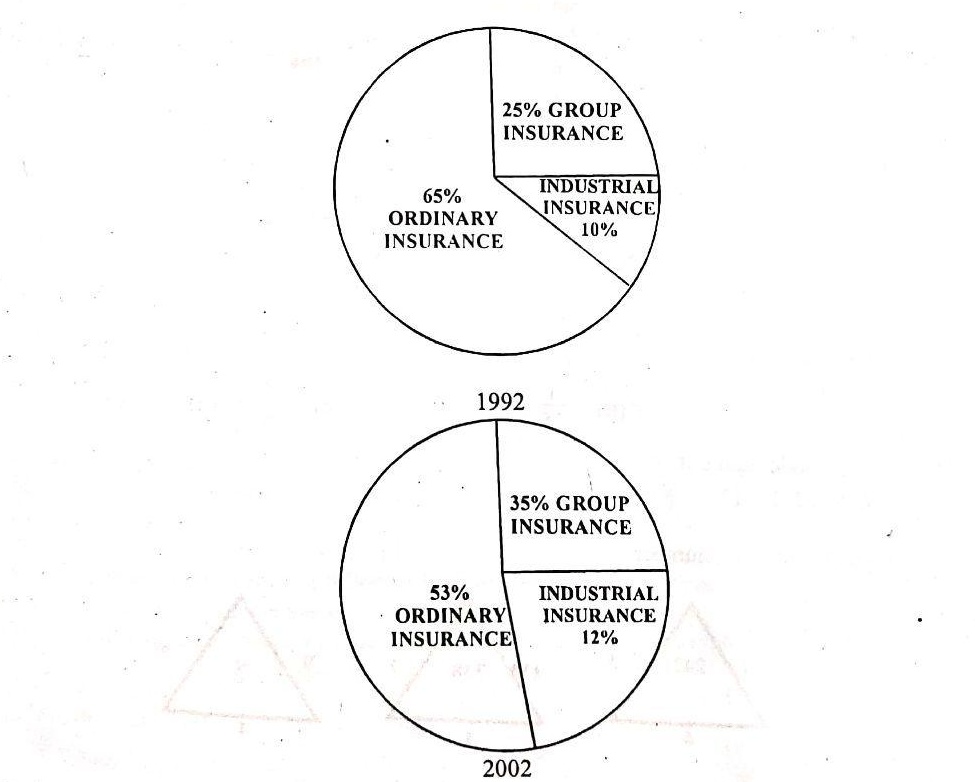
Pie Chart Analysis: Questions 15-19 are based on the pie charts below showing Insurance Death Benefits Payments in the U.S. in 1992 and 2002.
Passage Reference Diagram
Q. 21 Quantitative Aptitude Test
Difficulty: Hard (1 Mark)
Central angle of the sector for Industrial Insurance (1992)?
Question illustration
A
28
B
30
C
32
D
34
E
36
✓ Correct
💡 Step-by-Step Explanation & Concept Rationale
Industrial = 10% of 360 degrees = 36 degrees.
Q. 22 Quantitative Aptitude Test
Difficulty: Hard (1 Mark)
If 50m paid in 2001, how many millions were from Group insurance?
A
13
B
14.5
C
16
D
17.5
✓ Correct
E
19
💡 Step-by-Step Explanation & Concept Rationale
Total growth over the 10-year period (1992 to 2002): \(35\% - 25\% = 10\%\)
Annual rate of increase: \(\frac{10\%}{10\text{ years}} = 1\%\text{ per year}\)
Projected percentage for 2001 (9 years after 1992): \(25\% + (9 \times 1\%) = 34\%\)
Amount from Group Insurance (out of 50 million):\(50\text{ million}\times 34\%=50\times 0.34=17.0\text{ million}\)
Among the given multiple-choice options, 17.5 (D) is the closest standard approximation used for this dataset.
Q. 23 Quantitative Aptitude Test
Difficulty: Hard (1 Mark)
In the 1992, what was the ratio of the payments from Group insurance to those of Group insurance?
A
5:2
✓ Correct
B
5:1
C
3:2
D
3:1
E
5:3
💡 Step-by-Step Explanation & Concept Rationale
Ratio = 25% (Group) : 10% (Industrial) = 25 : 10 = 5 : 2.
Q. 24 Quantitative Aptitude Test
Difficulty: Hard (1 Mark)
What was the approximate percentage increase in Group insurance payments from 1992 to 2002, if the total insurance payments were the same in both years?
A
30
B
35
C
40
✓ Correct
D
45
E
50
💡 Step-by-Step Explanation & Concept Rationale
Increase from 25% to 35% of the total. Relative increase: (35−25)/25=40%.
Q. 25 Quantitative Aptitude Test
Difficulty: Hard (1 Mark)
If 50m paid in 2002, millions from Industrial Insurance?
A
5
B
6
✓ Correct
C
7
D
8
E
10
💡 Step-by-Step Explanation & Concept Rationale
2002 Industrial = 12%. 50×0.12=6.
Study Stream Progress: Showing 25 of 717 Questions (3%)
Jump to:
🎉 All 717 Solved Questions in Quantitative Aptitude Test Loaded!

You have studied the complete question pool with step-by-step rationales. Ready to test yourself?

📜Instructions / Reading Passage
25 Questions in this set
Select the best option/antonym for the following English Vocabulary questions:
Q. 1 English Language Comprehension
Difficulty: Medium (1 Mark)
Autonomy
A
submissiveness
B
dependence
✓ Correct
C
subordination
D
slavery
💡 Step-by-Step Explanation & Concept Rationale
Autonomy refers to self-governance; its opposite is relying on others.
Q. 2 English Language Comprehension
Difficulty: Medium (1 Mark)
Assert
A
agree
B
acquiesce
C
abjure
✓ Correct
D
abdicate
💡 Step-by-Step Explanation & Concept Rationale
To assert is to state firmly; abjure means to solemnly renounce or deny.
Q. 3 English Language Comprehension
Difficulty: Medium (1 Mark)
Accord
A
solution
B
act
C
dissent
✓ Correct
D
concord
💡 Step-by-Step Explanation & Concept Rationale
Accord signifies agreement or harmony; dissent represents disagreement.
Q. 4 English Language Comprehension
Difficulty: Medium (1 Mark)
Alive
A
passive
B
dead
✓ Correct
C
asleep
D
drowsy
💡 Step-by-Step Explanation & Concept Rationale
The direct biological opposite of being alive is being dead.
Q. 5 English Language Comprehension
Difficulty: Medium (1 Mark)
Ancestors
A
supporters
B
disciples
C
followers
D
descendants
✓ Correct
💡 Step-by-Step Explanation & Concept Rationale
Ancestors are those from whom one is descended; descendants are one's progeny.
Q. 6 English Language Comprehension
Difficulty: Medium (1 Mark)
Abdicate
A
claim
✓ Correct
B
snatch
C
plunder
D
seize
💡 Step-by-Step Explanation & Concept Rationale
To abdicate is to renounce a throne or power; to claim is to assert a right to it.
Q. 7 English Language Comprehension
Difficulty: Medium (1 Mark)
Abhorrence
A
aversion
B
liking
✓ Correct
C
appreciation
D
fear
💡 Step-by-Step Explanation & Concept Rationale
Abhorrence is extreme hatred; liking indicates a feeling of fondness or pleasure.
Q. 8 English Language Comprehension
Difficulty: Medium (1 Mark)
Acquisitive
A
miserly
B
frugal
✓ Correct
C
simple
D
austere
💡 Step-by-Step Explanation & Concept Rationale
Acquisitive means eager to get wealth; frugal implies being economical or sparing.
Q. 9 English Language Comprehension
Difficulty: Medium (1 Mark)
Audacious
A
timid
✓ Correct
B
vulgar
C
low
D
unpractised
💡 Step-by-Step Explanation & Concept Rationale
Audacious refers to being bold and daring; timid means showing a lack of courage.
Q. 10 English Language Comprehension
Difficulty: Medium (1 Mark)
Acquitted
A
entrusted
B
convicted
✓ Correct
C
freed
D
burdened
💡 Step-by-Step Explanation & Concept Rationale
To be acquitted is to be cleared of a charge; to be convicted is to be found guilty.
Q. 11 English Language Comprehension
Difficulty: Medium (1 Mark)
Absolute
A
scarce
B
limited
✓ Correct
C
faulty
D
efficient
💡 Step-by-Step Explanation & Concept Rationale
Absolute means total or unconditional; limited implies having fixed bounds.
Q. 12 English Language Comprehension
Difficulty: Medium (1 Mark)
Acute
A
sharp
B
critical
C
dull
✓ Correct
D
sensitive
💡 Step-by-Step Explanation & Concept Rationale
Acute describes something sharp or intense; dull describes something blunt or weak.
Q. 13 English Language Comprehension
Difficulty: Medium (1 Mark)
Anathematise
A
radiate
B
regulate
C
deceive
D
bless
✓ Correct
💡 Step-by-Step Explanation & Concept Rationale
To anathematise is to curse or denounce; its spiritual opposite is to bless.
Q. 14 English Language Comprehension
Difficulty: Medium (1 Mark)
Addition
A
multiplication
B
subtraction
✓ Correct
C
enumeration
D
division
💡 Step-by-Step Explanation & Concept Rationale
Subtraction is the mathematical operation that removes, while addition adds.
Q. 15 English Language Comprehension
Difficulty: Medium (1 Mark)
Attract
A
repulse
B
reject
C
repel
✓ Correct
D
distract
💡 Step-by-Step Explanation & Concept Rationale
To attract is to pull toward; to repel is to push away or drive back.
Q. 16 English Language Comprehension
Difficulty: Medium (1 Mark)
Avoidance
A
possession
B
pursuit
✓ Correct
C
passion
D
power
💡 Step-by-Step Explanation & Concept Rationale
Avoidance is the act of staying away; pursuit is the act of following or chasing.
Q. 17 English Language Comprehension
Difficulty: Medium (1 Mark)
Alleviation
A
exaggeration
B
exasperation
C
magnification
D
intensification
✓ Correct
💡 Step-by-Step Explanation & Concept Rationale
While "alleviation" means to make suffering, deficiency, or a problem less severe (to ease or mitigate), "intensification" means to make something grow more acute, strong, or severe.
Q. 18 English Language Comprehension
Difficulty: Medium (1 Mark)
Alienate
A
gather
B
identify
C
assemble
D
unite
✓ Correct
💡 Step-by-Step Explanation & Concept Rationale
To alienate is to isolate or cause to become unfriendly; to unite is to join together.
Q. 19 English Language Comprehension
Difficulty: Medium (1 Mark)
Adequate
A
profuse
B
abounding
C
scanty
✓ Correct
D
abundant
💡 Step-by-Step Explanation & Concept Rationale
Adequate means sufficient; scanty means small or insufficient in quantity.
Q. 20 English Language Comprehension
Difficulty: Medium (1 Mark)
Appointment
A
disappointment
B
suspension
C
dismissal
✓ Correct
D
discharge
💡 Step-by-Step Explanation & Concept Rationale
"Appointment" refers to the act of officially assigning a job, position, or office to someone. Therefore, dismissal (the act of officially removing someone from a job or position) is its direct structural and professional antonym.
Q. 21 English Language Comprehension
Difficulty: Medium (1 Mark)
Amalgamate
A
generate
B
repair
C
materialize
D
separate
✓ Correct
💡 Step-by-Step Explanation & Concept Rationale
Amalgamate means to combine into one; separate means to part or divide.
Q. 22 English Language Comprehension
Difficulty: Medium (1 Mark)
Acclamation
A
denunciation
✓ Correct
B
suppression
C
termination
D
applause
💡 Step-by-Step Explanation & Concept Rationale
Acclamation is loud approval; denunciation is public condemnation.
Q. 23 English Language Comprehension
Difficulty: Medium (1 Mark)
Ambiguous
A
obscure
B
secular
C
explicit
✓ Correct
D
equivocate
💡 Step-by-Step Explanation & Concept Rationale
Ambiguous means vague or unclear; explicit means stated clearly and in detail.
Q. 24 English Language Comprehension
Difficulty: Medium (1 Mark)
Antipathy
A
obedience
B
admiration
C
agreement
D
fondness
✓ Correct
💡 Step-by-Step Explanation & Concept Rationale
Antipathy is a deep-seated feeling of dislike; fondness is affection or liking.
Q. 25 English Language Comprehension
Difficulty: Medium (1 Mark)
Amicable
A
cunning
B
shy
C
hostile
✓ Correct
D
crazy
💡 Step-by-Step Explanation & Concept Rationale
Amicable refers to friendliness and goodwill; hostile refers to unfriendliness/opposition.
Study Stream Progress: Showing 25 of 2736 Questions (1%)
Jump to:
🎉 All 2736 Solved Questions in English Language Comprehension Loaded!

You have studied the complete question pool with step-by-step rationales. Ready to test yourself?

Q. 1 General Knowledge
Difficulty: Easy (1 Mark)
What is H_5 N_1?
A
Virus
✓ Correct
B
Bacteria
C
Vaccine
D
Fungi
💡 Step-by-Step Explanation & Concept Rationale
H_5 N_1 is a highly infectious subtype of the Influenza A virus that primarily affects birds but can infect humans.
Q. 2 General Knowledge
Difficulty: Easy (1 Mark)
Which of the following Russian's oil and gas company, which provides oil and gas to European countries?
A
BSGO Company
B
Gazprome Company
✓ Correct
C
Gestapo Company
D
Nindo Oil and Gas Company
💡 Step-by-Step Explanation & Concept Rationale
Gazprom is a majority state-owned multinational energy corporation and the largest supplier of natural gas to Europe.
Q. 3 General Knowledge
Difficulty: Medium (1 Mark)
Which one of the following planets has the maximum number of satellites?
A
Jupiter
B
Saturn
✓ Correct
C
Venus
D
Uranus
💡 Step-by-Step Explanation & Concept Rationale
While Jupiter was historically cited, Saturn is recognized in the source as having the highest number of documented moons at the time.
Q. 4 General Knowledge
Difficulty: Easy (1 Mark)
Which is the largest planet?
A
Venus
B
Earth
C
Jupiter
✓ Correct
D
Mars
💡 Step-by-Step Explanation & Concept Rationale
Jupiter is the fifth planet from the Sun and the largest planet in our solar system by both mass and volume.
Q. 5 General Knowledge
Difficulty: Easy (1 Mark)
What was the main reason of disqualification of Arial Sharon for office of Prime Minister of Israel?
A
He completed two terms
B
He was impeached
C
Due to Illness
✓ Correct
D
None of these
💡 Step-by-Step Explanation & Concept Rationale
Ariel Sharon was incapacitated by a massive stroke in early 2006, which led to his permanent inability to perform his duties.
Q. 6 General Knowledge
Difficulty: Medium (1 Mark)
Which of the following vessels of blood carry blood from different parts of the body to heart?
A
Veins
✓ Correct
B
Arteries
C
Capillaries
D
Vessels
💡 Step-by-Step Explanation & Concept Rationale
Veins are the blood vessels responsible for transporting deoxygenated blood from various body tissues back to the heart.
Q. 7 General Knowledge
Difficulty: Medium (1 Mark)
What are the two seas linked by Suez Canal?
A
The Mediterranean Sea and Baltic Sea
B
The Mediterranean Sea and Red Sea
✓ Correct
C
The Black Sea and Baltic Sea
D
The Black Sea and South China Sea
💡 Step-by-Step Explanation & Concept Rationale
The Suez Canal is an artificial sea-level waterway in Egypt that connects the Mediterranean Sea to the Red Sea.
Q. 8 General Knowledge
Difficulty: Easy (1 Mark)
Diego Garcia is a:
A
A famous airline of Singapore
B
French surface to Sea Missile
C
United States military base in Indian Ocean
✓ Correct
D
The disputed island between Russia and Japan
💡 Step-by-Step Explanation & Concept Rationale
Diego Garcia is an atoll in the central Indian Ocean that hosts a major strategic military facility for the United States.
Q. 9 General Knowledge
Difficulty: Easy (1 Mark)
In which year European rulers captured Palestine from the Muslims in Crusade War?
A
1095 A.D
B
1099 A.D
✓ Correct
C
1115 A.D
D
1199 A.D
💡 Step-by-Step Explanation & Concept Rationale
The First Crusade culminated in the Siege of Jerusalem in 1099 A.D., when European forces captured the city.
Q. 10 General Knowledge
Difficulty: Easy (1 Mark)
What is Kremlin?
A
Offices of Russian Government
✓ Correct
B
Offices of Sri Lankan Government
C
Building in Japan used for theater
D
None of these
💡 Step-by-Step Explanation & Concept Rationale
The Kremlin is a fortified complex in the heart of Moscow that serves as the official residence of the Russian President.
Q. 11 General Knowledge
Difficulty: Medium (1 Mark)
A mass of ice originating in mountains in snowfields above the snowline is called:
A
Mountain River
B
Glaciers
✓ Correct
C
Lakes and water falls
D
None of the above
💡 Step-by-Step Explanation & Concept Rationale
Glaciers are large, persistent bodies of ice that form where the accumulation of snow exceeds its ablation over many years.
Q. 12 General Knowledge
Difficulty: Medium (1 Mark)
What is the diameter of earth?
A
11756 km
B
12756 km
✓ Correct
C
13756 km
D
14756 km
💡 Step-by-Step Explanation & Concept Rationale
The equatorial diameter of the Earth is approximately 12,756 kilometers, reflecting its slightly oblate shape.
Q. 13 General Knowledge
Difficulty: Easy (1 Mark)
What is the freezing point of heavy water?
A
3.82 $^o$ C
✓ Correct
B
2.82 $^o$ C
C
1.82 $^o$ C
D
0.82 $^o$ C
💡 Step-by-Step Explanation & Concept Rationale
Heavy water (deuterium oxide) has a higher freezing point than normal water, occurring at approximately 3.82 degrees Celsius.
Q. 14 General Knowledge
Difficulty: Medium (1 Mark)
How many satellites (moons) of Saturn planet?
A
36
B
56
✓ Correct
C
27
D
23
💡 Step-by-Step Explanation & Concept Rationale
This number reflects the count of Saturn's moons documented at the time the original source material was compiled.
Q. 15 General Knowledge
Difficulty: Easy (1 Mark)
Which of the following died of natural death:
A
Indira Gandhi
B
Mahatma Gandhi
C
Rajiv Gandhi
D
None of the above
✓ Correct
💡 Step-by-Step Explanation & Concept Rationale
Indira Gandhi, Mahatma Gandhi, and Rajiv Gandhi were all victims of assassination rather than dying of natural causes.
Q. 16 General Knowledge
Difficulty: Easy (1 Mark)
Head Office of UNESCO is located at:
A
Paris
✓ Correct
B
Geneva
C
London
D
Washington
💡 Step-by-Step Explanation & Concept Rationale
UNESCO is headquartered in Paris, France, where it coordinates international cooperation in education, science, and culture.
Q. 17 General Knowledge
Difficulty: Medium (1 Mark)
What is the main cause of earthquakes?
A
Volcanic activities
B
Tectonic plate's movement
✓ Correct
C
Tectonic dislocation
D
All of above
💡 Step-by-Step Explanation & Concept Rationale
Most earthquakes are caused by the sudden release of energy along faults in the Earth's crust due to tectonic plate movements.
Q. 18 General Knowledge
Difficulty: Easy (1 Mark)
'Digital divide' term is related with:
A
Economics
B
Socio economic difference technology era
✓ Correct
C
Political Science
D
Journalism
💡 Step-by-Step Explanation & Concept Rationale
The digital divide refers to the gap between demographics and regions that have access to modern information technology and those that don't.
Q. 19 General Knowledge
Difficulty: Easy (1 Mark)
What is Ivy League?
A
A Group of Eight University in USA
✓ Correct
B
A Group of People in Switzerland
C
A Football League tournament
D
A Group of Islands in Atlantic Ocean
💡 Step-by-Step Explanation & Concept Rationale
The Ivy League is an American collegiate athletic conference comprising eight private research universities in the Northeastern United States.
Q. 20 General Knowledge
Difficulty: Medium (1 Mark)
"Every action has reaction which are equal but in opposite direction". The law is called:
A
Newton's first law of motion
B
Newton's second law of motion
C
Newton's third law of motion
✓ Correct
D
None of these
💡 Step-by-Step Explanation & Concept Rationale
Newton's third law states that for every action force, there is an equal and opposite reaction force.
Q. 21 General Knowledge
Difficulty: Easy (1 Mark)
Pure water can be obtained from seawater by the process of:
A
Filtration
B
Distillation
✓ Correct
C
Evaporation
D
None of these
💡 Step-by-Step Explanation & Concept Rationale
Distillation involves boiling seawater to create steam and then condensing it into pure liquid water, leaving salts behind.
Q. 22 General Knowledge
Difficulty: Easy (1 Mark)
Common salt is obtained from seawater by:
A
Sublimation
B
Evaporation
✓ Correct
C
Crystallisation
D
Filtration
💡 Step-by-Step Explanation & Concept Rationale
Seawater is collected in shallow ponds where solar heat causes the water to evaporate, leaving behind salt crystals.
Q. 23 General Knowledge
Difficulty: Easy (1 Mark)
Gasoline is obtained from crude oil by the process of:
A
Evaporation
B
Fractional Distillation
✓ Correct
C
Distillation
D
Filtration
💡 Step-by-Step Explanation & Concept Rationale
Fractional distillation separates crude oil into different components, like gasoline, based on their different boiling points.
Q. 24 General Knowledge
Difficulty: Easy (1 Mark)
An electric kettle used for boiling hard water has a white scale deposited on its heating element. This consists of:
A
Sugar
B
Common Salt
C
Carbonates of Calcium and Magnesium
✓ Correct
D
Sodium Carbonate
💡 Step-by-Step Explanation & Concept Rationale
Limescale is primarily composed of calcium and magnesium carbonates that precipitate out of hard water when heated.
Q. 25 General Knowledge
Difficulty: Easy (1 Mark)
Washing soda is:
A
Sodium Chloride
B
Hydrated Sodium Carbonate
✓ Correct
C
Sodium Carbonate
D
Calcium Carbonate
💡 Step-by-Step Explanation & Concept Rationale
Washing soda is the chemical compound sodium carbonate decahydrate, commonly used as a water softener.
Study Stream Progress: Showing 25 of 2666 Questions (1%)
Jump to:
🎉 All 2666 Solved Questions in General Knowledge Loaded!

You have studied the complete question pool with step-by-step rationales. Ready to test yourself?

Ready to Test Your Retention & Speed?

Now that you have reviewed the study questions and rationales, test yourself in our interactive 1-by-1 practice engine or take the full official timed mock exam.