
NETWORK ADMINISTRATOR (BS-16) Complete Preparation Guide & Solved Questions (2026) - Apex Rankers
Direct Departmental Recruitment Examination Syllabus & Question Bank
📘 Official Examination Scheme, Question Blueprint & Interview Masterclass
Official Written Examination Blueprint & Master Preparation Guide
Candidate Selection Architecture for NETWORK ADMINISTRATOR (BS-16)
📋 1. Examination Scheme & Marking Blueprint
The competitive recruitment screening for NETWORK ADMINISTRATOR (BS-16) consists of a single-paper 100-mark Multiple Choice Question (MCQ) written examination evaluating Computer Aptitude Test, English Language Comprehension, Quantitative Aptitude Test, and General Knowledge. The assessment duration is standardized at 90 minutes. A strict qualifying benchmark of 50% aggregate marks is mandatory for merit consideration. Negative marking is applied at a rate of 0.25 marks deducted per incorrect response, requiring candidates to exercise disciplined accuracy during question selection. Top-merit qualifiers are shortlisted for panel interview scrutiny at a ratio of 1:5 against announced vacancies.
| Examination Subject / Question Type | Target Marks | Weightage | Cognitive Focus & Syllabus Benchmark |
|---|---|---|---|
| Computer Aptitude Test | 50 MCQs | 50% | Operating Systems, Network Security & Firewalls, Database Management Systems (DBMS), Cyber Threat Intelligence & SIEM |
| English Language Comprehension | 20 MCQs | 20% | Grammar rules, sentence structuring, vocabulary, reading comprehension |
| Quantitative Aptitude Test | 15 MCQs | 15% | Arithmetic calculations, algebra, geometric reasoning, quantitative problem solving |
| General Knowledge | 15 MCQs | 15% | World affairs, international organizations, geography, everyday facts |
💡 2. High-Yield Conceptual Problem Solving & Case Scenarios
Mastery of applied operational problems is essential for securing top-tier percentiles. The following high-yield case scenarios reflect actual operational scenarios encountered in competitive selection exams:
Operational Dilemma: A network outage occurs during a critical exam period. Describe how you would diagnose and resolve the issue.
Operational Dilemma: A new firewall needs to be installed to enhance network security. Explain the steps involved in this process.
Operational Dilemma: A user reports slow internet speeds. How would you investigate and resolve this issue?
🎯 3. Departmental Selection Board Viva Voce & Panel Interview
Candidates shortlisted after the written screening will appear before a 3 to 5 member Departmental Selection Board. Interviews evaluate professional mastery, situational integrity, and knowledge of official rules.
📅 4. 14-Day Strategic Revision Roadmap
Execute this structured two-week study plan to consolidate syllabus coverage and peak cognitive readiness:
- Days 1-5: Computer Aptitude Test Mastery: Cover core theoretical foundations, statutory frameworks, technical standards, and high-frequency past paper questions.
- Days 6-8: English Language Comprehension Consolidation: Practice applied concepts, terminology, analytical structures, and domain-specific problem sets.
- Days 9-11: Quantitative Aptitude Test & Complementary Modules: Revise essential facts, regulatory rules, and cross-functional aptitude topics.
- Days 12-13: Error Log & Viva Voce Preparation: Review weak topic areas and rehearse oral responses for the Departmental Selection Board interview.
- Day 14: Full-Length Timed Mock Simulation: Complete two 100-MCQ timed mock tests strictly within 90 minutes to lock in pacing.
✅ 5. Examination Day Protocol & Merit Optimization Strategy
Candidates appearing for the NETWORK ADMINISTRATOR (BS-16) (BS-16) screening examination should strictly observe official test center protocols: carry the original CNIC, printed Roll Number Slip, and black or blue ballpoint pens for OMR bubble shading. Allocate the first 45 minutes to high-confidence questions in Computer Aptitude Test and English Language Comprehension before attempting multi-step analytical items. Maintain a minimum 80% accuracy rate across attempted items to absorb any negative marking deductions and secure a top-decile merit ranking for the Departmental Selection Committee interview.
You have studied the complete question pool with step-by-step rationales. Ready to test yourself?
You have studied the complete question pool with step-by-step rationales. Ready to test yourself?
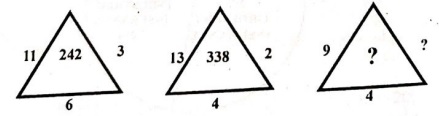
Right vertex: \(\frac{6}{2} = \mathbf{3}\)
Center: \(11^2 \times 2 = 121 \times 2 = \mathbf{242}\)
Triangle 2:
Right vertex: \(\frac{4}{2} = \mathbf{2}\)
Center: \(13^2 \times 2 = 169 \times 2 = \mathbf{338}\)
Solving for Triangle 3
Using the same pattern where \(\text{Left} = 9\) and \(\text{Bottom} = 4\):
Find the right side (?): \(\text{Right}=\frac{4}{2}=\mathbf{2}\)
Find the center (?): \(\text{Center}=9^{2}\times 2=81\times 2=\mathbf{162}\)
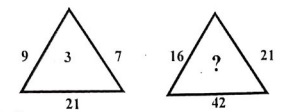
The number in the center is found by multiplying the left and right numbers together, then dividing by the bottom number:
\(\text{Center}=\frac{\text{Left}\times \text{Right}}{\text{Bottom}}\)
Verification
First Triangle:
\(\frac{9\times 7}{21}=\frac{63}{21}=\mathbf{3}\)
Solving for the Second TriangleSecond Triangle:
\(\frac{16\times 21}{42}=\frac{336}{42}=\mathbf{8}\)
First Right Turn: Facing South, turning right at a right angle makes him face West.
Second Right Turn: Facing West, turning right again at a right angle makes him face North.
Cash discount:
1800×0.98=1764.

\(21.3 - 20.8 = 0.5\text{ units}\)
Annual rate of increase: \(\frac{0.5}{3} \approx 0.1667\text{ units per year}\)
Time span from 1965 to 2000: \(2000 - 1965 = 35\text{ years}\)
Total projected increase by 2000: \(35 \times 0.1667 \approx 5.83\text{ units}\)
Projected value in 2000: \(20.8 + 5.83 = 26.63\text{ units}\)
Converting this back to the scale of millions yields approximately 2.66 million, which rounds cleanly to 2.7 million.
1953: The graph starts right at approximately 1.7 million.
1956: The first sharp peak returns exactly to that same height of 1.7 million.
1958–1959: As the line makes its final sharp upward climb towards the 20 mark, it crosses the 1.7 million threshold for the third time.
In 1966, the marriage value is approximately 21 (which corresponds to 2.1 million marriages).
\(\text{Collection from Marriages}=2.1\text{ million}\times \text{Rs }200=\text{Rs }420 \text{ million}\)
Number of Births (Bottom Graph):
In 1966, the birth line settles right at 3.55 million births.
\(\text{Collection from Births}=3.55\text{ million}\times \text{Rs }100=\text{Rs }355\text{ million}\)
Number of Young People (Top-Left Graph):
In 1966, the line sits at approximately 19.25 million young people.
\(\text{Collection from Young People}=19.25\text{ million}\times \text{Rs }20=\text{Rs }385\text{ million}\)
Total Government Collection:
\(\text{Total Collection}=420+355+385=\text{Rs }\mathbf{1160}\text{ million}\)
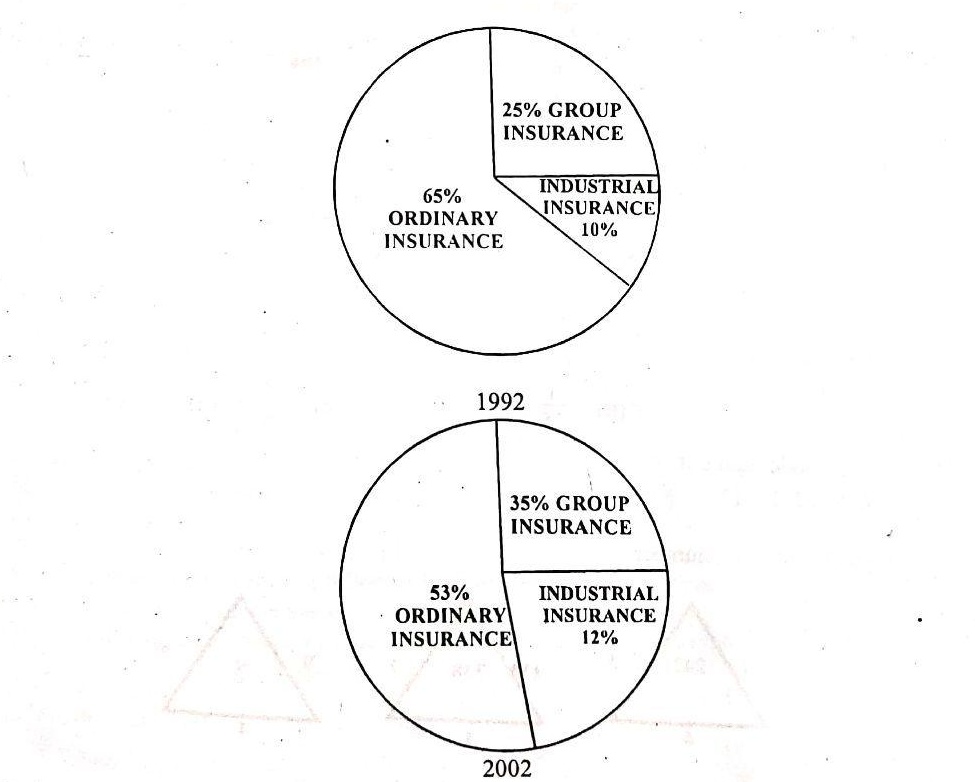
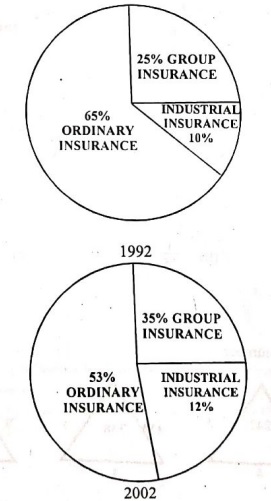
Annual rate of increase: \(\frac{10\%}{10\text{ years}} = 1\%\text{ per year}\)
Projected percentage for 2001 (9 years after 1992): \(25\% + (9 \times 1\%) = 34\%\)
Amount from Group Insurance (out of 50 million):\(50\text{ million}\times 34\%=50\times 0.34=17.0\text{ million}\)
Among the given multiple-choice options, 17.5 (D) is the closest standard approximation used for this dataset.
You have studied the complete question pool with step-by-step rationales. Ready to test yourself?
You have studied the complete question pool with step-by-step rationales. Ready to test yourself?
Ready to Test Your Retention & Speed?
Now that you have reviewed the study questions and rationales, test yourself in our interactive 1-by-1 practice engine or take the full official timed mock exam.