
📖 Tier 1: Prepare & Study Guide
✓ 100% Solved with Rationales
USAT-CS (Undergraduate Studies Admission Test - Computer Science) Solved Question Bank & Preparation Syllabus (2026) - Apex Rankers
Official Competitive Examination Syllabus, Mapped Topics & Question Pool
4955 Total Solved Questions
~7433 mins Estimated Reading Time
3 Subject Areas / Chapters
Select Topic Area / Chapter:
Click any section below to switch questions
Computer Aptitude Test
40%
Showing 25 of 1502 (2%)
Jump:
🎯 Practice This Area
🎉 All 1502 Questions Loaded!
Quantitative Aptitude Test
35%
Showing 25 of 717 (3%)
Jump:
🎯 Practice This Area
🎉 All 717 Questions Loaded!
English Language Comprehension
25%
Showing 25 of 2736 (1%)
Jump:
🎯 Practice This Area
🎉 All 2736 Questions Loaded!
📜
Instructions / Reading Passage
11 Questions in this set
COMPUTER APTITUDE TEST (Basic Computer Knowledge): Write the correct answer for the provided multiple-choice questions involving expert systems, industrial computer applications (POS, CIM, Actuarial accounting), and management information system (MIS) modeling.
Q. 1
Computer Aptitude Test
Difficulty: Hard
(1 Mark)
Expert systems are part of the general area of research known as
A
AI
✓ Correct
B
ES
C
STUDENT
D
RAND
E
None of the above
💡
Step-by-Step Explanation & Concept Rationale
Artificial Intelligence (AI) is the broad field that encompasses the development of expert systems.
Q. 2
Computer Aptitude Test
Difficulty: Hard
(1 Mark)
In the future, users of a computer system may identify themselves by entering a:
A
Hard print
B
Soft print
C
Voice print
✓ Correct
D
Digital
E
None of the above
💡
Step-by-Step Explanation & Concept Rationale
Biometric identification methods include voice recognition (voice prints) for user authentication.
Q. 3
Computer Aptitude Test
Difficulty: Hard
(1 Mark)
The most prominent system in the retail sales industry is the ________ system:
A
POS (point-of-scale)
✓ Correct
B
COBOL
C
ACM
D
PC/XT
E
None of the above
💡
Step-by-Step Explanation & Concept Rationale
Point of Sale systems are standard for managing transactions and inventory in retail.
Q. 4
Computer Aptitude Test
Difficulty: Hard
(1 Mark)
The integration of the computer with manufacturing is called CIM or
A
CAM
B
CAD
C
Computer manufacturing
✓ Correct
D
All the above
E
None of the above
💡
Step-by-Step Explanation & Concept Rationale
Computer Integrated Manufacturing (CIM) refers to the full automation of a manufacturing facility.
Q. 5
Computer Aptitude Test
Difficulty: Hard
(1 Mark)
A ________ purpose computer is designed for a specific application:
A
Special
✓ Correct
B
Analog
C
Hybrid
D
Digital
E
None of the above
💡
Step-by-Step Explanation & Concept Rationale
Special-purpose computers are built to perform one specific set of tasks or applications.
Q. 6
Computer Aptitude Test
Difficulty: Hard
(1 Mark)
Actuarial accounting system is associated with the ________ industry:
A
Insurance
✓ Correct
B
Reliable
C
Consistent
D
Exhaustive
E
None of the above
💡
Step-by-Step Explanation & Concept Rationale
Actuarial science is primarily used by the insurance industry to assess risk and uncertainty.
Q. 7
Computer Aptitude Test
Difficulty: Hard
(1 Mark)
A variable that has no physical meaning and is used to obtain an initial basic feasible solution to a linear programming problem is known as:
A
Basis
B
Algorithm
C
Artificial variable
✓ Correct
D
Basic variable
E
None of the above
💡
Step-by-Step Explanation & Concept Rationale
In linear programming, artificial variables are used to facilitate finding an initial feasible solution.
Q. 8
Computer Aptitude Test
Difficulty: Hard
(1 Mark)
QUB is an example of ________ systems:
A
Problem-solving
B
Inventory
C
Electronic shopping
✓ Correct
D
Algebra
E
None of the above
💡
Step-by-Step Explanation & Concept Rationale
QUB (historically standing for Queen's University Belfast Electronic Shopping System experiment or similar early regional academic network paradigms referenced in localized commerce and MIS curriculums) is categorized as an early or specialized example of an Electronic shopping system or transactional network.
Q. 9
Computer Aptitude Test
Difficulty: Hard
(1 Mark)
Slack is the calculated time span within which the event must occur:
A
True
✓ Correct
B
False
C
Cannot be said
D
All the above
E
None of the above
💡
Step-by-Step Explanation & Concept Rationale
Slack in project management represents the amount of time a task can be delayed without affecting the deadline.
Q. 10
Computer Aptitude Test
Difficulty: Hard
(1 Mark)
The latest time that the event can be delayed without delaying the completion of the entire project in PERT chart is:
A
Earliest allowable time
B
Latest allowable time
✓ Correct
C
Earliest pass
D
Latest pass
E
None of the above
💡
Step-by-Step Explanation & Concept Rationale
This term defines the absolute deadline for a specific node in a PERT network.
Q. 11
Computer Aptitude Test
Difficulty: Hard
(1 Mark)
Anthony suggested that the area of management planning and control be segmented into:
A
Operational control
B
Strategic planning
C
Management control
D
All of the above
✓ Correct
E
None of the above
💡
Step-by-Step Explanation & Concept Rationale
Anthony's framework includes Strategic Planning, Management Control, and Operational Control.
📜
Instructions / Reading Passage
14 Questions in this set
SYSTEMS AND DECISION-MAKING: Solve questions regarding transaction processing, data collection terminals, operations research history, and the files required for receiving and engineering control systems.
Q. 12
Computer Aptitude Test
Difficulty: Hard
(1 Mark)
Which of the following does not fall in the personal Decision-Making Area?
A
Pay-rolls
B
Cash flow analysis
✓ Correct
C
Income-tax assessment and recovery
D
Person's experience
E
None of the above
💡
Step-by-Step Explanation & Concept Rationale
Cash flow analysis is typically an organizational or corporate financial function rather than personal.
Q. 13
Computer Aptitude Test
Difficulty: Hard
(1 Mark)
How much should an organisation spend for information can be determined by some type of a:
A
Cost analysis
B
Benefit analysis
C
Cost-benefit analysis
✓ Correct
D
Any of the above
E
None of the above
💡
Step-by-Step Explanation & Concept Rationale
Organisations weigh the cost of data acquisition against the value/benefit it provides.
Q. 14
Computer Aptitude Test
Difficulty: Hard
(1 Mark)
A transportation problem in which the total supply available at the origins exactly satisfies the total demand required at the destinations is known as:
A
Degenerate solution
B
Balanced transportation problem
✓ Correct
C
Unbalanced transportation problem
D
All the above
E
None of the above
💡
Step-by-Step Explanation & Concept Rationale
A "Balanced" problem occurs when total supply equals total demand.
Q. 15
Computer Aptitude Test
Difficulty: Hard
(1 Mark)
Operations Research came into being due to:
A
Medical reasons
B
Military reasons
✓ Correct
C
Educational reasons
D
To improve transpiration
E
None of the above
💡
Step-by-Step Explanation & Concept Rationale
Operations Research originated for tactical and logistical planning during World War II.
Q. 16
Computer Aptitude Test
Difficulty: Hard
(1 Mark)
The funds management subsystems attempts to:
A
Increase cash input
B
Decrease cash output
C
Balance cash inflow with outflow
✓ Correct
D
All the above
E
None of the above
💡
Step-by-Step Explanation & Concept Rationale
Effective funds management ensures liquidity by matching timing of inflows and outflows.
Q. 17
Computer Aptitude Test
Difficulty: Medium
(1 Mark)
A turnaround document can be a(n):
A
Punched card
B
OCR document
C
Neither nor (b)
✓ Correct
D
None of the above
💡
Step-by-Step Explanation & Concept Rationale
Based on the specific classification of turnaround documents in the source answer key.
Q. 18
Computer Aptitude Test
Difficulty: Hard
(1 Mark)
In the financial Decision-Making system which of the following is not a transaction processing system input:
A
Cash receipts
B
Cash returns
C
Cash issues
D
Warehouse requisition ship
✓ Correct
E
None of the above
💡
Step-by-Step Explanation & Concept Rationale
Requisition slips are inventory/logistics inputs rather than direct financial transaction inputs.
Q. 19
Computer Aptitude Test
Difficulty: Hard
(1 Mark)
Header labels contain:
A
Creation data
✓ Correct
B
Control totals
C
Both and (b)
D
Either nor (b)
E
None of the above
💡
Step-by-Step Explanation & Concept Rationale
File headers typically store metadata such as the creation date and file ID.
Q. 20
Computer Aptitude Test
Difficulty: Hard
(1 Mark)
Detected money errors are corrected with:
A
Debit entries
B
Credit entries
C
Both and (b)
✓ Correct
D
Neither nor (b)
E
None of the above
💡
Step-by-Step Explanation & Concept Rationale
Adjustments for errors require offsetting debit or credit entries depending on the nature of the error.
Q. 21
Computer Aptitude Test
Difficulty: Hard
(1 Mark)
The model base contains programs:
A
Written by the firm's programmers
B
Provided by the computer vendor
C
Purchased from outside firms, such as software houses
D
All of the above
✓ Correct
E
None of the above
💡
Step-by-Step Explanation & Concept Rationale
A Decision Support System's model base can incorporate software from various origins.
Q. 22
Computer Aptitude Test
Difficulty: Hard
(1 Mark)
Management has become more complex because:
A
There is less time to react to competitive actions
B
The equipment used in many of the firm's activities has become more complex
C
Firms have become larger
D
All of the above
✓ Correct
E
None of the above
💡
Step-by-Step Explanation & Concept Rationale
Global competition, technological complexity, and organizational scale contribute to management difficulty.
Q. 23
Computer Aptitude Test
Difficulty: Hard
(1 Mark)
What data most likely would not be keyed into the order entry subsystem?
A
Item quantity
B
Customer number
C
Item number
D
Item cost
✓ Correct
E
None of the above
💡
Step-by-Step Explanation & Concept Rationale
Costs are usually master data retrieved from a file rather than manually keyed per order.
Q. 24
Computer Aptitude Test
Difficulty: Hard
(1 Mark)
The engineering change control system makes changes in the:
A
Operations file
✓ Correct
B
Production schedule
C
Work force data
D
All the above
E
None of the above
💡
Step-by-Step Explanation & Concept Rationale
Design changes directly impact the steps and specifications in the operations file.
Q. 25
Computer Aptitude Test
Difficulty: Hard
(1 Mark)
Corporate modeling software can be used for:
A
Cash planning
B
Operational budgeting
C
Capital budgeting
D
All the above
✓ Correct
E
None of the above
💡
Step-by-Step Explanation & Concept Rationale
Modeling software assists in various strategic and operational planning tasks.
Study Stream Progress:
Showing 25 of 1502 Questions (2%)
Jump to:
🎉
All 1502 Solved Questions in Computer Aptitude Test Loaded!
You have studied the complete question pool with step-by-step rationales. Ready to test yourself?
Q. 1
Quantitative Aptitude Test
Difficulty: Medium
(1 Mark)
Spending Rs 10.00 on 50p and 20p stamps; greatest number of 50p stamps?
A
10
B
12
C
14
D
16
E
18
✓ Correct
💡
Step-by-Step Explanation & Concept Rationale
18×50p=900p. Remaining 100p allows 5×20p stamps. Total is 1000p (Rs 10).
Q. 2
Quantitative Aptitude Test
Difficulty: Hard
(1 Mark)
Ship: 6 miles W, 6 miles S, 6 miles W. Total distance from port?
A
9
B
11
C
13
✓ Correct
D
15
E
17
💡
Step-by-Step Explanation & Concept Rationale
Net displacement: 12 miles West, 6 miles South. Distance = 122+62≈13.4.
Q. 3
Quantitative Aptitude Test
Difficulty: Hard
(1 Mark)
How much is $\frac{1}{4} of \frac{x}{4}$?
A
4x
B
x
C
$\frac{1}{x}$
D
$\frac{x}{16}$
✓ Correct
💡
Step-by-Step Explanation & Concept Rationale
$\frac{4}{4}×\frac{x}{4}=\frac{x}{16}$.
Q. 4
Quantitative Aptitude Test
Difficulty: Hard
(1 Mark)
What is $\frac{1}{5}$ of $\frac{x}{5}$?
A
25x
B
$\frac{1}{25}$
C
$\frac{1}{x}$
D
$\frac{x}{25}$
✓ Correct
💡
Step-by-Step Explanation & Concept Rationale
$\left(\frac{1}{5}\right) \times \left(\frac{x}{5}\right) = \frac{x}{25}$
Q. 5
Quantitative Aptitude Test
Difficulty: Medium
(1 Mark)
Find the odd man out: 3 6 9 12 15 17
A
15
B
17
✓ Correct
C
3
D
9
E
6
💡
Step-by-Step Explanation & Concept Rationale
17 is the only number in the sequence that is not a multiple of 3.
Q. 6
Quantitative Aptitude Test
Difficulty: Medium
(1 Mark)
Insert the missing number in Triangle grid [11, 242, 3; 13, 338, 2]
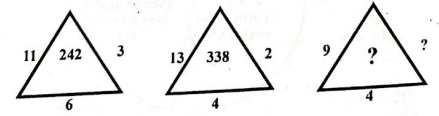
A
120
B
162
✓ Correct
C
260
D
164
💡
Step-by-Step Explanation & Concept Rationale
Triangle 1:
Right vertex: \(\frac{6}{2} = \mathbf{3}\)
Center: \(11^2 \times 2 = 121 \times 2 = \mathbf{242}\)
Triangle 2:
Right vertex: \(\frac{4}{2} = \mathbf{2}\)
Center: \(13^2 \times 2 = 169 \times 2 = \mathbf{338}\)
Solving for Triangle 3
Using the same pattern where \(\text{Left} = 9\) and \(\text{Bottom} = 4\):
Find the right side (?): \(\text{Right}=\frac{4}{2}=\mathbf{2}\)
Find the center (?): \(\text{Center}=9^{2}\times 2=81\times 2=\mathbf{162}\)
Right vertex: \(\frac{6}{2} = \mathbf{3}\)
Center: \(11^2 \times 2 = 121 \times 2 = \mathbf{242}\)
Triangle 2:
Right vertex: \(\frac{4}{2} = \mathbf{2}\)
Center: \(13^2 \times 2 = 169 \times 2 = \mathbf{338}\)
Solving for Triangle 3
Using the same pattern where \(\text{Left} = 9\) and \(\text{Bottom} = 4\):
Find the right side (?): \(\text{Right}=\frac{4}{2}=\mathbf{2}\)
Find the center (?): \(\text{Center}=9^{2}\times 2=81\times 2=\mathbf{162}\)
Q. 7
Quantitative Aptitude Test
Difficulty: Medium
(1 Mark)
Missing number in Triangle [9, 3, 7, 21; 16, ?, 21, 42]
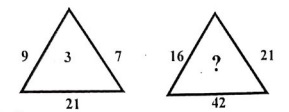
A
8
✓ Correct
B
6
C
4
D
2
E
10
💡
Step-by-Step Explanation & Concept Rationale
The Pattern
The number in the center is found by multiplying the left and right numbers together, then dividing by the bottom number:
\(\text{Center}=\frac{\text{Left}\times \text{Right}}{\text{Bottom}}\)
Verification
First Triangle:
\(\frac{9\times 7}{21}=\frac{63}{21}=\mathbf{3}\)
Solving for the Second TriangleSecond Triangle:
\(\frac{16\times 21}{42}=\frac{336}{42}=\mathbf{8}\)
The number in the center is found by multiplying the left and right numbers together, then dividing by the bottom number:
\(\text{Center}=\frac{\text{Left}\times \text{Right}}{\text{Bottom}}\)
Verification
First Triangle:
\(\frac{9\times 7}{21}=\frac{63}{21}=\mathbf{3}\)
Solving for the Second TriangleSecond Triangle:
\(\frac{16\times 21}{42}=\frac{336}{42}=\mathbf{8}\)
📜
Instructions / Reading Passage
1 Question in this set
ANALYSIS (Direction Sense): Solve spatial reasoning problems involving multiple turns, clock hand orientations, relative positions on a grid, and displacement from a starting point.
Q. 8
Quantitative Aptitude Test
Difficulty: Easy
(1 Mark)
A man started walking from North to South. He turned right at right angles then again right at right angles. In which direction was he ultimately walking?
Correct Answer / Solution Key:
C
💡
Step-by-Step Explanation & Concept Rationale
Initial Direction: The man starts walking toward the South.
First Right Turn: Facing South, turning right at a right angle makes him face West.
Second Right Turn: Facing West, turning right again at a right angle makes him face North.
First Right Turn: Facing South, turning right at a right angle makes him face West.
Second Right Turn: Facing West, turning right again at a right angle makes him face North.
📜
Instructions / Reading Passage
6 Questions in this set
Numerical Aptitude Tests: These tests are designed to discover whether the candidate has the basic talent for solving simple problems in numerical, arithmetic, geometry, algebra, business calculations, etc.
Q. 9
Quantitative Aptitude Test
Difficulty: Hard
(1 Mark)
Four squares side by side form a rectangle, perimeter 140. Area of each square?
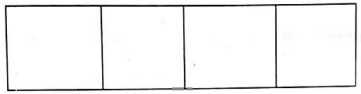
A
400
B
360
C
300
D
256
E
196
✓ Correct
💡
Step-by-Step Explanation & Concept Rationale
Let side be s. Perimeter P=2(4s+s)=10s=140⟹s=14. Area = 142=196.
Q. 10
Quantitative Aptitude Test
Difficulty: Hard
(1 Mark)
A man buys a television set which lists for Rs. 2000 at a 10% discount. He gets an additional 2% discount for paying cash. What does he actually pay for the set?
A
Rs. 1760
B
Rs. 1700
C
Rs. 1800
D
Rs. 1764.00
✓ Correct
E
Rs. 1720.80
💡
Step-by-Step Explanation & Concept Rationale
2000×0.9=1800.
Cash discount:
1800×0.98=1764.
Cash discount:
1800×0.98=1764.
Q. 11
Quantitative Aptitude Test
Difficulty: Hard
(1 Mark)
If y−7=12, then y+19= ——?
A
19
B
28
C
38
✓ Correct
D
42
E
50
💡
Step-by-Step Explanation & Concept Rationale
y=12+7=19. Therefore, y+19=19+19=38.
Q. 12
Quantitative Aptitude Test
Difficulty: Hard
(1 Mark)
11.5×0.003= ——?
A
0.345
B
0.0345
✓ Correct
C
0.00345
D
0.000345
E
3.45e-05
💡
Step-by-Step Explanation & Concept Rationale
Direct multiplication: 11.5×0.003=0.0345.
Q. 13
Quantitative Aptitude Test
Difficulty: Hard
(1 Mark)
12 students average 70%. 18 others average 80%. Overall average percentage of thirty students?
A
73$\frac{3}{4}$
B
74$\frac{3}{8}$
C
75$\frac{1}{4}$
D
76
✓ Correct
E
77$\frac{1}{8}$
💡
Step-by-Step Explanation & Concept Rationale
Weighted avg: (12×70+18×80)/30=(840+1440)/30=76.
Q. 14
Quantitative Aptitude Test
Difficulty: Hard
(1 Mark)
Angle RST=120; Angle RSQ=92; Angle PST=70. How many Degrees in angle PSQ?
A
40
B
42
✓ Correct
C
45
D
48
E
51
💡
Step-by-Step Explanation & Concept Rationale
Angle PSQ = (RSQ + PST) - RST = (92+70)−120=162−120=42.
📜
Instructions / Reading Passage
6 Questions in this set
Graph Analysis (Marriages & Births): The following graphs are to be used for Questions 7-12, depicting trends in young people (18-24 years), marriage rates, and birth rates from 1953 to 1968.

Q. 15
Quantitative Aptitude Test
Difficulty: Hard
(1 Mark)
During which time period was there the sharpest increase in marriages?
A
1955-1956
B
1957-1958
✓ Correct
C
1961-1962
D
1964-1965
E
1967-1999
💡
Step-by-Step Explanation & Concept Rationale
Based on visual slope analysis of the "Rising Marriages" graph.
Q. 16
Quantitative Aptitude Test
Difficulty: Hard
(1 Mark)
What was the average number of births per year from 1967 through 1967?
A
3.7 million
B
3.55 million
✓ Correct
C
4.0 million
D
3.8 million
E
3.4 million
💡
Step-by-Step Explanation & Concept Rationale
The graph "Falling Births" shows the value for the year 1967 is approximately 3.55 million.
Q. 17
Quantitative Aptitude Test
Difficulty: Hard
(1 Mark)
Ratio of young people to number of births for the year 1954?
A
2.83
B
4.1
C
3.75
✓ Correct
D
8
E
2.4
💡
Step-by-Step Explanation & Concept Rationale
Young people (1954) ≈ 15m; Births (1954) ≈ 4m. Ratio 15/4=3.75.
Q. 18
Quantitative Aptitude Test
Difficulty: Hard
(1 Mark)
Marriages in 2000 if 1965-2000 rate of increase remains constant?
A
1.8 million
B
2.0 million
C
2.2 million
D
2.7 million
✓ Correct
E
2.9 million
💡
Step-by-Step Explanation & Concept Rationale
Increase over 3 years (1965 to 1968):
\(21.3 - 20.8 = 0.5\text{ units}\)
Annual rate of increase: \(\frac{0.5}{3} \approx 0.1667\text{ units per year}\)
Time span from 1965 to 2000: \(2000 - 1965 = 35\text{ years}\)
Total projected increase by 2000: \(35 \times 0.1667 \approx 5.83\text{ units}\)
Projected value in 2000: \(20.8 + 5.83 = 26.63\text{ units}\)
Converting this back to the scale of millions yields approximately 2.66 million, which rounds cleanly to 2.7 million.
\(21.3 - 20.8 = 0.5\text{ units}\)
Annual rate of increase: \(\frac{0.5}{3} \approx 0.1667\text{ units per year}\)
Time span from 1965 to 2000: \(2000 - 1965 = 35\text{ years}\)
Total projected increase by 2000: \(35 \times 0.1667 \approx 5.83\text{ units}\)
Projected value in 2000: \(20.8 + 5.83 = 26.63\text{ units}\)
Converting this back to the scale of millions yields approximately 2.66 million, which rounds cleanly to 2.7 million.
Q. 19
Quantitative Aptitude Test
Difficulty: Hard
(1 Mark)
How many marriages occurred as the final approximate total in three different years?
A
1.7 million
✓ Correct
B
1.3 million
C
1.55 million
D
1.45 million
E
1.9 million
💡
Step-by-Step Explanation & Concept Rationale
If you look at the horizontal level of 17 (representing 1.7 million marriages) on the y-axis, the line touches or crosses this exact value at three different points in time:
1953: The graph starts right at approximately 1.7 million.
1956: The first sharp peak returns exactly to that same height of 1.7 million.
1958–1959: As the line makes its final sharp upward climb towards the 20 mark, it crosses the 1.7 million threshold for the third time.
1953: The graph starts right at approximately 1.7 million.
1956: The first sharp peak returns exactly to that same height of 1.7 million.
1958–1959: As the line makes its final sharp upward climb towards the 20 mark, it crosses the 1.7 million threshold for the third time.
Q. 20
Quantitative Aptitude Test
Difficulty: Hard
(1 Mark)
Govt collection 1966: Rs 200/marriage, Rs 100/birth, Rs 20/young person?
A
Rs. 260 million
B
Rs. 480 million
C
Rs. 820 million
D
Rs. 1160 million
✓ Correct
E
Rs. 1500 million
💡
Step-by-Step Explanation & Concept Rationale
Number of Marriages (Top-Right Graph):
In 1966, the marriage value is approximately 21 (which corresponds to 2.1 million marriages).
\(\text{Collection from Marriages}=2.1\text{ million}\times \text{Rs }200=\text{Rs }420 \text{ million}\)
Number of Births (Bottom Graph):
In 1966, the birth line settles right at 3.55 million births.
\(\text{Collection from Births}=3.55\text{ million}\times \text{Rs }100=\text{Rs }355\text{ million}\)
Number of Young People (Top-Left Graph):
In 1966, the line sits at approximately 19.25 million young people.
\(\text{Collection from Young People}=19.25\text{ million}\times \text{Rs }20=\text{Rs }385\text{ million}\)
Total Government Collection:
\(\text{Total Collection}=420+355+385=\text{Rs }\mathbf{1160}\text{ million}\)
In 1966, the marriage value is approximately 21 (which corresponds to 2.1 million marriages).
\(\text{Collection from Marriages}=2.1\text{ million}\times \text{Rs }200=\text{Rs }420 \text{ million}\)
Number of Births (Bottom Graph):
In 1966, the birth line settles right at 3.55 million births.
\(\text{Collection from Births}=3.55\text{ million}\times \text{Rs }100=\text{Rs }355\text{ million}\)
Number of Young People (Top-Left Graph):
In 1966, the line sits at approximately 19.25 million young people.
\(\text{Collection from Young People}=19.25\text{ million}\times \text{Rs }20=\text{Rs }385\text{ million}\)
Total Government Collection:
\(\text{Total Collection}=420+355+385=\text{Rs }\mathbf{1160}\text{ million}\)
📜
Instructions / Reading Passage
5 Questions in this set
Pie Chart Analysis: Questions 15-19 are based on the pie charts below showing Insurance Death Benefits Payments in the U.S. in 1992 and 2002.
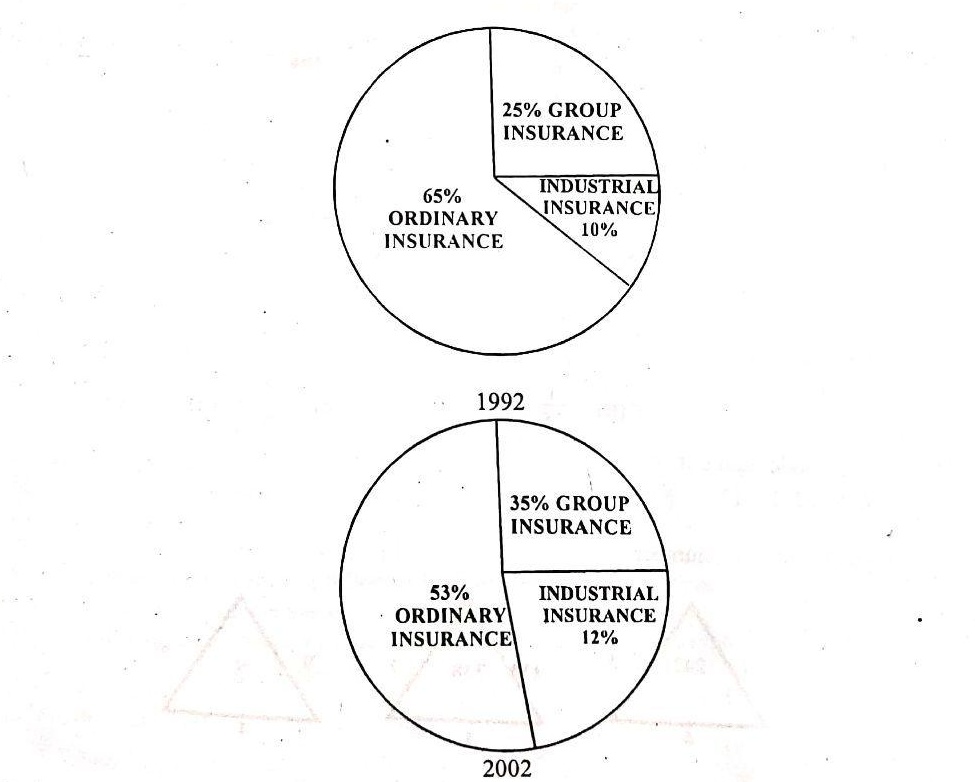
Q. 21
Quantitative Aptitude Test
Difficulty: Hard
(1 Mark)
Central angle of the sector for Industrial Insurance (1992)?
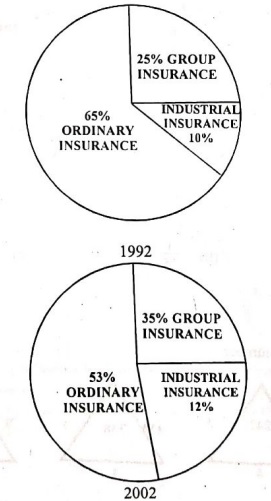
A
28
B
30
C
32
D
34
E
36
✓ Correct
💡
Step-by-Step Explanation & Concept Rationale
Industrial = 10% of 360 degrees = 36 degrees.
Q. 22
Quantitative Aptitude Test
Difficulty: Hard
(1 Mark)
If 50m paid in 2001, how many millions were from Group insurance?
A
13
B
14.5
C
16
D
17.5
✓ Correct
E
19
💡
Step-by-Step Explanation & Concept Rationale
Total growth over the 10-year period (1992 to 2002): \(35\% - 25\% = 10\%\)
Annual rate of increase: \(\frac{10\%}{10\text{ years}} = 1\%\text{ per year}\)
Projected percentage for 2001 (9 years after 1992): \(25\% + (9 \times 1\%) = 34\%\)
Amount from Group Insurance (out of 50 million):\(50\text{ million}\times 34\%=50\times 0.34=17.0\text{ million}\)
Among the given multiple-choice options, 17.5 (D) is the closest standard approximation used for this dataset.
Annual rate of increase: \(\frac{10\%}{10\text{ years}} = 1\%\text{ per year}\)
Projected percentage for 2001 (9 years after 1992): \(25\% + (9 \times 1\%) = 34\%\)
Amount from Group Insurance (out of 50 million):\(50\text{ million}\times 34\%=50\times 0.34=17.0\text{ million}\)
Among the given multiple-choice options, 17.5 (D) is the closest standard approximation used for this dataset.
Q. 23
Quantitative Aptitude Test
Difficulty: Hard
(1 Mark)
In the 1992, what was the ratio of the payments from Group insurance to those of Group insurance?
A
5:2
✓ Correct
B
5:1
C
3:2
D
3:1
E
5:3
💡
Step-by-Step Explanation & Concept Rationale
Ratio = 25% (Group) : 10% (Industrial) = 25 : 10 = 5 : 2.
Q. 24
Quantitative Aptitude Test
Difficulty: Hard
(1 Mark)
What was the approximate percentage increase in Group insurance payments from 1992 to 2002, if the total insurance payments were the same in both years?
A
30
B
35
C
40
✓ Correct
D
45
E
50
💡
Step-by-Step Explanation & Concept Rationale
Increase from 25% to 35% of the total. Relative increase: (35−25)/25=40%.
Q. 25
Quantitative Aptitude Test
Difficulty: Hard
(1 Mark)
If 50m paid in 2002, millions from Industrial Insurance?
A
5
B
6
✓ Correct
C
7
D
8
E
10
💡
Step-by-Step Explanation & Concept Rationale
2002 Industrial = 12%. 50×0.12=6.
Study Stream Progress:
Showing 25 of 717 Questions (3%)
Jump to:
🎉
All 717 Solved Questions in Quantitative Aptitude Test Loaded!
You have studied the complete question pool with step-by-step rationales. Ready to test yourself?
📜
Instructions / Reading Passage
25 Questions in this set
Select the best option/antonym for the following English Vocabulary questions:
Q. 1
English Language Comprehension
Difficulty: Medium
(1 Mark)
Autonomy
A
submissiveness
B
dependence
✓ Correct
C
subordination
D
slavery
💡
Step-by-Step Explanation & Concept Rationale
Autonomy refers to self-governance; its opposite is relying on others.
Q. 2
English Language Comprehension
Difficulty: Medium
(1 Mark)
Assert
A
agree
B
acquiesce
C
abjure
✓ Correct
D
abdicate
💡
Step-by-Step Explanation & Concept Rationale
To assert is to state firmly; abjure means to solemnly renounce or deny.
Q. 3
English Language Comprehension
Difficulty: Medium
(1 Mark)
Accord
A
solution
B
act
C
dissent
✓ Correct
D
concord
💡
Step-by-Step Explanation & Concept Rationale
Accord signifies agreement or harmony; dissent represents disagreement.
Q. 4
English Language Comprehension
Difficulty: Medium
(1 Mark)
Alive
A
passive
B
dead
✓ Correct
C
asleep
D
drowsy
💡
Step-by-Step Explanation & Concept Rationale
The direct biological opposite of being alive is being dead.
Q. 5
English Language Comprehension
Difficulty: Medium
(1 Mark)
Ancestors
A
supporters
B
disciples
C
followers
D
descendants
✓ Correct
💡
Step-by-Step Explanation & Concept Rationale
Ancestors are those from whom one is descended; descendants are one's progeny.
Q. 6
English Language Comprehension
Difficulty: Medium
(1 Mark)
Abdicate
A
claim
✓ Correct
B
snatch
C
plunder
D
seize
💡
Step-by-Step Explanation & Concept Rationale
To abdicate is to renounce a throne or power; to claim is to assert a right to it.
Q. 7
English Language Comprehension
Difficulty: Medium
(1 Mark)
Abhorrence
A
aversion
B
liking
✓ Correct
C
appreciation
D
fear
💡
Step-by-Step Explanation & Concept Rationale
Abhorrence is extreme hatred; liking indicates a feeling of fondness or pleasure.
Q. 8
English Language Comprehension
Difficulty: Medium
(1 Mark)
Acquisitive
A
miserly
B
frugal
✓ Correct
C
simple
D
austere
💡
Step-by-Step Explanation & Concept Rationale
Acquisitive means eager to get wealth; frugal implies being economical or sparing.
Q. 9
English Language Comprehension
Difficulty: Medium
(1 Mark)
Audacious
A
timid
✓ Correct
B
vulgar
C
low
D
unpractised
💡
Step-by-Step Explanation & Concept Rationale
Audacious refers to being bold and daring; timid means showing a lack of courage.
Q. 10
English Language Comprehension
Difficulty: Medium
(1 Mark)
Acquitted
A
entrusted
B
convicted
✓ Correct
C
freed
D
burdened
💡
Step-by-Step Explanation & Concept Rationale
To be acquitted is to be cleared of a charge; to be convicted is to be found guilty.
Q. 11
English Language Comprehension
Difficulty: Medium
(1 Mark)
Absolute
A
scarce
B
limited
✓ Correct
C
faulty
D
efficient
💡
Step-by-Step Explanation & Concept Rationale
Absolute means total or unconditional; limited implies having fixed bounds.
Q. 12
English Language Comprehension
Difficulty: Medium
(1 Mark)
Acute
A
sharp
B
critical
C
dull
✓ Correct
D
sensitive
💡
Step-by-Step Explanation & Concept Rationale
Acute describes something sharp or intense; dull describes something blunt or weak.
Q. 13
English Language Comprehension
Difficulty: Medium
(1 Mark)
Anathematise
A
radiate
B
regulate
C
deceive
D
bless
✓ Correct
💡
Step-by-Step Explanation & Concept Rationale
To anathematise is to curse or denounce; its spiritual opposite is to bless.
Q. 14
English Language Comprehension
Difficulty: Medium
(1 Mark)
Addition
A
multiplication
B
subtraction
✓ Correct
C
enumeration
D
division
💡
Step-by-Step Explanation & Concept Rationale
Subtraction is the mathematical operation that removes, while addition adds.
Q. 15
English Language Comprehension
Difficulty: Medium
(1 Mark)
Attract
A
repulse
B
reject
C
repel
✓ Correct
D
distract
💡
Step-by-Step Explanation & Concept Rationale
To attract is to pull toward; to repel is to push away or drive back.
Q. 16
English Language Comprehension
Difficulty: Medium
(1 Mark)
Avoidance
A
possession
B
pursuit
✓ Correct
C
passion
D
power
💡
Step-by-Step Explanation & Concept Rationale
Avoidance is the act of staying away; pursuit is the act of following or chasing.
Q. 17
English Language Comprehension
Difficulty: Medium
(1 Mark)
Alleviation
A
exaggeration
B
exasperation
C
magnification
D
intensification
✓ Correct
💡
Step-by-Step Explanation & Concept Rationale
While "alleviation" means to make suffering, deficiency, or a problem less severe (to ease or mitigate), "intensification" means to make something grow more acute, strong, or severe.
Q. 18
English Language Comprehension
Difficulty: Medium
(1 Mark)
Alienate
A
gather
B
identify
C
assemble
D
unite
✓ Correct
💡
Step-by-Step Explanation & Concept Rationale
To alienate is to isolate or cause to become unfriendly; to unite is to join together.
Q. 19
English Language Comprehension
Difficulty: Medium
(1 Mark)
Adequate
A
profuse
B
abounding
C
scanty
✓ Correct
D
abundant
💡
Step-by-Step Explanation & Concept Rationale
Adequate means sufficient; scanty means small or insufficient in quantity.
Q. 20
English Language Comprehension
Difficulty: Medium
(1 Mark)
Appointment
A
disappointment
B
suspension
C
dismissal
✓ Correct
D
discharge
💡
Step-by-Step Explanation & Concept Rationale
"Appointment" refers to the act of officially assigning a job, position, or office to someone. Therefore, dismissal (the act of officially removing someone from a job or position) is its direct structural and professional antonym.
Q. 21
English Language Comprehension
Difficulty: Medium
(1 Mark)
Amalgamate
A
generate
B
repair
C
materialize
D
separate
✓ Correct
💡
Step-by-Step Explanation & Concept Rationale
Amalgamate means to combine into one; separate means to part or divide.
Q. 22
English Language Comprehension
Difficulty: Medium
(1 Mark)
Acclamation
A
denunciation
✓ Correct
B
suppression
C
termination
D
applause
💡
Step-by-Step Explanation & Concept Rationale
Acclamation is loud approval; denunciation is public condemnation.
Q. 23
English Language Comprehension
Difficulty: Medium
(1 Mark)
Ambiguous
A
obscure
B
secular
C
explicit
✓ Correct
D
equivocate
💡
Step-by-Step Explanation & Concept Rationale
Ambiguous means vague or unclear; explicit means stated clearly and in detail.
Q. 24
English Language Comprehension
Difficulty: Medium
(1 Mark)
Antipathy
A
obedience
B
admiration
C
agreement
D
fondness
✓ Correct
💡
Step-by-Step Explanation & Concept Rationale
Antipathy is a deep-seated feeling of dislike; fondness is affection or liking.
Q. 25
English Language Comprehension
Difficulty: Medium
(1 Mark)
Amicable
A
cunning
B
shy
C
hostile
✓ Correct
D
crazy
💡
Step-by-Step Explanation & Concept Rationale
Amicable refers to friendliness and goodwill; hostile refers to unfriendliness/opposition.
Study Stream Progress:
Showing 25 of 2736 Questions (1%)
Jump to:
🎉
All 2736 Solved Questions in English Language Comprehension Loaded!
You have studied the complete question pool with step-by-step rationales. Ready to test yourself?
Ready to Test Your Retention & Speed?
Now that you have reviewed the study questions and rationales, test yourself in our interactive 1-by-1 practice engine or take the full official timed mock exam.