
PPSC PMS Combined Competitive Screening (Punjab) Solved Question Bank & Preparation Syllabus (2026) - Apex Rankers
Official Competitive Examination Syllabus, Mapped Topics & Question Pool
Pakistan Affairs
25%General Knowledge
25%English Language Comprehension
15%Quantitative Aptitude Test
10%Computer Aptitude Test
10%You have studied the complete question pool with step-by-step rationales. Ready to test yourself?
You have studied the complete question pool with step-by-step rationales. Ready to test yourself?
His name appears in Surah Al-Ahzab (Chapter 33, Verse 37):
"So when Zayd had accomplished his desire from her, We married her to you..."
This verse was revealed regarding his divorce from Hazrat Zainab bint Jahsh (RA), establishing an important legal precedent in Islamic family law that adopted children do not carry the same legal restrictions regarding marriage as biological children.
As a prominent and permanent member of the Ashaab-e-Sufah, he lived a completely ascetic life on the porch of the Prophet's Mosque (Masjid-e-Nabwi). Freed from the responsibilities of trade or agriculture, he dedicated his entire day and night to accompanying the Holy Prophet Muhammad (PBUH). He famously possessed an extraordinary, miraculous memory—blessed directly by a supplication from the Prophet (PBUH)—which allowed him to memorize and preserve everything he heard.
Imam Ahmad bin Hanbal (780–855 CE) painstakingly curated this massive, encyclopedic work from an initial pool of over 750,000 narrations to preserve the Sunnah. Unlike subject-based books (like Sahih Bukhari), a "Musnad" is structurally organized alphabetically or by rank based on the individual companion (Sahabi) who originally reported the narration.
This specific count breaks down according to Hadith classification as follows:
600 Marfu' traditions (directly attributed statements of the Holy Prophet Muhammad PBUH)
613 Mawquf traditions (statements or actions traced back to the Companions/Sahaba)
285 Maqtu' traditions (statements traced back to the Successors/Tabi'un)
222 Mursal traditions (hadiths with a missing link between the Tabi'un and the Prophet PBUH)
It holds a monumental place in Islamic history as the first formulated and written collection of Hadith and Islamic law (Fiqh) ever compiled. Imam Malik spent over forty years meticulously sorting, analyzing, and legalizing the traditions of the Holy Prophet (PBUH) along with the rulings of the Companions (Sahaba) and Successors (Tabi'un) practiced in the city of Madinah.
A Hadith is classified as Za'eef due to a minor defect, such as a break in the chain of narrators or one of the narrators having a less-than-perfect memory. It is crucial to note that Za'eef does not mean it is a fabrication or a lie; rather, it simply means it lacks the ironclad absolute certainty of authenticity. It is still strictly differentiated from a fabricated Hadith, which is termed Mawdu'.
If you subtract the repetitions and only count the completely unique, core traditions (Mu'allaqat and Muttabi'at excluded), the number drops to around 2,602. However, for standard multiple-choice testing keys, 7,397 is the exact total count expected.
You have studied the complete question pool with step-by-step rationales. Ready to test yourself?
You have studied the complete question pool with step-by-step rationales. Ready to test yourself?
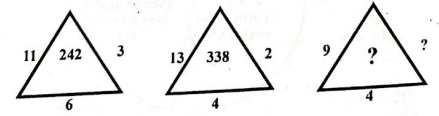
Right vertex: \(\frac{6}{2} = \mathbf{3}\)
Center: \(11^2 \times 2 = 121 \times 2 = \mathbf{242}\)
Triangle 2:
Right vertex: \(\frac{4}{2} = \mathbf{2}\)
Center: \(13^2 \times 2 = 169 \times 2 = \mathbf{338}\)
Solving for Triangle 3
Using the same pattern where \(\text{Left} = 9\) and \(\text{Bottom} = 4\):
Find the right side (?): \(\text{Right}=\frac{4}{2}=\mathbf{2}\)
Find the center (?): \(\text{Center}=9^{2}\times 2=81\times 2=\mathbf{162}\)
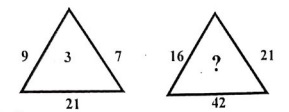
The number in the center is found by multiplying the left and right numbers together, then dividing by the bottom number:
\(\text{Center}=\frac{\text{Left}\times \text{Right}}{\text{Bottom}}\)
Verification
First Triangle:
\(\frac{9\times 7}{21}=\frac{63}{21}=\mathbf{3}\)
Solving for the Second TriangleSecond Triangle:
\(\frac{16\times 21}{42}=\frac{336}{42}=\mathbf{8}\)
First Right Turn: Facing South, turning right at a right angle makes him face West.
Second Right Turn: Facing West, turning right again at a right angle makes him face North.
Cash discount:
1800×0.98=1764.

\(21.3 - 20.8 = 0.5\text{ units}\)
Annual rate of increase: \(\frac{0.5}{3} \approx 0.1667\text{ units per year}\)
Time span from 1965 to 2000: \(2000 - 1965 = 35\text{ years}\)
Total projected increase by 2000: \(35 \times 0.1667 \approx 5.83\text{ units}\)
Projected value in 2000: \(20.8 + 5.83 = 26.63\text{ units}\)
Converting this back to the scale of millions yields approximately 2.66 million, which rounds cleanly to 2.7 million.
1953: The graph starts right at approximately 1.7 million.
1956: The first sharp peak returns exactly to that same height of 1.7 million.
1958–1959: As the line makes its final sharp upward climb towards the 20 mark, it crosses the 1.7 million threshold for the third time.
In 1966, the marriage value is approximately 21 (which corresponds to 2.1 million marriages).
\(\text{Collection from Marriages}=2.1\text{ million}\times \text{Rs }200=\text{Rs }420 \text{ million}\)
Number of Births (Bottom Graph):
In 1966, the birth line settles right at 3.55 million births.
\(\text{Collection from Births}=3.55\text{ million}\times \text{Rs }100=\text{Rs }355\text{ million}\)
Number of Young People (Top-Left Graph):
In 1966, the line sits at approximately 19.25 million young people.
\(\text{Collection from Young People}=19.25\text{ million}\times \text{Rs }20=\text{Rs }385\text{ million}\)
Total Government Collection:
\(\text{Total Collection}=420+355+385=\text{Rs }\mathbf{1160}\text{ million}\)
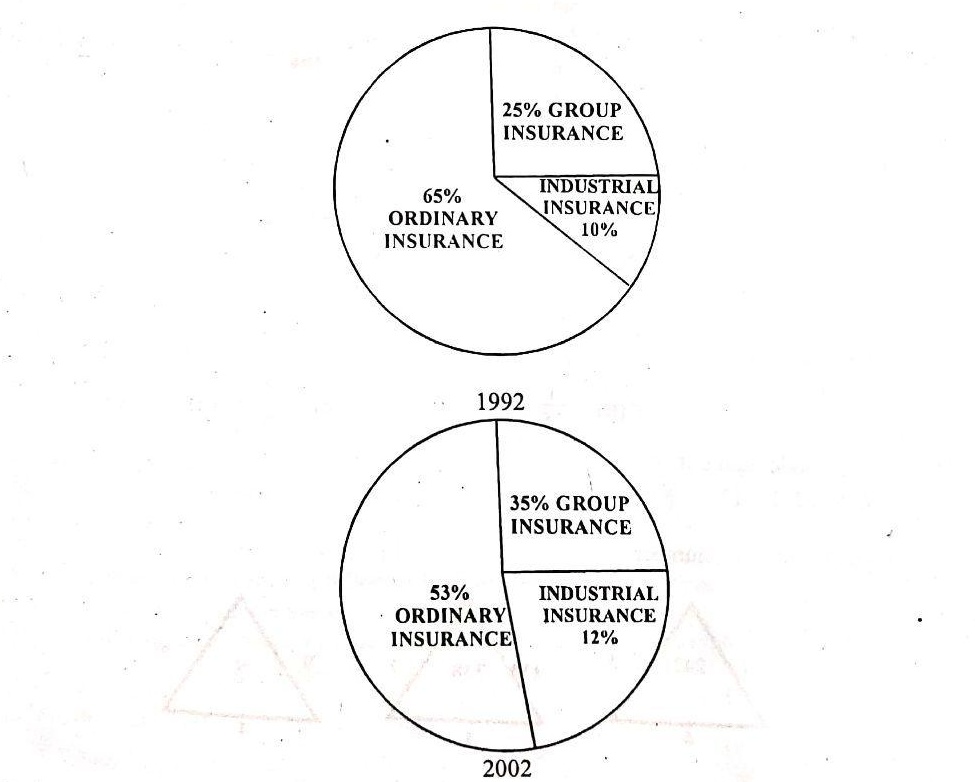
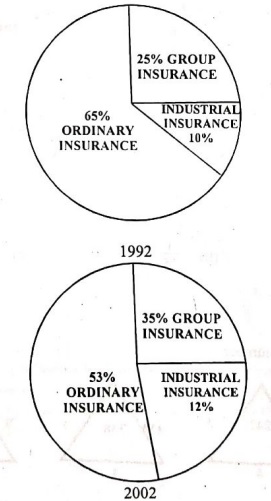
Annual rate of increase: \(\frac{10\%}{10\text{ years}} = 1\%\text{ per year}\)
Projected percentage for 2001 (9 years after 1992): \(25\% + (9 \times 1\%) = 34\%\)
Amount from Group Insurance (out of 50 million):\(50\text{ million}\times 34\%=50\times 0.34=17.0\text{ million}\)
Among the given multiple-choice options, 17.5 (D) is the closest standard approximation used for this dataset.
You have studied the complete question pool with step-by-step rationales. Ready to test yourself?
You have studied the complete question pool with step-by-step rationales. Ready to test yourself?
Ready to Test Your Retention & Speed?
Now that you have reviewed the study questions and rationales, test yourself in our interactive 1-by-1 practice engine or take the full official timed mock exam.