
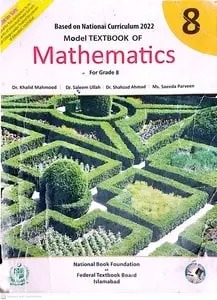
Class 8 Mathematics Ch 9: Geometry Mastery Guide (FBISE)
Teacher & Parent Instructional Roadmap
Unit Focus: Under the Pakistan Single National Curriculum (SNC 2022) and Federal Board (FBISE) standards for Grade 8 Mathematics, Unit 9: Geometry (جیومیٹری) establishes rigorous deductive and computational foundations in 2D Euclidean geometry. Students master the mathematical distinctions between similar figures ($\sim$) and congruent figures ($\cong$), apply the four fundamental triangle congruence postulates ($SSS, SAS, ASA, RHS$), and compute circle metrics (arc lengths, sector areas, and circle theorems).
- Differentiate between Similar figures (equal angles, proportional sides) and Congruent figures (identical shape and size).
- Establish One-to-One Correspondence ($\Delta ABC \leftrightarrow \Delta DEF$) and set up side ratio equations.
- Apply the 4 triangle congruence postulates: $SSS \cong SSS$, $SAS \cong SAS$, $ASA \cong ASA$ (or AAS), and $RHS \cong RHS$ ($HS \cong HS$).
- Calculate Arc Length ($L = \frac{\theta}{360^\circ} \times 2\pi r$) and Sector Area ($A = \frac{\theta}{360^\circ} \times \pi r^2$).
- Prove and apply circle theorems: Angle in a Semicircle is $90^\circ$ (Thales' theorem) and Angles in the same segment are equal.
- Apply the Intersecting Chords Theorem ($PA \cdot PB = PC \cdot PD$) and tangent perpendicularity ($r \perp \text{tangent}$).
- The "Angle-Side-Side" (SSA/ASS) Trap: Two sides and a non-included angle do NOT prove congruence (except the special $RHS$ condition in right-angled triangles). The angle in $SAS$ MUST be strictly included between the two given sides.
- Mixing Arc Length vs. Sector Area: Arc length represents a linear boundary perimeter fraction ($2\pi r$), while sector area represents a 2D surface area fraction ($\pi r^2$).
- Diameter vs. Radius Oversight: Forgetting to divide diameter by $2$ to obtain radius $r$ before substituting into $\pi r^2$ or $2\pi r$.
- Confusing Semicircle Angle with Central Angle: The angle subtended by a diameter at the circle circumference is $90^\circ$, whereas the central angle of a semicircle is $180^\circ$.
2. Match Corresponding Vertices & Formulate Equations: Write down exact vertex correspondences ($\Delta ABC \leftrightarrow \Delta DEF$) or substitution formulas ($L = \frac{\theta}{360^\circ} 2\pi r$, $PA \cdot PB = PC \cdot PD$).
3. Solve Algebraically & Include Physical Units: Compute unknown sides, angles, arc lengths, or areas with correct units ($\text{cm}, \text{cm}^2, ^\circ$).
🌍 Real-World Connections & Kid-Friendly Tips
🌟 Complete Geometric Theory & Circle Theorems Reference
1. Similar Figures ($\sim$):
Two geometric figures are similar if:
- All pairs of corresponding angles are equal: $\angle A = \angle D, \angle B = \angle E, \angle C = \angle F$.
- All pairs of corresponding sides are in the same ratio: $\frac{AB}{DE} = \frac{BC}{EF} = \frac{AC}{DF} = k$ (Scale factor).
2. The Four Triangle Congruence Criteria ($\cong$):
Two triangles are congruent ($\Delta ABC \cong \Delta DEF$) if any of the following conditions is satisfied:
- SSS (Side-Side-Side): Three sides of one triangle are equal to the corresponding three sides of the second triangle.
- SAS (Side-Angle-Side): Two sides and the included angle of one triangle equal two sides and the included angle of the second.
- ASA (Angle-Side-Angle) / AAS: Two angles and the side of one triangle equal two angles and the corresponding side of the second.
- RHS / HS (Right-Hypotenuse-Side): In right-angled triangles, the hypotenuse and one side of one triangle equal the hypotenuse and corresponding side of the other.
3. Circle Anatomy & Formulas:
- Arc Length ($L$): $L = \frac{\theta}{360^\circ} \times 2\pi r = \frac{\theta}{360^\circ} \times \pi d$.
- Sector Area ($A$): $A = \frac{\theta}{360^\circ} \times \pi r^2 = \frac{1}{2} L r$.
- Semicircle Inscribed Right Angle Theorem (Thales): Any angle subtended by a diameter at any point on the circumference is a right angle ($90^\circ$).
- Angles in the Same Segment Theorem: Angles subtended by the same chord in the same circular segment are equal ($\angle ACB = \angle ADB$).
- Intersecting Chords Theorem: If two chords $AB$ and $CD$ intersect at point $P$, then $PA \cdot PB = PC \cdot PD$.
- Tangent Line Perpendicularity: A tangent to a circle is perpendicular to the radius drawn to the point of contact ($OT \perp PT \implies \angle OTP = 90^\circ$).
Exercise 9.1 • Similar Figures & Proportionality
Pages 153–157Q1. Look at the figures drawn on the square grid and write down the pairs of similar figures.
Step 1: Inspect grid dimensions and shape proportions:
Compare the ratio of corresponding vertical and horizontal dimensions of each labeled grid shape.
Step 2: Identify matching pairs:
* Figure A and Figure D are similar right triangles ($A \sim D$).
* Figure B and Figure H are similar rectangles ($B \sim H$).
* Figure C and Figure G are similar trapezoids ($C \sim G$).
* Figure E and Figure F are similar squares ($E \sim F$).
Final Answer: Pairs of similar figures: $A \sim D, \quad B \sim H, \quad C \sim G, \quad E \sim F$.
Q2. Draw figures similar to the given shapes on graph paper with the specified scale factors: (i) Scale factor $k = 2$ (ii) Scale factor $k = \frac{1}{2}$ (iii) Scale factor $k = 3$.
(i) Scale factor $k=2$: Multiply each side length by 2 while keeping interior angles identical.
(ii) Scale factor $k=\frac{1}{2}$: Multiply each side length by $0.5$ (halve every dimension).
(iii) Scale factor $k=3$: Multiply each side length by 3.
Final Answer: Enlarged and reduced figures drawn with corresponding sides scaled by factor $k$ and equal corresponding angles.
Q3. Determine which of the following pairs of figures are similar (parts i to viii):
(i) Two squares of side lengths $4\text{ cm}$ and $6\text{ cm}$: All angles $=90^\circ$, ratio $= \frac{4}{6} = \frac{2}{3}$. Similar ($\sim$).
(ii) Two circles of radii $3\text{ cm}$ and $5\text{ cm}$: All circles are always similar. Similar ($\sim$).
(iii) Two equilateral triangles of sides $5\text{ cm}$ and $8\text{ cm}$: All angles $=60^\circ$, sides proportional. Similar ($\sim$).
(iv) A rectangle ($4\times 6$) and a square ($4\times 4$): Angles equal ($90^\circ$), but sides not proportional ($\frac{4}{4} \neq \frac{6}{4}$). Not Similar.
(v) Two right triangles with angles $(30^\circ, 60^\circ, 90^\circ)$ and $(30^\circ, 60^\circ, 90^\circ)$: Angles equal. Similar ($\sim$).
(vi) A rhombus and a square of same side lengths: Angles are different (rhombus has non-right angles). Not Similar.
(vii) Two regular hexagons: All regular polygons with same number of sides are similar. Similar ($\sim$).
(viii) Two isosceles triangles with vertex angles $40^\circ$ and $50^\circ$: Angles are unequal ($70^\circ, 70^\circ$ vs $65^\circ, 65^\circ$). Not Similar.
Final Answer: Similar pairs: (i), (ii), (iii), (v), (vii). Not similar: (iv), (vi), (viii).
Q4. In each of the following pairs of similar figures, find the values of unknown quantities $x, y$ (and $z$):
(i) Similar Triangles with side ratios $\frac{x}{6} = \frac{4}{8}$ and $\frac{y}{10} = \frac{4}{8}$:
$$\frac{x}{6} = \frac{1}{2} \implies x = 3\text{ cm}, \qquad \frac{y}{10} = \frac{1}{2} \implies y = 5\text{ cm}$$
(ii) Similar Triangles with side ratios $\frac{x}{12} = \frac{5}{15}$ and $\frac{y}{9} = \frac{5}{15}$:
$$\frac{x}{12} = \frac{1}{3} \implies x = 4\text{ cm}, \qquad \frac{y}{9} = \frac{1}{3} \implies y = 3\text{ cm}$$
(iii) Similar Quadrilaterals with side ratios $\frac{x}{8} = \frac{y}{10} = \frac{z}{14} = \frac{6}{12} = \frac{1}{2}$:
$$x = 4\text{ cm}, \quad y = 5\text{ cm}, \quad z = 7\text{ cm}$$
(iv) Similar Trapeziums with side ratios $\frac{x}{9} = \frac{4}{6}$ and $\frac{y}{12} = \frac{4}{6}$:
$$\frac{x}{9} = \frac{2}{3} \implies x = 6\text{ cm}, \qquad \frac{y}{12} = \frac{2}{3} \implies y = 8\text{ cm}$$
Final Answer:
(i) $x = 3, y = 5$ | (ii) $x = 4, y = 3$ | (iii) $x = 4, y = 5, z = 7$ | (iv) $x = 6, y = 8$
Q5. Two isosceles triangles $\Delta ABC \sim \Delta DEF$ have base ratio $\frac{BC}{EF} = \frac{6}{9}$. If the equal sides of $\Delta ABC$ are $8\text{ cm}$, find the length of equal sides of $\Delta DEF$ and the perimeter of $\Delta DEF$.
Step 1: Scale factor: $k = \frac{EF}{BC} = \frac{9}{6} = 1.5$.
Step 2: Equal sides of $\Delta DEF$: $DE = DF = 8 \times 1.5 = 12\text{ cm}$.
Step 3: Perimeter of $\Delta DEF$: $\text{Perimeter} = 12 + 12 + 9 = 33\text{ cm}$.
Final Answer: Equal sides = $12\text{ cm}$, Perimeter = $33\text{ cm}$.
Q6. Quadrilateral ABCD is similar to quadrilateral PQRS ($ABCD \sim PQRS$). If $AB = 6, BC = 9, CD = 12, DA = 15$ and the shortest side of PQRS is $PQ = 4$, find the remaining sides of PQRS.
Step 1: Proportionality ratio: $\frac{PQ}{AB} = \frac{4}{6} = \frac{2}{3}$.
Step 2: Compute remaining sides:
$QR = 9 \times \frac{2}{3} = 6\text{ cm}$
$RS = 12 \times \frac{2}{3} = 8\text{ cm}$
$SP = 15 \times \frac{2}{3} = 10\text{ cm}$
Final Answer: $QR = 6\text{ cm}, RS = 8\text{ cm}, SP = 10\text{ cm}$.
Q7. [Real-Life Physics Connection] A convex lens forms an inverted image similar to the object through similar triangles. If an object of height $4\text{ cm}$ is placed at a distance of $12\text{ cm}$ from the lens and its image is formed at a distance of $24\text{ cm}$ on the other side, find the height of the image.
Step 1: Magnification formula from similar triangles:
$$\frac{\text{Height of Image }(h')}{\text{Height of Object }(h)} = \frac{\text{Image Distance }(v)}{\text{Object Distance }(u)}$$
Step 2: Substitute values:
$$\frac{h'}{4} = \frac{24}{12} = 2 \implies h' = 4 \times 2 = 8\text{ cm}$$
Final Answer: The height of the image is $8\text{ cm}$ (Magnified 2 times).
Q8. [Astronomy Connection] In an astronomical telescope, the objective lens has focal length $f_o = 100\text{ cm}$ and eyepiece has focal length $f_e = 5\text{ cm}$. Find the magnification of the telescope using the similar triangles ratio $M = \frac{f_o}{f_e}$.
Step 1: Calculate magnification ratio:
$$M = \frac{f_o}{f_e} = \frac{100}{5} = 20$$
Final Answer: Magnification $M = 20$ (The telescope makes objects appear 20 times larger).
Q9. [Civil Engineering Connection] A suspension bridge cable forms two similar right-angled triangles with the vertical support towers. If a $6\text{ m}$ vertical post is located $8\text{ m}$ from the bridge anchoring point, and the main tower is located $40\text{ m}$ from the anchoring point, find the height of the main tower.
Step 1: Set up similar triangle proportions:
$$\frac{\text{Height of Tower }(H)}{\text{Height of Post }(6)} = \frac{\text{Distance of Tower }(40)}{\text{Distance of Post }(8)}$$
Step 2: Solve for $H$:
$$\frac{H}{6} = 5 \implies H = 6 \times 5 = 30\text{ m}$$
Final Answer: The height of the main support tower is $30\text{ m}$.
Exercise 9.2 • Triangle Congruence Postulates ($SSS, SAS, ASA, RHS$)
Pages 160–162Q1. State the name of the congruence property used in each pair of congruent triangles (i to vii):
(i) Right-angled triangles with right angle ($90^\circ$), side $=8$, hypotenuse $=10$: $\mathbf{HS \cong HS}$ (or $\mathbf{RHS \cong RHS}$).
(ii) Triangles with sides $3, 2, 3$ and $2, 3, 3$: $\mathbf{SSS \cong SSS}$.
(iii) Triangles with sides $3, 4$ and included obtuse angle $120^\circ$: $\mathbf{SAS \cong SAS}$.
(iv) Triangles with angles $30^\circ, 60^\circ$ and included side $7$: $\mathbf{ASA \cong ASA}$.
(v) Triangles with angles $85^\circ, 35^\circ$ and non-included side $5$: $\mathbf{AAS \cong AAS}$ (or $\mathbf{ASA \cong ASA}$).
(vi) Triangles with angles $70^\circ, 80^\circ, 30^\circ$ and side $4$ between $80^\circ$ and $30^\circ$: $\mathbf{ASA \cong ASA}$.
(vii) Right-angled triangles with right angle ($90^\circ$), side $=5$, hypotenuse $=10$: $\mathbf{HS \cong HS}$ (or $\mathbf{RHS \cong RHS}$).
Final Answer: (i) $HS \cong HS$ | (ii) $SSS \cong SSS$ | (iii) $SAS \cong SAS$ | (iv) $ASA \cong ASA$ | (v) $AAS \cong AAS$ | (vi) $ASA \cong ASA$ | (vii) $HS \cong HS$.
Q2. Identify the congruent pairs among the 8 given triangles:
1. $\Delta ABC$ (sides $3, 3, 4$) $\cong$ 6. $\Delta STU$ (sides $3, 3, 4$) by $\mathbf{SSS \cong SSS}$.
2. $\Delta DEF$ (right-angled, sides $3, 4, 5$) $\cong$ 4. $\Delta MNO$ (sides $3, 4, 5$) by $\mathbf{RHS \cong RHS / SSS}$.
3. $\Delta JKL$ (sides $3, 3, 5$) $\cong$ 8. $\Delta XYZ$ (sides $3, 3, 5$) by $\mathbf{SSS \cong SSS}$.
5. $\Delta PQR$ (right-angled, sides $6, 8, 10$) $\cong$ 7. $\Delta GHI$ (right-angled, sides $6, 8, 10$) by $\mathbf{RHS \cong RHS}$.
Final Answer: Congruent pairs: (1, 6), (2, 4), (3, 8), (5, 7).
Q3. Identify the pairs of triangles that are congruent from figures (i to ix):
* Figure (v) $\cong$ Figure (vii): Both triangles have sides $3\text{ cm}, 4\text{ cm}$ with angle $130^\circ$ and $20^\circ$ ($\mathbf{SAS/ASA}$).
* Figure (vi) $\cong$ Figure (ix): Both have base $5\text{ cm}$ and angles $40^\circ, 40^\circ, 100^\circ$ ($\mathbf{ASA \cong ASA}$).
* Figure (i) $\cong$ Figure (iv): Isosceles right triangles with angles $45^\circ, 45^\circ, 90^\circ$ and hypotenuse $4\text{ cm}$ ($\mathbf{RHS/AAS}$).
Final Answer: Congruent pairs: (v) & (vii), (vi) & (ix), (i) & (iv).
Q4. Find the unknown quantities in the following pairs of congruent triangles:
(i) Right-angled pair $\Delta ABC \cong \Delta DEC$:
* Right angle at $E \implies x = 90^\circ$
* Corresponding acute angle at vertex $C \implies y = 40^\circ$
* Angle sum: $a = 180^\circ - (90^\circ + 40^\circ) = 50^\circ$
* Angle sum: $b = 180^\circ - (90^\circ + 40^\circ) = 50^\circ$
* Hypotenuse: $z = DC = 10\text{ cm}$
* Perpendicular: $c = DE = 4\text{ cm}$
* Base: $d = BC = 6\text{ cm}$
(ii) Triangles $\Delta ABC \cong \Delta DFE$:
* In $\Delta ABC$, $\angle C = a = 180^\circ - (45^\circ + 70^\circ) = 65^\circ$
* Corresponding angle $\angle D = b = \angle A = 45^\circ$
* Corresponding angle $\angle E = c = \angle B = 70^\circ$
* Side $x = AB = DE = 4.2\text{ cm}$
* Side $y = AC = DF = 5\text{ cm}$
* Side $z = FE = BC = 4\text{ cm}$
Final Answer:
(i) $a=50^\circ, b=50^\circ, c=4, d=6, x=90^\circ, y=40^\circ, z=10$
(ii) $a=65^\circ, b=45^\circ, c=70^\circ, x=4.2, y=5, z=4$
Q5. [Surveying Canal Width Problem] In the figure, $ABC$ and $CDE$ are right-angled triangles with $AC = DC = 9\text{ m}$. Using the $ASA$ property of congruency of triangles, prove that $AB = DE$. Hence find the width of the canal if $DE = 15\text{ m}$.
Step 1: Establish $ASA$ Congruence between $\Delta ABC$ and $\Delta DEC$:
1. $\angle B = \angle E = 90^\circ$ (Right angles on riverbank)
2. $AC = DC = 9\text{ m}$ (Given equal segment lengths)
3. $\angle ACB = \angle DCE$ (Vertically opposite angles at intersection $C$)
$$\therefore \Delta ABC \cong \Delta DEC \quad (\text{by } ASA \cong ASA)$$
Step 2: Conclude corresponding sides are equal:
Since $\Delta ABC \cong \Delta DEC$, corresponding side $AB = DE$.
Given $DE = 15\text{ m}$, the width of canal is $AB = 15\text{ m}$.
Final Answer: $\Delta ABC \cong \Delta DEC$ by $ASA$, therefore $AB = DE = 15\text{ m}$. Width of canal = $15\text{ m}$.
Exercise 9.3 • Circles, Arcs, Sectors & Circle Theorems
Pages 168–170Q1. Find the length of arc and area of sector of a circle of radius $r = 7\text{ cm}$ and central angle $\theta = 60^\circ$. (Take $\pi = \frac{22}{7}$)
Arc Length: $L = \frac{60^\circ}{360^\circ} \times 2 \times \frac{22}{7} \times 7 = \frac{1}{6} \times 44 = \frac{22}{3} \approx 7.33\text{ cm}$.
Sector Area: $A = \frac{60^\circ}{360^\circ} \times \frac{22}{7} \times 7^2 = \frac{1}{6} \times 154 = \frac{77}{3} \approx 25.67\text{ cm}^2$.
Final Answer: Arc Length = $7.33\text{ cm}$, Sector Area = $25.67\text{ cm}^2$.
Q2. Find the length of arc and area of sector of a circle of radius $r = 14\text{ cm}$ and central angle $\theta = 90^\circ$.
Arc Length: $L = \frac{90^\circ}{360^\circ} \times 2 \times \frac{22}{7} \times 14 = \frac{1}{4} \times 88 = 22\text{ cm}$.
Sector Area: $A = \frac{90^\circ}{360^\circ} \times \frac{22}{7} \times 14^2 = \frac{1}{4} \times 616 = 154\text{ cm}^2$.
Final Answer: Arc Length = $22\text{ cm}$, Sector Area = $154\text{ cm}^2$.
Q3. Find the length of arc and area of sector of a circle of radius $r = 21\text{ cm}$ and central angle $\theta = 120^\circ$.
Arc Length: $L = \frac{120^\circ}{360^\circ} \times 2 \times \frac{22}{7} \times 21 = \frac{1}{3} \times 132 = 44\text{ cm}$.
Sector Area: $A = \frac{120^\circ}{360^\circ} \times \frac{22}{7} \times 21^2 = \frac{1}{3} \times 1386 = 462\text{ cm}^2$.
Final Answer: Arc Length = $44\text{ cm}$, Sector Area = $462\text{ cm}^2$.
Q4. Find the length of arc and area of sector of a circle of radius $r = 3.5\text{ cm}$ and central angle $\theta = 45^\circ$.
Arc Length: $L = \frac{45^\circ}{360^\circ} \times 2 \times \frac{22}{7} \times 3.5 = \frac{1}{8} \times 22 = 2.75\text{ cm}$.
Sector Area: $A = \frac{45^\circ}{360^\circ} \times \frac{22}{7} \times 3.5^2 = \frac{1}{8} \times 38.5 = 4.8125\text{ cm}^2$.
Final Answer: Arc Length = $2.75\text{ cm}$, Sector Area = $4.81\text{ cm}^2$.
Q5. The length of an arc of a circle is $22\text{ cm}$ and its central angle is $60^\circ$. Find the radius of the circle.
$$L = \frac{\theta}{360^\circ} \times 2\pi r \implies 22 = \frac{60^\circ}{360^\circ} \times 2 \times \frac{22}{7} \times r$$ $$22 = \frac{1}{6} \times \frac{44}{7} \times r = \frac{44}{42} r \implies r = \frac{22 \times 42}{44} = 21\text{ cm}$$
Final Answer: Radius $r = 21\text{ cm}$.
Q6. The area of a sector of a circle of radius $7\text{ cm}$ is $77\text{ cm}^2$. Find the central angle of the sector.
$$A = \frac{\theta}{360^\circ} \times \pi r^2 \implies 77 = \frac{\theta}{360^\circ} \times \frac{22}{7} \times 49$$ $$77 = \frac{\theta}{360^\circ} \times 154 \implies \theta = \frac{77 \times 360^\circ}{154} = \frac{360^\circ}{2} = 180^\circ$$
Final Answer: Central angle $\theta = 180^\circ$ (Semicircle).
Q7. In the figure, AB is a diameter of the circle with centre O. If $\angle CAB = 35^\circ$, find $\angle ABC$.
Step 1 (Semicircle Theorem): $\angle ACB = 90^\circ$ because the angle in a semicircle is a right angle.
Step 2 (Angle sum in $\Delta ABC$): $\angle ABC = 180^\circ - (90^\circ + 35^\circ) = 55^\circ$.
Final Answer: $\angle ABC = 55^\circ$.
Q8. In a circle, two chords AB and CD intersect at point P. If $PA = 4\text{ cm}, PB = 6\text{ cm}$, and $PC = 3\text{ cm}$, find the length of PD.
Intersecting Chords Theorem: $PA \cdot PB = PC \cdot PD$
$$4 \times 6 = 3 \times PD \implies 24 = 3 PD \implies PD = \frac{24}{3} = 8\text{ cm}$$
Final Answer: $PD = 8\text{ cm}$.
Q9. [Clock Pendulum Problem] A pendulum of length $28\text{ cm}$ swings through an angle of $15^\circ$. Find the length of the path traversed by the pendulum bob.
$$L = \frac{\theta}{360^\circ} \times 2\pi r = \frac{15^\circ}{360^\circ} \times 2 \times \frac{22}{7} \times 28 = \frac{1}{24} \times 176 = \frac{22}{3} \approx 7.33\text{ cm}$$
Final Answer: Length of path = $7.33\text{ cm}$ (or $7\frac{1}{3}\text{ cm}$).
Q10. [Automotive Problem] A car windshield wiper of blade length $35\text{ cm}$ sweeps through an angle of $120^\circ$. Find the area of the windshield cleaned by the wiper blade.
$$A = \frac{120^\circ}{360^\circ} \times \frac{22}{7} \times 35^2 = \frac{1}{3} \times \frac{22}{7} \times 1225 = \frac{1}{3} \times 3850 = 1283.33\text{ cm}^2$$
Final Answer: Cleaned area = $1283.33\text{ cm}^2$.
Q11. Two concentric circles have radii $r_1 = 7\text{ cm}$ and $r_2 = 14\text{ cm}$. Find the area of the shaded annular sector subtending a central angle of $60^\circ$.
$$A = \frac{\theta}{360^\circ} \times \pi (r_2^2 - r_1^2) = \frac{60^\circ}{360^\circ} \times \frac{22}{7} \times (14^2 - 7^2)$$ $$A = \frac{1}{6} \times \frac{22}{7} \times (196 - 49) = \frac{1}{6} \times \frac{22}{7} \times 147 = \frac{1}{6} \times 462 = 77\text{ cm}^2$$
Final Answer: Shaded annular sector area = $77\text{ cm}^2$.
Q12. In a circle, chord AB subtends angles $\angle ACB = 48^\circ$ and $\angle ADB = x$ at the circumference in the same segment. Find $x$.
Same Segment Theorem: Angles subtended by the same chord in the same segment of a circle are equal. Therefore, $x = \angle ACB = 48^\circ$.
Final Answer: $x = 48^\circ$.
Q13. In a circle with centre O and diameter PQ, point R lies on the circumference. If $\angle PQR = 62^\circ$, find $\angle QPR$.
1. Angle in semicircle: $\angle PRQ = 90^\circ$.
2. In $\Delta PQR$: $\angle QPR = 180^\circ - (90^\circ + 62^\circ) = 28^\circ$.
Final Answer: $\angle QPR = 28^\circ$.
Q14. Chords AB and CD intersect at point E inside a circle. If $AE = 5\text{ cm}, EB = 8\text{ cm}$, and $CE = 4\text{ cm}$, find the length of ED.
$$AE \cdot EB = CE \cdot ED \implies 5 \times 8 = 4 \times ED \implies 40 = 4 ED \implies ED = 10\text{ cm}$$
Final Answer: $ED = 10\text{ cm}$.
Q15. Tangent line PT touches a circle at T. The radius of the circle is $OT = 6\text{ cm}$ and the distance from the centre O to the external point P is $OP = 10\text{ cm}$. Find the length of tangent PT.
Since the radius is perpendicular to the tangent at the point of contact, $\Delta OTP$ is a right triangle with $\angle OTP = 90^\circ$. By Pythagoras' theorem:
$$PT = \sqrt{OP^2 - OT^2} = \sqrt{10^2 - 6^2} = \sqrt{100 - 36} = \sqrt{64} = 8\text{ cm}$$
Final Answer: Tangent length $PT = 8\text{ cm}$.
Q16. An equilateral triangle is inscribed in a circle. Find the central angle subtended by each side of the triangle at the centre of the circle.
An equilateral triangle divides the circle's $360^\circ$ into 3 equal central angles:
$$\theta = \frac{360^\circ}{3} = 120^\circ$$
Final Answer: Central angle = $120^\circ$.
Q17. In a circle with centre O, chord AB is equal in length to the radius $r$ ($AB = r$). Find: (i) Central angle $\angle AOB$ (ii) Angle $\angle ACB$ subtended by chord AB at any point C on the major arc.
(i) In $\Delta AOB$, $OA = OB = AB = r$. Therefore, $\Delta AOB$ is equilateral $\implies \angle AOB = 60^\circ$.
(ii) The angle subtended at the circumference is half the central angle: $\angle ACB = \frac{1}{2} \angle AOB = \frac{60^\circ}{2} = 30^\circ$.
Final Answer: (i) $\angle AOB = 60^\circ$ | (ii) $\angle ACB = 30^\circ$.
Q18. Quadrilateral ABCD is inscribed in a semicircle with diameter AD. If $\angle BAD = 70^\circ$, find: (i) $\angle BCD$ (ii) $\angle ACD$.
(i) Opposite angles of cyclic quadrilateral sum to $180^\circ$: $\angle BCD = 180^\circ - \angle BAD = 180^\circ - 70^\circ = 110^\circ$.
(ii) Semicircle Theorem on diameter AD: $\angle ACD = 90^\circ$.
Final Answer: (i) $\angle BCD = 110^\circ$ | (ii) $\angle ACD = 90^\circ$.
Review Exercise 9 • Official Board MCQs & Review Problems
Pages 171–172Q1. Choose the correct option for each of the following (10 Board MCQs):
Figures with identical shape AND size are congruent. Correct: congruent
Figures with same shape but different sizes are similar. Correct: similar
The tilde represents similarity. Correct: ~
Equal sign with tilde represents congruence. Correct: ≅
Congruent triangles have equal corresponding sides. Correct: equal
Formula: $L = \frac{\theta}{360^\circ} \times 2\pi r$. Correct: $\frac{\theta}{360^\circ} \times 2\pi r$
Formula: $A = \frac{\theta}{360^\circ} \times \pi r^2$. Correct: $\frac{\theta}{360^\circ} \times \pi r^2$
Thales' theorem proves this is always a right angle. Correct: 90° (Right angle)
Inscribed angles on the same chord are equal. Correct: equal
A straight line meeting a circle at a single point of contact. Correct: tangent
Q2. Two triangles are similar with scale factor $k = \frac{3}{2}$. If the side lengths of the larger triangle are $12\text{ cm}, 15\text{ cm}$, and $18\text{ cm}$, find the side lengths of the smaller triangle.
$$\text{Side}_{\text{small}} = \text{Side}_{\text{large}} \div \frac{3}{2} = \text{Side}_{\text{large}} \times \frac{2}{3}$$ $$a = 12 \times \frac{2}{3} = 8\text{ cm}, \quad b = 15 \times \frac{2}{3} = 10\text{ cm}, \quad c = 18 \times \frac{2}{3} = 12\text{ cm}$$
Final Answer: Side lengths of smaller triangle: $8\text{ cm}, 10\text{ cm}, 12\text{ cm}$.
Q3. State the congruence criteria ($SSS, SAS, ASA, RHS$) for the following: (i) Two triangles with 3 equal sides. (ii) Two right triangles with equal hypotenuses and one equal leg. (iii) Two triangles with 2 equal angles and included side.
(i) $SSS \cong SSS$ | (ii) $RHS \cong RHS$ (or $HS \cong HS$) | (iii) $ASA \cong ASA$.
Q4. In two congruent triangles $\Delta ABC \cong \Delta PQR$, given $\angle A = 55^\circ, \angle B = 75^\circ, AB = 7\text{ cm}, BC = 9\text{ cm}$. Find $\angle R, \angle P, PQ$, and $QR$.
1. $\angle C = 180^\circ - (55^\circ + 75^\circ) = 50^\circ \implies \angle R = 50^\circ$.
2. $\angle P = \angle A = 55^\circ$.
3. $PQ = AB = 7\text{ cm}$.
4. $QR = BC = 9\text{ cm}$.
Final Answer: $\angle P = 55^\circ, \angle R = 50^\circ, PQ = 7\text{ cm}, QR = 9\text{ cm}$.
Q5. Find the length of arc and area of sector of a circle of radius $r = 10.5\text{ cm}$ and central angle $\theta = 120^\circ$.
Arc Length: $L = \frac{120^\circ}{360^\circ} \times 2 \times \frac{22}{7} \times 10.5 = \frac{1}{3} \times 66 = 22\text{ cm}$.
Sector Area: $A = \frac{120^\circ}{360^\circ} \times \frac{22}{7} \times 10.5^2 = \frac{1}{3} \times 346.5 = 115.5\text{ cm}^2$.
Final Answer: Arc Length = $22\text{ cm}$, Sector Area = $115.5\text{ cm}^2$.
Q6. Find the radius of a circle if an arc of length $33\text{ cm}$ subtends a central angle of $90^\circ$.
$$33 = \frac{90^\circ}{360^\circ} \times 2 \times \frac{22}{7} \times r = \frac{1}{4} \times \frac{44}{7} \times r = \frac{11}{7} r \implies r = \frac{33 \times 7}{11} = 21\text{ cm}$$
Final Answer: Radius $r = 21\text{ cm}$.
Q7. The area of a sector of radius $14\text{ cm}$ is $154\text{ cm}^2$. Find the central angle of the sector.
$$154 = \frac{\theta}{360^\circ} \times \frac{22}{7} \times 14^2 = \frac{\theta}{360^\circ} \times 616 \implies \theta = \frac{154 \times 360^\circ}{616} = \frac{360^\circ}{4} = 90^\circ$$
Final Answer: Central angle $\theta = 90^\circ$ (Quadrant).
Q8. Chords AB and CD intersect at P inside a circle. If $PA = 3\text{ cm}, PB = 8\text{ cm}$, and $PC = 4\text{ cm}$, find the length of PD.
$$PA \cdot PB = PC \cdot PD \implies 3 \times 8 = 4 \times PD \implies 24 = 4 PD \implies PD = 6\text{ cm}$$
Final Answer: $PD = 6\text{ cm}$.
Q9. In a circle with diameter AB and centre O, point C lies on the circle. If $\angle CAB = 42^\circ$, find $\angle ABC$.
1. Angle in semicircle: $\angle ACB = 90^\circ$.
2. In $\Delta ABC$: $\angle ABC = 180^\circ - (90^\circ + 42^\circ) = 48^\circ$.
Final Answer: $\angle ABC = 48^\circ$.
🎯 Unit Synthesis Summary
Unit 9 connects 2D similarity and triangle congruence with foundational circle geometry. Similar figures share equal angles and proportional side lengths, whereas congruent figures are exact isometric duplicates proven via $SSS, SAS, ASA$, and $RHS$ criteria. Circle arcs and sectors scale proportionally with the central angle $\theta$, while inscribed angles on diameters always form $90^\circ$ right angles and angles in the same segment remain strictly equal.
More Chapter Notes for Class 8 (FBISE)
MathematicsTest Your Knowledge on Chapter 9: Class 8 Mathematics Ch 9: Geometry Mastery Guide (FBISE)
Practice textbook-aligned solved MCQs with instant answer feedback, step-by-step solutions, and timed test simulation.
Class 8 Mathematics - Ch 9: Geometry Chapter Mock Test
Test your complete conceptual mastery across all chapters under real board exam conditions with official timer, anti-cheat surveillance, and instant grading.