
Class 8 Mathematics - Ch 4: Financial Arithmetic Mastery Guide (FBISE)
Instructional Guide: Unit 04 Financial Arithmetic (مالیاتی ریاضیات)
- Distinguish between Direct Proportion (straight line graph through origin) and Inverse Proportion (smooth hyperbola curve).
- Solve multi-variable real-world problems using Compound Proportion.
- Calculate profit and loss distribution in Compound Business Partnerships involving variable capital and unequal time durations ($Capital \times Time$).
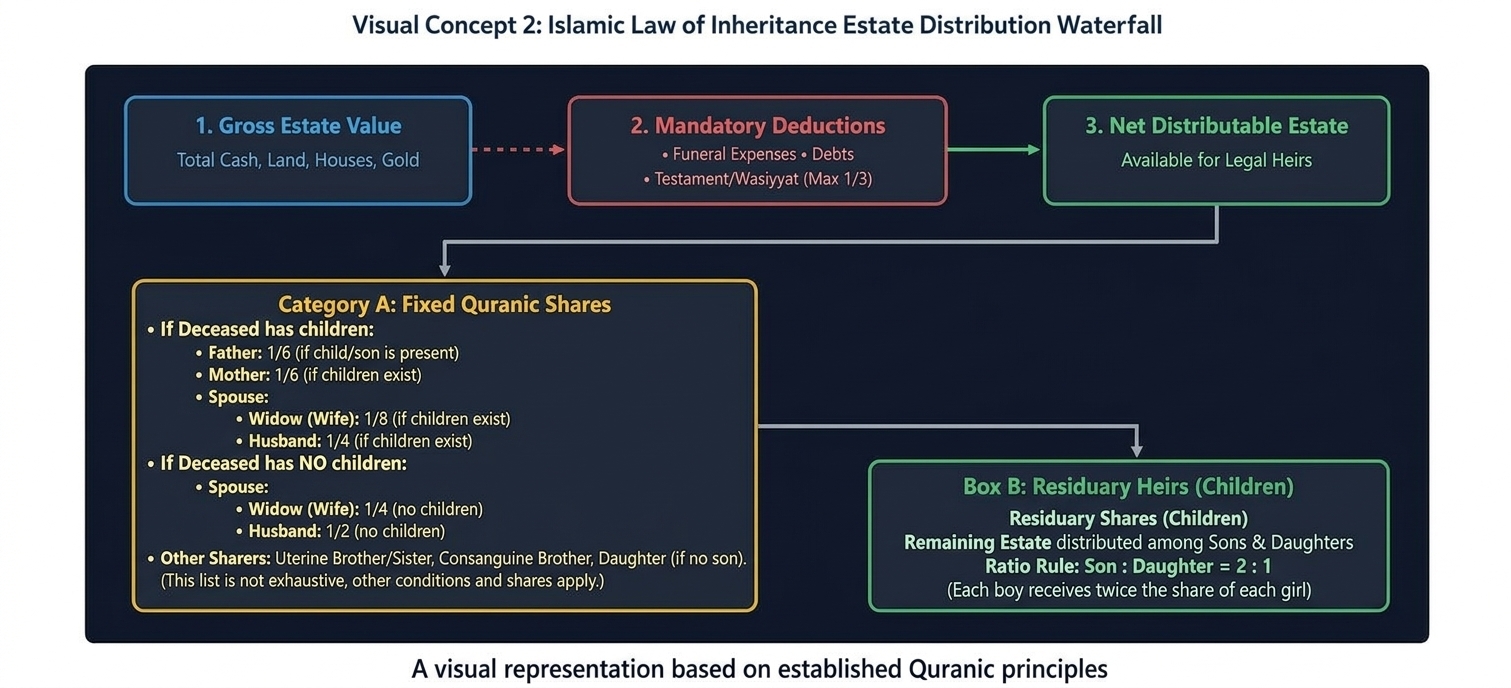
- Compute legal estate shares under Islamic Law of Inheritance (deducting debts, funeral expenses, and bequests $\le 1/3$).
- Convert Pakistani Rupees to international currencies (USD, SAR, EUR, GBP, CNY, JPY) using buying/selling exchange rates.
- Calculate simple profit/markup using $I = \frac{PRT}{100}$ and determine total payable amounts and monthly installments.
- Analyze multi-step Successive Transactions involving Cost Price ($CP$), Sale Price ($SP$), Marked Price ($MP$), Profit/Loss %, and Discount %.
- Compute Life and Vehicle Insurance premiums, policy fees, family income contracts, maturity bonuses, and asset depreciation (10% per annum).
- Proportion Arrow Alignment: In compound proportion, placing arrows incorrectly. Always compare each independent variable directly with the unknown target variable ($x$).
- Partnership Time Weighting: Forgetting to multiply investment by time when partners join or withdraw mid-year ($Investment \times Months$).
- Inheritance Deduction Order: Distributing estate before clearing debts or funeral expenses. The Quranic order is: Funeral Costs $\to$ Debts $\to$ Bequest (max 1/3) $\to$ Fixed Heirs $\to$ Sons/Daughters in 2:1 ratio.
- Profit % vs Discount % Base: Profit and Loss % are always calculated on Cost Price ($CP$), whereas Discount % is always calculated on Marked Price ($MP$).
- Vehicle Depreciation Cycle: In vehicle insurance, the annual premium decreases each year because the insured car value depreciates by 10% annually.
- Step 1: Classify the Financial Operation: Determine if the problem is proportion, banking markup, commercial trade, inheritance, currency conversion, or insurance.
- Step 2: Establish the Conversion & Equation: Set up proportional fractional products ($\frac{x}{x_0} = \prod \text{factors}$), markup formula ($\frac{PRT}{100}$), or ratio sum partition.
- Step 3: Dimensional & Balance Check: Verify monetary units (PKR, SAR, USD), ensure ratios sum up to total remaining fund, and check net profit/loss balance.
Chapter 4: Financial Arithmetic (مالیاتی ریاضیات)
Financial Arithmetic is the mathematics of money, commerce, and real-life resource distribution. From managing commercial trade, calculating banking markups, and exchanging global currencies, to executing equitable business partnerships, fulfilling Islamic inheritance laws, and securing assets through insurance, this guide equips you with lifelong practical financial literacy!
💡 Kid-Friendly Tips for Success
- Direct = Same Way: If more buys more, both arrows point up ($\uparrow \uparrow$). Cross-multiply straight: $\frac{x}{a} = \frac{b}{c}$.
- Inverse = Flip it: If more workers take fewer days, flip the second ratio: $\frac{x}{a} = \frac{c}{b}$.
- Partnership Magic: Effective Capital = $\text{Money} \times \text{Months}$. If duration is same, time cancels out!
- Inheritance 2-to-1 Rule: Every brother receives double of what a sister receives ($2 : 1$).
- Marked vs Sale: $\text{Sale Price} = \text{Marked Price} - \text{Discount}$. Never pay sticker price if there is a sale!
🌍 Real-World Connections
- Hajj & Travel Banking: Exchanging Pakistani Rupees for Saudi Riyals (SAR) or US Dollars (USD) before international travel.
- Car Financing & Installments: Understanding how commercial banks compute markup on auto loans over 3 to 5 years.
- Family Estate Settlement: Applying Islamic Shariah laws to justly divide properties, shops, and land among family heirs.
- Auto & Health Protection: How vehicle insurance covers accidental damage and life insurance provides financial security to families.
Visual Concept 1: Direct Proportion vs. Inverse Proportion Characteristics
Visual Concept 3: Commercial Transactions & Insurance Premium Structure
Section-by-Section Theoretical Mastery
1. Direct, Inverse, and Compound Proportions
A proportion is a statement that two ratios are equivalent: $a : b :: c : d$ or $\frac{a}{b} = \frac{c}{d}$.
2. Compound Business Partnerships
When partners invest different sums of capital for different lengths of time, profit or loss is divided in proportion to the effective monthly capital: $$\text{Effective Capital} = \text{Investment Amount} \times \text{Time Duration (Months)}$$ $$\text{Ratio of Shares} = (C_1 \times T_1) : (C_2 \times T_2) : (C_3 \times T_3)$$ $$\text{Individual Share} = \frac{\text{Individual Ratio Term}}{\text{Sum of Ratio Terms}} \times \text{Total Profit or Loss}$$
3. Islamic Law of Inheritance (قانونِ وراثت)
The estate of a deceased person is distributed strictly in the following mandatory legal sequence:
- Funeral & Burial Costs: Deducted first from gross property.
- Debts (Qarz): All outstanding debts must be settled in full.
- Testament / Wasiyyat: Fulfill any charitable bequest (cannot exceed $\frac{1}{3}$ of remaining property).
- Fixed Quranic Shares:
- Parents (Father and Mother): $\frac{1}{6}$ each when deceased leaves children.
- Widow (Wife): $\frac{1}{8}$ of net estate when children exist; $\frac{1}{4}$ if no children.
- Husband: $\frac{1}{4}$ when deceased wife leaves children; $\frac{1}{2}$ if no children.
- Single Daughter (no sons): $\frac{1}{2}$; Multiple Daughters (no sons): $\frac{2}{3}$ shared equally.
- Residue Distribution: The remaining estate is distributed among sons and daughters in the ratio $2 : 1$ (each son receives twice the share of a daughter).
4. Foreign Currency Conversions
Currencies are exchanged using prevailing bank exchange rates. To convert foreign currency into PKR, multiply by the conversion rate; to convert PKR into foreign currency, divide by the conversion rate: $$\text{Amount in PKR} = \text{Foreign Currency Amount} \times \text{Exchange Rate (PKR per unit)}$$ $$\text{Foreign Currency Amount} = \frac{\text{Amount in PKR}}{\text{Exchange Rate (PKR per unit)}}$$
5. Banking Profit / Markup Formula
For a principal amount $P$ deposited or borrowed at rate $R\%$ per annum for $T$ years: $$\text{Profit / Markup } (I) = \frac{P \times R \times T}{100}$$ $$\text{Total Payable / Received Amount } (A) = P + I$$ $$\text{Monthly Installment} = \frac{\text{Total Amount } (A)}{\text{Total Number of Months } (12 \times T)}$$
6. Successive Commercial Transactions & Discount
$\text{Profit} = SP - CP$
$\text{Loss} = CP - SP$
$\text{Profit } \% = \frac{\text{Profit}}{CP} \times 100$
$\text{Loss } \% = \frac{\text{Loss}}{CP} \times 100$
$\text{Discount} = MP - SP$
$\text{Discount } \% = \frac{\text{Discount}}{MP} \times 100$
$SP = MP \times \left(1 - \frac{\text{Discount } \%}{100}\right)$
$MP = \frac{SP}{1 - \frac{\text{Discount } \%}{100}}$
7. Insurance (Life & Vehicle Insurance)
Life Insurance: $\text{Annual Premium} = \text{First (Basic) Premium} + \text{Policy Fee} + \text{Family Income Contract Fee}$. At maturity, insurer receives $\text{Policy Amount} + \text{Accumulated Bonuses}$.
Vehicle Insurance: Annual premium is a percentage of the vehicle's depreciated value. Standard annual depreciation is $10\%$ of previous year's value.
Exercise 4.1 • Direct and Inverse Proportion
Let the discount on 18 books be $\text{Rs. } x$. More books mean more discount (Direct Proportion):
$$\begin{array}{|c|c|} \hline \textbf{Books} & \textbf{Discount (Rs.)} \\ \hline 5 \uparrow & 45 \uparrow \\ 18 & x \\ \hline \end{array}$$ Step 2: Solve the direct proportion equation:
$$\frac{x}{45} = \frac{18}{5}$$ $$x = \frac{18}{5} \times 45 = 18 \times 9 = 162$$ Final Answer: The discount on 18 books is Rs. 162.
Cost of 1 dozen bananas $= \text{Rs. } 50$. More dozens mean more cost (Direct Proportion).
Step 2: Calculate total cost:
$$\text{Cost} = 2.5 \times 50 = \text{Rs. } 125$$ Final Answer: The cost price of 2.5 dozen bananas is Rs. 125.
$$\text{Cost of 1 kg} = \frac{400}{5} = \text{Rs. } 80$$ $$\text{Cost of 12 kg} = 12 \times 80 = \text{Rs. } 960$$ Step 2: Calculate change returned:
$$\text{Money given} = \text{Rs. } 1000$$ $$\text{Money returned} = 1000 - 960 = \text{Rs. } 40$$ Final Answer: Hassan will get back Rs. 40.
Fewer men will take more days (Inverse Proportion):
$$\begin{array}{|c|c|} \hline \textbf{Men} & \textbf{Days} \\ \hline 12 \downarrow & 20 \uparrow \\ 10 & x \\ \hline \end{array}$$ Step 2: Solve the inverse proportion equation:
$$\frac{x}{20} = \frac{12}{10}$$ $$x = \frac{12}{10} \times 20 = 12 \times 2 = 24$$ Final Answer: 10 men will take 24 days.
$$\frac{x}{20} = \frac{15}{10}$$ $$x = \frac{15}{10} \times 20 = 30\text{ people}$$ Step 2: Compute additional people required:
$$\text{More people required} = 30 - 20 = 10$$ Final Answer: 10 more people are required.
$$\frac{x}{96} = \frac{8}{12}$$ $$x = \frac{8}{12} \times 96 = 8 \times 8 = 64$$ Final Answer: The cost of 8 eggs is Rs. 64.
In the same time (10 days), less work requires fewer people (Direct Proportion with work):
$$\text{People required} = 18 \times \frac{1}{3} = 6$$ Final Answer: 6 people are required.
$$\frac{x}{25000} = \frac{9000}{4000}$$ $$x = \frac{9}{4} \times 25000 = 9 \times 6250 = \text{Rs. } 56250$$ Final Answer: The cost of 9000 bricks is Rs. 56,250.
Exercise 4.2 • Compound Proportion, Business Partnership & Inheritance
Let the required charge be $\text{Rs. } x$. Charge is directly proportional to both distance and weight:
$$\begin{array}{|c|c|c|} \hline \textbf{Charge (Rs.)} & \textbf{Distance (km)} & \textbf{Weight (kg)} \\ \hline 2000 \uparrow & 10 \uparrow & 800 \uparrow \\ x & 8 & 600 \\ \hline \end{array}$$ Step 2: Solve compound equation:
$$\frac{x}{2000} = \frac{8}{10} \times \frac{600}{800}$$ $$x = 2000 \times \frac{4}{5} \times \frac{3}{4} = 2000 \times \frac{3}{5} = 1200$$ Final Answer: The driver will charge Rs. 1,200.
Machines repaired is directly proportional to both men and days:
$$\frac{x}{5} = \frac{8}{10} \times \frac{3}{2}$$ $$x = 5 \times \frac{4}{5} \times \frac{3}{2} = 6$$ Final Answer: 6 machines are repaired.
Men is inversely proportional to days and directly proportional to work:
$$\frac{x}{12} = \frac{8}{16} \times \frac{3}{1}$$ $$x = 12 \times \frac{1}{2} \times 3 = 18$$ Final Answer: 18 men are required.
Remaining feed $= 1 - \frac{1}{4} = \frac{3}{4}$. Days is inversely proportional to hens and directly proportional to feed:
$$\frac{x}{21} = \frac{100}{84} \times \frac{3/4}{1/4} = \frac{100}{84} \times 3 = \frac{300}{84} = \frac{25}{7}$$ $$x = 21 \times \frac{25}{7} = 3 \times 25 = 75$$ Final Answer: 84 hens will eat the remaining feed in 75 days.
Hours is inversely proportional to workers and directly proportional to articles:
$$\frac{x}{10} = \frac{49}{45} \times \frac{1350}{1050}$$ $$\frac{1350}{1050} = \frac{135}{105} = \frac{9}{7}$$ $$x = 10 \times \frac{49}{45} \times \frac{9}{7} = 10 \times \left(\frac{49}{7}\right) \times \left(\frac{9}{45}\right) = 10 \times 7 \times \frac{1}{5} = 14$$ Final Answer: The remaining workers will take 14 hours.
Days is inversely proportional to scouts and directly proportional to food:
$$\frac{x}{6} = \frac{28}{36} \times \frac{144}{168}$$ $$\frac{28}{36} = \frac{7}{9}, \quad \frac{144}{168} = \frac{6}{7}$$ $$x = 6 \times \frac{7}{9} \times \frac{6}{7} = 6 \times \frac{6}{9} = 4$$ Final Answer: The food will be sufficient for 4 days.
- Hassan: $10000 \times 12 = 120000$
- Akbar: $12000 \times 12 = 144000$
- Asghar: $15000 \times 10 = 150000$
Step 2: Simplify investment ratio:
$$120 : 144 : 150 = 20 : 24 : 25 \quad (\div 6)$$ $$\text{Sum of ratio terms} = 20 + 24 + 25 = 69$$ Step 3: Calculate individual shares from total profit Rs. 27600:
- Hassan's share $= \frac{20}{69} \times 27600 = 20 \times 400 = \text{Rs. } 8000$
- Akbar's share $= \frac{24}{69} \times 27600 = 24 \times 400 = \text{Rs. } 9600$
- Asghar's share $= \frac{25}{69} \times 27600 = 25 \times 400 = \text{Rs. } 10000$
Final Answer: Hassan: Rs. 8,000, Akbar: Rs. 9,600, Asghar: Rs. 10,000.
- Alia (10 months): $12000 \times 10 = 120000$
- Maha (5 months): $15000 \times 5 = 75000$
- Sundas (10 months): $18000 \times 10 = 180000$
Step 2: Simplify ratio:
$$120 : 75 : 180 = 8 : 5 : 12 \quad (\div 15)$$ $$\text{Sum of ratio terms} = 8 + 5 + 12 = 25$$ Step 3: Calculate individual loss shares:
- Alia's loss $= \frac{8}{25} \times 18750 = 8 \times 750 = \text{Rs. } 6000$
- Maha's loss $= \frac{5}{25} \times 18750 = 5 \times 750 = \text{Rs. } 3750$
- Sundas's loss $= \frac{12}{25} \times 18750 = 12 \times 750 = \text{Rs. } 9000$
Final Answer: Alia: Rs. 6,000, Maha: Rs. 3,750, Sundas: Rs. 9,000.
- Total business duration $= 3 + 2 + 5 = 10\text{ months}$
- X was in business for $10\text{ months}$
- Y was in business for $10 - 3 = 7\text{ months}$
- Z was in business for $5\text{ months}$
Step 2: Weighted investments:
- X: $35000 \times 10 = 350000$
- Y: $30000 \times 7 = 210000$
- Z: $40000 \times 5 = 200000$
$$\text{Ratio} = 35 : 21 : 20, \quad \text{Sum of ratio terms} = 35 + 21 + 20 = 76$$ Step 3: Profit shares ($\text{Total} = \text{Rs. } 152000$):
$$\text{Value of 1 ratio unit} = \frac{152000}{76} = \text{Rs. } 2000$$ - X's share $= 35 \times 2000 = \text{Rs. } 70000$
- Y's share $= 21 \times 2000 = \text{Rs. } 42000$
- Z's share $= 20 \times 2000 = \text{Rs. } 40000$
Final Answer: X: Rs. 70,000, Y: Rs. 42,000, Z: Rs. 40,000.
$$\text{Remaining Property} = 300000 - 10000 = \text{Rs. } 290000$$ Step 2: Calculate widow's share ($\frac{1}{8}$):
$$\text{Widow's share} = \frac{1}{8} \times 290000 = \text{Rs. } 36250$$ $$\text{Remaining for children} = 290000 - 36250 = \text{Rs. } 253750$$ Step 3: Distribute among 2 sons and 1 daughter ($2 : 2 : 1$):
$$\text{Sum of ratios} = 2 + 2 + 1 = 5$$ - Each son's share $= \frac{2}{5} \times 253750 = \text{Rs. } 101500$
- Daughter's share $= \frac{1}{5} \times 253750 = \text{Rs. } 50750$
Final Answer: Widow: Rs. 36,250, Each Son: Rs. 101,500, Daughter: Rs. 50,750.
$$\text{Total Gross Value} = 660000 + 320000 = \text{Rs. } 980000$$ $$\text{Net Estate after Debt} = 980000 - 20000 = \text{Rs. } 960000$$ Step 2: Fixed shares of parents and widow:
- Father's share $(\frac{1}{6}) = \frac{1}{6} \times 960000 = \text{Rs. } 160000$
- Mother's share $(\frac{1}{6}) = \frac{1}{6} \times 960000 = \text{Rs. } 160000$
- Widow's share $(\frac{1}{8}) = \frac{1}{8} \times 960000 = \text{Rs. } 120000$
$$\text{Total fixed shares} = 160000 + 160000 + 120000 = \text{Rs. } 440000$$ $$\text{Remaining for children} = 960000 - 440000 = \text{Rs. } 520000$$ Step 3: Distribute between 1 son and 1 daughter ($2 : 1$, sum = 3):
- Son's share $= \frac{2}{3} \times 520000 = \text{Rs. } 346666.67$
- Daughter's share $= \frac{1}{3} \times 520000 = \text{Rs. } 173333.33$
Final Answer: Father: Rs. 160,000, Mother: Rs. 160,000, Widow: Rs. 120,000, Son: Rs. 346,666.67, Daughter: Rs. 173,333.33.
$$\text{Land value} = 10 \times 30000 = \text{Rs. } 300000$$ $$\text{Total estate} = 300000 + 800000 = \text{Rs. } 1100000$$ Step 2: Distribute shares:
- Widow's share $(\frac{1}{8}) = \frac{1}{8} \times 1100000 = \text{Rs. } 137500$
- Son's share (remaining) $= 1100000 - 137500 = \text{Rs. } 962500$
Final Answer: Widow: Rs. 137,500, Son: Rs. 962,500.
$$\text{Widow's share} = \frac{1}{8} \times 500000 = \text{Rs. } 62500$$ $$\text{Remaining for children} = 500000 - 62500 = \text{Rs. } 437500$$ Step 2: Distribute among 2 sons and 1 daughter ($2 : 2 : 1$, sum = 5):
- Each son's share $= \frac{2}{5} \times 437500 = \text{Rs. } 175000$
- Daughter's share $= \frac{1}{5} \times 437500 = \text{Rs. } 87500$
Final Answer: Widow: Rs. 62,500, Each Son: Rs. 175,000, Daughter: Rs. 87,500.
$$\text{Husband's share} = \frac{1}{4} \times 850000 = \text{Rs. } 212500$$ $$\text{Remaining property} = 850000 - 212500 = \text{Rs. } 637500$$ Step 2: Distribute among 2 sons and 2 daughters ($2 : 2 : 1 : 1$, sum = 6):
- Each son's share $= \frac{2}{6} \times 637500 = \frac{1}{3} \times 637500 = \text{Rs. } 212500$
- Each daughter's share $= \frac{1}{6} \times 637500 = \text{Rs. } 106250$
Final Answer: Husband: Rs. 212,500, Each Son: Rs. 212,500, Each Daughter: Rs. 106,250.
Exercise 4.3 • Exchange of Currencies
Using Textbook Table Exchange Rates (Page 56): $1\text{ USD} = \text{Rs. } 155$, $1\text{ SAR} = \text{Rs. } 42$, $1\text{ EUR} = \text{Rs. } 185$, $1\text{ GBP} = \text{Rs. } 215$, $1\text{ CNY (Yuan)} = \text{Rs. } 24$, $1\text{ JPY} = \text{Rs. } 1.5$.
$$\text{Amount in PKR} = 26 \times 155 = \textbf{Rs. 4,030}$$ (b) 352 Riyal:
$$\text{Amount in PKR} = 352 \times 42 = \textbf{Rs. 14,784}$$ (c) 199 Euro:
$$\text{Amount in PKR} = 199 \times 185 = \textbf{Rs. 36,815}$$
$$\text{PKR} = 88 \times 155 = 13640 \implies \text{Yen} = \frac{13640}{1.5} = \textbf{9,093.33 Yen}$$ (b) 500 Euro:
$$\text{PKR} = 500 \times 185 = 92500 \implies \text{Yen} = \frac{92500}{1.5} = \textbf{61,666.67 Yen}$$ (c) Rs. 666:
$$\text{Yen} = \frac{666}{1.5} = \textbf{444 Yen}$$
$$\text{USD} = \frac{2000000}{155} = \textbf{\$ 12,903.23}$$ (b) 3000 Euro:
$$\text{PKR} = 3000 \times 185 = 555000 \implies \text{USD} = \frac{555000}{155} = \textbf{\$ 3,580.65}$$ (c) 4200 Riyal:
$$\text{PKR} = 4200 \times 42 = 176400 \implies \text{USD} = \frac{176400}{155} = \textbf{\$ 1,138.06}$$
$$\text{Yens} = 610 \times 140 = \textbf{85,400 Yen}$$ (b) 9240 Yens in Pounds:
$$\text{Pounds} = \frac{9240}{140} = \textbf{66 Pounds (£ 66)}$$
- Sugar (5 kg): $26 \times 40 = \text{Rs. } 1040$
- Oil tin (5 kg): $30 \times 40 = \text{Rs. } 1200$
- Shampoo (2.5 L): $12.5 \times 40 = \text{Rs. } 500$
$$\text{Total Bill} = 103.5 \times 40 = \text{Rs. } 4140$$ Final Answer: The total amount is Rs. 4,140.
$$\text{Yuan} = \frac{54500}{24} = \textbf{2,270.83 Yuan}$$ (ii) Total spent in 6 months:
$$\text{Monthly total} = 54500 + 700 = \text{Rs. } 55200$$ $$\text{Spent in 6 months} = 55200 \times 6 = \textbf{Rs. 331,200}$$
- Euros $= 1560 \times 1.05 = \textbf{1,638 Euros}$
- Dollars $= 2250 \times 1.05 = \textbf{2,362.50 Dollars}$
(ii) Convert whole amount into Rupees:
$$\text{Rupees} = (1638 \times 185) + (2362.50 \times 155) = 303030 + 366187.50 = \textbf{Rs. 669,217.50}$$
Exercise 4.4 • Profit / Markup & Commercial Banking
Final Answer: The rate of markup is 4% per annum (or 5% on principal 40,000).
$$\text{Markup} = 1089000 - 900000 = \textbf{Rs. 189,000}$$ (ii) Rate of markup:
$$R = \frac{189000 \times 100}{900000 \times 3} = \frac{18900000}{2700000} = \textbf{7\% per annum}$$ (iii) Monthly installment:
$$\text{Installment} = \frac{1089000}{3 \times 12} = \frac{1089000}{36} = \textbf{Rs. 30,250}$$
$$\text{Markup for 3 years} = \frac{25000 \times 12 \times 3}{100} = \text{Rs. } 9000$$ $$\text{Total liability after 3 years} = 25000 + 9000 = \text{Rs. } 34000$$ Step 2: Deduct repayments made in 3 years:
$$\text{Total repaid} = 3 \times 5500 = \text{Rs. } 16500$$ $$\text{Outstanding Loan} = 34000 - 16500 = \text{Rs. } 17500$$ Final Answer: Outstanding loan is Rs. 17,500.
Exercise 4.5 • Successive Transactions, Profit, Loss & Discount
- Akmal's purchase price $= 350000 + 28000 = \text{Rs. } 378000$
- Akmal's profit $= 378000 \times \frac{10}{100} = \text{Rs. } 37800$
$$\text{Total Profit} = 28000 + 37800 = \text{Rs. } 65800$$ Final Answer: Total profit is Rs. 65,800.
- Sale price by Y $= 880 \times 0.90 = \text{Rs. } 792$
$$\text{Net Difference} = 792 - 800 = -\text{Rs. } 8$$ Final Answer: There is a Net Loss of Rs. 8.
- Zain's cost price $= \text{Rs. } 1100 \implies \text{Zain's profit rate} = \frac{100}{1100} \times 100 = 9.09\%$
Final Answer: Ali's transaction is better because his profit percentage ($10\%$) is higher than Zain's ($9.09\%$).
Exercise 4.6 • Life and Vehicle Insurance
- Quarterly premium $= 2600 \times 0.27 = \textbf{Rs. 702}$
- Monthly premium $= 2600 \times 0.09 = \textbf{Rs. 234}$
- Regular Bonus $= 150000 \times 0.045 \times 25 = \text{Rs. } 168750$
- Family Income Bonus $= \text{Rs. } 100000$
- Maturity Bonus $= 150000 \times 0.025 \times 25 = \text{Rs. } 93750$
$$\text{Total Amount} = 150000 + 168750 + 100000 + 93750 = \text{Rs. } 512500$$ Final Answer: Amount received is Rs. 512,500.
- Bonus for 18 years $= 6000 \times 18 = \text{Rs. } 108000$
- Additional amount $= (5000 \times 18) + (0.5 \times 100000) = 90000 + 50000 = \text{Rs. } 140000$
$$\text{Total given to family} = 100000 + 108000 + 140000 = \text{Rs. } 348000$$ Final Answer: Total amount given to family is Rs. 348,000.
- 2nd year car value $= 1200000 \times 0.90 = \text{Rs. } 1080000$
- 2nd year premium $= 1080000 \times 0.05 = \text{Rs. } 54000$
$$\text{Total Premium} = 60000 + 54000 = \text{Rs. } 114000$$ Final Answer: Total premium paid is Rs. 114,000.
- 2nd year value $= 500000 \times 0.90 = 450000 \implies \text{2nd premium} = 450000 \times 0.035 = \text{Rs. } 15750$
- Total premium paid in 2 years $= 17500 + 15750 = \text{Rs. } 33250$
$$\text{Net Loss Recovered / Benefit} = 50000 - 33250 = \text{Rs. } 16750$$ Final Answer: Net loss recovered is Rs. 16,750.
- 2nd year car value $= 270000 \implies \text{2nd premium} = 270000 \times 0.045 = \text{Rs. } 12150$
- Total premium paid $= 13500 + 12150 = \text{Rs. } 25650$
$$\text{Benefit} = 60000 - 25650 = \text{Rs. } 34350$$ Final Answer: She got a benefit of Rs. 34,350.
Review Exercise 4 • Comprehensive Mastery Assessment
→ (c) SAR. 40 $(1600 \div 40 = 40)$
(ii) Rashida deposited Rs. 15000 and got profit of Rs. 900 after 1 year. Rate of profit?
→ (b) 6% $(\frac{900}{15000} \times 100 = 6\%)$
(iii) What will be the markup for principal of Rs. 100 @ 10% in 10 years?
→ (a) Rs. 100 $(\frac{100 \times 10 \times 10}{100} = 100)$
(iv) Usually rate of depreciation for vehicle is:
→ (d) 10%
(v) Share of father and mother is:
→ (a) $\frac{1}{6}$ of the property
(vi) If a deceased man has only one daughter, she will get:
→ (b) $\frac{1}{2}$ of the property
(vii) TV set costing Rs. 25000 purchased for Rs. 24500. Rate of discount?
→ (c) 2% $(\frac{500}{25000} \times 100 = 2\%)$
(viii) Time period agreed by both parties in insurance policy is called:
→ (b) maturity period
(ix) Cost of 1 dozen eggs is Rs. 180. Cost of 3 eggs?
→ (c) Rs. 45 $(\frac{180}{12} \times 3 = 45)$
(x) Marked price − sale price =
→ (a) discount
- 2nd year premium $= 450000 \times 0.045 = \text{Rs. } 20250$
- 3rd year premium $= 405000 \times 0.045 = \text{Rs. } 18225$
$$\text{Total Premium} = 22500 + 20250 + 18225 = \textbf{Rs. 60,975}$$
- Saeed's share $= 4 \times 3000 = \textbf{Rs. 12,000}$
- Asim's share $= 7 \times 3000 = \textbf{Rs. 21,000}$
- Son's share (remaining) $= 830000 - 207500 = \textbf{Rs. 622,500}$
- Rice $= \frac{1520}{0.95} = \textbf{Rs. 1,600}$
- Sugar $= \frac{960}{0.96} = \textbf{Rs. 1,000}$
- Flour $= \frac{1235}{0.95} = \textbf{Rs. 1,300}$
(ii) Discounts:
- Rice $= 1600 - 1520 = \textbf{Rs. 80}$
- Sugar $= 1000 - 960 = \textbf{Rs. 40}$
- Flour $= 1300 - 1235 = \textbf{Rs. 65}$
(iii) Total Discount:
$$\text{Total Discount} = 80 + 40 + 65 = \textbf{Rs. 185}$$
Unit 4 Check Point & Challenge Solved Solutions
Solution:
- Year 1 profit $= 12000 \times 0.08 = \text{Rs. } 960 \implies \text{Amount} = \text{Rs. } 12960$
- Year 2 profit $= 12960 \times 0.10 = \text{Rs. } 1296$
- Total amount $= 12960 + 1296 = \textbf{Rs. 14,256}$.
Solution:
- $\text{Sale Price} = 400 \times (1 - 0.10) = \text{Rs. } 360$
- $\text{Cost Price} = \frac{\text{Sale Price}}{1 + \text{Profit } \%} = \frac{360}{1.20} = \textbf{Rs. 300}$.
More Chapter Notes for Class 8 (FBISE)
MathematicsTest Your Knowledge on Chapter 4: Class 8 Mathematics - Ch 4: Financial Arithmetic Mastery Guide (FBISE)
Practice textbook-aligned solved MCQs with instant answer feedback, step-by-step solutions, and timed test simulation.
Class 8 Mathematics - Ch 4: Financial Arithmetic Chapter Mock Test
Test your complete conceptual mastery across all chapters under real board exam conditions with official timer, anti-cheat surveillance, and instant grading.