
Class 7 Mathematics Ch 9 Mastery Guide: Angles of Polygons, Regular Polygons, Quadrilaterals & Circle Geometry (FBISE)
🗺️ Teacher & Parent Roadmap: Unit 9 (Geometry)
Geometry is the language of spatial reasoning, shapes, angles, and real-world design. In this unit, students advance from basic shape recognition to formal geometric deduction. They will uncover the underlying mathematical laws governing polygons, master interior and exterior angle sums, explore the rich hierarchy of quadrilaterals (parallelograms, rectangles, rhombuses, trapeziums, and kites), and dissect circular geometry (radii, diameters, chords, arcs, sectors, and segments).
- Calculate interior and exterior angles of regular & irregular polygons using
(n-2) × 180°and360°rules. - Compute diagonals from a single vertex (
n-3) and total diagonals. - Identify, classify, and solve properties of special quadrilaterals using algebraic systems.
- Distinguish between chords, diameters, secants, tangents, major/minor arcs, and segments in circles.
- Misconception: Thinking exterior angle sum increases with more sides. (Fact: Exterior angle sum is always
360°for ANY polygon). - Error: Confusing a circular region (area inside) with the circle itself (curved boundary line).
- Pitfall: Forgetting that opposite angles in a parallelogram are equal, while adjacent angles sum to
180°.
📐 Unit Overview: The World of Polygons, Quadrilaterals & Circles
Everything around us in architecture, art, engineering, and nature is composed of geometric figures. From the hexagonal structure of honeycombs and tile patterns to the circular gears in clockwork and planetary orbits, understanding geometric relationships empowers us to analyze and design the physical world.
1. Polygons: Convex vs. Concave & Diagonals
A polygon is a 2D closed figure bounded by three or more straight line segments joined end to end.
Diagonals from a Single Vertex (Formula: n - 3)
From any vertex of an n-sided polygon, you cannot draw diagonals to itself or its two immediate neighbors. Therefore, the number of diagonals from one vertex is always n - 3.
| Polygon Name | Sides (n) | Interior Sum (n-2)×180° |
Each Interior Angle | Each Exterior Angle | Diagonals (n-3) |
|---|---|---|---|---|---|
| Triangle | 3 | (3-2)×180° = 180° | 180° / 3 = 60° | 360° / 3 = 120° | 3 - 3 = 0 |
| Quadrilateral | 4 | (4-2)×180° = 360° | 360° / 4 = 90° | 360° / 4 = 90° | 4 - 3 = 1 |
| Pentagon | 5 | (5-2)×180° = 540° | 540° / 5 = 108° | 360° / 5 = 72° | 5 - 3 = 2 |
| Hexagon | 6 | (6-2)×180° = 720° | 720° / 6 = 120° | 360° / 6 = 60° | 6 - 3 = 3 |
| Heptagon | 7 | (7-2)×180° = 900° | 900° / 7 ≈ 128.57° | 360° / 7 ≈ 51.43° | 7 - 3 = 4 |
| Octagon | 8 | (8-2)×180° = 1080° | 1080° / 8 = 135° | 360° / 8 = 45° | 8 - 3 = 5 |
| Decagon | 10 | (10-2)×180° = 1440° | 1440° / 10 = 144° | 360° / 10 = 36° | 10 - 3 = 7 |
2. Hierarchy & Visual Guide of Special Quadrilaterals
3. Anatomy of a Circle & Circular Regions
A circle is a set of all points in a 2D plane equidistant from a fixed interior point (the centre).
📝 Complete Step-by-Step Textbook Solutions
Exercise 9.1: Angles of Polygons & Quadrilaterals
Question 1: Calculate unknown angles in the following figures (not drawn to scale).
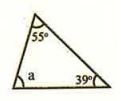
a + 55° + 39° = 180° ⇒ a = 180° - 94° = 86°
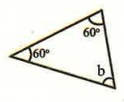
b + 60° + 60° = 180° ⇒ b = 60°
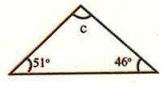
c + 51° + 46° = 180° ⇒ c = 83°
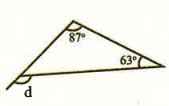
d = 87° + 63° = 150°
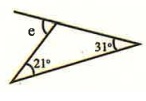
Remote Interior angles: 21° + 31°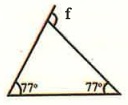
Remote interior angles = 77° + 77°f = 77° + 77° = 154°
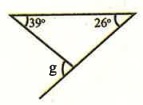
Remote interior angles = 39° + 26°g = 39° + 26° = 65°
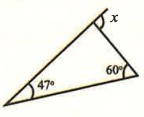
Remote interior angles = 47° + 60°x = 47° + 60° = 107°
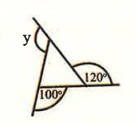
Remote angle x on right side:x + 100° = 180° ⇒ x = 180° - 100° = 80°z + 120° = 180° ⇒ z = 180° - 120° = 60°y + 40° = 180° ⇒ y = 140°
Question 2: Calculate unknown angles in quadrilaterals.
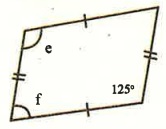
e = 125° (opposite angle)f = 180° - 125° = 55° (adjacent angle)
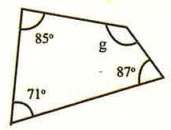
g = 360° - (85° + 71° + 87°) = 360° - 243° = 117°
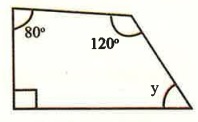
y = 360° - (90° + 80° + 120°) = 360° - 290° = 70°

180° - 121° = 59°
x + 84° + 100° + 59° = 360°x = 360° - (84° + 100° + 59°) = 117°
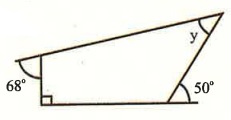
180° - 50° = 80°
Interior angle z = 180° - 68° = 112°
y + 80° + 112° + 90° = 360°y = 360° - (80° + 112° + 90°) = 28°y = 28°
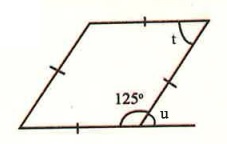
t + t + 125° + 125° = 360°
2t = 360° - 250°
t = 110°/2
t = 55°
Adjacent angles:u = 180° - 125° = 55°
Exercise 9.2: Exterior Angles & Diagonals of Regular Polygons
(i)
(n-2)×180° = 720° ⇒ n-2 = 4 ⇒ n = 6 (Hexagon)(ii)
Interior angle = 720° / 6 = 120°
360° / 5 = 72°.
(i)
n = 360° / 45° = 8. Sum = (8-2)×180° = 1080°(ii) Name: Octagon.
(a) Exterior angle =
180° - 144° = 36°(b) Sides =
360° / 36° = 10 sides(c) Name: Decagon.
(a) Formula:
d = n - 3(b) (i) Quadrilateral:
4-3 = 1, (ii) Pentagon: 5-3 = 2, (iii) Hexagon: 6-3 = 3, (iv) Decagon: 10-3 = 7.
- n = 3 (Triangle): Interior = 60°, Central = 120°
- n = 4 (Square): Interior = 90°, Central = 90°
- n = 5 (Pentagon): Interior = 108°, Central = 72°
- n = 6 (Hexagon): Interior = 120°, Central = 60°
- n = 8 (Octagon): Interior = 135°, Central = 45°
- n = 10 (Decagon): Interior = 144°, Central = 36°
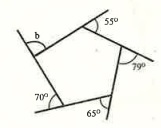
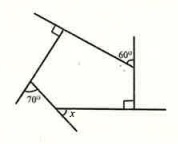
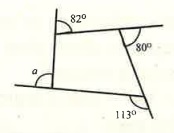
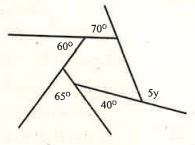
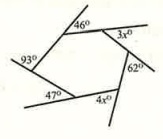
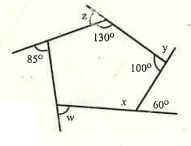
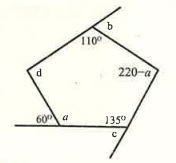
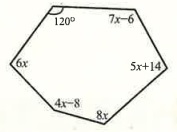
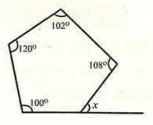 Exterior angles:
Exercise 9.3: Characteristics of Quadrilaterals
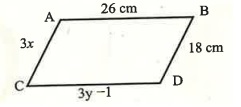
3x = 18 ⇒ x = 6 cm3y - 1 = 26 ⇒ 3y = 27 ⇒ y = 9 cm
∠ABC = 180° - 56° = 124°∠DBC = 124° / 2 = 62°
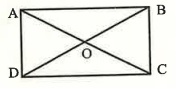
3x + 1 = 2x + 4 ⇒ x = 3OB = 2(3) + 4 = 10 cm ⇒ BD = 2 × 10 = 20 cm
(3x - 5) + (3x + 11) = 180 ⇒ 6x + 6 = 180 ⇒ x = 29°Four angles: 82°, 98°, 82°, 98°.
Other side =
1.5 × 4.8 = 7.2 cm. Perimeter = 2(4.8 + 7.2) = 24 cm.
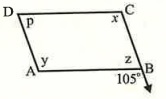
x = 105°, y = 105°, z = 75°, p = 75°.
Other angles: 100°, 100°;
5x + 10 = 45 ⇒ x = 7°.
5x + 10 = 180 ⇒ x = 34°. Angles: 97°, 83°, 97°, 83°.
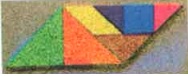
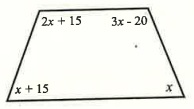
7x + 10 = 360 ⇒ x = 50°. Angles: 50°, 65°, 115°, 130°.
Exercise 9.4: Circles, Chords, Arcs & Segments
Question 1: Circle Elements Identification Table
| Element | (i) | (ii) | (iii) | (iv) |
|---|---|---|---|---|
| Radii | OA, OB | PX, PY, PZ | OA, OD | PA, PB, PD |
| Diameter | - | XZ | AD | AD |
| Chords | AC, BC | XY, YZ | AB, BC, CA | AC, AB, BC |
| Centre | O | P | O | P |
Question 2: Minor Arcs, Major Arcs, and Semicircles Table
| Figure | Minor Arcs | Major Arcs | Semicircles |
|---|---|---|---|
| (i) | Arc(BC) | Arc(BAC) | - |
| (ii) | Arc(PR), Arc(RQ) | Arc(PQR), Arc(QPR) | Arc(PQR) |
| (iii) | Arc(LM), Arc(MN), Arc(NO), Arc(OL) | Arc(MNL), Arc(NOM), Arc(OLN), Arc(LMO) | Arc(LMN), Arc(MNO), Arc(NOL), Arc(OLM) |
| (iv) | Arc(BC), Arc(CA), Arc(AD), Arc(DB) | Arc(CAB), Arc(ADC), Arc(DBA), Arc(BCD) | Arc(BCA), Arc(CAD), Arc(ADB), Arc(DBC) |
Review Exercise 9: Comprehensive Review
Question 1: Multiple Choice Questions (MCQs)
(i) Exterior =
360° / 7 ≈ 51.43°, Interior = 180° - 51.43° ≈ 128.57°.(ii) Sum of interior angles =
(7-2)×180° = 5×180° = 900°.
(i) Central angle with interior 135° =
180° - 135° = 45°.(ii) Regular pentagon angles: x = 72°, y = 144°.
(i) a = 44° | (ii) n = 45° | (iii) x = 33° (Angles: 36°, 99°, 125°)
(iv) x = 63°, 126° | (v) b = 105° | (vi) Angles: 123°, 121°, 118°
(vii) Angles: 110°, 105°, 126° | (viii) x = 132° (or 120°).
Centre: O, Radii: OA, OB, OC, OD, Diameters: AB, CD, Chord: BC.
Minor arcs: AC, CB, BD, DA; Major arcs: CBA, BDC, DAB, ACD.
Minor segment: Shaded region; Major segment: Unshaded region.
Diagonals intersect perpendicularly at 90°: x = 32°, y = 58°.
⚡ Unit 9 Master Formula Cheat Sheet
Sum = (n - 2) × 180°Regular Polygon:
[(n - 2) × 180°] / n
Sum = 360° (Always)Regular Polygon:
360° / n
From 1 vertex:
n - 3Total diagonals:
[n(n - 3)] / 2
Diameter d = 2rCentral Angle = 360° / n = 180° - Interior Angle
More Chapter Notes for Class 7 (FBISE)
MathematicsTest Your Knowledge on Chapter 9: Class 7 Mathematics Ch 9 Mastery Guide: Angles of Polygons, Regular Polygons, Quadrilaterals & Circle Geometry (FBISE)
Practice textbook-aligned solved MCQs with instant answer feedback, step-by-step solutions, and timed test simulation.
Class 7 Mathematics - Ch 9: Geometry Chapter Mock Test
Test your complete conceptual mastery across all chapters under real board exam conditions with official timer, anti-cheat surveillance, and instant grading.